Back to the on-screen lesson ·
$\ddot{x} + 2\beta\dot{x} + \omega_0^2x = 0$: underdamped, critically damped and overdamped motion, fitting initial conditions, energy decay and the quality factor $Q = \omega_0/2\beta$.
Paper packet. Every task here also exists on screen, where it is checked automatically; answers written on paper are not assessed by Nydus. When you are back at a device, enter your answers there.
By the end of this lesson you will be able to classify a damped oscillator, write and fit its solution, and compute its damped frequency, decay time and quality factor.
The last lesson found that small oscillations about any stable equilibrium are simple harmonic, and wrote the solution as complex exponentials. From the drag lessons you know that a resistive force proportional to velocity makes motion decay exponentially. You can solve linear differential equations with constant coefficients by trying $e^{rt}$. This lesson combines the two: a spring with a damper.
| Term | What it means |
|---|---|
| Damping constant | $\beta = b/2m$, from a resistive force $-b\dot{x}$; it has units of s⁻¹. |
| Natural frequency | $\omega_0 = \sqrt{k/m}$, the frequency with no damping. |
| Underdamped | $\beta < \omega_0$: oscillation at $\omega_1 = \sqrt{\omega_0^2 - \beta^2}$ inside an envelope $e^{-\beta t}$. |
| Critically damped | $\beta = \omega_0$: the fastest return to equilibrium without overshoot. |
| Overdamped | $\beta > \omega_0$: a slow return without oscillation. |
| Quality factor | $Q = \omega_0/2\beta$, the natural frequency over the energy decay rate. |
| Logarithmic decrement | The log of the ratio of successive peaks, $\beta\tau_1$ with $\tau_1 = 2\pi/\omega_1$. |
A mass on a spring with a resistive force $-b\dot{x}$ obeys $m\ddot{x} + b\dot{x} + kx = 0$. Dividing by $m$ and naming $\beta = b/2m$ and $\omega_0 = \sqrt{k/m}$,
$$\ddot{x} + 2\beta\dot{x} + \omega_0^2x = 0.$$
Trying $x = e^{rt}$ gives $r^2 + 2\beta r + \omega_0^2 = 0$, so $r = -\beta \pm \sqrt{\beta^2 - \omega_0^2}$. Everything depends on the sign under the root:
The quality factor $Q = \omega_0/2\beta$ measures how lightly damped an oscillator is: roughly the number of radians it swings through while its energy falls by a factor of $e$.
Another way: picture
Push down on a car's fender and let go. A good car rises back smoothly and stops, near critical damping. A car with worn shocks bounces two or three times, underdamped. Now imagine the damper filled with thick honey: the fender oozes back up over several seconds, overdamped, slower than either.
Another way: steps
With $\beta < \omega_0$, the roots are $r = -\beta \pm i\omega_1$, and the real solution is $x = Ae^{-\beta t}\cos(\omega_1t - \delta)$. Two things change from the undamped case. The amplitude falls as $e^{-\beta t}$, dropping by a factor of $e$ in the time $1/\beta$. And the frequency is reduced to $\omega_1 = \sqrt{\omega_0^2 - \beta^2}$, though for light damping the reduction is tiny: with $\beta = 0.1\omega_0$ it is half a percent.
Successive peaks, one period $\tau_1 = 2\pi/\omega_1$ apart, have heights in the constant ratio $e^{\beta\tau_1}$. Its logarithm, the logarithmic decrement, is how damping is measured in practice: record a ringing, read off two peaks, and take the log of their ratio. Engineers testing a bridge or an aircraft wing tap it and measure exactly this.
With $\beta > \omega_0$, both roots are real and negative: $r_1 = -\beta + \sqrt{\beta^2 - \omega_0^2}$ is small, $r_2 = -\beta - \sqrt{\beta^2 - \omega_0^2}$ is large. The fast term dies quickly and the motion is governed by the slow one, $e^{-|r_1|t}$. As $\beta$ grows, $|r_1| \approx \omega_0^2/2\beta$ shrinks: heavy damping makes the return slower, not faster.
At $\beta = \omega_0$ the roots coincide, and the second solution is $te^{-\beta t}$, which you can check by substitution. The critically damped return, $(C_1 + C_2t)e^{-\omega_0t}$, decays at the rate $\omega_0$, faster than any overdamped motion. Instruments that must settle quickly without ringing, from galvanometers to the needle of an analog meter and a door closer, are designed close to critical damping.
The damping force does negative work at the rate $-b\dot{x}^2$, so the energy $\tfrac{1}{2}m\dot{x}^2 + \tfrac{1}{2}kx^2$ decreases. For light damping, averaged over a cycle, it decays as $e^{-2\beta t}$: twice the rate of the amplitude, because energy goes as amplitude squared.
The quality factor $Q = \omega_0/2\beta$ compares the oscillation rate with the energy loss rate. Equivalently, $2\pi$ times the energy stored divided by the energy lost per cycle. A car suspension has $Q$ near $1$; a playground swing, about $20$; a guitar string, about $1000$; a quartz watch crystal, about $10^4$ to $10^5$; and the superconducting cavities of particle accelerators at Fermilab, over $10^{10}$. High $Q$ means a sharp, long-ringing tone and, as the next lesson shows, a sharp resonance.
Each general solution has two constants, fixed by the initial position and velocity. For the underdamped oscillator released from rest at $x_0$, write $x = e^{-\beta t}(B_1\cos\omega_1t + B_2\sin\omega_1t)$. Then $x(0) = B_1 = x_0$, and $\dot{x}(0) = -\beta B_1 + \omega_1B_2 = 0$ gives $B_2 = \beta x_0/\omega_1$.
The sine term is a small correction for light damping, but it matters: without it the velocity at $t = 0$ would be $-\beta x_0$, not zero. For critical damping from rest, $C_1 = x_0$ and $C_2 = \beta x_0$, giving $x = x_0(1 + \beta t)e^{-\beta t}$. A common slip is to fit only the position and forget the velocity, leaving a solution that starts with a jerk the problem never described.
An inductor, resistor and capacitor in series obey $L\ddot{q} + R\dot{q} + q/C = 0$, the same equation with $\beta = R/2L$ and $\omega_0 = 1/\sqrt{LC}$. Every result of this lesson carries over, and radio engineers speak of a circuit's $Q$ exactly as mechanical engineers do.
Tall buildings are lightly damped, with $Q$ of perhaps $50$, so wind can set them swaying. Some skyscrapers add tuned mass dampers: a heavy block on springs and dampers near the top, tuned to the building's natural frequency, which absorbs the sway's energy and dissipates it. Seismic isolators under hospitals and emergency centers in California do a related job, placing the building on bearings with a low natural frequency and heavy damping, so that ground shaking is not passed up into it.
Checking an answer. Setting $\beta = 0$ must recover simple harmonic motion at $\omega_0$. The solution must satisfy both initial conditions, which you can check by substituting $t = 0$ into $x$ and $\dot{x}$. An underdamped $\omega_1$ must be less than $\omega_0$. And the energy must never increase.
At critical damping the characteristic equation has only one root, but a second-order equation needs two independent solutions. The missing one is $te^{-\beta t}$. One way to see it is as a limit: the overdamped solution $(e^{r_1t} - e^{r_2t})/(r_1 - r_2)$ is a valid solution for any two distinct roots, and as they approach each other it becomes the derivative of $e^{rt}$ with respect to $r$, which is $te^{rt}$.
The same pattern turns up throughout physics and engineering: repeated roots of a characteristic equation bring powers of $t$. It is also the first sign of a theme the course returns to with coupled oscillators, that a system's behavior is written in the roots of an algebraic equation, and changes character when roots meet.
The linear damping force $-b\dot{x}$ is a model, and it is a good one in more places than it might seem. A body moving slowly through a viscous fluid feels exactly this force, as the linear drag lesson showed. An automotive shock absorber pushes oil through small valves, and over its working range the force is close to proportional to the piston's speed. An eddy-current damper, a copper plate moving past a magnet, gives a force exactly proportional to speed, which is why it is used in precision balances and in some roller coaster brakes.
Other losses are not linear. Dry friction gives a force of constant size that opposes the motion, and the amplitude then falls by a fixed amount each cycle rather than by a fixed fraction, so the oscillation stops completely after a finite number of swings. Air drag on a large pendulum is quadratic. Internal friction in a metal spring is different again. For light damping, all of these can be summarized by an effective $Q$, which is why the quality factor is the number engineers quote whatever the loss mechanism behind it.
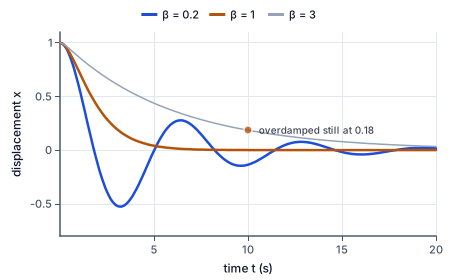
The chart releases the same oscillator from the same displacement three times, changing only the damping. With $\beta = 0.2$ the curve crosses zero again and again, each swing smaller than the last by the same factor, the underdamped ringing. With $\beta = 1$, equal to $\omega_0$, it slides back to zero without ever crossing, and is closest to zero of the three over the first few seconds. With $\beta = 3$ it has barely moved after ten seconds. Compare the critical and overdamped curves at $t = 5$ s: the heavier damping is the slower return, which is the point of the misconception at the end of this lesson.
A car's suspension is a spring and a damper at each wheel. A corner carrying $400$ kg on a $40{,}000$ N/m spring has natural frequency $10$ rad/s, about $1.6$ Hz, close to the range engineers choose for comfort. Critical damping would need $b = 2\sqrt{km} = 8000$ N s/m.
Engineers in Detroit usually tune a passenger car to about a quarter to a half of critical, a damping ratio of $0.25$ to $0.5$. Fully critical damping would transmit every sharp bump into the body; too little would let the car float and wallow after a dip. Sports cars are set firmer, near $0.5$ to $0.7$, trading comfort for control. When shock absorbers wear, the damping falls and the car bounces two or three times after a bump, which is exactly the fender test mechanics use: an underdamped oscillator with a low $Q$ becoming a less damped one.
A seismometer is a mass on a spring inside a case bolted to the ground. When the ground shakes, the case moves and the mass lags behind, and the relative motion is recorded. If the instrument were underdamped, it would ring at its own frequency after every jolt, and the record would show the instrument rather than the earthquake.
So seismometers are damped close to critical, often to a damping ratio of about $0.7$, which gives a flat response over the widest range of frequencies. The United States Geological Survey's national network uses broadband instruments whose damping is supplied electronically by feedback, keeping the mass nearly still and measuring the force needed to hold it. The design problem is the one of this lesson, choosing $\beta$ relative to $\omega_0$, solved so that the curve on the screen is the Earth's motion.
It is natural to think that adding damping always brings a system to rest sooner. Up to critical damping it does: the envelope $e^{-\beta t}$ shrinks faster as $\beta$ grows. Past critical damping the opposite happens. The slow exponential's rate, about $\omega_0^2/2\beta$, falls as $\beta$ grows, and a heavily overdamped system creeps back very slowly, like a door on a stiff closer.
A second error is to think damping changes the frequency a lot. For light damping it barely changes it; the decay of the amplitude is the main effect.
A $2.0$ kg mass on a $50$ N/m spring has $b = 8.0$ kg/s. Find the damping constant.
$\beta = \dfrac{b}{2m} = \dfrac{8.0}{4.0} = 2.0\ \text{s}^{-1}$
Half the damping per unit mass.
Find the natural frequency.
$\omega_0 = \sqrt{\dfrac{50}{2.0}} = 5.0\ \text{s}^{-1}$
Stiffness over mass.
Compare the two.
$\beta = 2.0 < \omega_0 = 5.0$
So the motion is underdamped.
Find the damped frequency.
$\omega_1 = \sqrt{25 - 4} = \sqrt{21} = 4.58\ \text{s}^{-1}$
Somewhat below $\omega_0$.
Find the quality factor.
$Q = \dfrac{5.0}{2 \times 2.0} = 1.25$
Heavily damped for an oscillator: it rings only once or twice.
A $440$ Hz tuning fork's sound falls by a factor of $e$ in amplitude in $2.0$ s. Find the damping constant.
$\beta = \dfrac{1}{2.0\ \text{s}} = 0.50\ \text{s}^{-1}$
The amplitude decays as $e^{-\beta t}$.
Find the natural angular frequency.
$\omega_0 = 2\pi \times 440 = 2765\ \text{s}^{-1}$
Hertz to radians per second.
Find the quality factor.
$Q = \dfrac{2765}{2 \times 0.50} = 2765$
$Q = \omega_0/2\beta$.
Check the frequency shift.
$\dfrac{\omega_0 - \omega_1}{\omega_0} \approx \dfrac{\beta^2}{2\omega_0^2} = 1.6 \times 10^{-8}$
The pitch is not changed by the damping in any audible way.
Count the vibrations in the decay time.
$f \times \dfrac{1}{\beta} = 440 \times 2.0 = 880$
About $Q/\pi$ oscillations, as the rule of thumb says.
A critically damped oscillator with $\omega_0 = 4.0$ s⁻¹ is released from rest at $x_0 = 10$ cm. Write the solution.
$x = (C_1 + C_2t)e^{-4.0t}$
$\beta = \omega_0$ at critical damping.
Apply the starting position.
$x(0) = C_1 = 10\ \text{cm}$
At $t = 0$ the bracket is $C_1$.
Differentiate the solution.
$\dot{x} = (C_2 - 4.0C_1 - 4.0C_2t)e^{-4.0t}$
The product rule.
Apply the release from rest.
$\dot{x}(0) = C_2 - 40 = 0 \Rightarrow C_2 = 40\ \text{cm/s}$
Zero initial velocity.
Write the full solution.
$x = 10(1 + 4.0t)e^{-4.0t}\ \text{cm}$
Substituting both constants.
Find the position after $1.0$ s.
$x = 10 \times 5.0 \times e^{-4.0} = 50 \times 0.0183 = 0.92\ \text{cm}$
Under a tenth of the start, with no overshoot.
Find the damping constant.
$\beta = \dfrac{4.0}{2 \times 1.0} = 2.0\ \text{s}^{-1}$
$\beta = b/2m$.
Find the natural frequency.
$\omega_0 = \sqrt{100/1.0} = 10\ \text{s}^{-1}$
$\omega_0 = \sqrt{k/m}$.
Name the regime.
An oscillator obeys $\ddot{x} + 2\beta\dot{x} + \omega_0^2x = 0$ with $\beta = 4$ s⁻¹ and $\omega_0 = 9$ s⁻¹. Released from rest away from equilibrium, how does it move?
Complete the worked solution: a $2$ kg mass on a spring of stiffness $338$ N/m has damping coefficient $b = 20$ kg/s. Find the damping constant $\beta$, the natural frequency $\omega_0$ and the damped frequency $\omega_1$, all in s⁻¹.
Divide the damping coefficient by twice the mass.
$\beta = \dfrac{b}{2m} =$ b
Half the damping per unit mass.
Divide the stiffness by the mass and take the square root.
$\omega_0 = \sqrt{k/m} =$ o
The frequency it would have with no damping.
Take the square root of the difference of the squares.
$\omega_1 = \sqrt{\omega_0^2 - \beta^2} =$ w
The frequency of the decaying oscillation.
Check the regime from the first two results.
$\text{damping constant below natural frequency} \Rightarrow \text{underdamped}$
So the mass overshoots and rings down.
Match each damping regime to its solution.
| $Ae^{-\beta t}\cos(\omega_1t - \delta)$ | $(C_1 + C_2t)e^{-\beta t}$ | two decaying exponentials | $A\cos(\omega_0t - \delta)$ | |
|---|---|---|---|---|
| underdamped | ||||
| critically damped | ||||
| overdamped | ||||
| undamped |
A mass of $2$ kg on a spring of stiffness $578$ N/m feels a damping force $-b\dot{x}$ with $b = 60$ kg/s. Fill in $\beta$ in s⁻¹, $\omega_0^2$ in s⁻², and the damped frequency $\omega_1$ in s⁻¹.
| value | |
|---|---|
| $\beta$ (s⁻¹) | |
| $\omega_0^2$ (s⁻²) | |
| $\omega_1$ (s⁻¹) |
A critically damped oscillator has $\beta = \omega_0 = 5$ s⁻¹. It is released from rest at $x = 3$ cm. Write $x$ in cm as a formula in $t$, in seconds.
Answer:
A lightly damped oscillator has natural frequency $\omega_0 = 22$ rad/s and damping constant $\beta = 5$ s⁻¹. What is its quality factor $Q$?
Answer: quality factor
An engineer in Detroit is tuning a car's suspension. Each wheel carries $500$ kg on a spring of stiffness $50000$ N/m. What damping coefficient, in N s/m, makes that corner critically damped?
Answer: N s/m of damping
Lesson test: one question per skill, one attempt each, no hints. Your answers are checked when you submit.
A critically damped oscillator has $\beta = \omega_0 = 4$ s⁻¹. It is released from rest at $x = 2$ cm. Write $x$ in cm as a formula in $t$, in seconds.
Answer:
You can analyze damped oscillators. Explain to someone why a car's shock absorbers are not tuned to the heaviest damping possible.
20. Your turn: a $1.0$ kg mass has $k = 100$ N/m and $b = 4.0$ kg/s. Find $\beta$, $\omega_0$ and the regime., step 3
$\beta < \omega_0 \Rightarrow \text{underdamped}$
It rings down.