Back to the on-screen lesson ·
The steady-state amplitude $f_0/\sqrt{(\omega_0^2 - \omega^2)^2 + 4\beta^2\omega^2}$ and phase, transients, the resonance peak and its width, power, and Fourier series for periodic forces.
Paper packet. Every task here also exists on screen, where it is checked automatically; answers written on paper are not assessed by Nydus. When you are back at a device, enter your answers there.
By the end of this lesson you will be able to find the steady-state amplitude and phase of a driven damped oscillator, describe its resonance peak, and explain how a periodic force of any shape drives it.
The last lesson solved the damped oscillator $\ddot{x} + 2\beta\dot{x} + \omega_0^2x = 0$ in its three regimes and defined the quality factor. You can write oscillations as complex exponentials and take real parts. This lesson adds a driving force, the situation of nearly every oscillator that matters in practice: a bridge in the wind, a radio receiving a station, a building shaken by an earthquake.
| Term | What it means |
|---|---|
| Driving force | An external force $F_0\cos\omega t$ at a frequency $\omega$ set from outside. |
| Transient | The homogeneous solution, which decays as $e^{-\beta t}$ and depends on the start. |
| Steady state | The particular solution $A\cos(\omega t - \delta)$ left once the transient has died. |
| Phase lag | $\delta$, how far the response trails the force, from $0$ to $180°$. |
| Resonance | The large response when the driving frequency is near the natural frequency. |
| Full width at half maximum | The width of the resonance peak of $A^2$, about $2\beta$ for light damping. |
| Fourier series | A periodic force written as a sum of sinusoids at multiples of its fundamental frequency. |
A damped oscillator driven by $F_0\cos\omega t$ obeys
$$\ddot{x} + 2\beta\dot{x} + \omega_0^2x = f_0\cos\omega t, \qquad f_0 = F_0/m.$$
Replace the force by $f_0e^{i\omega t}$ and look for $z = Ce^{i\omega t}$. Substituting gives $(\omega_0^2 - \omega^2 + 2i\beta\omega)C = f_0$, so $C = f_0/(\omega_0^2 - \omega^2 + 2i\beta\omega)$. The real part of $z$ is the steady state,
$$x = A\cos(\omega t - \delta), \qquad A = \frac{f_0}{\sqrt{(\omega_0^2 - \omega^2)^2 + 4\beta^2\omega^2}}, \qquad \tan\delta = \frac{2\beta\omega}{\omega_0^2 - \omega^2}.$$
The full solution adds the transient, the damped oscillation of the last lesson, which carries the initial conditions and dies away as $e^{-\beta t}$. After a few times $1/\beta$ only the steady state remains, oscillating at the driving frequency, not its own. When $\omega$ is near $\omega_0$ and damping is light, $A$ becomes very large: resonance. The peak amplitude is $f_0/2\beta\omega_0$, which is $Q$ times the static response $f_0/\omega_0^2$.
Another way: picture
Push a child on a swing. Push at random and the swing jiggles. Push once per swing, just as the swing starts forward, and each push adds energy: the swing climbs higher and higher until the air and friction take away as much as you add each cycle. You naturally push when the swing is at the bottom moving away, a quarter cycle after it was at the top: the $90°$ lag of resonance.
Another way: steps
The amplitude formula has two terms under the root, and which one wins sets the behavior. Slow driving, $\omega \ll \omega_0$: the first term is $\omega_0^4$, so $A \approx f_0/\omega_0^2 = F_0/k$ and $\delta \approx 0$. The spring just follows the slowly changing force, stretched as if the force were steady.
Fast driving, $\omega \gg \omega_0$: the first term is about $\omega^4$, so $A \approx f_0/\omega^2$ and $\delta \approx 180°$. The mass is too sluggish to follow, moves only a little, and moves opposite to the force, as a free mass would. Near resonance, the first term vanishes and only damping limits the amplitude, with the phase passing through $90°$. The phase therefore tells you which side of resonance a system is on, which is how engineers find a resonance experimentally without driving the system to dangerous amplitudes.
Near resonance write $\omega = \omega_0 + \epsilon$, so $\omega_0^2 - \omega^2 \approx -2\omega_0\epsilon$. Then $A^2 \approx f_0^2/(4\omega_0^2(\epsilon^2 + \beta^2))$, a Lorentzian curve. It falls to half its peak when $\epsilon = \pm\beta$, so the full width at half maximum of $A^2$ is $2\beta$.
Dividing the frequency by the width gives the quality factor again: $Q = \omega_0/2\beta$. A high-$Q$ oscillator has a tall, narrow resonance, responding strongly only to driving very close to its natural frequency. That is what makes a radio selective: the tuned circuit responds to one station and ignores its neighbors. It is also what makes a wine glass shatter at one sung note and not at another a few percent away.
The force does work at the rate $F\dot{x}$. With $x = A\cos(\omega t - \delta)$, averaging over a cycle gives $\langle P\rangle = \tfrac{1}{2}F_0A\omega\sin\delta$. The force is most effective when $\sin\delta = 1$, $\delta = 90°$: then the velocity, a quarter cycle ahead of the displacement, is in step with the force, and the force pushes the mass along its motion for the whole cycle.
In the steady state that power is exactly what damping removes, $b\langle\dot{x}^2\rangle$. At resonance the balance is reached only at a large amplitude, because each cycle adds a lot of energy. Off resonance, the force spends part of each cycle pushing against the motion and taking energy back, and the balance comes at a small amplitude.
The full solution is the steady state plus the transient, $x = A\cos(\omega t - \delta) + A_{\text{tr}}e^{-\beta t}\cos(\omega_1t - \delta_{\text{tr}})$, with the transient's two constants fixed by the start. Starting from rest at equilibrium, the transient must cancel the steady state at $t = 0$, so the two beat against each other at first, producing the irregular swinging of a newly pushed system.
The transient dies in a few times $1/\beta = 2Q/\omega_0$. A high-$Q$ system takes many cycles to settle, which is a practical cost: a very sharp radio filter responds slowly to a change of signal, and a very lightly damped structure takes a long time to calm down after it is disturbed. Selectivity and speed trade against each other through the one number $Q$.
A force that repeats with period $\tau$ but is not a sinusoid, such as a piston's regular kicks or a walker's footsteps, can be written as a Fourier series, $f(t) = \sum_n(a_n\cos n\omega t + b_n\sin n\omega t)$ with $\omega = 2\pi/\tau$. Because the oscillator equation is linear, the response is the sum of the responses to each term.
Each term is amplified according to how close $n\omega$ lies to $\omega_0$. So a system can resonate with a harmonic of the driving force even when the fundamental is far from $\omega_0$. A washing machine whose drum spins at one frequency can shake a floor whose natural frequency is at twice that, and a car engine's firing can make a body panel buzz at one particular speed. Designers check every harmonic, not just the fundamental.
Checking an answer. At $\omega = 0$ the amplitude must be the static $F_0/k$. At $\omega = \omega_0$ the phase must be exactly $90°$. The amplitude must never exceed $f_0/2\beta\omega_1$, the true peak, and with $\beta \to 0$ it must blow up at $\omega_0$. Units: $f_0$ in m/s² divided by s⁻² gives meters.
Resonance stories are often told wrong. The Tacoma Narrows Bridge in Washington, which twisted itself apart in a steady $40$ mile-per-hour wind in 1940, is the famous example, but it was not simple resonance with a periodic force. The wind was steady; the bridge's own motion shaped the airflow so that it fed energy into the twisting, a self-excited instability called aeroelastic flutter, in effect negative damping.
True forced resonance does trouble structures. Footbridges with lateral frequencies near $1$ Hz can lock walkers into step, and floors in gyms and concert halls must keep their natural frequencies well above the $2$ to $3$ Hz of jumping crowds. Engineers now design with both mechanisms in mind: they move natural frequencies away from likely forcing and add damping to lower $Q$, and they test bridge sections in wind tunnels to rule out flutter.
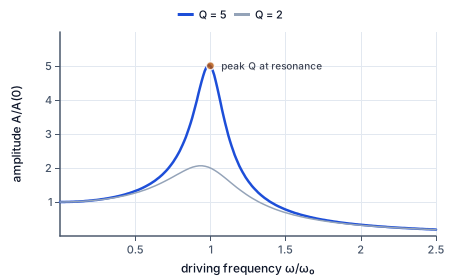
The chart plots the steady-state amplitude, as a multiple of the static stretch $f_0/\omega_0^2$, against the driving frequency as a fraction of $\omega_0$. At the left edge both curves start at $1$: slow driving just stretches the spring. At the right they fall toward zero as $\omega_0^2/\omega^2$. In between, each peaks close to $\omega = \omega_0$ at a height equal to its $Q$: about $2$ for the more heavily damped oscillator and about $5$ for the lighter one. Notice also that the taller peak is narrower. Its width at half the peak energy is $2\beta = \omega_0/Q$, so sharpness and height come together, set by the one number $Q$.
People walk at about two steps a second, and their weight shifts sideways once per stride, about once a second. A light footbridge with a lateral natural frequency near $1$ Hz is therefore driven close to resonance. Such bridges are lightly damped, with $\zeta$ around $0.01$ and $Q$ near $50$, so a sideways force that would deflect the deck only half a millimeter statically can sway it $25$ mm at resonance.
Worse, a swaying deck makes walkers adjust their gait to keep balance, which puts them in step with the sway and with each other: the force grows with the motion. Engineers retrofit such bridges with tuned mass dampers and viscous dampers that raise $\zeta$ to several percent, cutting $Q$ by a factor of five or more, and new designs for pedestrian bridges across the United States now check lateral frequencies against walking rates before construction.
A magnetic resonance imaging scanner is a resonance experiment on protons. In the scanner's field, each proton's magnetic moment precesses at the Larmor frequency, about $64$ MHz at $1.5$ T and $128$ MHz at $3$ T. A radio pulse at exactly that frequency drives the protons, tipping their moments; a pulse a little off frequency does almost nothing, because the resonance is extremely narrow.
The scanner adds a gradient to its field so that the Larmor frequency varies across the body. A pulse at one frequency then drives only the protons in one slice, which is how the machine selects the slice it images. Tens of millions of MRI scans are done in the United States each year, each one relying on the sharpness of a resonance: the same $Q$ that makes a wine glass sing at one note lets a scanner pick one slice of tissue out of a whole body.
It seems that the biggest response should come when the mass moves in step with the push. But in step, $\delta = 0$, is the slow-driving limit, where the force is simply balanced by the spring. At resonance the displacement lags the force by $90°$, which puts the velocity in step with the force, and that is what lets the force feed energy in over the whole cycle.
A second error is to think the oscillator ends up moving at its own natural frequency. In the steady state it moves at the driving frequency, whatever that is; its own frequency appears only in the transient, and in how strongly it responds.
An oscillator has $\omega_0 = 5.0$ rad/s and $\beta = 2.0$ s⁻¹, driven at $\omega = 3.0$ rad/s with $f_0 = 10$ m/s². Find the in-phase term.
$\omega_0^2 - \omega^2 = 25 - 9 = 16\ \text{s}^{-2}$
The part that vanishes at resonance.
Find the damping term.
$2\beta\omega = 2 \times 2.0 \times 3.0 = 12\ \text{s}^{-2}$
The part that keeps the peak finite.
Combine the two terms.
$\sqrt{16^2 + 12^2} = \sqrt{400} = 20\ \text{s}^{-2}$
The modulus of the complex denominator.
Find the amplitude.
$A = \dfrac{10}{20} = 0.50\ \text{m}$
$f_0$ over the modulus.
Find the phase lag.
$\tan\delta = \dfrac{12}{16} = 0.75 \Rightarrow \delta = 36.9°$
Below resonance, so less than $90°$.
An oscillator has $\omega_0 = 100$ rad/s and $\beta = 2.0$ s⁻¹. Find its quality factor.
$Q = \dfrac{100}{2 \times 2.0} = 25$
$Q = \omega_0/2\beta$.
Find the static amplitude for $f_0 = 50$ m/s².
$A(0) = \dfrac{50}{100^2} = 5.0 \times 10^{-3}\ \text{m}$
$f_0/\omega_0^2$.
Find the resonant amplitude.
$A(\omega_0) = \dfrac{50}{2 \times 2.0 \times 100} = 0.125\ \text{m}$
$f_0/2\beta\omega_0$.
Check the amplification.
$\dfrac{0.125}{0.0050} = 25 = Q$
Resonance multiplies the static response by $Q$.
Find the width of the peak.
$\Delta\omega = 2\beta = 4.0\ \text{rad/s}$
Half-power points at $98$ and $102$ rad/s.
Find the amplitude at the half-power point.
$A = \dfrac{0.125}{\sqrt{2}} = 0.088\ \text{m}$
Half the energy means amplitude over $\sqrt{2}$.
Write the driven equation with a complex force.
$\ddot{z} + 2\beta\dot{z} + \omega_0^2z = f_0e^{i\omega t}$
The real part of $z$ will be $x$, because the equation is real and linear.
Try a response at the driving frequency.
$z = Ce^{i\omega t} \Rightarrow \dot{z} = i\omega z, \quad \ddot{z} = -\omega^2z$
Each derivative multiplies by $i\omega$.
Substitute into the equation.
$(-\omega^2 + 2i\beta\omega + \omega_0^2)Ce^{i\omega t} = f_0e^{i\omega t}$
The exponential cancels.
Solve for the complex amplitude.
$C = \dfrac{f_0}{\omega_0^2 - \omega^2 + 2i\beta\omega}$
One line of algebra.
Write it in polar form.
$C = Ae^{-i\delta}, \quad A = \dfrac{f_0}{\sqrt{(\omega_0^2 - \omega^2)^2 + 4\beta^2\omega^2}}$
The modulus and argument of a quotient.
Take the real part.
$x = \operatorname{Re}\left(Ae^{i(\omega t - \delta)}\right) = A\cos(\omega t - \delta)$
The steady-state response.
Read off the phase.
$\tan\delta = \dfrac{2\beta\omega}{\omega_0^2 - \omega^2}$
The argument of the denominator.
Write the resonant amplitude.
$A = \dfrac{f_0}{2\beta\omega_0}$
Only damping limits it.
Substitute the values.
$A = \dfrac{2.0}{2 \times 0.5 \times 10}$
SI units.
Evaluate the amplitude.
A lightly damped oscillator with $\omega_0 = 17$ rad/s is driven by $F_0\cos\omega t$ at exactly $\omega = 17$ rad/s. In the steady state, how does the displacement's phase compare with the force's?
Complete the worked solution: an oscillator has $\omega_0^2 = 7$ s⁻² and $\beta = 4$ s⁻¹, and is driven at $\omega = 1$ rad/s. Find $\omega_0^2 - \omega^2$, the damping term $2\beta\omega$, and $\sqrt{(\omega_0^2 - \omega^2)^2 + 4\beta^2\omega^2}$, all in s⁻².
Subtract the driving frequency squared from the natural frequency squared.
$\omega_0^2 - \omega^2 =$ d
The part of the denominator that vanishes at resonance.
Multiply twice the damping constant by the driving frequency.
$2\beta\omega =$ e
The part that keeps the amplitude finite.
Combine the two as the sides of a right triangle.
$\sqrt{(\omega_0^2 - \omega^2)^2 + (2\beta\omega)^2} =$ r
The magnitude of the complex denominator.
Check the phase from the same triangle.
$\tan\delta = \text{damping term} / \text{in-phase term}$
Below resonance both parts are positive, so the lag is less than $90°$.
Match each driving condition to the steady-state response.
| in phase, $f_0/\omega_0^2$ | $90°$ behind, $f_0/2\beta\omega_0$ | $180°$ behind, about $f_0/\omega^2$ | about $2\beta$ | |
|---|---|---|---|---|
| slow driving | ||||
| driving at resonance | ||||
| fast driving | ||||
| width of the peak |
An oscillator has $\omega_0 = 11$ rad/s and $\beta = 4$ s⁻¹, and is driven with $f_0 = F_0/m = 2904$ m/s². Fill in the amplitude for very slow driving, the amplitude at resonance, both in m, and their ratio.
| value | |
|---|---|
| amplitude for slow driving (m) | |
| amplitude at resonance (m) | |
| their ratio |
An undamped oscillator with $\omega_0 = 9$ rad/s is driven by $f_0\cos\omega t$ with $f_0 = 2$ m/s². Write the steady-state amplitude $A$, in meters, as a formula in the driving frequency, written $w$ for $\omega$ (take $A$ negative above resonance).
Answer:
A mass on a spring, with natural frequency $\omega_0 = 8$ rad/s and damping coefficient $b = 4$ kg/s, is driven at resonance by a force of amplitude $9$ N. What is the steady-state amplitude, in meters?
Answer: m at resonance
A light steel footbridge over the Mississippi in Minneapolis sways sideways at a natural frequency of about $1$ Hz, close to the rate at which walkers' weight shifts from foot to foot. A crowd walking in step pushes it with a force that alone would deflect it $0.7$ mm statically. Its damping ratio is $\zeta = 0.005$. How far does it sway at resonance, in millimeters?
Answer: mm of sway
Lesson test: one question per skill, one attempt each, no hints. Your answers are checked when you submit.
An undamped oscillator with $\omega_0 = 8$ rad/s is driven by $f_0\cos\omega t$ with $f_0 = 19$ m/s². Write the steady-state amplitude $A$, in meters, as a formula in the driving frequency, written $w$ for $\omega$ (take $A$ negative above resonance).
Answer:
You can analyze driven oscillators and resonance. Explain to someone why you push a swing when it is at the bottom rather than at the top.
19. Your turn: an oscillator with $\omega_0 = 10$ rad/s and $\beta = 0.5$ s⁻¹ is driven at resonance with $f_0 = 2.0$ m/s². Find the amplitude., step 3
$A = 0.20\ \text{m}$
Ten times the static $0.02$ m, since $Q = 10$.