Back to the on-screen lesson ·
Euler's equations in principal axes, free precession of a symmetric body at $(\lambda_3 - \lambda_1)\omega_3/\lambda_1$, the Chandler wobble, the tennis racket theorem and the major axis rule.
Paper packet. Every task here also exists on screen, where it is checked automatically; answers written on paper are not assessed by Nydus. When you are back at a device, enter your answers there.
By the end of this lesson you will be able to write Euler's equations, solve the free motion of a symmetric body, and decide which axes of rotation are stable.
The last lesson introduced the inertia tensor and its principal axes, and showed that about a principal axis $\vec{L} = \lambda\vec{\omega}$. The rotating-frame lesson gave the rule $(d\vec{Q}/dt)_{\text{inertial}} = (d\vec{Q}/dt)_{\text{rot}} + \vec{\Omega} \times \vec{Q}$. This lesson combines them: it writes $\dot{\vec{L}} = \vec{\Gamma}$ in axes fixed in the turning body, where the inertia tensor is diagonal and constant, and solves the motion of a body spinning freely.
| Term | What it means |
|---|---|
| Body frame | Axes fixed in the rigid body, rotating with it; the principal axes are chosen here. |
| Euler's equations | $\lambda_1\dot{\omega}_1 - (\lambda_2 - \lambda_3)\omega_2\omega_3 = \Gamma_1$ and its two cyclic partners. |
| Torque-free motion | Rotation with no external torque, so $\vec{L}$ is fixed in space. |
| Free precession | The turning of $\vec{\omega}$ about the symmetry axis of a free symmetric body, at $\Omega_b$ in the body frame. |
| Chandler wobble | The Earth's free precession, a motion of the pole of about $433$ days. |
| Tennis racket theorem | Rotation about the axis of intermediate moment is unstable. |
| Major axis rule | A body that loses energy but not angular momentum ends up spinning about its axis of largest moment. |
In an inertial frame, $\dot{\vec{L}} = \vec{\Gamma}$, but the inertia tensor changes as the body turns. In the body frame, along the principal axes, the tensor is fixed and diagonal and $\vec{L} = (\lambda_1\omega_1, \lambda_2\omega_2, \lambda_3\omega_3)$. The rate of change seen from the body is corrected by $\vec{\omega} \times \vec{L}$, so $\dot{\vec{L}}_{\text{body}} + \vec{\omega} \times \vec{L} = \vec{\Gamma}$. Written out, these are Euler's equations:
$$\lambda_1\dot{\omega}_1 - (\lambda_2 - \lambda_3)\omega_2\omega_3 = \Gamma_1,$$ $$\lambda_2\dot{\omega}_2 - (\lambda_3 - \lambda_1)\omega_3\omega_1 = \Gamma_2,$$ $$\lambda_3\dot{\omega}_3 - (\lambda_1 - \lambda_2)\omega_1\omega_2 = \Gamma_3.$$
With no torque and a symmetric body, $\lambda_1 = \lambda_2$, the third equation gives $\omega_3$ constant, and the first two become $\dot{\omega}_1 = -\Omega_b\omega_2$, $\dot{\omega}_2 = \Omega_b\omega_1$ with
$$\Omega_b = \frac{\lambda_3 - \lambda_1}{\lambda_1}\omega_3.$$
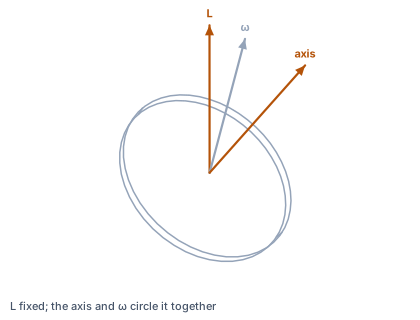
The part of $\vec{\omega}$ perpendicular to the symmetry axis turns steadily at $\Omega_b$: free precession. Seen from outside, the symmetry axis and $\vec{\omega}$ both circle the fixed $\vec{L}$.
Another way: picture
Throw a football with a slight wobble. It spins fast about its long axis, and that axis traces a small cone as it flies, the wobble repeating steadily. No torque acts in flight, so the angular momentum points in one fixed direction; the ball's axis and its spin vector swing around that direction together, locked at fixed angles to it.
Another way: steps
The rotating-frame rule, applied to $\vec{L}$ with the frame turning at $\vec{\omega}$ itself, gives $\vec{\Gamma} = \dot{\vec{L}}_{\text{body}} + \vec{\omega} \times \vec{L}$. In principal axes, $\dot{\vec{L}}_{\text{body}} = (\lambda_1\dot{\omega}_1, \lambda_2\dot{\omega}_2, \lambda_3\dot{\omega}_3)$, since the moments do not change in the body frame. The first component of the cross product is $\omega_2L_3 - \omega_3L_2 = (\lambda_3 - \lambda_2)\omega_2\omega_3$.
Putting these together gives the first equation, and the others follow by cycling $1 \to 2 \to 3 \to 1$. The equations are nonlinear: products of angular velocities appear. That is why free rigid-body motion is richer than it looks, and why general solutions for unequal moments need elliptic functions. The symmetric case, where one product drops out, is the one solvable with sines and cosines.
For a symmetric body with no torque, $\omega_3$ is constant and the perpendicular part of $\vec{\omega}$ rotates at $\Omega_b$ in the body frame. For a flattened body, $\lambda_3 > \lambda_1$, it rotates in the same sense as the spin; for an elongated one, like a football, $\lambda_3 < \lambda_1$ and it rotates backward.
Seen from the space frame, where $\vec{L}$ is fixed, the symmetry axis circles $\vec{L}$ at the faster rate $\Omega_s = L/\lambda_1$. A well-thrown football wobbles at about the spin rate divided by a small number, which is why a spiral with a little wobble looks like a slow, regular nodding. A coin spun on a table and a dinner plate tossed in the air show the same free precession; Richard Feynman worked out the plate's wobble, twice its spin rate, in a Cornell cafeteria.
The Earth is slightly flattened, with $(\lambda_3 - \lambda_1)/\lambda_1 \approx 1/305$. If its axis of rotation is slightly off its figure axis, Euler's equations predict that the rotation axis circles the figure axis once every $305$ sidereal days, about $305$ days. Leonhard Euler predicted this in 1765.
It was found in 1891 by Seth Carlo Chandler, an American astronomer in Massachusetts, but with a period of about $433$ days. The difference is because the Earth is not rigid: its mantle yields elastically and its oceans slosh, which slows the wobble. The pole wanders a few meters on the ground, and the International Earth Rotation Service and the U.S. Naval Observatory track it daily, because GPS and spacecraft navigation must correct for it.
Steady rotation about any principal axis solves Euler's equations. To test stability, spin about axis $1$ and add small $\omega_2$ and $\omega_3$. To first order, $\ddot{\omega}_2 = -\frac{(\lambda_1 - \lambda_3)(\lambda_1 - \lambda_2)}{\lambda_2\lambda_3}\omega_1^2\,\omega_2$. If axis $1$ has the largest or the smallest moment, the two differences have the same sign, the coefficient is negative, and $\omega_2$ oscillates: stable. If axis $1$ is the intermediate one, the coefficient is positive, and $\omega_2$ grows exponentially: unstable.
Toss a tennis racket or a phone spinning about its intermediate axis and it flips half over each turn. The Soviet cosmonaut Vladimir Dzhanibekov filmed a wing nut doing this in orbit in 1985, which is why it is sometimes called the Dzhanibekov effect; astronauts on the International Space Station have since demonstrated it on video.
For a given angular momentum, the kinetic energy $L^2/2\lambda$ is least for spin about the axis of largest moment. A real body that flexes or sloshes loses energy but keeps its angular momentum, so it drifts toward that least-energy state: whatever axis it starts spinning about, it ends up spinning about its axis of largest moment. This is the major axis rule.
America's first satellite, Explorer 1, launched from Cape Canaveral in 1958, was a long thin cylinder spun about its long axis, its axis of smallest moment. Its four whip antennas flexed and dissipated energy, and within hours it had gone into a flat spin, tumbling end over end. The episode taught spacecraft designers to spin satellites about their major axis or to add active control, a lesson built into every spin-stabilized spacecraft since.
Checking an answer. With no torque, $L^2 = \sum\lambda_i^2\omega_i^2$ and $2T = \sum\lambda_i\omega_i^2$ must both be constant along your solution. For a sphere, all moments equal, $\Omega_b$ must vanish: a sphere cannot wobble. And the sign of $\Omega_b$ must match the shape: forward for flattened bodies, backward for elongated ones.
In the space frame the angular momentum is simple, fixed for a free body, but the inertia tensor changes from moment to moment as the body turns, so $\vec{L} = \mathbf{I}\vec{\omega}$ is hard to use. In the body frame the tensor is fixed and diagonal, and the price is the extra $\vec{\omega} \times \vec{L}$ term. Trading a changing tensor for a cross product is almost always the better bargain.
Spacecraft attitude control software works in exactly this way. Gyroscopes measure $\omega_1$, $\omega_2$ and $\omega_3$ in the body frame, Euler's equations predict how they will change under the torques from reaction wheels and thrusters, and the controller chooses torques to keep the spacecraft pointed. The Hubble Space Telescope holds its pointing this way to within a few thousandths of an arcsecond.
A free rigid body conserves two things: the size of its angular momentum, $L^2 = \lambda_1^2\omega_1^2 + \lambda_2^2\omega_2^2 + \lambda_3^2\omega_3^2$, and its kinetic energy, $2T = \lambda_1\omega_1^2 + \lambda_2\omega_2^2 + \lambda_3\omega_3^2$. In the space of $(\omega_1, \omega_2, \omega_3)$ each is an ellipsoid, and the body's angular velocity must lie on both at once: on the curve where they intersect.
Near the axes of largest and smallest moment, those intersection curves are small closed loops around the axis, so a slightly disturbed spin stays close to it: stable. Near the intermediate axis, the curves cross in an X, and a trajectory starting near it runs far away along one arm before coming back: the flip of the tennis racket. This picture, due to Louis Poinsot, makes the stability result visible without solving anything, and it shows why the flips recur periodically rather than happening once.
The scene shows a flat disk spinning with no torque on it. Its angular momentum $\vec{L}$ is drawn straight up and never moves. The disk's symmetry axis is tilted from $\vec{L}$, and the angular velocity $\vec{\omega}$ lies between them in the same plane. As the scene turns, watch the symmetry axis and $\vec{\omega}$ sweep round $\vec{L}$ together, each on its own cone, while the three stay in one plane. That is the space-frame view of free precession. In the body frame, the one Euler's equations use, the same motion is $\vec{\omega}$ circling the symmetry axis at the slower rate $\Omega_b$.
The Earth's rotation axis wanders over the surface in a rough circle a few meters across. Most of that wander is the Chandler wobble, the Earth's free precession. Treated as a rigid symmetric top with $(\lambda_3 - \lambda_1)/\lambda_1 = 1/305.5$ and a sidereal day of $0.9973$ days, Euler's equations predict a period of about $305$ days.
Seth Chandler found the real period, $433$ days, in 1891 from careful records of how star positions shifted at observatories. The difference measures the Earth's elasticity: a yielding Earth partly follows the wandering axis, weakening the restoring effect. The U.S. Naval Observatory in Washington publishes the pole's position every day, and every GPS receiver's accuracy depends, through the coordinates it uses, on these tiny corrections.
Explorer 1, launched from Cape Canaveral on January 31, 1958, was a $14$ kg cylinder about two meters long, spun at $750$ revolutions per minute about its long axis to keep it stable. That axis had the smallest moment of inertia. Four flexible wire antennas stuck out from its middle.
The antennas flexed with every slight wobble, turning rotational energy into heat. Angular momentum was conserved, so the satellite drifted toward the state of least energy for that angular momentum, spin about its axis of largest moment, which for a long cylinder is an axis perpendicular to its length. Within one orbit it was tumbling end over end. Ronald Bracewell and Owen Garriott explained the flat spin from Euler's equations, and every spinning spacecraft designed since obeys the major axis rule.
About every principal axis, steady spin is possible, since $\vec{L}$ and $\vec{\omega}$ are parallel. It is tempting to conclude that spin about any of them stays steady. But about the axis of intermediate moment, the smallest wobble grows exponentially and the body flips over and back, as any tossed phone or book shows.
A second error is to think spin about the smallest axis is as good as about the largest in practice. For a perfectly rigid body it is; for a real body that loses energy, only the largest axis is stable, which Explorer 1 demonstrated.
Write Euler's first equation with no torque.
$\lambda_1\dot{\omega}_1 = (\lambda_2 - \lambda_3)\omega_2\omega_3$
Body-frame form of $\dot{\vec{L}} = 0$.
Set all moments equal for a uniform sphere.
$\lambda_1 = \lambda_2 = \lambda_3 = \tfrac{2}{5}MR^2$
Complete symmetry.
Evaluate the right side.
$(\lambda_2 - \lambda_3)\omega_2\omega_3 = 0$
The difference of moments vanishes.
Conclude for all three components.
$\dot{\omega}_1 = \dot{\omega}_2 = \dot{\omega}_3 = 0$
The same holds cyclically.
Interpret the result.
$\vec{\omega} \text{ constant, parallel to } \vec{L}$
A free sphere spins steadily about any axis and cannot wobble.
A disk-like body has $\lambda_1 = \lambda_2 = 4.0$ kg m² and $\lambda_3 = 5.0$ kg m², spinning with $\omega_3 = 20$ rad/s. Find the fractional excess.
$\dfrac{\lambda_3 - \lambda_1}{\lambda_1} = \dfrac{1.0}{4.0} = 0.25$
How far from spherical it is.
Find the body-frame precession rate.
$\Omega_b = 0.25 \times 20 = 5.0\ \text{rad/s}$
Euler's equations.
Find the precession period.
$T_b = \dfrac{2\pi}{5.0} = 1.26\ \text{s}$
Period is $2\pi$ over rate.
Find the spin period.
$T_{\text{spin}} = \dfrac{2\pi}{20} = 0.314\ \text{s}$
For comparison.
Count the spins per wobble.
$\dfrac{T_b}{T_{\text{spin}}} = 4.0$
$\lambda_1/(\lambda_3 - \lambda_1)$.
A box has $\lambda_1 = 1$, $\lambda_2 = 2$ and $\lambda_3 = 3$ kg m² and spins about axis $2$ at $\Omega = 4.0$ rad/s. Write Euler's equations for small $\omega_1$ and $\omega_3$.
$\lambda_1\dot{\omega}_1 = (\lambda_2 - \lambda_3)\Omega\omega_3, \quad \lambda_3\dot{\omega}_3 = (\lambda_1 - \lambda_2)\omega_1\Omega$
Keep only first-order terms.
Substitute the moments.
$\dot{\omega}_1 = -4.0\,\omega_3, \quad 3\dot{\omega}_3 = -4.0\,\omega_1$
$\lambda_2 - \lambda_3 = -1$ and $\lambda_1 - \lambda_2 = -1$.
Differentiate the first and substitute the second.
$\ddot{\omega}_1 = -4.0\,\dot{\omega}_3 = -4.0 \times \left(-\dfrac{4.0}{3}\omega_1\right) = \dfrac{16}{3}\omega_1$
A single second-order equation.
Read off the growth rate.
$\omega_1 \propto e^{\kappa t}, \quad \kappa = \sqrt{16/3} = 2.31\ \text{s}^{-1}$
A positive coefficient means exponential growth.
Find how long a small wobble takes to grow a hundredfold.
$t = \dfrac{\ln 100}{2.31} = 2.0\ \text{s}$
Within about one and a quarter turns the spin is visibly disturbed.
Contrast spin about axis $3$.
$\ddot{\omega}_1 = -\dfrac{(\lambda_3 - \lambda_2)(\lambda_3 - \lambda_1)}{\lambda_1\lambda_2}\Omega^2\omega_1 < 0$
A negative coefficient: small wobbles only oscillate.
Write the precession rate.
$\Omega_b = \dfrac{\lambda_3 - \lambda_1}{\lambda_1}\omega_3$
From Euler's equations.
Substitute the values.
$\Omega_b = \dfrac{2}{10} \times 30$
SI units.
Evaluate the rate.
A phone lying flat has principal moments $\lambda_1 < \lambda_2 < \lambda_3$ about its length, width and thickness axes. Tossed spinning, with $1$ turns in the air, about which axis does its spin fail to stay steady?
Complete the worked solution: a free symmetric body has $\lambda_1 = \lambda_2 = 2$ kg m² and $\lambda_3 = 6$ kg m². At one instant $\omega = (2, 4, 4)$ rad/s. Find $\dot{\omega}_1$ and $\dot{\omega}_2$ in rad/s², and the body-frame precession rate in rad/s.
Use Euler's first equation with no torque.
$\dot{\omega}_1 = \dfrac{\lambda_2 - \lambda_3}{\lambda_1}\omega_2\omega_3 = -2\omega_2\omega_3 =$ x
$(\lambda_2 - \lambda_3)/\lambda_1 = -2$.
Use Euler's second equation.
$\dot{\omega}_2 = \dfrac{\lambda_3 - \lambda_1}{\lambda_2}\omega_3\omega_1 = 2\omega_3\omega_1 =$ y
$(\lambda_3 - \lambda_1)/\lambda_2 = 2$.
Multiply the fractional excess by the spin rate.
$\Omega_b = \dfrac{\lambda_3 - \lambda_1}{\lambda_1}\omega_3 =$ o
The rate at which the perpendicular part of $\vec{\omega}$ turns.
Check the third component.
$\dot{\omega}_3 = 0 \text{ since } \lambda_1 = \lambda_2$
The spin about the symmetry axis never changes.
Match each statement to its result.
| $\lambda_1\dot{\omega}_1 - (\lambda_2 - \lambda_3)\omega_2\omega_3 = \Gamma_1$ | $(\lambda_3 - \lambda_1)\omega_3/\lambda_1$ | largest and smallest moments | largest moment only | |
|---|---|---|---|---|
| Euler's first equation | ||||
| body-frame precession rate | ||||
| stable axes, rigid body | ||||
| stable axis with energy loss |
A symmetric body has $\lambda_1 = \lambda_2 = 8$ kg m² and $\lambda_3 = 9$ kg m², and spins with $\omega_3 = 11$ rad/s while wobbling slightly. Fill in the ratio $(\lambda_3 - \lambda_1)/\lambda_1$, the body-frame precession rate in rad/s, and the number of spins per wobble.
| value | |
|---|---|
| fractional excess | |
| precession rate (rad/s) | |
| spins per wobble |
A free symmetric top has $\lambda_3 = 2\lambda_1$ and spins with $\omega_3 = 8$ rad/s. At $t = 0$, $\omega_1 = 6$ rad/s and $\omega_2 = 0$. Write $\omega_1$ as a formula in $t$.
Answer:
A rigid, nearly spherical body spinning freely has $\lambda_1/(\lambda_3 - \lambda_1) = 39$ and a rotation period of $6$ hours. How long, in hours, does its free wobble take to go round once in the body frame?
Answer: hours per wobble
For the Earth, treated as rigid, the ratio $\lambda_1/(\lambda_3 - \lambda_1)$ is $305.5$ and the rotation period is $0.9973$ days. How long, in days, does its free wobble of the spin axis take?
Answer: days per wobble
Lesson test: one question per skill, one attempt each, no hints. Your answers are checked when you submit.
A free symmetric top has $\lambda_3 = 2\lambda_1$ and spins with $\omega_3 = 4$ rad/s. At $t = 0$, $\omega_1 = 7$ rad/s and $\omega_2 = 0$. Write $\omega_1$ as a formula in $t$.
Answer:
You can use Euler's equations. Explain to someone why a phone tossed spinning about its width axis flips over while one spun about its thickness axis does not.
20. Your turn: a free symmetric body has $\lambda_1 = 10$ kg m², $\lambda_3 = 12$ kg m² and $\omega_3 = 30$ rad/s. Find its body-frame precession rate., step 3
$\Omega_b = 6.0\ \text{rad/s}$
Five spins per wobble.