Back to the on-screen lesson ·
The orbit equation in $u = 1/r$, conic orbits $r = c/(1 + \epsilon\cos\phi)$, orbital elements, energy $-GMm/2a$, the vis-viva equation and Kepler's third law.
Paper packet. Every task here also exists on screen, where it is checked automatically; answers written on paper are not assessed by Nydus. When you are back at a device, enter your answers there.
By the end of this lesson you will be able to derive the conic orbits of an inverse-square force, find an orbit's elements, and compute speeds, energies and periods.
The last lesson reduced two bodies to one particle of reduced mass $\mu$ with conserved angular momentum $\ell$ in the effective potential $U + \ell^2/2\mu r^2$, and showed that slightly perturbed gravitational orbits close. You know Kepler's three laws from Physics C and can solve $u'' + u = $ constant. This lesson derives the exact shape of every orbit under an inverse-square force and the laws of planetary motion that follow from it.
| Term | What it means |
|---|---|
| Orbit equation | $u'' + u = -\mu F/\ell^2u^2$ with $u = 1/r$ and primes meaning $d/d\phi$. |
| Eccentricity | $\epsilon$, which sets the shape: $0$ for a circle, between $0$ and $1$ for an ellipse. |
| Semi-latus rectum | $c = \ell^2/\gamma\mu$, the distance from the focus at right angles to the major axis. |
| Semimajor axis | $a = c/(1 - \epsilon^2)$, half the longest diameter of an ellipse. |
| Perihelion and aphelion | The closest and farthest points from the Sun; perigee and apogee for Earth orbits. |
| Vis-viva equation | $v^2 = GM(2/r - 1/a)$, the speed anywhere on an orbit. |
| Kepler's third law | $\tau^2 = 4\pi^2a^3/GM$, the period from the semimajor axis. |
The radial equation $\mu\ddot{r} = F(r) + \ell^2/\mu r^3$ is hard to integrate in time but easy in angle. Change variables to $u = 1/r$ and use $\dot{\phi} = \ell u^2/\mu$ to turn time derivatives into angle derivatives: $\dot{r} = -(\ell/\mu)u'$ and $\ddot{r} = -(\ell^2u^2/\mu^2)u''$. The radial equation becomes the orbit equation
$$u''(\phi) + u = -\frac{\mu}{\ell^2u^2}F.$$
For gravity, $F = -\gamma/r^2 = -\gamma u^2$ with $\gamma = Gm_1m_2$, and the right side is the constant $\gamma\mu/\ell^2$. This is the equation of a driven oscillator in the angle, with solution $u = \gamma\mu/\ell^2 + A\cos\phi$. Writing $c = \ell^2/\gamma\mu$ and $\epsilon = Ac$,
$$r(\phi) = \frac{c}{1 + \epsilon\cos\phi},$$
a conic section with the center of force at a focus. For $0 \le \epsilon < 1$ it is an ellipse, Kepler's first law. The energy is $E = \gamma(\epsilon^2 - 1)/2c$, which is negative for ellipses and depends only on the semimajor axis: $E = -\gamma/2a$.
Another way: picture
An ellipse is a stretched circle, with two special points inside, the foci. The Sun sits at one focus, not at the center. The planet dips in close on one side, where it whips around fast, and swings far out on the other, where it slows to a crawl. The eccentricity measures the stretch: Earth's orbit, at $0.017$, looks like a circle; Halley's comet, at $0.97$, is a long thin loop.
Another way: steps
With $u = 1/r$, the chain rule gives $\dot{r} = -\dot{u}/u^2 = -(u'/u^2)\dot{\phi}$. Angular momentum gives $\dot{\phi} = \ell/\mu r^2 = \ell u^2/\mu$, so $\dot{r} = -(\ell/\mu)u'$, and differentiating again, $\ddot{r} = -(\ell/\mu)u''\dot{\phi} = -(\ell^2u^2/\mu^2)u''$.
Substituting into $\mu\ddot{r} = F + \ell^2u^3/\mu$ and dividing by $-\ell^2u^2/\mu$ gives $u'' + u = -\mu F/\ell^2u^2$. For an inverse-square force the right side is constant, and the equation is simple harmonic in $\phi$ with period $2\pi$ in the angle. That the period in angle is exactly $2\pi$ is why the orbit closes after one revolution: it is the same fact as $\omega_r = \omega_\phi$ from the last lesson, now seen for orbits of any size.
At $\phi = 0$ the orbit is closest, $r_{\min} = c/(1 + \epsilon)$; at $\phi = \pi$ it is farthest, $r_{\max} = c/(1 - \epsilon)$. Their sum is the major axis, $2a = 2c/(1 - \epsilon^2)$, and dividing the difference by the sum gives $\epsilon = (r_{\max} - r_{\min})/(r_{\max} + r_{\min})$. So two measured distances fix the whole ellipse.
The Earth's distance from the Sun ranges from $147.1$ to $152.1$ million km, which gives $a = 149.6$ million km, one astronomical unit, and $\epsilon = 0.0167$. The Earth is closest to the Sun in early January, during the northern winter, which shows that the seasons come from the tilt of the Earth's axis and not from its distance: the difference in sunlight from distance is only about seven percent.
At perihelion the energy is $\tfrac{1}{2}\mu v_p^2 - \gamma/r_{\min}$, with $v_p = \ell/\mu r_{\min}$. Substituting $\ell^2 = \gamma\mu c$ and $r_{\min} = c/(1 + \epsilon)$ gives $E = \gamma(\epsilon^2 - 1)/2c = -\gamma/2a$. Every orbit with the same semimajor axis has the same energy, whatever its eccentricity.
Combining $E = \tfrac{1}{2}mv^2 - GMm/r$ with $E = -GMm/2a$ gives the vis-viva equation, $v^2 = GM(2/r - 1/a)$, the speed anywhere on the orbit from the distance alone. On a circle, $r = a$ and $v^2 = GM/r$. At perigee of an ellipse the speed is larger than the circular speed at that radius; at apogee it is smaller. Mission designers use this one equation more than any other.
The area swept per unit time is $\ell/2\mu$, constant by the second law. The whole ellipse has area $\pi ab$, where $b = a\sqrt{1 - \epsilon^2}$ is the semiminor axis. So the period is $\tau = \pi ab/(\ell/2\mu)$. Using $\ell^2 = \gamma\mu c$ and $c = b^2/a$, this simplifies to
$$\tau^2 = \frac{4\pi^2\mu}{\gamma}a^3 = \frac{4\pi^2}{G(m_1 + m_2)}a^3.$$
The period depends only on the semimajor axis and the total mass. In years and AU for bodies orbiting the Sun, $\tau^2 = a^3$: Mars at $1.524$ AU takes $1.88$ years, Jupiter at $5.2$ AU takes $11.9$. Kepler found this in 1618 from Tycho Brahe's observations; Newton's derivation, with the total mass in it, is how astronomers weigh stars, planets and galaxies from the orbits around them.
When $\epsilon \ge 1$, the denominator $1 + \epsilon\cos\phi$ reaches zero at some angle and $r$ goes to infinity: the body escapes. At $\epsilon = 1$, the parabola, the energy is exactly zero, and the body leaves with zero speed at infinity. That boundary gives the escape speed, $v_{\text{esc}} = \sqrt{2GM/r}$, which is $\sqrt{2}$ times the circular speed at the same radius.
For $\epsilon > 1$ the orbit is a hyperbola, and the body leaves with speed to spare. Interstellar visitors follow hyperbolas: the object ʻOumuamua, discovered in 2017 from the Pan-STARRS telescope in Hawaii, had eccentricity $1.2$, proof that it came from outside the solar system. So do spacecraft flying past planets, and the scattering lesson two lessons on is built on these hyperbolic paths.
Checking an answer. Setting $\epsilon = 0$ must give a circle with $v^2 = GM/r$. The perihelion speed must exceed the aphelion speed in the ratio $r_{\max}/r_{\min}$. The energy must be negative for a closed orbit. And a period in years must obey $\tau^2 = a^3$ for anything orbiting the Sun.
Real orbits are not perfect ellipses. Other planets tug on each one, making the ellipse slowly turn and change shape; Earth's eccentricity varies between about $0$ and $0.06$ over a hundred thousand years, one of the Milankovitch cycles that pace the ice ages. The Earth's equatorial bulge makes satellite orbits precess, which engineers exploit to keep sun-synchronous satellites passing overhead at the same local time every day.
Close to a massive body, general relativity adds a small $1/r^3$ term to the effective potential. The orbit then no longer closes, and its perihelion advances each turn. For Mercury the advance is $43$ arcseconds a century; for stars orbiting the black hole at the center of our galaxy, measured by teams including one at UCLA, it is large enough to see in a single orbit.
The orbit equation gives the shape of the path but not when the planet is where. Kepler solved that too. Measure the angle not from the focus but from the center of the ellipse, as the eccentric anomaly $E$; then the time since perihelion satisfies Kepler's equation, $M = E - \epsilon\sin E$, where the mean anomaly $M = 2\pi t/\tau$ grows steadily with time.
Kepler's equation has no solution in elementary functions: given $M$, finding $E$ needs iteration. Starting from $E = M$ and repeating $E \leftarrow M + \epsilon\sin E$ converges quickly for small eccentricities, and Newton's method does better for large ones. Every planetarium program, every satellite tracking system and the software that predicts when the International Space Station will pass over your town solves Kepler's equation this way, many times a second, which makes it one of the most frequently solved equations in the world.
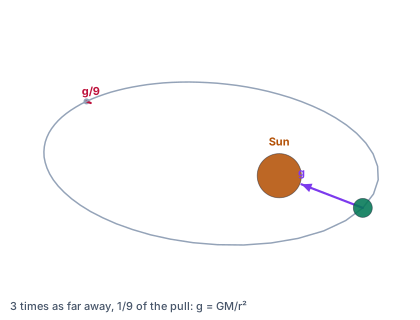
The scene draws an orbit of eccentricity $0.5$ with the Sun at one focus, and moves the planet along it at the pace the orbit equation and Kepler's second law set. Watch it whip around the near end and crawl around the far end: the far end is three times as far from the Sun, so by angular momentum conservation the planet moves three times more slowly there. Notice too that the Sun sits off center, at the focus, and that the other focus is empty. The arrows show gravity at the two ends, one-ninth as strong at the far end, as the inverse square requires.
The Global Positioning System's satellites, operated by the U.S. Space Force, orbit at a semimajor axis of $26{,}560$ km, about $20{,}200$ km up. Kepler's third law gives a period of $2\pi\sqrt{a^3/GM} = 11.97$ hours, half a sidereal day, so each satellite traces the same path over the ground twice a day, which made the system's early planning and testing predictable.
Their orbits are nearly circular, with eccentricities kept below $0.02$, because the receivers' calculations assume the satellites' positions from broadcast orbital elements: the semimajor axis, eccentricity and four angles. Each satellite transmits these elements, and your phone solves the orbit equation of this lesson, with small corrections, to know where the satellite was when the signal left it.
A satellite whose period equals one sidereal day, $23.93$ hours, keeps pace with the turning Earth. Kepler's third law puts that orbit at $a = 42{,}164$ km, about $35{,}786$ km above the equator. There, a satellite hangs over one longitude, and a dish on the ground can point at it permanently.
The National Oceanic and Atmospheric Administration's GOES weather satellites sit in this belt, one watching the eastern United States and the Atlantic and one watching the west and the Pacific, imaging the whole disk of the Earth every ten minutes. Satellite television and much of the world's broadcast traffic use the same belt, which is so crowded that the International Telecommunication Union assigns each operator its slot, spaced a fraction of a degree apart.
A diagram of the solar system suggests planets glide around at constant speed. On an ellipse, angular momentum $\mu rv_\perp$ is constant, so a planet moves fastest where it is closest to the Sun and slowest where it is farthest, in the ratio of those distances. Halley's comet moves sixty times faster at perihelion than at aphelion.
A second error is to put the Sun at the center of the ellipse. It sits at a focus, which for a very eccentric orbit is near one end; the other focus is empty.
Write the orbit equation with $u = 1/r$.
$u'' + u = -\dfrac{\mu}{\ell^2u^2}F$
From the radial equation with $\dot{\phi} = \ell u^2/\mu$.
Substitute the inverse-square force.
$F = -\gamma u^2 \Rightarrow u'' + u = \dfrac{\gamma\mu}{\ell^2}$
The $u^2$ cancels.
Write the general solution.
$u = \dfrac{\gamma\mu}{\ell^2} + A\cos\phi$
Particular constant plus a homogeneous oscillation, with $\phi$ measured from perihelion.
Name the constants.
$c = \dfrac{\ell^2}{\gamma\mu}, \quad \epsilon = Ac$
So $u = (1 + \epsilon\cos\phi)/c$.
Invert for the orbit.
$r = \dfrac{c}{1 + \epsilon\cos\phi}$
A conic with the force center at a focus.
The Earth ranges from $147.1$ to $152.1$ million km from the Sun. Find the semimajor axis.
$a = \dfrac{147.1 + 152.1}{2} = 149.6\ \text{million km}$
The mean of the two extremes.
Find the eccentricity.
$\epsilon = \dfrac{152.1 - 147.1}{152.1 + 147.1} = \dfrac{5.0}{299.2} = 0.0167$
Difference over sum.
Find the semi-latus rectum.
$c = a(1 - \epsilon^2) = 149.6 \times 0.99972 = 149.56\ \text{million km}$
Nearly equal to $a$ for so small an $\epsilon$.
Find the ratio of perihelion to aphelion speeds.
$\dfrac{v_p}{v_a} = \dfrac{r_{\max}}{r_{\min}} = \dfrac{152.1}{147.1} = 1.034$
Angular momentum conservation.
Check the period.
$\tau^2 = a^3 = 1^3 \Rightarrow \tau = 1\ \text{year}$
In AU and years, by construction of the units.
An orbit around the Sun touches Earth's orbit at $1.00$ AU and Mars's at $1.52$ AU. Find its semimajor axis.
$a = \dfrac{1.00 + 1.52}{2} = 1.26\ \text{AU}$
Perihelion at Earth, aphelion at Mars.
Find its period.
$\tau = 1.26^{3/2} = 1.41\ \text{years}$
Kepler's third law in AU and years.
Find the travel time.
$\dfrac{\tau}{2} = 0.71\ \text{years} \approx 259\ \text{days}$
Half an orbit, from perihelion to aphelion.
Write the vis-viva equation at perihelion.
$v^2 = GM_\odot\left(\dfrac{2}{1.00} - \dfrac{1}{1.26}\right)\dfrac{1}{\text{AU}}$
With $GM_\odot/\text{AU} = (29.8\ \text{km/s})^2$.
Evaluate the perihelion speed.
$v = 29.8\sqrt{2 - 0.794} = 29.8 \times 1.098 = 32.7\ \text{km/s}$
Faster than the Earth's $29.8$ km/s.
Find the speed boost needed at departure.
$\Delta v = 32.7 - 29.8 = 2.9\ \text{km/s}$
Relative to the Earth, the rest of the way is coasting.
Write Kepler's third law in years and AU.
$\tau^2 = a^3$
For bodies orbiting the Sun.
Substitute the semimajor axis.
$\tau^2 = 4^3 = 64$
Cube the distance.
Take the square root.
A body's orbit about the Sun has $r = c/(1 + \epsilon\cos\phi)$ with eccentricity $\epsilon = 0.9$. What shape is its orbit?
Complete the worked solution: an orbit's closest distance is $4$ and its farthest $16$ (in AU). Find its semimajor axis in AU, its eccentricity, and its semi-latus rectum $c$ in AU.
Average the closest and farthest distances.
$a = \dfrac{r_{\min} + r_{\max}}{2} =$ a
Half the major axis.
Divide the difference of the distances by their sum.
$\epsilon = \dfrac{r_{\max} - r_{\min}}{r_{\max} + r_{\min}} =$ e
From $r = c/(1 \pm \epsilon)$ at the two ends.
Multiply the semimajor axis by one minus the eccentricity squared.
$c = a(1 - \epsilon^2) =$ c
The distance at right angles to the major axis, seen from the focus.
Check the closest distance from the elements.
$\text{semi-latus rectum} / (1 + \text{eccentricity}) = \text{closest distance}$
The elements must reproduce the data.
Match each eccentricity to the orbit it gives.
| circle | ellipse | parabola | hyperbola | |
|---|---|---|---|---|
| $\epsilon = 0$ | ||||
| $0 < \epsilon < 1$ | ||||
| $\epsilon = 1$ | ||||
| $\epsilon > 1$ |
For bodies orbiting the Sun, with $\tau$ in years and $a$ in AU, Kepler's third law is $\tau^2 = a^3$. Fill in the period for $a = 1$ AU, the period for $a = 4$ AU, and the semimajor axis for $\tau = 27$ years.
| value | |
|---|---|
| period at the first distance (yr) | |
| period at the second distance (yr) | |
| distance for the stated period (AU) |
An asteroid's closest approach to the Sun is $2$ AU and its farthest distance is $8$ AU. Write its orbit $r$, in AU, as a formula in the angle from perihelion, written $p$.
Answer:
A satellite's orbit has perigee altitude $1000$ km and apogee altitude $5000$ km above the Earth ($R_E = 6371$ km, $GM = 3.986 \times 10^{14}$ m³/s²). How fast does it move at perigee, in km/s?
Answer: km/s at perigee
The orbit of a GPS satellite has a semimajor axis of $26560$ km. With the Earth's $GM = 3.986 \times 10^{14}$ m³/s², what is its period, in hours?
Answer: hours per orbit
Lesson test: one question per skill, one attempt each, no hints. Your answers are checked when you submit.
An asteroid's closest approach to the Sun is $3$ AU and its farthest distance is $5$ AU. Write its orbit $r$, in AU, as a formula in the angle from perihelion, written $p$.
Answer:
You can analyze Kepler orbits. Explain to someone why the Earth is closest to the Sun in January, and why that does not make January warm in the United States.
20. Your turn: an asteroid orbits the Sun with semimajor axis $4$ AU. Find its period., step 3
$\tau = 8\ \text{years}$
Twice as far as Earth's orbit, squared and cubed.