Back to the on-screen lesson ·
Impulsive burns, raising an apsis, the Hohmann transfer and its burns and time, launch windows and the synodic period, plane changes and gravity assists.
Paper packet. Every task here also exists on screen, where it is checked automatically; answers written on paper are not assessed by Nydus. When you are back at a device, enter your answers there.
By the end of this lesson you will be able to predict how a burn changes an orbit, compute the burns and time of a Hohmann transfer, find launch windows, and price a plane change.
The last lesson gave the conic orbit, the energy $E = -GMm/2a$, the vis-viva equation $v^2 = GM(2/r - 1/a)$ and Kepler's third law. You know the rocket equation, which prices a speed change in fuel. This lesson puts them together: how a spacecraft changes from one orbit to another, what each change costs in $\Delta v$, and how long the trip takes.
| Term | What it means |
|---|---|
| Impulsive burn | A short engine firing, treated as an instant change of velocity at one point. |
| Delta-v | $\Delta v$, the size of a velocity change, the currency of spaceflight. |
| Hohmann transfer | The half-ellipse tangent to two circular orbits, reached and left by two tangential burns. |
| Prograde and retrograde | Along and against the direction of orbital motion. |
| Synodic period | The time between repeated alignments of two orbiting bodies. |
| Plane change | A burn that rotates the orbital plane, costing $2v\sin(\theta/2)$. |
| Gravity assist | A flyby that changes a craft's velocity relative to the Sun using a planet's motion. |
An engine burn lasting a few minutes changes a spacecraft's velocity at one point of its orbit. Because the new orbit must pass through that point with the new velocity, the vis-viva equation fixes its semimajor axis, and the direction fixes the rest.
A prograde burn at any point raises the energy and so the semimajor axis. If it is made at an apsis, where the velocity is perpendicular to the radius, the burn point stays an apsis: a burn at perigee raises the apogee, and a burn at apogee raises the perigee. The opposite side of the orbit moves; the burn point does not.
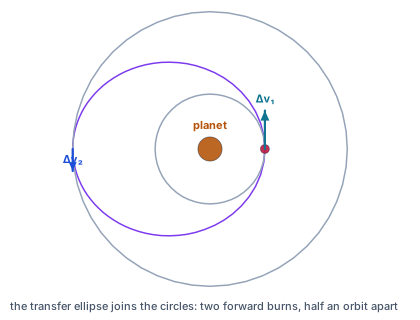
The Hohmann transfer from a circular orbit of radius $r_1$ to one of radius $r_2$ uses two such burns. The first puts the craft on an ellipse with perigee $r_1$ and apogee $r_2$, whose semimajor axis is $a = (r_1 + r_2)/2$; the second, half an orbit later, circularizes it:
$$\Delta v_1 = v_1\left(\sqrt{\frac{2r_2}{r_1 + r_2}} - 1\right), \qquad \Delta v_2 = v_2\left(1 - \sqrt{\frac{2r_1}{r_1 + r_2}}\right),$$
with $v_1$ and $v_2$ the circular speeds. The transfer takes half the ellipse's period, $\pi\sqrt{a^3/GM}$.
Another way: picture
Picture a circular orbit as a groove. A kick forward at one point sends the spacecraft out of the groove, swinging wide on the far side, and it comes back to the point where it was kicked. If, when it reaches the far side, it kicks forward again, it settles into a new, wider groove. Two kicks, half an orbit apart: that is the whole Hohmann transfer.
Another way: steps
After an instantaneous burn the spacecraft is at the same position with a new velocity. The new orbit passes through that position, so the burn point is always on it. If the burn is along the velocity at an apsis, the velocity is still perpendicular to the radius there, so the point is still an apsis of the new orbit: the perigee if the craft is now faster than circular speed, the apogee if slower.
This is why orbit changes feel backward at first. To catch up with a space station ahead in the same orbit, a crew burns backward: the lower orbit that results has a shorter period, and after a few turns they have gained on the station, then burn forward to rise and meet it. Astronauts on the Gemini missions learned this counterintuitive rule the hard way in 1965.
Among two-burn transfers between circular orbits in the same plane, the Hohmann ellipse needs the least total $\Delta v$, as Walter Hohmann showed in 1925. The reason is that burns are most effective where the craft is already moving fastest: a small $\Delta v$ at high speed changes the kinetic energy by $v\,\Delta v$, a larger amount than the same $\Delta v$ at low speed.
From low Earth orbit at $6671$ km to geostationary orbit at $42{,}164$ km, the first burn is $2.43$ km/s and the second $1.47$ km/s, for $3.89$ km/s in total and a trip of $5.3$ hours. For very distant targets, a bi-elliptic transfer, going out beyond the target and coming back, can be cheaper, but it takes much longer; missions almost always use Hohmann transfers or their close cousins.
A Hohmann transfer to Mars takes $259$ days, during which Mars moves about $136°$ around the Sun. So the probe must leave when Mars is about $44°$ ahead of the Earth. That alignment repeats once per synodic period, the time for the Earth to gain one full lap on Mars: $1/S = 1/\tau_{\text{Earth}} - 1/\tau_{\text{Mars}}$, which gives $S = 2.14$ years.
That is why NASA's Mars missions launch in clusters about every $26$ months, and why a missed window means a two-year wait. The rovers Spirit and Opportunity launched in the 2003 window, Curiosity in 2011, and Perseverance in the 2020 window, all from Cape Canaveral, all on trajectories close to Hohmann transfers.
A burn that turns the velocity without changing its size rotates the orbit's plane. The two velocities and the burn form an isosceles triangle, so the cost is $\Delta v = 2v\sin(\theta/2)$. At orbital speed this is enormous: turning a low orbit through $60°$ costs the whole orbital speed, $7.7$ km/s, more than going to geostationary orbit.
This is why launch sites near the equator are valuable for geostationary missions, which need an equatorial orbit: from Cape Canaveral, at $28.5°$ north, the plane change is unavoidable, and it is made at apogee of the transfer orbit, where the speed is lowest, and combined with the circularizing burn. It is also why the Space Shuttle, once launched to one inclination, could never visit a satellite in a very different one.
A spacecraft flying past a planet swings around it on a hyperbola. In the planet's frame its speed leaves as it came, only turned. But the planet is moving around the Sun, and in the Sun's frame the turn adds or subtracts the planet's velocity, so the craft can leave faster or slower than it arrived, taking or giving a tiny amount of the planet's orbital energy.
Gravity assists made the outer solar system reachable. Voyager 2, launched from Cape Canaveral in 1977, used Jupiter, Saturn and Uranus in turn to reach Neptune in 12 years, a trip a Hohmann transfer would have made in 31. Parker Solar Probe uses Venus flybys the other way, to shed speed and fall ever closer to the Sun.
Checking an answer. The first burn of an outward transfer must be larger than the second. The ellipse's perigee speed must exceed the inner circular speed, and its apogee speed must be less than the outer circular speed. The total must be less than the escape $\Delta v$ from the inner orbit, $(\sqrt{2} - 1)v_1$, when the outer radius is finite. And the transfer time must be between the two circular orbits' half periods.
A kilogram of fuel burned deep in a gravity well gives more energy than the same burn far out. The kinetic energy gained by a $\Delta v$ is $v\,\Delta v + \tfrac{1}{2}\Delta v^2$, which is largest where $v$ is largest: at perigee, close to the planet. Hermann Oberth pointed this out in 1929.
Mission planners use it constantly. A probe leaving the Earth for the outer planets burns at perigee of a low parking orbit rather than climbing slowly out first. A craft arriving at Mars burns to capture as close to the planet as it safely can. Together with the Hohmann transfer and gravity assists, the Oberth effect makes up most of the practical art of getting around the solar system on a limited budget of fuel.
The scene shows the inner and outer circular orbits, with radii in the ratio $1$ to $2.5$, and the transfer ellipse that touches both, with the planet at its focus. The spacecraft rides the ellipse: quickly near the inner circle, slowly near the outer, exactly as the vis-viva equation says. The first burn, $\Delta v_1$, is drawn at the near end, where it turns a circular orbit into the ellipse; the second, $\Delta v_2$, is at the far end, half an orbit later, where it lifts the perigee and makes the orbit circular again. Both burns point forward, along the motion, and the second is the smaller, as the formulas predict.
Commercial communications satellites launched from Cape Canaveral are usually released by the rocket's upper stage into a geostationary transfer orbit: perigee a few hundred kilometers up, apogee at $35{,}786$ km, tilted $28.5°$ to the equator. The first Hohmann burn, $2.4$ km/s, has already been made by the rocket.
The satellite's own engine then fires at apogee, where it moves only about $1.6$ km/s. That burn does two jobs at once: it adds the $1.5$ km/s needed to circularize and rotates the plane to the equator. Doing both together costs about $1.8$ km/s, much less than the $0.8$ km/s plane change plus $1.5$ km/s circularization done separately, because velocity changes add as vectors. Engineers plan every such mission by adding up burns exactly as in this lesson.
NASA's Mars missions are timed by the synodic period of $2.14$ years. A Hohmann transfer from Earth to Mars takes about $259$ days, and the departure needs Mars about $44°$ ahead of the Earth, an alignment that recurs every $26$ months. Perseverance launched from Cape Canaveral on July 30, 2020, near the start of its window, and landed in Jezero Crater on February 18, 2021, $203$ days later, on a faster-than-Hohmann path that cost a little more fuel.
The departure burn relative to the Earth's orbit is about $2.9$ km/s, on top of escaping the Earth, and arriving in orbit around Mars costs about $2.1$ km/s more; landers avoid that by entering the atmosphere directly and braking with a heat shield and parachute. Planners for crewed Mars missions face the same windows, which is why a round trip would take about two and a half years.
It seems obvious that thrusting forward pushes a spacecraft up where it is. It does not: the burn adds speed at that point, the new orbit still passes through that point, and it is the opposite side of the orbit, half a revolution later, that rises. To raise the whole orbit into a larger circle takes a second burn at the new apogee.
A related error is to think a faster orbit is a higher one. Circular speed falls with radius, $v = \sqrt{GM/r}$, so a craft that raises its orbit ends up moving more slowly, even though both of its burns were forward.
A satellite circles at $r = 7000$ km, where $GM/r = 56.94$ km²/s². Find its circular speed.
$v_c = \sqrt{56.94} = 7.546\ \text{km/s}$
$v = \sqrt{GM/r}$.
It burns $0.50$ km/s forward. Write its new speed.
$v = 7.546 + 0.50 = 8.046\ \text{km/s}$
Along the velocity.
Use vis-viva to find the new semimajor axis.
$\dfrac{1}{a} = \dfrac{2}{r} - \dfrac{v^2}{GM} = \dfrac{2}{7000} - \dfrac{64.74}{398{,}600}$
$GM = 398{,}600$ km³/s².
Evaluate the semimajor axis.
$\dfrac{1}{a} = 2.857 \times 10^{-4} - 1.624 \times 10^{-4} = 1.233 \times 10^{-4} \Rightarrow a = 8110\ \text{km}$
Larger than $7000$ km.
Find the new apogee.
$r_a = 2a - r_p = 16{,}220 - 7000 = 9220\ \text{km}$
The burn point is the perigee.
Find the circular speeds at $6671$ km and $42{,}164$ km.
$v_1 = \sqrt{\dfrac{398{,}600}{6671}} = 7.730, \quad v_2 = \sqrt{\dfrac{398{,}600}{42{,}164}} = 3.075\ \text{km/s}$
$v = \sqrt{GM/r}$.
Find the transfer's semimajor axis.
$a = \dfrac{6671 + 42{,}164}{2} = 24{,}418\ \text{km}$
Tangent to both circles.
Find the first burn.
$\Delta v_1 = 7.730\left(\sqrt{\dfrac{2 \times 42{,}164}{48{,}835}} - 1\right) = 7.730 \times 0.3141 = 2.428\ \text{km/s}$
At perigee of the transfer.
Find the second burn.
$\Delta v_2 = 3.075\left(1 - \sqrt{\dfrac{2 \times 6671}{48{,}835}}\right) = 3.075 \times 0.4773 = 1.468\ \text{km/s}$
At apogee, to circularize.
Add the burns.
$\Delta v = 2.428 + 1.468 = 3.896\ \text{km/s}$
Before any plane change.
Find the transfer time.
$t = \pi\sqrt{\dfrac{(2.4418 \times 10^7)^3}{3.986 \times 10^{14}}} = 1.899 \times 10^4\ \text{s} = 5.27\ \text{h}$
Half the transfer period.
Earth's period is $1.000$ yr and Mars's $1.881$ yr. Find each rate.
$\dfrac{1}{\tau_E} = 1.000, \quad \dfrac{1}{\tau_M} = 0.532\ \text{turns/yr}$
Reciprocals of the periods.
Find the synodic period.
$\dfrac{1}{S} = 1.000 - 0.532 = 0.468 \Rightarrow S = 2.14\ \text{yr}$
The Earth gains a lap on Mars every $2.14$ years.
Find the transfer time.
$t = \tfrac{1}{2}(1.262)^{3/2} = 0.709\ \text{yr} = 259\ \text{days}$
Half the transfer orbit's period.
Find how far Mars moves during the transfer.
$0.709 \times 0.532 \times 360° = 136°$
Its rate times the time.
Find where Mars must be at launch.
$180° - 136° = 44° \text{ ahead of the Earth}$
The probe travels $180°$; Mars must arrive at the same place.
State when the window recurs.
$\text{every } 2.14 \text{ years, about } 26 \text{ months}$
The same geometry needs the same alignment.
Write the relative rate.
$\dfrac{1}{S} = \dfrac{1}{3} - \dfrac{1}{6}$
Rates subtract.
Combine the fractions.
$\dfrac{1}{S} = \dfrac{2 - 1}{6} = \dfrac{1}{6}$
Common denominator.
Invert the rate.
A satellite in a circular orbit $507$ km up fires its engine briefly forward, along its velocity. What happens to its orbit?
Complete the worked solution: a craft circles at radius $5$ thousand km with speed $9$ km/s and transfers to a circle of radius $40$ thousand km. Find the transfer's semimajor axis in thousands of km, its perigee speed in km/s, and the first burn in km/s.
Average the two radii.
$a = \dfrac{r_1 + r_2}{2} =$ a
The transfer ellipse's semimajor axis.
Multiply the circular speed by the square root of the radius factor.
$v_p = v_1\sqrt{\dfrac{2r_2}{r_1 + r_2}} = v_1\sqrt{\dfrac{16}{9}} =$ p
Vis-viva at perigee of the transfer.
Subtract the circular speed from the perigee speed.
$\Delta v_1 = v_p - v_1 =$ d
The burn adds exactly that much, along the velocity.
Check the size of the burn against the speed.
$\text{burn} = \text{one third of the circular speed}$
Since the perigee speed is four thirds of it.
Match each quantity of a Hohmann transfer to its expression.
| $v_1(\sqrt{2r_2/(r_1 + r_2)} - 1)$ | $v_2(1 - \sqrt{2r_1/(r_1 + r_2)})$ | $\pi\sqrt{a^3/GM}$ | $1/(1/\tau_1 - 1/\tau_2)$ | |
|---|---|---|---|---|
| first burn | ||||
| second burn | ||||
| transfer time | ||||
| launch window interval |
Two bodies circle the same star in the same direction with periods $1$ and $1.25$ years. Fill in each one's rate in turns per year, and the synodic period, the time between alignments, in years.
| value | |
|---|---|
| inner rate (turns per year) | |
| outer rate (turns per year) | |
| synodic period (years) |
A satellite moves at $7$ km/s in a circular orbit. Write the burn $\Delta v$, in km/s, needed to tilt its orbit by an angle $t$ (in radians) while keeping its speed, as a formula in $t$.
Answer:
A spacecraft in a circular orbit of radius $6671$ km, where its speed is $7.730$ km/s, starts a Hohmann transfer to a circular orbit of radius $42164$ km. How large is its first burn, in km/s?
Answer: km/s for the first burn
A probe launched from Cape Canaveral leaves Earth's orbit (1 AU) on a Hohmann transfer to Mars, which orbits at $1.524$ AU. How long does the transfer take, in days?
Answer: days on the transfer
Lesson test: one question per skill, one attempt each, no hints. Your answers are checked when you submit.
A satellite moves at $8$ km/s in a circular orbit. Write the burn $\Delta v$, in km/s, needed to tilt its orbit by an angle $t$ (in radians) while keeping its speed, as a formula in $t$.
Answer:
You can plan orbital transfers. Explain to someone why a spacecraft that wants to catch up with a station ahead of it first slows down.
19. Your turn: two moons circle a planet with periods $3$ days and $6$ days. Find their synodic period., step 3
$S = 6\ \text{days}$
The inner moon laps the outer every six days.