Back to the on-screen lesson ·
The harmonic approximation $\omega = \sqrt{U''(x_0)/m}$, the forms of simple harmonic motion, pendulums, two-dimensional oscillators and Lissajous figures, and the reduced mass.
Paper packet. Every task here also exists on screen, where it is checked automatically; answers written on paper are not assessed by Nydus. When you are back at a device, enter your answers there.
By the end of this lesson you will be able to find the frequency of small oscillations about any stable equilibrium, write and fit the solution, and describe two-dimensional oscillations.
You met simple harmonic motion in Physics C: a mass on a spring, $x = A\cos(\omega t - \delta)$ with $\omega = \sqrt{k/m}$, and the pendulum for small swings. The last lesson showed how a potential energy curve organizes one-dimensional motion and that a minimum of $U$ is a stable equilibrium. This lesson shows that near any such minimum the motion is simple harmonic, and extends it to two dimensions.
| Term | What it means |
|---|---|
| Harmonic approximation | Replacing $U$ near a minimum by its Taylor parabola $\tfrac{1}{2}U''(x_0)(x - x_0)^2$. |
| Angular frequency | $\omega$, in rad/s; the period is $2\pi/\omega$ and the frequency $\omega/2\pi$. |
| Amplitude | $A$, the largest displacement from equilibrium. |
| Phase | $\delta$, which fixes where in its cycle the oscillator starts. |
| Isotropic oscillator | One with the same spring constant in every direction; its orbits are ellipses. |
| Lissajous figure | The path of a two-dimensional oscillator with different frequencies in $x$ and $y$. |
| Reduced mass | $\mu = m_1m_2/(m_1 + m_2)$, the effective mass of two bodies vibrating about their center of mass. |
Expand a smooth potential about a stable equilibrium $x_0$:
$$U(x) = U(x_0) + U'(x_0)(x - x_0) + \tfrac{1}{2}U''(x_0)(x - x_0)^2 + \cdots$$
The constant does not affect the motion, and the linear term is zero because the force vanishes at equilibrium. For small displacements the cubic and higher terms are negligible, so the particle moves in a parabola with effective spring constant $k = U''(x_0)$. The equation of motion is $m\ddot{x} = -k(x - x_0)$, simple harmonic, with
$$\omega = \sqrt{\frac{U''(x_0)}{m}}.$$
The solution can be written four equivalent ways: $C_1e^{i\omega t} + C_2e^{-i\omega t}$; $B_1\cos\omega t + B_2\sin\omega t$; $A\cos(\omega t - \delta)$; or the real part of $Ce^{i\omega t}$. Two constants are fixed by the initial position and velocity. The period $2\pi/\omega$ does not depend on the amplitude, which is the defining property of a harmonic oscillator and why pendulum clocks keep time.
Another way: picture
Zoom in on the bottom of any valley and it looks like a bowl, then like a parabola. A marble rolling a little way from the bottom only ever sees that parabola, so it rocks back and forth exactly like a mass on a spring. How steep the bowl is at the bottom sets how fast it rocks; how far the marble goes out does not.
Another way: steps
The argument used nothing about the physics except that $U$ is smooth with a minimum. That is why simple harmonic motion appears everywhere: the pendulum, a floating buoy bobbing, a guitar string's fundamental, the atoms of a crystal, the charge in a tuned circuit, and a star's pulsation all oscillate at a frequency set by the curvature of their energy at equilibrium.
The approximation holds while the neglected cubic term is small compared with the quadratic one, $|U'''(x - x_0)| \ll 3U''$. Beyond that, the period starts to depend on the amplitude. For a pendulum the correction is $T \approx T_0(1 + \phi_0^2/16)$: at a $20°$ swing the period is longer by less than one percent, which is why Galileo, timing a church lamp against his pulse, saw no change.
The same recipe works when the natural coordinate is an angle or another generalized coordinate $q$. Write the energy as $T = \tfrac{1}{2}M\dot{q}^2$ and $U(q)$; then $\omega = \sqrt{U''(q_0)/M}$. For a pendulum, $q = \phi$, $T = \tfrac{1}{2}mL^2\dot{\phi}^2$ and $U = mgL(1 - \cos\phi)$, so $U''(0) = mgL$ and $\omega = \sqrt{mgL/mL^2} = \sqrt{g/L}$.
For a physical pendulum, a rigid body swinging about a pivot a distance $d$ from its center of mass, $M = I$ and $U'' = mgd$, giving $\omega = \sqrt{mgd/I}$. A uniform rod of length $L$ hung from one end has $I = mL^2/3$ and $d = L/2$, so $\omega = \sqrt{3g/2L}$: it swings faster than a simple pendulum of the same length, because its mass is on average nearer the pivot.
With $x = A\cos(\omega t - \delta)$, the kinetic energy is $\tfrac{1}{2}kA^2\sin^2(\omega t - \delta)$ and the potential energy $\tfrac{1}{2}kA^2\cos^2(\omega t - \delta)$. They trade back and forth twice per cycle, and their sum is the constant $\tfrac{1}{2}kA^2$. Averaged over a cycle, each is half the total.
The maximum speed, $\omega A$, is reached at the center, and the maximum acceleration, $\omega^2A$, at the ends. These are handy checks: the ratio $a_{\max}/v_{\max}$ must equal $\omega$. Engineers designing a washing machine's suspension or an earthquake-isolated building use these relations to turn an allowed acceleration into an allowed amplitude at the frequency of the disturbance.
A particle held by springs in a plane has $U = \tfrac{1}{2}k_xx^2 + \tfrac{1}{2}k_yy^2$. The $x$ and $y$ equations separate, each simple harmonic with its own frequency. When $k_x = k_y$, the isotropic case, both frequencies are equal: $x = A\cos\omega t$ and $y = B\cos(\omega t - \delta)$. The path is an ellipse, a line when $\delta = 0$, and a circle when $A = B$ and $\delta = \pi/2$.
When the stiffnesses differ, the path is a Lissajous figure. If $\omega_x/\omega_y$ is a ratio of whole numbers the path closes after that many cycles; if it is irrational, it never closes and eventually passes arbitrarily close to every point of a rectangle. Oscilloscopes display Lissajous figures to compare two frequencies, and the pattern of the figure reads off their ratio.
A diatomic molecule is two atoms joined by a bond that acts as a spring. Both atoms move, but their center of mass stays put, so the motion is really in the separation $r$. The energy of that motion has the form $\tfrac{1}{2}\mu\dot{r}^2 + \tfrac{1}{2}k(r - r_0)^2$ with the reduced mass $\mu = m_1m_2/(m_1 + m_2)$, so $\omega = \sqrt{k/\mu}$.
When one atom is much heavier, $\mu$ is nearly the light one's mass: in HCl the chlorine barely moves and the hydrogen does almost all the vibrating, so $\mu = 0.98$ u. Replacing hydrogen by deuterium doubles the light mass and lowers the frequency by nearly $\sqrt{2}$, a shift chemists use to tell which bonds a hydrogen atom sits in. The same reduction reappears for planets and stars in the central-force unit.
Checking an answer. The units of $U''/M$ must be s⁻², as N/m over kg is. The result must reduce to $\sqrt{k/m}$ for a plain spring and to $\sqrt{g/L}$ for a pendulum. Stiffer wells must oscillate faster and heavier bodies slower. And the amplitude must not appear in the frequency; if it does, the harmonic approximation has not been made.
Of the four ways to write the solution, the complex exponential looks the least physical and is the one physicists use most. The reason is that differentiating $e^{i\omega t}$ just multiplies it by $i\omega$, so a linear differential equation with constant coefficients turns into an algebraic equation for $\omega$. Try $x = e^{rt}$ in $m\ddot{x} + kx = 0$ and you get $mr^2 + k = 0$, so $r = \pm i\omega$ at once.
The physical position is the real part, and the constants are fixed from the initial conditions in whichever form is most convenient. For a release from rest at $x_0$, the cosine form gives $A = x_0$ and $\delta = 0$ in one line. For a start at the center with speed $v_0$, the sine form gives $B_2 = v_0/\omega$. The next two lessons, on damped and driven oscillators, depend on this trick: damping makes $r$ complex with a negative real part, and a driving force at frequency $\omega$ becomes a single complex amplitude to solve for, instead of a pair of sines and cosines to juggle. Learning to move freely between the forms now saves a great deal of algebra later.
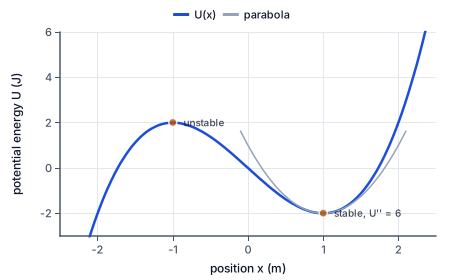
The chart draws $U = x^3 - 3x$ with the parabola $3(x - 1)^2 - 2$ laid over its valley. Look at the bottom of the valley at $x = 1$: the two curves are indistinguishable for a few tenths of a meter either side, which is the range in which a particle oscillates harmonically at $\omega = \sqrt{6/m}$. Farther out they part company. To the right the true curve rises more steeply than the parabola, and to the left it flattens toward the hump at $x = -1$, so a large swing to the left spends longer out there and takes longer than the harmonic period. Past the hump there is no restoring force at all, and the particle escapes.
Infrared spectroscopy identifies molecules by the frequencies at which their bonds vibrate. A carbon monoxide bond has stiffness $1902$ N/m and reduced mass $6.86$ u, giving $f = 6.5 \times 10^{13}$ Hz, a wavelength of $4.6$ μm. Light at exactly that wavelength is absorbed, so a beam through a gas sample comes out with a dark line wherever the gas has a bond to excite.
The Environmental Protection Agency and state air-quality agencies use instruments built on this idea to monitor carbon monoxide in city air and in vehicle exhaust. Forensic labs use it to identify unknown powders, and the James Webb Space Telescope uses the same physics to find water, carbon dioxide and methane in the atmospheres of planets around other stars. Every one of these measurements starts from $\omega = \sqrt{k/\mu}$, the harmonic approximation to a chemical bond.
A pendulum clock counts swings. Christiaan Huygens built the first in 1656, and for almost three centuries the best clocks in the world were pendulums. The seconds pendulum, about $0.994$ m long, swings once each second, so a tall case clock keeps its pendulum in the case below the dial.
The period $2\pi\sqrt{L/g}$ is independent of amplitude only for small swings, so good clocks keep the swing to a few degrees, where the amplitude correction is well under a part in ten thousand. Because $g$ varies with latitude and altitude, a clock carried from New Orleans to Denver runs at a different rate, which surveyors in the nineteenth century used to map the Earth's gravity. Today the second is defined by a cesium atom's oscillation, a harmonic oscillator of another kind, at the National Institute of Standards and Technology's clocks in Boulder.
It seems obvious that a pendulum swung farther should take longer, since it travels farther. For a harmonic oscillator it does not: the restoring force grows in proportion to the displacement, so the speed grows in the same proportion as the distance, and the time is unchanged. Only when the swing is large enough for the harmonic approximation to fail does the period start to grow.
A second error is to take the frequency from the depth of a well rather than its curvature. A deep well with a flat bottom oscillates slowly; a shallow well with a sharp bottom oscillates fast. What matters is $U''$ at the minimum.
A $1.5$ kg particle sits in $U = x^3 - 3x$ (joules, meters). Find the stable equilibrium.
$U' = 3x^2 - 3 = 0, \quad U''(1) = 6 > 0 \Rightarrow x_0 = 1\ \text{m}$
From the last lesson.
Read off the effective spring constant.
$k = U''(1) = 6\ \text{N/m}$
The curvature at the minimum.
Find the angular frequency.
$\omega = \sqrt{\dfrac{6}{1.5}} = \sqrt{4} = 2.0\ \text{rad/s}$
$\omega = \sqrt{k/m}$.
Find the period.
$T = \dfrac{2\pi}{2.0} = \pi = 3.14\ \text{s}$
$T = 2\pi/\omega$.
Estimate how far the approximation holds.
$|U'''(x - 1)| = 6|x - 1| \ll 3U'' = 18 \Rightarrow |x - 1| \ll 3\ \text{m}$
Keep the swing to a few tenths of a meter.
Write the pendulum's potential energy.
$U = mgL(1 - \cos\phi)$
Height of the bob above its lowest point.
Expand for small angles.
$1 - \cos\phi \approx \tfrac{1}{2}\phi^2 \Rightarrow U \approx \tfrac{1}{2}mgL\phi^2$
The Taylor series of cosine.
Write the kinetic energy.
$T = \tfrac{1}{2}mL^2\dot{\phi}^2$
The bob moves at $L\dot{\phi}$.
Find the angular frequency.
$\omega = \sqrt{\dfrac{mgL}{mL^2}} = \sqrt{\dfrac{g}{L}}$
Effective stiffness over effective inertia.
Evaluate the period for $L = 0.994$ m.
$T = 2\pi\sqrt{\dfrac{0.994}{9.8}} = 2.00\ \text{s}$
Each swing takes one second: the seconds pendulum of old clocks.
A $2.0$ kg puck has $k = 18$ N/m in every direction. Find the angular frequency.
$\omega = \sqrt{\dfrac{18}{2.0}} = 3.0\ \text{rad/s}$
The same in $x$ and $y$.
It is released at $(0.20, 0)$ m with velocity $(0, 0.30)$ m/s. Write the $x$ motion.
$x = 0.20\cos 3t$
Starts at its largest $x$, at rest in $x$.
Write the $y$ motion.
$y = \dfrac{0.30}{3.0}\sin 3t = 0.10\sin 3t$
Starts at $y = 0$ with speed $\omega B = 0.30$.
Eliminate the time.
$\left(\dfrac{x}{0.20}\right)^2 + \left(\dfrac{y}{0.10}\right)^2 = \cos^2 3t + \sin^2 3t = 1$
The Pythagorean identity.
Identify the path.
$\text{an ellipse with semi-axes } 0.20 \text{ and } 0.10\ \text{m}$
Centered on the equilibrium.
Find the energy.
$E = \tfrac{1}{2} \times 18 \times 0.20^2 + \tfrac{1}{2} \times 2.0 \times 0.30^2 = 0.36 + 0.09 = 0.45\ \text{J}$
Potential in $x$ plus kinetic in $y$ at the start.
Find the curvature.
$U'' = 16\ \text{N/m}$
Differentiate $8(x - 1)^2$ twice.
Write the angular frequency.
$\omega = \sqrt{\dfrac{16}{0.50}} = \sqrt{32}$
$\omega = \sqrt{U''/m}$; the constant $3$ plays no part.
Evaluate the angular frequency.
A mass on a spring oscillates with period $3$ s when pulled $2$ cm from equilibrium and released. What is its period when pulled $6$ cm instead?
Complete the worked solution: a $2$ kg puck is held by springs giving stiffness $k_x = 32$ N/m along $x$ and $k_y = 72$ N/m along $y$. It is released from $(2, 0)$ m with a sideways push. Find $\omega_x$ and $\omega_y$ in rad/s, and the largest $x$ component of velocity, in m/s.
Divide the $x$ stiffness by the mass and take the root.
$\omega_x = \sqrt{k_x/m} =$ x
The $x$ equation is $m\ddot{x} = -k_xx$, untouched by $y$.
Divide the $y$ stiffness by the mass and take the root.
$\omega_y = \sqrt{k_y/m} =$ y
The same for $y$.
Multiply the $x$ amplitude by its angular frequency.
$v_{x,\max} = \omega_xA_x =$ v
Released at rest in $x$ from its largest displacement.
Check whether the path closes.
$\text{closed exactly when the frequency ratio is rational}$
Otherwise the Lissajous figure never repeats and fills a rectangle.
Match each system to its small-oscillation result.
| $\sqrt{U''(x_0)/m}$ | $\sqrt{k/m}$ | $\sqrt{g/L}$ | an ellipse | |
|---|---|---|---|---|
| any potential well | ||||
| mass on a spring | ||||
| simple pendulum | ||||
| isotropic oscillator in a plane |
A $2$ kg mass on a spring of stiffness $72$ N/m oscillates with amplitude $4$ m. Fill in its angular frequency in rad/s, maximum speed in m/s, maximum acceleration in m/s², and energy in J.
| value | |
|---|---|
| angular frequency (rad/s) | |
| maximum speed (m/s) | |
| maximum acceleration (m/s²) | |
| energy (J) |
A particle moves in the double well $U(x) = 4(x^2 - 16)^2$ (joules, meters). Write the harmonic approximation to $U$ near the minimum at $x = 4$, as a formula in $x$.
Answer:
A particle of mass $8$ kg sits at the bottom of one well of the potential $U(x) = 4(x^2 - 4)^2$ (joules, meters). What is the angular frequency of small oscillations about $x = 2$, in rad/s?
Answer: rad/s in the well
An infrared spectrometer at a university chemistry lab measures the vibration of the $\mathrm{HBr}$ molecule. Its bond acts as a spring of stiffness $412$ N/m, and its reduced mass is $0.995$ u ($1\ \text{u} = 1.6605 \times 10^{-27}$ kg). What is its vibration frequency, in units of $10^{13}$ Hz?
Answer: times ten to the thirteenth hertz
Lesson test: one question per skill, one attempt each, no hints. Your answers are checked when you submit.
A particle moves in the double well $U(x) = 3(x^2 - 4)^2$ (joules, meters). Write the harmonic approximation to $U$ near the minimum at $x = 2$, as a formula in $x$.
Answer:
You can analyze small oscillations. Explain to someone why a clock's pendulum keeps time whether it swings a little or a little more.
19. Your turn: a $0.50$ kg particle sits in the well $U = 8(x - 1)^2 + 3$ (joules, meters). Find the angular frequency of small oscillations., step 3
$\omega = 5.66\ \text{rad/s}$
The square root of $32$.