Back to the on-screen lesson ·
Gyroscopic precession $\Omega = MgR/\lambda_3\omega_3$, Euler angles and the heavy top's Lagrangian, conserved momenta, nutation, the sleeping top, gyrocompasses and the precession of the equinoxes.
Paper packet. Every task here also exists on screen, where it is checked automatically; answers written on paper are not assessed by Nydus. When you are back at a device, enter your answers there.
By the end of this lesson you will be able to compute the precession of a gyroscope or top, relate Euler-angle rates to its conserved momenta, and explain nutation and the sleeping top.
You know Euler's equations for a free rigid body, the inertia tensor of a symmetric body, and how to find conserved momenta from ignorable coordinates in a Lagrangian. From Physics C you know that torque changes angular momentum. This lesson puts a torque on a spinning symmetric body, gravity on a top, and finds why it circles instead of falling.
| Term | What it means |
|---|---|
| Heavy symmetric top | A symmetric body spinning about its axis with one point fixed, under gravity. |
| Euler angles | $\phi$ (precession about the vertical), $\theta$ (tilt from the vertical) and $\psi$ (spin about the body's axis). |
| Precession | The slow circling of the top's axis about the vertical, at rate $\dot{\phi}$. |
| Nutation | A nodding of the axis, the tilt $\theta$ oscillating between two values. |
| Sleeping top | A top spinning upright, $\theta = 0$, fast enough to be stable there. |
| Gyroscope | A fast-spinning wheel whose angular momentum resists changes of direction. |
| Precession of the equinoxes | The $26{,}000$-year circling of the Earth's axis driven by the Sun's and Moon's torques on its bulge. |
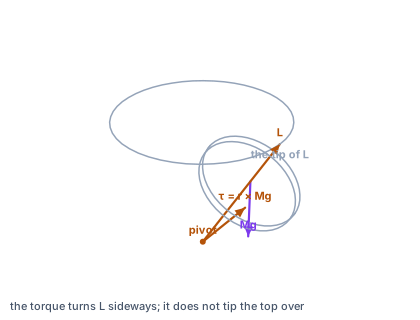
Put a fast-spinning top on a table with its axis tilted. Gravity, acting at the center of mass a distance $R$ from the tip, exerts a torque $\vec{\Gamma} = \vec{R} \times M\vec{g}$, horizontal and perpendicular to the axis. Since $d\vec{L}/dt = \vec{\Gamma}$ and $\vec{L} \approx \lambda_3\omega_3$ along the axis, the change of $\vec{L}$ is sideways: the axis does not fall but swings around the vertical. For steady motion, $\vec{\Gamma} = \vec{\Omega} \times \vec{L}$, which gives the precession rate
$$\Omega = \frac{MgR}{\lambda_3\omega_3},$$
independent of the tilt, and smaller the faster the top spins.
The exact treatment uses the Euler angles $\phi$, $\theta$, $\psi$ and the Lagrangian
$$\mathcal{L} = \tfrac{1}{2}\lambda_1(\dot{\phi}^2\sin^2\theta + \dot{\theta}^2) + \tfrac{1}{2}\lambda_3(\dot{\psi} + \dot{\phi}\cos\theta)^2 - MgR\cos\theta.$$
Both $\phi$ and $\psi$ are ignorable, so $p_\psi = \lambda_3\omega_3$ and $p_\phi$, the vertical angular momentum, are conserved, and the tilt moves in a one-dimensional effective potential.
Another way: picture
Hold a spinning bicycle wheel by one end of its axle and let go of the other end. Instead of flopping down, the wheel stays nearly level and walks slowly around your hand. Each instant, gravity's twist adds a little angular momentum sideways to the large spin angular momentum, and the sum points a little further around. The axis follows, round and round.
Another way: steps
Three angles fix a body's orientation. Start with the body's symmetry axis along the vertical. Rotate about the vertical by $\phi$, then tilt the axis away from the vertical by $\theta$, then spin the body about its own axis by $\psi$. The angular velocity is the sum of the three rates along their own axes: $\dot{\phi}$ about the vertical, $\dot{\theta}$ about the horizontal line of nodes, and $\dot{\psi}$ about the symmetry axis.
Resolving these along the body's principal axes gives the components used in the kinetic energy. For a symmetric body only two combinations matter: the spin along the axis, $\omega_3 = \dot{\psi} + \dot{\phi}\cos\theta$, and the perpendicular part, whose square is $\dot{\phi}^2\sin^2\theta + \dot{\theta}^2$. That is what makes the Lagrangian above so compact.
Since $\psi$ is missing from $\mathcal{L}$, $p_\psi = \lambda_3(\dot{\psi} + \dot{\phi}\cos\theta) = \lambda_3\omega_3$ is conserved: the spin about the symmetry axis never changes. Since $\phi$ is missing, $p_\phi = \lambda_1\dot{\phi}\sin^2\theta + p_\psi\cos\theta$ is conserved: the angular momentum about the vertical, which gravity's horizontal torque cannot change. And since $t$ is missing, the energy is conserved.
Using the two momenta to eliminate $\dot{\phi}$ and $\dot{\psi}$, the energy becomes $\tfrac{1}{2}\lambda_1\dot{\theta}^2 + U_{\text{eff}}(\theta)$, a one-dimensional problem in the tilt, just as the central-force problem became one in the radius. The motion of the tilt is read off the curve of $U_{\text{eff}}(\theta)$.
The figure shows why the top does not fall: the torque of its weight is horizontal, at right angles to L, so it swings the axis around instead of tipping it over.
At the minimum of $U_{\text{eff}}$ the tilt stays fixed and the top precesses steadily. Solving the condition exactly gives two possible precession rates for a given spin; for a fast top the slow one is $\Omega \approx MgR/\lambda_3\omega_3$, the rate every toy top shows. If the top is released with its axis still, $\theta$ oscillates between two turning points in $U_{\text{eff}}$: nutation, a nodding superimposed on the precession, which friction soon damps.
Stood upright and spun fast enough, with $\lambda_3^2\omega_3^2 > 4\lambda_1MgR$, the vertical position becomes a stable minimum: the sleeping top stands still and looks motionless. As friction slows it, the inequality eventually fails, the top begins to wobble, and it falls into precession and then onto its side.
A gyroscope mounted in gimbals that transmit no torque keeps its axis fixed in space, because its angular momentum cannot change. Aircraft attitude indicators long used such gyroscopes to show the horizon in cloud. A gyrocompass goes further: its axis is constrained to the horizontal, and the Earth's rotation then exerts a torque that makes the axis precess until it aligns with true north, the direction of the Earth's axis, unaffected by magnetism.
The U.S. Navy adopted the gyrocompass in 1911, from the design of Elmer Sperry in New York, because a ship's steel hull and machinery disturb magnetic compasses. Modern ships and aircraft use laser and fiber-optic gyroscopes with no spinning parts, but the physics of detecting rotation through its effect on angular momentum, or on light going round a loop, is the same.
The Earth is a spinning top. Its equatorial bulge is tilted $23.4°$ to the plane of its orbit, and the Sun and Moon pull harder on the near side of the bulge than the far side, exerting a torque that tries to straighten the axis. Like any top, the Earth responds by precessing: its axis traces a cone once every $25{,}800$ years.
The effect was noticed by Hipparchus about $130$ BC from star positions. Today it means the North Star changes: Polaris is near the pole now, but $4{,}800$ years ago, when the pyramids were built, the pole star was Thuban, and in about $12{,}000$ years it will be Vega. Astronomers' star catalogs specify the epoch of their coordinates, such as J2000, because the sky's coordinate grid slides by $50$ arcseconds a year.
Checking an answer. The precession rate must fall as the spin rises and grow with the weight and the lever arm. Its units, N m over kg m²/s, are s⁻¹. The tilt must cancel from the slow-precession formula. And the direction must satisfy the right-hand rule: for a top spinning counterclockwise seen from above, the axis precesses counterclockwise too.
A moving bicycle is hard to tip over, and gyroscopic effects are part of the reason. When the bicycle leans left, gravity's torque on the spinning front wheel makes it precess, steering it left, which brings the wheels back under the rider. But careful experiments, including a bicycle built at Cornell with counter-rotating wheels that cancel all gyroscopic effects, show that it still balances itself.
The larger effects come from the steering geometry: the front wheel touches the ground behind the line of the steering axis, the trail, so a lean steers the wheel into the lean. Gyroscopic precession helps, especially at high speed, but the full answer needs the whole bicycle's equations of motion. It is a good example of a system whose Lagrangian is straightforward to write and hard to solve, which is typical of rigid-body mechanics.
A precessing top seems to get motion for free: gravity pulls down, yet the top swings around sideways. But steady precession changes no energy. The center of mass moves on a horizontal circle, so gravity does no work; the precession adds a small kinetic energy $\tfrac{1}{2}\lambda_1\Omega^2\sin^2\theta$, which was paid for when the top was released, by a slight dip of its axis at the start.
That dip is the beginning of nutation. A top let go with its axis at rest cannot start precessing at once, because precession needs angular momentum about the vertical that it does not yet have. It falls a little, gaining speed, and the gyroscopic torque turns that fall into sideways motion. The axis bobs between its starting tilt and a slightly lower one, and friction at the tip and in the air gradually damps the bobbing, leaving the smooth steady precession that a toy top shows after its first second.
Physics teachers across the country hang a spinning bicycle wheel by one end of its axle from a rope and watch it precess. For a $2$ kg wheel with its mass near a $0.30$ m rim, $\lambda_3 \approx Mr^2 = 0.18$ kg m². Spun at $20$ rad/s and held $0.20$ m from its center, it precesses at $\Omega = gd/(r^2\omega) = 1.1$ rad/s, once around in under six seconds.
Spinning it faster slows the precession, and letting it slow down speeds it up, exactly as the formula predicts, until the wheel is too slow and the fast-top approximation fails: it then dips, nutates and falls. A student standing on a rotating stool and turning the wheel's axis feels the other half of the story: to change the wheel's angular momentum she must apply a torque, and the reaction turns her the other way.
Polaris sits within a degree of the north celestial pole today, so it barely moves as the sky turns, and navigators have used it for centuries. But the Earth's axis precesses once in about $25{,}800$ years, driven by the torque of the Sun and Moon on the equatorial bulge, and the pole moves across the stars.
Polaris will be closest to the pole around the year 2100, then drift away. In about $12{,}000$ years Vega, one of the brightest stars in the summer sky over the United States, will be near the pole. The same precession shifts the dates of the equinoxes against the stars, which is why astrologers' signs no longer match the constellations the Sun is actually in, and why astronomical catalogs must say which epoch their coordinates refer to.
A fast-spinning top seems more energetic, so it is natural to expect it to precess faster. The reverse is true: the precession rate $MgR/\lambda_3\omega_3$ falls as the spin rises. The torque adds angular momentum sideways at a fixed rate, and a larger spin angular momentum is turned through a smaller angle by it. As friction slows a real top, its precession speeds up, which is the visible sign that it is about to fall.
A second error is to think a gyroscope defies gravity. It does not; the support still carries its whole weight. What gravity's torque changes is the direction of the angular momentum, not the height of the center of mass.
A gyroscope of mass $0.50$ kg has its center of mass $0.040$ m from the pivot and $\lambda_3 = 5.0 \times 10^{-4}$ kg m². Find the torque with the axis horizontal.
$\Gamma = MgR = 0.50 \times 9.8 \times 0.040 = 0.196\ \text{N m}$
Weight times lever arm.
It spins at $400$ rad/s. Find its spin angular momentum.
$L = \lambda_3\omega_3 = 5.0 \times 10^{-4} \times 400 = 0.20\ \text{kg m}^2/\text{s}$
Along the axis.
Find the precession rate.
$\Omega = \dfrac{0.196}{0.20} = 0.98\ \text{rad/s}$
Torque over angular momentum.
Find the precession period.
$T = \dfrac{2\pi}{0.98} = 6.4\ \text{s}$
Once around.
Check the fast-top condition.
$\dfrac{\Omega}{\omega_3} = \dfrac{0.98}{400} = 0.0025 \ll 1$
The slow-precession formula applies.
A top has $\lambda_1 = 8.0$ and $\lambda_3 = 2.0$ in units of $10^{-5}$ kg m², tilted at $\theta = 60°$ with $\dot{\psi} = 150$ rad/s and $\dot{\phi} = 4.0$ rad/s. Find its spin.
$\omega_3 = \dot{\psi} + \dot{\phi}\cos 60° = 150 + 2.0 = 152\ \text{rad/s}$
The axial component of $\vec{\omega}$.
Find the axial angular momentum.
$p_\psi = \lambda_3\omega_3 = 2.0 \times 152 = 304$
In units of $10^{-5}$ kg m²/s.
Find the first part of the vertical angular momentum.
$\lambda_1\dot{\phi}\sin^2 60° = 8.0 \times 4.0 \times 0.75 = 24$
From the precession of the axis.
Find the second part.
$p_\psi\cos 60° = 304 \times 0.5 = 152$
The spin's share along the vertical.
Add the two parts.
$p_\phi = 24 + 152 = 176$
Conserved as the top moves.
The Earth's axis precesses once in $25{,}800$ years. Find the rate in degrees per year.
$\dfrac{360°}{25{,}800} = 0.01395°\ \text{per year}$
Full circle over the period.
Convert to arcseconds per year.
$0.01395 \times 3600 = 50.2''\ \text{per year}$
An arcsecond is $1/3600$ of a degree.
Find the shift of the equinox over a century.
$50.2'' \times 100 = 5020'' = 1.39°$
Star coordinates drift by this much.
Relate the rate to the Earth's spin.
$\dfrac{\Omega}{\omega} = \dfrac{1\ \text{day}}{25{,}800 \times 365.25\ \text{days}} = 1.06 \times 10^{-7}$
An extremely slow precession for a fast top.
Estimate the torque from $\Gamma = \Omega L\sin 23.4°$.
$\Gamma \approx 7.7 \times 10^{-12} \times 5.9 \times 10^{33} \times 0.40 = 1.8 \times 10^{22}\ \text{N m}$
With $L = 5.9 \times 10^{33}$ kg m²/s and $\Omega$ in rad/s.
Say where the torque comes from.
$\text{Sun and Moon pulling on the equatorial bulge}$
A slightly flattened Earth, tilted to its orbit.
Write the precession rate.
$\Omega = \dfrac{\Gamma}{L}$
The torque turns the angular momentum.
Substitute the values.
$\Omega = \dfrac{0.30}{0.60}$
SI units.
Evaluate the rate.
A gyroscope supported at one end precesses at $4$ rad/s. Its spin rate is then doubled, with nothing else changed. What is its new precession rate?
Complete the worked solution: a gyroscope of mass $3$ kg has its center of mass $0.2$ m from the pivot and spin angular momentum $4$ kg m²/s, with its axis horizontal and $g = 10$ m/s². Find the gravitational torque in N m, confirm the angular momentum it turns, and find the precession rate in rad/s.
Multiply the weight by the lever arm.
$\Gamma = MgR =$ g
About the pivot, with the axis horizontal.
Divide the torque by the angular momentum.
$\Omega = \dfrac{\Gamma}{L} =$ o
The torque turns $\vec{L}$ sideways at this rate.
Multiply the precession rate by two seconds.
$\Delta\phi = \Omega \times 2\ \text{s} =$ c
The angle in radians the axis sweeps in that time.
Check the direction of precession.
$\vec{\Gamma} = \vec{\Omega} \times \vec{L}$
The axis swings the way the torque points, not the way gravity pulls.
Match each feature of a heavy top's motion to its description.
| $MgR/\lambda_3\omega_3$ | $\vec{\Gamma} = \vec{\Omega} \times \vec{L}$ | the tilt oscillating | upright, not precessing | |
|---|---|---|---|---|
| steady precession rate | ||||
| torque and angular momentum | ||||
| nutation | ||||
| sleeping top |
A symmetric top has $\lambda_1 = 8$ kg m² and $\lambda_3 = 4$ kg m², and is tilted at $\theta = 60°$ with $\dot{\psi} = 9$ rad/s and $\dot{\phi} = 4$ rad/s. Fill in the spin $\omega_3$ in rad/s, and the conserved momenta $p_\psi$ and $p_\phi$ in kg m²/s.
| value | |
|---|---|
| $\omega_3$ (rad/s) | |
| $p_\psi$ (kg m²/s) | |
| $p_\phi$ (kg m²/s) |
A gyroscope of mass $3$ kg has its center of mass $0.3$ m from the pivot, and $\lambda_3 = 0.01$ kg m². With $g = 10$ m/s², write its slow precession rate $\Omega$, in rad/s, as a formula in its spin rate $w$ (rad/s).
Answer:
A toy top of mass $0.1$ kg has its center of mass $4$ cm above its tip and $\lambda_3 = 4 \times 10^{-5}$ kg m². Spinning at $200$ rad/s, at what rate does it precess, in rad/s? Use $g = 9.8$ m/s².
Answer: rad/s of precession
A physics teacher in Chicago spins a bicycle wheel of mass $1.8$ kg and rim radius $0.30$ m at $30$ rad/s, then holds it by one end of its horizontal axle, $0.15$ m from the wheel's center. Treating the mass as all at the rim, how many seconds does the wheel take to precess once around?
Answer: s per precession
Lesson test: one question per skill, one attempt each, no hints. Your answers are checked when you submit.
A gyroscope of mass $3$ kg has its center of mass $0.2$ m from the pivot, and $\lambda_3 = 0.02$ kg m². With $g = 10$ m/s², write its slow precession rate $\Omega$, in rad/s, as a formula in its spin rate $w$ (rad/s).
Answer:
You can analyze tops and gyroscopes. Explain to someone why a top that is slowing down precesses faster just before it falls.
19. Your turn: a gyroscope has torque $0.30$ N m on it and spin angular momentum $0.60$ kg m²/s. Find its precession rate., step 3
$\Omega = 0.50\ \text{rad/s}$
One turn in about $12.6$ s.