Back to the on-screen lesson ·
The reduced mass $\mu = m_1m_2/(m_1 + m_2)$, motion in a plane, the effective potential $U + \ell^2/2\mu r^2$, circular orbits, turning points and the barycenter.
Paper packet. Every task here also exists on screen, where it is checked automatically; answers written on paper are not assessed by Nydus. When you are back at a device, enter your answers there.
By the end of this lesson you will be able to reduce a two-body problem to one body, build and read its effective potential, and find circular orbits, turning points and each body's motion about the center of mass.
You can write Lagrangians, find conserved quantities from missing coordinates, and read one-dimensional motion from a potential energy curve. You met the reduced mass for a vibrating molecule. This lesson opens the central-force unit by reducing any two bodies interacting through a force along the line between them to a single radial problem, which the next three lessons apply to planets, spacecraft and scattered particles.
| Term | What it means |
|---|---|
| Central force | A force along the line joining two bodies whose size depends only on their separation. |
| Center of mass | $\vec{R} = (m_1\vec{r}_1 + m_2\vec{r}_2)/M$, which moves uniformly with no external force. |
| Relative position | $\vec{r} = \vec{r}_1 - \vec{r}_2$, the separation vector. |
| Reduced mass | $\mu = m_1m_2/(m_1 + m_2)$, the inertia of the relative motion. |
| Effective potential | $U_{\text{eff}}(r) = U(r) + \ell^2/2\mu r^2$, the potential the radial motion moves in. |
| Centrifugal barrier | The repulsive term $\ell^2/2\mu r^2$ that keeps orbits with $\ell \ne 0$ from reaching $r = 0$. |
| Barycenter | The center of mass of an orbiting pair, which both bodies circle. |
Two bodies interacting through $U(|\vec{r}_1 - \vec{r}_2|)$ have $\mathcal{L} = \tfrac{1}{2}m_1\dot{\vec{r}}_1^2 + \tfrac{1}{2}m_2\dot{\vec{r}}_2^2 - U$. Change to the center of mass $\vec{R}$ and the separation $\vec{r} = \vec{r}_1 - \vec{r}_2$. The kinetic energy splits cleanly:
$$\mathcal{L} = \tfrac{1}{2}M\dot{\vec{R}}^2 + \tfrac{1}{2}\mu\dot{\vec{r}}^2 - U(r), \qquad \mu = \frac{m_1m_2}{m_1 + m_2}.$$
$\vec{R}$ is ignorable, so the center of mass moves uniformly, and the rest is one particle of reduced mass $\mu$ in the potential $U(r)$. Because $U$ depends only on distance, angular momentum $\vec{\ell}$ is conserved; its direction fixes the plane of the motion, and in polar coordinates in that plane $\ell = \mu r^2\dot{\phi}$. The energy becomes
$$E = \tfrac{1}{2}\mu\dot{r}^2 + U_{\text{eff}}(r), \qquad U_{\text{eff}}(r) = U(r) + \frac{\ell^2}{2\mu r^2}.$$
The radial motion is a one-dimensional problem in the effective potential, and everything learned about reading potential curves applies to it.
Another way: picture
Watch a binary star from far away: two points swinging around a spot between them. Now sit on one star and watch the other: it traces a single orbit around you. That orbit is the motion of the fictitious particle, and its inertia is the reduced mass. Plot its energy against distance and you see a well, with a steep centrifugal wall close in and gravity's gentle slope far out.
Another way: steps
Write $\vec{r}_1 = \vec{R} + (m_2/M)\vec{r}$ and $\vec{r}_2 = \vec{R} - (m_1/M)\vec{r}$, which you can check reproduce the definitions of $\vec{R}$ and $\vec{r}$. Squaring the velocities and adding, the cross terms $m_1(m_2/M)\dot{\vec{R}} \cdot \dot{\vec{r}}$ and $-m_2(m_1/M)\dot{\vec{R}} \cdot \dot{\vec{r}}$ cancel exactly. What remains is $\tfrac{1}{2}M\dot{R}^2 + \tfrac{1}{2}(m_1m_2^2 + m_2m_1^2)/M^2\,\dot{r}^2 = \tfrac{1}{2}M\dot{R}^2 + \tfrac{1}{2}\mu\dot{r}^2$.
The reduced mass is smaller than either mass. When one is much heavier, $\mu$ is almost the lighter one: for the Earth and the Sun it differs from the Earth's mass by three parts in a million. For equal masses it is half of either. Using $\mu$ instead of the lighter mass corrects every prediction for the motion of the heavier body, which matters for binary stars, the Earth and Moon, and hydrogen's spectrum.
The angular momentum $\vec{\ell} = \mu\vec{r} \times \dot{\vec{r}}$ is conserved for any central force, since the torque $\vec{r} \times \vec{F}$ vanishes. Both $\vec{r}$ and $\dot{\vec{r}}$ are perpendicular to the fixed vector $\vec{\ell}$, so the motion stays in the plane perpendicular to it. Two coordinates, $r$ and $\phi$, suffice.
In that plane $\phi$ is ignorable, so $\ell = \mu r^2\dot{\phi}$ is constant. The rate at which the separation sweeps out area is $\tfrac{1}{2}r^2\dot{\phi} = \ell/2\mu$, constant: Kepler's second law, which holds for every central force, not only gravity. What is special about gravity, the closed ellipses of the first law and the period law of the third, comes from the shape of $U$, and is the subject of the next lesson.
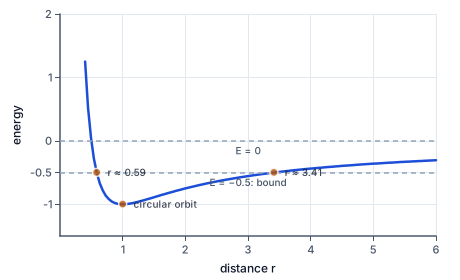
In the figure, the floor of the well is a circular orbit, an energy line inside the well cuts the curve at the closest and farthest approach, and a line above zero never meets the outer side: the body escapes.
For gravity, $U = -k/r$ with $k = Gm_1m_2$, and $U_{\text{eff}} = -k/r + \ell^2/2\mu r^2$. Close in, the centrifugal term dominates and the curve rises steeply; far out, the gravitational term dominates and the curve approaches zero from below. Between them is a well with its minimum at $r_0 = \ell^2/\mu k$.
Draw a horizontal line at the energy $E$. If $E$ equals the minimum, $r$ stays at $r_0$: a circular orbit. If $E$ is between the minimum and zero, $r$ oscillates between two turning points: a bound orbit swinging between a closest and a farthest distance. If $E \ge 0$, there is only an inner turning point, and the body comes in once and leaves forever: an unbound orbit. Everything is read off one curve.
The term $\ell^2/2\mu r^2$ is not a potential energy of any real force. It is the angular part of the kinetic energy, written with the conserved $\ell$ so it depends only on $r$. It acts like a repulsion because, as $r$ shrinks at fixed $\ell$, $\dot{\phi}$ grows as $1/r^2$ and so does the angular kinetic energy, which must come out of the radial motion.
That is why a comet with any angular momentum at all cannot fall straight into the Sun: its closest approach is where the barrier has taken all its radial energy. To crash a spacecraft into the Sun, NASA would have to cancel almost all of the Earth's orbital speed, about $30$ km/s, which is harder than escaping the solar system entirely. The Parker Solar Probe gets close by using repeated Venus flybys to shed angular momentum step by step.
A slightly non-circular orbit has $r$ oscillating about $r_0$ in the well of $U_{\text{eff}}$, with frequency $\omega_r = \sqrt{U_{\text{eff}}''(r_0)/\mu}$. Meanwhile the angle advances at the orbital rate $\omega_\phi = \ell/\mu r_0^2$. If the two are equal, $r$ returns to its minimum exactly once per revolution and the orbit closes on itself.
For gravity, a short calculation gives $\omega_r = \omega_\phi$ exactly: slightly perturbed orbits are closed ellipses. For most other force laws the ratio is irrational and the orbit is a rosette whose closest point creeps around. Bertrand's theorem says only the inverse-square law and the spring force give closed orbits for all bound motions. Mercury's closest point does creep, by $43$ arcseconds a century beyond what the other planets explain, and general relativity's small correction to $1/r$ accounts for exactly that.
Checking an answer. The reduced mass must be less than either mass. The two bodies' distances from the center of mass must add to the separation, with the heavier nearer. A circular orbit must be at a minimum of $U_{\text{eff}}$, not a maximum. And turning points must bracket the circular radius.
The one-body solution gives the separation $\vec{r}(t)$. The actual positions are $\vec{r}_1 = \vec{R} + (m_2/M)\vec{r}$ and $\vec{r}_2 = \vec{R} - (m_1/M)\vec{r}$: each body traces a copy of the relative orbit, scaled down by the other body's share of the mass, on opposite sides of the center of mass.
For the Sun and Jupiter, the Sun's share of the relative orbit is about one part in a thousand, a circle of radius about $742{,}000$ km, slightly larger than the Sun itself: the Sun wobbles about a point just outside its surface every $12$ years. Astronomers detect planets around other stars through exactly this wobble, which shifts the star's spectrum back and forth, and they recover the planet's mass from the size of the star's orbit and the ratio of masses.
Nothing in the reduction used the form of $U$. A spring joining two masses, $U = \tfrac{1}{2}kr^2$, gives $U_{\text{eff}} = \tfrac{1}{2}kr^2 + \ell^2/2\mu r^2$, a well with no escape: every orbit is bound, and the orbits turn out to be ellipses centered on the origin rather than with the origin at a focus. A screened potential such as $-ke^{-r/a}/r$, which describes the force between nucleons, has a well that becomes shallow beyond the range $a$, and for large enough $\ell$ the centrifugal term wipes out the well altogether, so no bound orbit exists at that angular momentum.
That last case explains why a force must be strong enough over a large enough range to bind a pair at all, and why nuclei have only a few bound states. The method is always the same: build $U_{\text{eff}}$, draw it, and read the orbits off it.
Jupiter has about a thousandth of the Sun's mass, so the Sun sits about a thousandth of the way along the line to Jupiter from their center of mass: about $742{,}000$ km, slightly more than the Sun's radius. Every $12$ years the Sun circles a point just outside its own surface at about $12$ m/s.
Seen from another star, that motion shifts the Sun's spectral lines by a few parts in a hundred million. Astronomers measure such shifts for other stars; the first planet found around a Sun-like star, in 1995, showed up this way, and since then spectrographs, including those at the W. M. Keck Observatory in Hawaii, have found hundreds more. The size of the star's wobble gives the planet's mass relative to the star, through exactly the ratio $m_2/M$ of this lesson.
Charon has about an eighth of Pluto's mass and orbits $19{,}600$ km away. Their center of mass lies $2{,}130$ km from Pluto's center, outside Pluto, whose radius is $1{,}190$ km. Pluto and Charon therefore circle a point in empty space between them, each keeping the same face toward the other, a double body rather than a planet and a moon.
NASA's New Horizons spacecraft, built at the Johns Hopkins Applied Physics Laboratory in Maryland, flew past in 2015 and measured the masses precisely by tracking how each body pulled on the spacecraft and on each other. The reduced mass and the barycenter came straight out of those measurements, and the result helped settle the question of how to classify the pair.
It is natural to picture the Moon circling a fixed Earth or a planet circling a fixed star. In fact both bodies circle their common center of mass, each on its own copy of the relative orbit. For the Earth and Moon the balance point is inside the Earth, so the picture is nearly right; for Pluto and Charon it lies in the space between them, and Pluto visibly swings around a point outside itself.
A second error is to treat the centrifugal term as a real repulsive force. It is kinetic energy of the angular motion, rewritten; no force pushes the bodies apart.
The Earth has $5.97 \times 10^{24}$ kg and the Moon $7.34 \times 10^{22}$ kg. Find the total mass.
$M = 5.97 \times 10^{24} + 0.0734 \times 10^{24} = 6.04 \times 10^{24}\ \text{kg}$
Line up the powers of ten.
Find the reduced mass.
$\mu = \dfrac{5.97 \times 10^{24} \times 7.34 \times 10^{22}}{6.04 \times 10^{24}} = 7.25 \times 10^{22}\ \text{kg}$
$m_1m_2/M$.
Compare with the Moon's mass.
$\dfrac{\mu}{m_{\text{Moon}}} = \dfrac{7.25}{7.34} = 0.988$
About one percent less.
Find the Earth's distance from the barycenter.
$r_1 = \dfrac{7.34 \times 10^{22}}{6.04 \times 10^{24}} \times 3.84 \times 10^5 = 4670\ \text{km}$
Inside the Earth, whose radius is $6371$ km.
Find the Moon's distance from the barycenter.
$r_2 = 3.84 \times 10^5 - 4670 = 3.79 \times 10^5\ \text{km}$
The two distances add to the separation.
Take $U_{\text{eff}} = -k/r + c/r^2$ with $k = 6$ and $c = 9$ in consistent units. Differentiate it.
$U_{\text{eff}}' = \dfrac{6}{r^2} - \dfrac{18}{r^3}$
Power rule.
Set the derivative to zero.
$6r = 18 \Rightarrow r_0 = 3$
Multiply by $r^3$.
Evaluate the energy of the circular orbit.
$U_{\text{eff}}(3) = -\dfrac{6}{3} + \dfrac{9}{9} = -2 + 1 = -1$
The bottom of the well.
Check the general formula.
$-\dfrac{k^2}{4c} = -\dfrac{36}{36} = -1$
The same value.
Find the turning points for $E = -0.75$.
$-\dfrac{6}{r} + \dfrac{9}{r^2} = -0.75 \Rightarrow 0.75r^2 - 6r + 9 = 0 \Rightarrow r = 2 \text{ or } 6$
The orbit swings between $2$ and $6$, bracketing $r_0 = 3$.
Write the second derivative of $U_{\text{eff}} = -k/r + \ell^2/2\mu r^2$.
$U_{\text{eff}}'' = -\dfrac{2k}{r^3} + \dfrac{3\ell^2}{\mu r^4}$
Differentiate twice.
Use the circular-orbit condition.
$r_0 = \dfrac{\ell^2}{\mu k} \Rightarrow \ell^2 = \mu kr_0$
From $U_{\text{eff}}'(r_0) = 0$.
Evaluate the curvature at the minimum.
$U_{\text{eff}}''(r_0) = -\dfrac{2k}{r_0^3} + \dfrac{3k}{r_0^3} = \dfrac{k}{r_0^3}$
Substitute $\ell^2$.
Find the radial frequency.
$\omega_r^2 = \dfrac{U_{\text{eff}}''}{\mu} = \dfrac{k}{\mu r_0^3}$
Small oscillations in the well.
Find the orbital frequency.
$\omega_\phi^2 = \left(\dfrac{\ell}{\mu r_0^2}\right)^2 = \dfrac{\mu kr_0}{\mu^2r_0^4} = \dfrac{k}{\mu r_0^3}$
$\dot{\phi} = \ell/\mu r^2$.
Compare the two.
$\omega_r = \omega_\phi$
One radial swing per revolution: the orbit closes, as an ellipse.
Write the reduced mass formula.
$\mu = \dfrac{m_1m_2}{m_1 + m_2}$
The inertia of the relative motion.
Substitute the masses.
$\mu = \dfrac{3 \times 6}{3 + 6} = \dfrac{18}{9}$
Product over sum.
Evaluate the reduced mass.
Two stars of $4$ solar masses each orbit each other. What is the reduced mass of the pair, in solar masses?
Complete the worked solution: a relative orbit has $U_{\text{eff}} = -40/r + 80/r^2$ (in consistent units). Find the radius of the circular orbit, the energy of that orbit, and the value of $U_{\text{eff}}$ at twice that radius.
Divide twice the centrifugal constant by the strength.
$r_0 = \dfrac{2c}{k} =$ r
Where $U_{\text{eff}}' = 0$.
Evaluate the effective potential at its minimum.
$E_0 = U_{\text{eff}}(r_0) = -\dfrac{k^2}{4c} =$ e
A circular orbit has no radial kinetic energy.
Evaluate the effective potential at twice the radius.
$U_{\text{eff}}(2r_0) = -\dfrac{k}{2r_0} + \dfrac{c}{4r_0^2} =$ u
An orbit with this energy would swing out to that radius and back.
Check the ordering of the energies.
$\text{minimum} < \text{value at twice the radius} < 0$
Higher than the bottom of the well, but still bound.
Match each quantity of the two-body problem to its expression.
| $m_1m_2/(m_1 + m_2)$ | $\mu r^2\dot{\phi}$ | $\ell^2/2\mu r^2$ | $U + \ell^2/2\mu r^2$ | |
|---|---|---|---|---|
| reduced mass | ||||
| angular momentum | ||||
| centrifugal potential | ||||
| effective potential |
Two bodies of masses $7$ kg and $3$ kg are $8$ m apart. Fill in the reduced mass in kg, and the distances of the heavier and the lighter body from their center of mass, in m.
| value | |
|---|---|
| reduced mass (kg) | |
| heavier body's distance (m) | |
| lighter body's distance (m) |
Two bodies attract with $U(r) = -3/r$, and their relative motion has $\ell^2/2\mu = 7$ (in consistent units). Write the effective potential $U_{\text{eff}}(r)$ as a formula in $r$.
Answer:
A relative orbit has effective potential $U_{\text{eff}} = -8/r + 9/r^2$ (in consistent units). At what radius is the orbit circular?
Answer: radius of the circular orbit
For the Earth and the Moon, the mass ratio of the lighter body to the heavier is $q = 0.01229$ and their mean separation is $384.4$ thousand km. How far is the heavier body's center from the pair's center of mass, in thousands of km?
Answer: thousand km from the center of mass
Lesson test: one question per skill, one attempt each, no hints. Your answers are checked when you submit.
Two bodies attract with $U(r) = -3/r$, and their relative motion has $\ell^2/2\mu = 9$ (in consistent units). Write the effective potential $U_{\text{eff}}(r)$ as a formula in $r$.
Answer:
You can solve the two-body problem with an effective potential. Explain to someone why a comet with any sideways motion cannot fall straight into the Sun.
19. Your turn: two bodies of $3$ kg and $6$ kg interact. Find their reduced mass., step 3
$\mu = 2\ \text{kg}$
Less than either mass.