Back to the on-screen lesson ·
Plane waves from Maxwell's equations: transverse, in-phase fields with $B_0 = E_0/c$ and $\omega = ck$, polarization, the spectrum and antennas.
Paper packet. Every task here also exists on screen, where it is checked automatically; answers written on paper are not assessed by Nydus. When you are back at a device, enter your answers there.
By the end of this lesson you will be able to read wavelength, frequency, field amplitudes and directions from a plane wave, describe polarization, and size antennas.
You derived the wave equation from Maxwell's equations and know that waves travel at $c = 1/\sqrt{\mu_0\varepsilon_0}$. From mechanics you know waves on strings and sound, with wavelength, frequency and speed related by $v = f\lambda$. This lesson describes the electromagnetic waves themselves: their structure, polarization and spectrum.
| Term | What it means |
|---|---|
| Plane wave | A wave whose fields are uniform over planes perpendicular to its direction of travel. |
| Wave number | $k = 2\pi/\lambda$, radians of phase per meter. |
| Angular frequency | $\omega = 2\pi f$, radians of phase per second; $\omega = ck$ in vacuum. |
| Transverse wave | A wave whose fields oscillate perpendicular to its direction of travel. |
| Polarization | The direction in which the electric field oscillates. |
| Electromagnetic spectrum | The full range of frequencies, from radio to gamma rays. |
| Half-wave dipole | An antenna half a wavelength long, resonant at its design frequency. |
In empty space the wave equation has plane-wave solutions
$$\vec{E}(z, t) = E_0\cos(kz - \omega t)\,\hat{x}, \qquad \vec{B}(z, t) = \frac{E_0}{c}\cos(kz - \omega t)\,\hat{y},$$
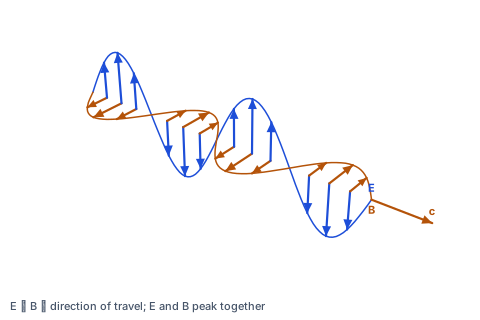
traveling in the $+z$ direction with $\omega = ck$. Maxwell's equations constrain them in three ways. $\nabla \cdot \vec{E} = 0$ and $\nabla \cdot \vec{B} = 0$ make the waves transverse: neither field has a component along the direction of travel. Faraday's law makes $\vec{B}$ perpendicular to $\vec{E}$, in phase with it, and smaller by $c$: $B_0 = E_0/c$. And the direction of travel is along $\vec{E} \times \vec{B}$, the Poynting vector.
The direction of $\vec{E}$ is the polarization. Light can be linearly polarized, with $\vec{E}$ along a fixed line; circularly polarized, with $\vec{E}$ rotating at $\omega$; or unpolarized, with the direction changing randomly, as in sunlight.
All frequencies travel at the same speed in vacuum. From radio waves meters long through microwaves, infrared, visible light (about $400$ to $700$ nm), ultraviolet, x-rays and gamma rays, the electromagnetic spectrum spans more than twenty orders of magnitude in frequency, all described by the same equations.
Another way: picture
Picture a rope stretched along the $z$ axis, shaken up and down to send a wave: the rope's displacement is the electric field, up and down along $x$. Now picture a second rope in the same place shaken side to side, perfectly in step: the magnetic field, along $y$. Both patterns slide forward together at the speed of light. Where one peaks, so does the other.
Another way: steps
Checks. $\vec{E}$, $\vec{B}$ and $\hat{k}$ must be mutually perpendicular. The speed $\omega/k$ must equal $c$. The ratio $E_0/B_0$ must be $c$ in SI units. And the fields' energy densities must be equal.
For a plane wave depending only on $z$ and $t$, Gauss's law in empty space says $\partial E_z/\partial z = 0$, so any $z$ component of $\vec{E}$ would be constant in space — not part of the wave. The same holds for $\vec{B}$. Both fields must lie in the plane perpendicular to the direction of travel.
Faraday's law, $\partial E_x/\partial z = -\partial B_y/\partial t$, then links the $x$ component of $\vec{E}$ to the $y$ component of $\vec{B}$. Substituting cosines gives $kE_0 = \omega B_0$, so $B_0 = E_0/c$ with no phase difference. The fields do not take turns generating each other; they rise and fall together, each one's changes sustaining the other's.
A wave with $\vec{E}$ along $\hat{x}$ is linearly polarized. Adding a second wave along $\hat{y}$, shifted by a quarter cycle, produces circular polarization: the field's tip traces a circle. Unpolarized light, from the Sun or a bulb, is a random mixture of polarizations changing faster than any detector can follow.
A polarizer transmits the component of $\vec{E}$ along its axis, so linearly polarized light of intensity $I_0$ passing a polarizer at angle $\theta$ emerges with $I_0\cos^2\theta$, Malus's law. Polarized sunglasses block light reflected from water and roads, which is partly polarized horizontally; LCD screens use crossed polarizers and liquid crystals that rotate polarization to switch each pixel. Satellite television uses both polarizations of the same frequency to double its capacity.
The electromagnetic spectrum is continuous, but different frequencies interact with matter so differently that they seem like different things. Radio waves, below about $1$ GHz, have wavelengths of meters and are produced by currents in antennas. Microwaves, centimeters long, heat food and carry radar and Wi-Fi. Infrared, micrometers long, is emitted by warm objects. Visible light, $400$ to $700$ nm, matches the energy gaps of the molecules in our eyes.
Ultraviolet breaks chemical bonds, which is why it causes sunburn; x-rays pass through soft tissue but not bone; gamma rays come from nuclei. The atmosphere is transparent in only two windows, visible light and radio, which is why ground-based astronomy used those first and why NASA puts infrared, x-ray and gamma-ray telescopes in space.
Classically, an electromagnetic wave's energy depends on its amplitude, not its frequency. Quantum mechanics adds that the energy comes in photons of $E = hf$. A radio photon at $100$ MHz carries $4 \times 10^{-7}$ eV; a visible photon about $2$ eV; an x-ray photon thousands of eV. The classical wave description works when enormous numbers of photons are involved, as for radio; the photon picture becomes essential when single photons matter, as when ultraviolet light breaks a DNA bond.
Both descriptions are the same electromagnetic field seen at different scales. The wave equation of this lesson governs the probability amplitudes of the photons, and Maxwell's equations, written as quantum operators, are the foundation of quantum electrodynamics.
An antenna converts currents into waves and back. A half-wave dipole, two rods whose total length is half a wavelength, resonates at its design frequency: standing waves of current fit neatly on it, with maximum current at the center. FM broadcasts at $88$ to $108$ MHz have wavelengths near $3$ m, so a car's FM antenna, a quarter-wave whip over the car's metal body acting as a mirror, is about $75$ cm long.
Higher frequencies mean smaller antennas. Phones operating near $2$ GHz use antennas a few centimeters long, folded into the case; the $5$G millimeter-wave bands near $28$ GHz use arrays of tiny antennas that steer beams electronically. Radio astronomy's largest wavelengths need the largest antennas: the Very Large Array in New Mexico uses dishes $25$ m across.
Because all frequencies travel at the same speed in vacuum, a pulse made of many frequencies keeps its shape, and information travels at $c$. That is why GPS works: satellites broadcast time signals, and a receiver computes its distance to each satellite from the signal's travel time. A timing error of one nanosecond corresponds to $30$ cm of position.
The same property underlies radar and lidar, which measure distance from the round-trip time of a pulse, and the laser ranging to reflectors left on the Moon by Apollo astronauts, which measures the Earth–Moon distance to about a millimeter. In matter, different frequencies travel at different speeds — dispersion — and pulses spread, which the next lessons take up.
Maxwell's equations predict a single speed $c$ with no reference to the motion of the source or the observer. Nineteenth-century physicists assumed waves needed a medium, the ether, and that $c$ held only relative to it. Albert Michelson and Edward Morley at Case School in Cleveland found in 1887 that the speed of light does not depend on Earth's motion through any ether.
Einstein took the constancy of $c$ as a principle, and special relativity followed: space and time must adjust so that every observer measures the same $c$. Since 1983 the meter has been defined by fixing $c = 299{,}792{,}458$ m/s exactly. The final lesson of this course shows how electric and magnetic fields themselves transform between moving observers, completing the picture.
FM radio stations in the United States broadcast between $88$ and $108$ MHz, wavelengths of about $2.8$ to $3.4$ m. A half-wave dipole for $100$ MHz is $1.5$ m long; the rabbit-ear antennas on old radios and the folded dipoles on rooftops are adjusted to roughly this length. The station's transmitting antennas, often stacks of dipoles on tall towers, are cut precisely for their frequency, because a resonant antenna radiates most efficiently.
Stations are required by the Federal Communications Commission to transmit with specific polarization, usually a mix of horizontal and vertical so that both car whips and home antennas receive well. The engineering of every broadcast tower begins with $\lambda = c/f$ and the structure of the plane wave.
Light reflecting off a lake or a wet road is partly polarized horizontally, and fully so at Brewster's angle, the subject of the next lesson. Polarized sunglasses have their transmission axis vertical, blocking much of this glare while passing about half of ordinary unpolarized light. Fishermen and pilots rely on them to see into water and reduce glare.
Liquid-crystal displays, in laptops, cars and many televisions, sandwich a layer of twisted liquid crystal between crossed polarizers. The twist rotates the light's polarization by $90°$, letting it through; a voltage across a pixel untwists the molecules, the polarization stays put, and the second polarizer blocks it. The brightness of every pixel is set by how far its polarization is rotated — Malus's law applied millions of times per frame.
A common picture has the electric field creating the magnetic field, which then creates the electric field, alternating like runners in a relay, so that one peaks while the other is zero. In a traveling plane wave they are in phase: both peak at the same place and time. Each field's rate of change in time is tied to the other's rate of change in space, not to its value.
A second misconception is that higher-frequency light travels faster. In vacuum every frequency travels at exactly $c$. In glass, water or air, speeds differ slightly with frequency, which is what makes a prism separate colors, but that is a property of the material, not of light itself.
A wave is $\vec{E} = 50\cos(4.0z - \omega t)\,\hat{x}$ V/m. Find the wavelength.
$\lambda = \dfrac{2\pi}{4.0} = 1.57\ \text{m}$
$k = 4.0$ rad/m.
Find the angular frequency.
$\omega = ck = 3.00 \times 10^8 \times 4.0 = 1.2 \times 10^{9}\ \text{rad/s}$
Vacuum dispersion relation.
Find the frequency.
$f = \dfrac{\omega}{2\pi} = 191\ \text{MHz}$
In the VHF band.
Find the magnetic amplitude.
$B_0 = \dfrac{50}{3.00 \times 10^8} = 1.67 \times 10^{-7}\ \text{T}$
Along $\hat{y}$.
Find the intensity.
$I = \dfrac{50^2}{2 \times 376.7} = 3.3\ \text{W/m}^2$
Along $+z$.
A wave travels in the $-y$ direction with $\vec{E}$ along $+z$ at some instant. Write the condition on $\vec{B}$.
$\hat{E} \times \hat{B} = -\hat{y}$
The Poynting vector points along the travel.
Try $\vec{B}$ along $+x$.
$\hat{z} \times \hat{x} = \hat{y}$
Wrong direction.
Try $\vec{B}$ along $-x$.
$\hat{z} \times (-\hat{x}) = -\hat{y}$
Correct.
Write the full wave.
$\vec{E} = E_0\cos(ky + \omega t)\,\hat{z}, \quad \vec{B} = -\dfrac{E_0}{c}\cos(ky + \omega t)\,\hat{x}$
The $+\omega t$ makes it travel toward $-y$.
Check that both fields are transverse.
$\hat{z} \perp \hat{y}, \quad \hat{x} \perp \hat{y}$
Both fields perpendicular to travel.
Check the phase relation.
$E_z \text{ and } B_x \text{ peak together (with opposite sign)}$
In phase, as a plane wave requires.
Unpolarized light of intensity $I_0$ passes a polarizer. Find the transmitted intensity.
$I_1 = \tfrac{1}{2}I_0$
The average of $\cos^2\theta$ over random directions.
Pass it through a second polarizer at $90°$.
$I_2 = I_1\cos^2 90° = 0$
Crossed polarizers block everything.
Insert a third polarizer at $45°$ between them.
$I_2 = I_1\cos^2 45° = \tfrac{1}{4}I_0$
The middle polarizer passes half.
Pass through the last one at $90°$ to the first.
$I_3 = I_2\cos^2 45° = \tfrac{1}{8}I_0$
At $45°$ to the middle one.
Compare with no middle polarizer.
$\tfrac{1}{8}I_0 > 0$
Adding a polarizer lets more light through.
Explain the paradox.
$\text{each polarizer projects } \vec{E} \text{ onto its own axis}$
The middle one rotates the polarization partway.
Generalize to $N$ polarizers.
$I = \tfrac{1}{2}I_0\left(\cos^2\dfrac{90°}{N}\right)^N \to \tfrac{1}{2}I_0$
Many small steps rotate polarization with little loss.
Connect to liquid-crystal displays.
$\text{liquid crystals rotate polarization smoothly by } 90°$
Between crossed polarizers, an LCD pixel transmits until a voltage untwists it.
Write the relation.
$\lambda = \dfrac{c}{f}$
Speed over frequency.
Substitute the values.
$\lambda = \dfrac{3.00 \times 10^8}{5 \times 10^9}$
SI units.
Evaluate the wavelength.
A plane electromagnetic wave in vacuum has electric field amplitude $75$ V/m. What is its magnetic field amplitude?
Complete the worked solution: a transmitter broadcasts at $15$ MHz. Find the wavelength, the length of a half-wave antenna, and the length of a quarter-wave antenna, in meters. Use $c = 3.00 \times 10^8$ m/s.
Divide the speed of light by the frequency.
$\lambda = \dfrac{300}{15} =$ a
$c/f$ with $f$ in MHz gives meters when $c$ is $300$ m/μs.
Halve it for a dipole.
$\dfrac{\lambda}{2} =$ b
A half-wave dipole resonates at this frequency.
Quarter it for a monopole.
$\dfrac{\lambda}{4} =$ c
A quarter-wave whip over a ground plane.
Match each property of electromagnetic waves in vacuum to its expression.
| $\nabla^2\vec{E} = \mu_0\varepsilon_0\partial_t^2\vec{E}$ | $1/\sqrt{\mu_0\varepsilon_0}$ | $\omega = ck$ | along $\vec{E} \times \vec{B}$ | |
|---|---|---|---|---|
| the wave equation | ||||
| the speed | ||||
| the dispersion relation | ||||
| the direction of travel |
Fill in the wavelength, in meters, for an FM radio signal at $100$ MHz, Wi-Fi at $2.4$ GHz, and a $30$ GHz millimeter-wave link. Use $c = 3.00 \times 10^8$ m/s.
| wavelength (m) | |
|---|---|
| FM radio, $100$ MHz | |
| Wi-Fi, $2.4$ GHz | |
| millimeter wave, $30$ GHz |
A radar beam has electric field amplitude $9$ V/m. What is its magnetic field amplitude, in nT? Use $c = 3.00 \times 10^8$ m/s.
Answer: nT
A wave in vacuum has electric field $\vec{E} = 66\cos(10z - \omega t)\,\hat{x}$ V/m with $z$ in meters. What is its frequency, in MHz? Use $c = 2.998 \times 10^8$ m/s.
Answer: MHz
An FM station broadcasts at $100$ MHz. How long should a half-wave dipole antenna be to receive it best, in meters? Use $c = 3.00 \times 10^8$ m/s.
Answer: m
Lesson test: one question per skill, one attempt each, no hints. Your answers are checked when you submit.
Complete the worked solution: a transmitter broadcasts at $30$ MHz. Find the wavelength, the length of a half-wave antenna, and the length of a quarter-wave antenna, in meters. Use $c = 3.00 \times 10^8$ m/s.
Divide the speed of light by the frequency.
$\lambda = \dfrac{300}{30} =$ a
$c/f$ with $f$ in MHz gives meters when $c$ is $300$ m/μs.
Halve it for a dipole.
$\dfrac{\lambda}{2} =$ b
A half-wave dipole resonates at this frequency.
Quarter it for a monopole.
$\dfrac{\lambda}{4} =$ c
A quarter-wave whip over a ground plane.
You can describe electromagnetic waves in vacuum. Explain to someone how the electric and magnetic fields of light are arranged.
19. Your turn: what is the wavelength of a $5$ GHz Wi-Fi signal?, step 3
$\lambda = 0.06\ \text{m} = 6\ \text{cm}$
Shorter than the $2.4$ GHz band's $12.5$ cm.