Back to the on-screen lesson ·
$W = \tfrac{\varepsilon_0}{2}\int E^2\,d\tau$: the energy of shells, balls and capacitors, the electrostatic pressure on conductors, and where a charge distribution's energy lives.
Paper packet. Every task here also exists on screen, where it is checked automatically; answers written on paper are not assessed by Nydus. When you are back at a device, enter your answers there.
By the end of this lesson you will be able to compute the electrostatic energy of charge distributions from their fields, find the pressure and forces on charged conductors, and compute the energy stored in capacitors.
You know how to compute the work to assemble point charges, the potential of charge distributions, and the capacitance and energy of capacitors from Physics C. You know that conductors in equilibrium have zero field inside. This lesson finds where the energy of a charge distribution is stored and what forces fields exert on conductors.
| Term | What it means |
|---|---|
| Electrostatic energy | The work needed to assemble a charge distribution from charges infinitely far apart. |
| Energy density | $u = \tfrac{1}{2}\varepsilon_0E^2$, the field energy per unit volume. |
| Self-energy | The energy to assemble a single object's charge; infinite for a true point charge. |
| Surface charge density | $\sigma$, related to the field just outside a conductor by $E = \sigma/\varepsilon_0$. |
| Electrostatic pressure | The outward force per area on a charged conductor's surface, $\sigma^2/2\varepsilon_0$. |
| Capacitance | $C = Q/V$, the charge stored per volt between two conductors. |
| Capacitor energy | $U = \tfrac{1}{2}CV^2 = \tfrac{1}{2}QV = Q^2/2C$. |
The work to assemble point charges is $W = \tfrac{1}{2}\sum_iq_iV(\vec{r}_i)$, where $V$ is the potential from all the other charges; the $\tfrac{1}{2}$ stops each pair being counted twice. For a continuous distribution this becomes $W = \tfrac{1}{2}\int\rho V\,d\tau$. Using Gauss's law to replace $\rho$ by $\varepsilon_0\nabla \cdot \vec{E}$ and integrating by parts turns it into an integral over all space:
$$W = \frac{\varepsilon_0}{2}\int E^2\,d\tau.$$
The energy can be regarded as stored in the field, with density $u = \tfrac{1}{2}\varepsilon_0E^2$ wherever the field is. For a thin charged shell, the field is zero inside and $kQ/r^2$ outside, and the integral gives $W = kQ^2/2R$. A uniformly charged ball adds the field inside, giving $W = 3kQ^2/5R$.
At a conductor's surface, the field jumps from zero inside to $\sigma/\varepsilon_0$ outside, and the charges feel the average, $\sigma/2\varepsilon_0$. The force per unit area is an outward electrostatic pressure
$$P = \frac{\sigma^2}{2\varepsilon_0} = \tfrac{1}{2}\varepsilon_0E^2,$$
equal to the energy density just outside. For a capacitor, $W = \tfrac{1}{2}CV^2$, and the same energy is found by integrating $u$ over the field between the plates.
Another way: picture
Picture the field as a stretched elastic medium filling space around the charges. Stretching it takes work, and the work is stored in the stretch, most where the field is strongest. Squeeze charge onto a smaller sphere and the field near it grows, storing more energy; let the charge spread and the field relaxes. The medium also pushes: a charged surface feels an outward pull toward the region where the field lives, like a balloon's skin pushed by the air inside.
Another way: steps
Checks. Field energy must be positive, since $E^2 \ge 0$; a pair of opposite charges can have negative interaction energy, but that sum omits their positive self-energies. The field-energy and $\tfrac{1}{2}QV$ methods must agree. Energies must scale as $Q^2$ and, for fixed charge, as $1/R$. And a capacitor's $\tfrac{1}{2}CV^2$ must match $\tfrac{1}{2}\varepsilon_0E^2$ times the volume between plates.
Starting from $W = \tfrac{1}{2}\int\rho V\,d\tau$, replace $\rho$ with $\varepsilon_0\nabla \cdot \vec{E}$ and use the product rule $\nabla \cdot (V\vec{E}) = V\nabla \cdot \vec{E} + \vec{E} \cdot \nabla V$. Since $\nabla V = -\vec{E}$, the integral becomes a surface term plus $\tfrac{\varepsilon_0}{2}\int E^2\,d\tau$. Enlarging the volume to all space sends the surface term to zero for bounded charges, because $VE$ falls as $1/r^3$ while the area grows only as $r^2$.
In electrostatics the two pictures — energy on the charges, energy in the field — give the same total, so neither can be proved right by statics alone. Electrodynamics decides the question. Light carries energy across empty space with no charges at all, so energy must be able to live in fields. The field-energy picture is the one that generalizes, and it becomes the Poynting theorem later in the course.
The energy of a charged shell, $kQ^2/2R$, grows without bound as $R \to 0$. A true point charge would have infinite self-energy. That is why the pair formula for point charges, $\sum kq_iq_j/r_{ij}$, leaves self-energy out: it counts only the work to bring pre-made charges together.
Setting the electron's self-energy equal to its rest energy $mc^2$ defines the classical electron radius, $r_e = ke^2/(m_ec^2) = 2.82 \times 10^{-15}$ m. Experiments show the electron is pointlike far below this scale, so classical electrodynamics cannot be the whole story there. Quantum electrodynamics handles the infinity by renormalization, absorbing it into the measured mass; the mismatch between classical intuition and reality at tiny scales is one of the deep lessons of twentieth-century physics.
Charges on a conductor's surface repel each other, so the surface is pushed outward. Each patch feels the field of all the other charges, which is the average of the fields just inside ($0$) and just outside ($\sigma/\varepsilon_0$), giving $\sigma/2\varepsilon_0$. The force per area is $\sigma \times \sigma/2\varepsilon_0 = \sigma^2/2\varepsilon_0$.
The same result gives the attraction between capacitor plates: each plate feels the other's field, $F = Q^2/(2\varepsilon_0A)$. Electrostatic pressures are small at ordinary fields — at air's breakdown field of $3$ MV/m, only $40$ Pa — which is why electrostatic motors are weak at large scales. At the micrometer scale they win: the comb drives in the accelerometers and gyroscopes of every smartphone move by electrostatic forces, because the forces scale favorably as devices shrink.
A parallel-plate capacitor has a nearly uniform field $E = V/d$ between plates of area $A$. The field energy is $\tfrac{1}{2}\varepsilon_0E^2 \times Ad = \tfrac{1}{2}\frac{\varepsilon_0A}{d}V^2 = \tfrac{1}{2}CV^2$. The two formulas agree, and the field picture shows where the energy is: between the plates, not on them.
Capacitors release their energy fast, which makes them ideal where power matters more than total energy. Camera flashes, defibrillators and the pulsed-power machines that drive fusion experiments all store energy in capacitors and discharge it in milliseconds or less. The Z machine at Sandia National Laboratories in New Mexico stores about $20$ MJ in capacitor banks and releases it in about a hundred nanoseconds, briefly delivering far more power than the entire world's electrical grid.
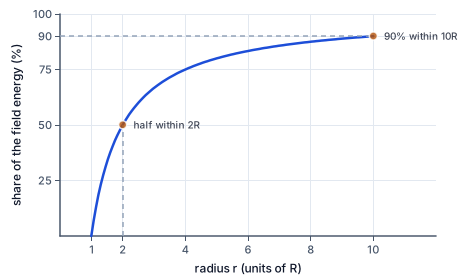
For a charged shell, the energy between $R$ and $r$ is $\frac{kQ^2}{2}\left(\frac{1}{R} - \frac{1}{r}\right)$. Half of the total lies within $2R$, ninety percent within $10R$. The energy is concentrated near the charge but spreads out with a long tail.
This matters for design. Enclosing a charged electrode in a grounded shell of radius $b$ removes the field beyond $b$ and reduces the stored energy to $\frac{kQ^2}{2}\left(\frac{1}{R} - \frac{1}{b}\right)$, the energy of a spherical capacitor. High-voltage equipment is shielded partly for safety and partly so that the energy that could be released in a fault is confined to a known volume.
Systems move toward lower energy, so field energy tells you which way charges want to go. Charge on an isolated conductor spreads over its surface because spreading lowers the field energy; the equilibrium distribution is the one of minimum energy for the given total charge, a result known as Thomson's theorem. A dielectric slab is pulled into a charged capacitor because inserting it lowers the stored energy at fixed charge.
Energy methods often give forces more easily than direct calculation: find the energy as a function of a position, and the force is minus its derivative at fixed charge. Engineers designing electrostatic actuators, and physicists computing the forces in ion traps, use exactly this shortcut.
When a heart falls into ventricular fibrillation, its muscle fibers contract chaotically and it stops pumping. A strong electric shock through the chest depolarizes the whole heart at once, giving its natural pacemaker a chance to restart a normal rhythm. The energy comes from a capacitor charged to one or two thousand volts by a battery, because a battery alone cannot deliver the needed power: tens of kilowatts for a few milliseconds.
The American Heart Association's guidelines call for shocks of about $120$ to $200$ J from modern biphasic defibrillators. A $100$ μF capacitor at $2000$ V stores $\tfrac{1}{2}CV^2 = 200$ J. Automated external defibrillators, now found in airports, schools and offices across the United States, charge their capacitors in a few seconds and walk untrained bystanders through the rescue; each use of a public AED before paramedics arrive roughly doubles a cardiac-arrest victim's chance of survival.
The Z machine at Sandia National Laboratories in Albuquerque is the world's most powerful pulsed-power facility. It stores about $20$ MJ in thousands of capacitors, charged in parallel, then switches them so that their energy is compressed in time and delivered to a target a few centimeters across in about $100$ ns. The peak electrical power, around $80$ TW, exceeds the average power of all the world's power plants combined for that instant.
The currents, about $26$ million amperes, crush tiny cylinders of metal or gas with magnetic pressure, reaching temperatures and pressures found inside stars and giant planets. Researchers use it to study fusion, to measure how materials behave under extreme compression, and to test components for the nation's stockpile stewardship program. It all starts with energy stored as $\tfrac{1}{2}\varepsilon_0E^2$ in the dielectric of ordinary capacitors.
It is natural to think a charged sphere's energy sits on its surface, where the charge is. The field-energy formula places it throughout the surrounding space, with density $\tfrac{1}{2}\varepsilon_0E^2$; half of it lies beyond the sphere's surface, out to twice its radius, and some reaches far away. Both pictures give the same total in electrostatics, but only the field picture survives when fields change and carry energy as radiation.
A second error is to drop the factor of one half. The work to assemble a set of charges counts each pair once, while $\sum q_iV_i$ counts each pair twice; and charging a capacitor from zero, each added charge faces an average voltage of half the final value. The one half appears in every correct formula.
Write the field of a thin shell of radius $R$ and charge $Q$.
$E = 0 \ (r < R), \qquad E = \dfrac{kQ}{r^2} \ (r > R)$
From Gauss's law.
Write the energy integral.
$W = \dfrac{\varepsilon_0}{2}\displaystyle\int_R^\infty\left(\dfrac{kQ}{r^2}\right)^24\pi r^2\,dr$
Only the outside contributes.
Simplify the integrand.
$W = 2\pi\varepsilon_0k^2Q^2\displaystyle\int_R^\infty\dfrac{dr}{r^2}$
Collect constants.
Evaluate the integral.
$\displaystyle\int_R^\infty\dfrac{dr}{r^2} = \dfrac{1}{R}$
A standard power integral.
Simplify with $4\pi\varepsilon_0k = 1$.
$W = \dfrac{kQ^2}{2R}$
Equal to $\tfrac{1}{2}QV$ with $V = kQ/R$.
Write the energy outside the ball.
$W_{\text{out}} = \dfrac{kQ^2}{2R}$
Same field as the shell outside.
Write the field inside.
$E = \dfrac{kQr}{R^3}$
Linear in $r$.
Set up the inside integral.
$W_{\text{in}} = \dfrac{\varepsilon_0}{2}\displaystyle\int_0^R\dfrac{k^2Q^2r^2}{R^6}4\pi r^2\,dr$
Energy density times shell volume.
Evaluate the expression.
$W_{\text{in}} = 2\pi\varepsilon_0\dfrac{k^2Q^2}{R^6}\cdot\dfrac{R^5}{5} = \dfrac{kQ^2}{10R}$
Using $4\pi\varepsilon_0k = 1$.
Add the two parts.
$W = \dfrac{kQ^2}{2R} + \dfrac{kQ^2}{10R} = \dfrac{3kQ^2}{5R}$
Twenty percent more than the shell.
Check with $\tfrac{1}{2}\int\rho V\,d\tau$.
$\tfrac{1}{2}\displaystyle\int_0^R\rho\dfrac{kQ}{2R}\left(3 - \dfrac{r^2}{R^2}\right)4\pi r^2\,dr = \dfrac{3kQ^2}{5R}$
Both methods agree.
A parallel-plate capacitor has plates of area $A = 0.010$ m² separated by $d = 1.0$ mm, charged to $V = 500$ V. Find the field.
$E = \dfrac{V}{d} = \dfrac{500}{1.0 \times 10^{-3}} = 5.0 \times 10^{5}\ \text{V/m}$
Uniform between the plates.
Find the energy density.
$u = \tfrac{1}{2}\varepsilon_0E^2 = \tfrac{1}{2} \times 8.85 \times 10^{-12} \times (5.0 \times 10^5)^2 = 1.11\ \text{J/m}^3$
Joules per cubic meter.
Find the stored energy.
$U = u \times Ad = 1.11 \times 0.010 \times 1.0 \times 10^{-3} = 1.11 \times 10^{-5}\ \text{J}$
Energy density times volume.
Check with the capacitance.
$C = \dfrac{\varepsilon_0A}{d} = 8.85 \times 10^{-11}\ \text{F}, \quad \tfrac{1}{2}CV^2 = 1.11 \times 10^{-5}\ \text{J}$
The same.
Find the pressure on each plate.
$P = \tfrac{1}{2}\varepsilon_0E^2 = 1.11\ \text{Pa}$
Equal to the energy density.
Find the force.
$F = PA = 1.11 \times 0.010 = 0.011\ \text{N}$
About the weight of a paper clip.
Check with the energy method.
$F = -\dfrac{dU}{dd}\Big|_Q = \dfrac{Q^2}{2\varepsilon_0A} = 0.011\ \text{N}$
At fixed charge, $U = Q^2d/(2\varepsilon_0A)$ grows with $d$, so the plates attract.
Interpret the result.
$\text{attractive, tiny at everyday fields}$
Electrostatic forces matter mainly at small scales or high fields.
Write the energy formula.
$U = \tfrac{1}{2}CV^2$
For any capacitor.
Substitute the values.
$U = \tfrac{1}{2} \times 10 \times 10^{-6} \times 300^2$
SI units.
Evaluate the energy.
In a region the electric field stores $31$ J/m³. If the field were doubled, what would the energy density be?
Complete the worked solution: a $34$ pF capacitor is charged to $2$ V. Find its charge in pC, its energy in pJ, and its energy if the voltage were doubled.
Multiply capacitance by voltage.
$Q = CV =$ a pC
The definition of capacitance.
Find the stored energy.
$U = \tfrac{1}{2}CV^2 =$ b pJ
The work done charging it.
Double the voltage.
$U' = \tfrac{1}{2}C(2V)^2 =$ d pJ
Four times the energy.
Match each quantity to its expression.
| $\tfrac{1}{2}\varepsilon_0E^2$ | $kQ^2/2R$ | $3kQ^2/5R$ | $\sigma^2/2\varepsilon_0$ | |
|---|---|---|---|---|
| field energy density | ||||
| a charged shell's energy | ||||
| a uniform ball's energy | ||||
| pressure on a charged conductor |
For a charge $Q$ and length $R$ with $kQ^2/R = 283$ μJ, fill in the stored energy, in μJ, for each arrangement.
| energy (μJ) | |
|---|---|
| thin shell of radius $R$ | |
| uniform ball of radius $R$ | |
| two charges $Q/2$ a distance $R$ apart |
What is the energy density, in J/m³, of an electric field of $0.1$ MV/m? Use $\varepsilon_0 = 8.85 \times 10^{-12}$ C²/(N m²).
Answer: J/m³
A conducting sphere of radius $5$ cm carries $13$ nC. How much energy is stored in its electric field, in μJ? Use $k = 8.99 \times 10^9$ N m²/C².
Answer: μJ
A defibrillator charges a $60$ μF capacitor to $2500$ V before delivering a shock to a patient's heart. How much energy does the capacitor store, in joules?
Answer: J
Lesson test: one question per skill, one attempt each, no hints. Your answers are checked when you submit.
For a charge $Q$ and length $R$ with $kQ^2/R = 29$ μJ, fill in the stored energy, in μJ, for each arrangement.
| energy (μJ) | |
|---|---|
| thin shell of radius $R$ | |
| uniform ball of radius $R$ | |
| two charges $Q/2$ a distance $R$ apart |
You can locate and compute electrostatic energy. Explain to someone where the energy of a charged sphere is stored.
18. Your turn: how much energy does a $10$ μF capacitor store at $300$ V?, step 3
$U = 0.45\ \text{J}$
Enough for a camera flash.