Back to the on-screen lesson ·
Uniqueness licenses guessing: image charges for grounded planes and spheres, induced surface charge, image forces, and the averaging property of Laplace's equation.
Paper packet. Every task here also exists on screen, where it is checked automatically; answers written on paper are not assessed by Nydus. When you are back at a device, enter your answers there.
By the end of this lesson you will be able to use image charges to find fields, forces and induced charge near grounded planes and spheres, and to explain why the uniqueness theorem makes the method valid.
You know Poisson's and Laplace's equations, that a conductor's surface is an equipotential, and that a conductor's surface charge is $\sigma = \varepsilon_0E$. You can find the potential of point charges. This lesson shows how to solve for fields near conductors whose surface charge is unknown, by replacing the conductor with imaginary charges.
| Term | What it means |
|---|---|
| Boundary conditions | The values of $V$, or of its normal derivative, specified on the edges of a region. |
| Uniqueness theorem | In a region with given charge, a solution of Poisson's equation with the given boundary values is the only one. |
| Image charge | A fictitious charge outside the region of interest, chosen so that the boundary conditions are met. |
| Grounded conductor | A conductor held at $V = 0$ by connection to a large reservoir of charge. |
| Induced charge | Surface charge drawn onto a conductor by a nearby charge. |
| Mean-value property | A solution of Laplace's equation equals its average over any sphere inside the region. |
| Earnshaw's theorem | No static arrangement of charges can hold another charge in stable equilibrium. |
Near a conductor the charge on its surface is unknown: it rearranges itself in response to nearby charges. But the conductor's potential is known — zero if it is grounded — and in the region outside, the potential obeys Poisson's equation with the known charges. The uniqueness theorem says that a potential satisfying Poisson's equation in the region and matching the boundary values is the only one. So any way of producing such a potential, however artificial, gives the right answer.
For a charge $q$ at height $d$ above an infinite grounded plane, add an image charge $-q$ at depth $d$ below it. On the plane, every point is equidistant from $q$ and $-q$, so $V = 0$. Above the plane the only real charge is $q$, as it should be. Therefore the potential above the plane is exactly
$$V = kq\left(\frac{1}{\mathscr{r}_+} - \frac{1}{\mathscr{r}_-}\right),$$
the charge feels a force $kq^2/(2d)^2$ toward the plane, and the induced surface charge is $\sigma = -qd/[2\pi(x^2 + d^2)^{3/2}]$, which totals exactly $-q$. For a grounded sphere of radius $R$ with $q$ at distance $a$ from the center, the image is
$$q' = -\frac{R}{a}q \quad\text{at}\quad b = \frac{R^2}{a}.$$
Another way: picture
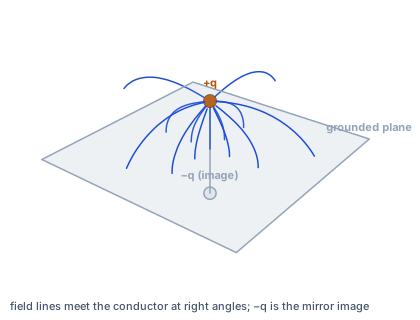
Picture a conducting plane as a mirror for field lines. The field lines from a charge bend toward the plane and end on it at right angles, exactly as if they had continued through to an opposite charge behind the mirror. Above the mirror you cannot tell the difference between the real induced charge and the reflected image; below it the image picture is meaningless, because inside the metal the field is zero.
Another way: steps
Checks. The total induced charge must equal the total image charge. The force must be attractive toward a grounded conductor. Far from the conductor, the image effects must fade: the plane's force falls as $1/d^2$, the sphere's faster, since the image shrinks as $R/a$. And the potential must satisfy Laplace's equation in the region, which it does automatically when it is built from point charges outside it.
In the figure, the field lines above the plane are those of the charge and its image together. They meet the plane at right angles, so the plane is an equipotential, and uniqueness says this is the answer.
Suppose two potentials $V_1$ and $V_2$ both satisfy Poisson's equation with the same charge in a region and the same boundary values. Their difference $V_3 = V_1 - V_2$ satisfies Laplace's equation inside and is zero on the boundary. Solutions of Laplace's equation have no maxima or minima inside a region, because each value equals the average of its neighbors. So $V_3$ must be zero everywhere, and the two solutions are the same.
A second version applies to conductors whose total charge, rather than potential, is given; it too guarantees a unique field. These theorems are what make electrostatics a well-posed problem: specify the charges and the boundary data, and nature has no further choices. They also justify numerical methods, which approximate the unique solution by relaxing a guess until every grid point equals the average of its neighbors.
For a charge $q$ at distance $a$ from the center of a grounded sphere of radius $R$, try an image $q'$ at distance $b$ along the same line. On the sphere, the distances to $q$ and $q'$ are in a fixed ratio for every point when $b = R^2/a$, and choosing $q' = -qR/a$ makes the potentials cancel everywhere on the surface.
As the charge moves close, $a \to R$, the image approaches $-q$ at the mirror point: near its surface the sphere looks like a plane. As the charge moves far away, the image shrinks as $R/a$ and moves to the center. If the sphere is insulated and neutral rather than grounded, add a second image $+qR/a$ at the center to cancel the net induced charge while keeping the surface an equipotential; the neutral sphere then attracts the charge more weakly.
The image force is why charged dust and droplets cling to metal and why a charged balloon sticks to a wall — a dielectric wall acts as a partial mirror, with a weaker image. It governs how close an electron can come to a metal surface: at a nanometer the image attraction is about $0.36$ eV, a sizable fraction of a work function, and it shapes the barrier electrons tunnel through in field emission and in scanning tunneling microscopes.
Electrical engineers use images to model power lines above the ground, which acts as a conducting plane: the line and its image form a two-wire system whose capacitance and field at ground level follow from the image picture. Antenna designers treat a vertical antenna over the ground, or a car's roof, as half of a dipole whose other half is the image.
In one dimension, Laplace's equation says $d^2V/dx^2 = 0$, so $V$ is a straight line between boundary values: the potential between the plates of a capacitor. In two and three dimensions the solutions are richer but share the same averaging character. They cannot have bumps or dips inside, only on the edges, which is why a potential landscape in empty space is always a smooth saddle-like surface.
That same property forbids stable trapping by static fields, Earnshaw's theorem: a charge in empty space sits at a point where $V$ equals its surroundings' average, so it cannot be at a minimum. Paul traps get around this with oscillating fields, and Penning traps with a magnetic field; Wolfgang Paul and Hans Dehmelt shared the 1989 Nobel Prize for these traps, which now hold the ions of quantum computers and atomic clocks.
The energy needed to bring a charge from infinity to height $d$ above a grounded plane is not the energy of the charge and its image, $-kq^2/2d$. Integrating the force as the charge moves in gives $-kq^2/4d$, half as much. The reason is that the image is not a fixed charge: it moves as the real charge moves, and the field exists only above the plane, half of the space the image picture fills.
This factor of one half catches many students and some textbooks. The safe rule: use images for fields, forces and potentials in the real region, and compute energies either by integrating the force or by integrating $\tfrac{1}{2}\varepsilon_0E^2$ over the real region only.
Images work for planes, spheres, cylinders and a few other shapes. For arbitrary conductors, Laplace's equation is solved numerically. The simplest method, relaxation, uses the averaging property directly: cover the region with a grid, fix the boundary values, and repeatedly replace each interior value by the average of its four neighbors in two dimensions, or six in three. The values converge to the unique solution.
Modern solvers use faster algorithms, such as multigrid and finite elements, but the principle is the same. Chip designers use them to extract the capacitances between billions of wires on an integrated circuit, because those capacitances limit how fast signals can switch. An image charge and a relaxation grid are two tools for the same problem, one exact for simple shapes, the other approximate for any shape.
Electron sources in x-ray tubes, older television tubes and many electron microscopes heat a metal until some electrons have enough energy to escape over the work-function barrier. An applied electric field lowers that barrier. The reason is the image force: an electron just outside the metal is attracted back by its image with potential energy $-ke^2/4x$, and adding the applied field's $-eEx$ produces a maximum lower than the bare work function by $\sqrt{e^3E/4\pi\varepsilon_0}$.
Walter Schottky explained this in 1914. At a field of $0.25$ V/nm the barrier drops by $0.6$ eV, which at $1800$ K multiplies the emitted current by about $50$. Schottky emitters, made of zirconium-coated tungsten and operated in strong fields, are the electron sources in most modern scanning electron microscopes, including those in American semiconductor fabs that inspect every chip.
The ground under a transmission line is a reasonable conductor, so for electrostatic purposes it acts as a grounded plane. Engineers model each conductor of the line together with an image conductor at the same depth below ground, carrying the opposite charge. The pair behaves like a two-wire line whose spacing is twice the height, and that determines the line's capacitance to ground and the electric field at ground level.
Under the highest-voltage lines in the United States, the $765$ kV lines of the eastern grid, the image model predicts ground-level fields of several kilovolts per meter, which utilities must keep within limits at the edge of the right-of-way. The same picture explains why a person standing under such a line can feel a slight tingle from induced charge and why vehicles parked beneath them should be grounded before refueling.
The image is a mathematical device. It reproduces the field of the actual induced surface charge only in the region outside the conductor. Inside a grounded conductor the real field is zero, not the field of the image; and nothing physical sits at the image's location. Treating the image as real leads to errors such as computing field energy over all space, which doubles the answer for a plane.
A related error is to think a grounded conductor carries no charge. Grounding fixes the potential, not the charge; charge flows in from the ground until the potential is zero, and that induced charge is what attracts the nearby charge.
Place the charge and its image.
$q \text{ at } (0, 0, d), \qquad -q \text{ at } (0, 0, -d)$
Mirror images through the plane $z = 0$.
Write the potential above the plane.
$V = kq\left[\dfrac{1}{\sqrt{x^2 + y^2 + (z - d)^2}} - \dfrac{1}{\sqrt{x^2 + y^2 + (z + d)^2}}\right]$
Two point charges.
Check the boundary condition.
$z = 0: \quad V = 0$
Equal distances to both charges.
Find the force on $q$.
$F = \dfrac{kq^2}{(2d)^2}, \text{ toward the plane}$
Coulomb's law with the image.
Evaluate for $q = 5$ nC at $d = 1$ cm.
$F = \dfrac{8.99 \times 10^9 \times 25 \times 10^{-18}}{(0.02)^2} = 5.6 \times 10^{-4}\ \text{N}$
About half a millinewton.
Differentiate the potential at the plane.
$E_z = -\dfrac{\partial V}{\partial z}\Big|_{z = 0} = -\dfrac{2kqd}{(x^2 + y^2 + d^2)^{3/2}}$
Only the $z$ component survives on the plane.
Relate it to the surface charge.
$\sigma = \varepsilon_0E_z = -\dfrac{qd}{2\pi(r^2 + d^2)^{3/2}}$
With $r^2 = x^2 + y^2$ and $4\pi\varepsilon_0k = 1$.
Find the peak value.
$\sigma(0) = -\dfrac{q}{2\pi d^2}$
Directly under the charge.
Set up the total induced charge.
$Q_{\text{ind}} = \displaystyle\int_0^\infty\sigma\,2\pi r\,dr = -qd\int_0^\infty\dfrac{r\,dr}{(r^2 + d^2)^{3/2}}$
Rings of area $2\pi r\,dr$.
Evaluate the integral.
$\displaystyle\int_0^\infty\dfrac{r\,dr}{(r^2 + d^2)^{3/2}} = \dfrac{1}{d}$
Substitute $w = r^2 + d^2$.
Conclude the total.
$Q_{\text{ind}} = -q$
Equal to the image charge, as it must be.
Place a charge $q$ at distance $a = 5$ cm from the center of a grounded sphere of radius $R = 3$ cm. Find the image strength.
$q' = -\dfrac{R}{a}q = -0.6q$
The image is weaker than the charge.
Find the image position.
$b = \dfrac{R^2}{a} = \dfrac{9}{5} = 1.8\ \text{cm}$
Inside the sphere, toward $q$.
Check $V = 0$ at the nearest point.
$\dfrac{kq}{5 - 3} + \dfrac{k(-0.6q)}{3 - 1.8} = kq(0.5 - 0.5) = 0$
Distances $2$ cm and $1.2$ cm.
Check $V = 0$ at the farthest point.
$\dfrac{kq}{5 + 3} + \dfrac{k(-0.6q)}{3 + 1.8} = kq(0.125 - 0.125) = 0$
Distances $8$ cm and $4.8$ cm.
Find the separation of charge and image.
$a - b = 5 - 1.8 = 3.2\ \text{cm}$
For Coulomb's law.
Find the force for $q = 2$ nC.
$F = \dfrac{8.99 \times 10^9 \times 2 \times 10^{-9} \times 1.2 \times 10^{-9}}{(0.032)^2} = 2.1 \times 10^{-5}\ \text{N}$
Attractive.
Find the total induced charge.
$Q_{\text{ind}} = q' = -1.2\ \text{nC}$
Less than $q$: some of $q$'s field lines escape to infinity.
Compare with a plane.
$\dfrac{kq^2}{(2 \times 2\ \text{cm})^2} = 2.2 \times 10^{-5}\ \text{N}$
Close to the sphere's value, because the charge is near the surface.
Find the image strength.
$q' = -\dfrac{R}{a}q = -\dfrac{4}{10}q$
The ratio of radius to distance.
Find the image position.
$b = \dfrac{R^2}{a} = \dfrac{16}{10}$
Measured from the center.
State the results.
A point charge $q$ is held a distance $d$ above an infinite grounded conducting plane. What force does it feel?
Complete the worked solution: a charge $q$ sits $a = 5$ cm from the center of a grounded sphere of radius $R = 2$ cm. Find the image's strength as a fraction of $q$, its distance from the center in cm, and its distance from $q$ in cm.
Divide the radius by the distance.
$\dfrac{|q'|}{q} = \dfrac{R}{a} =$ p
The image is weaker than the charge.
Find the image's position.
$b = \dfrac{R^2}{a} =$ b
Inside the sphere, on the line to $q$.
Subtract to find the separation.
$a - b =$ d
The distance used in Coulomb's law.
Match each idea to its statement.
| $-q$ at the mirror point | $-qR/a$ at $R^2/a$ | boundary values fix the solution | $V$ equals its average over a sphere | |
|---|---|---|---|---|
| the image in a grounded plane | ||||
| the image in a grounded sphere | ||||
| the uniqueness theorem | ||||
| the mean-value property |
A charge above a grounded plane induces a surface charge whose magnitude directly below it is $557$ nC/m². Fill in the magnitude, in nC/m², at horizontal distances $x = 0$, $\tfrac{3}{4}d$ and $\tfrac{4}{3}d$ from that point.
| $|\sigma|$ (nC/m²) | |
|---|---|
| $x = 0$ | |
| $x = \tfrac{3}{4}d$ | |
| $x = \tfrac{4}{3}d$ |
A $3$ nC charge is $5$ cm above a large grounded metal plate. How strongly is it attracted to the plate, in μN? Use $k = 8.99 \times 10^9$ N m²/C².
Answer: μN
A $5$ nC charge sits $a = 10$ cm from the center of a grounded conducting sphere of radius $R = 5$ cm. With what force, in μN, is it attracted to the sphere? Use $k = 8.99 \times 10^9$ N m²/C².
Answer: μN
An electron leaving a hot metal cathode feels the attraction of its image in the metal, with potential energy $-ke^2/4x$, while an applied field $E = 0.25$ V/nm pulls it away. By how much, in eV, is the barrier it must cross lowered? Use $ke^2 = 1.44$ eV nm.
Answer: eV
Lesson test: one question per skill, one attempt each, no hints. Your answers are checked when you submit.
A charge above a grounded plane induces a surface charge whose magnitude directly below it is $285$ nC/m². Fill in the magnitude, in nC/m², at horizontal distances $x = 0$, $\tfrac{3}{4}d$ and $\tfrac{4}{3}d$ from that point.
| $|\sigma|$ (nC/m²) | |
|---|---|
| $x = 0$ | |
| $x = \tfrac{3}{4}d$ | |
| $x = \tfrac{4}{3}d$ |
You can solve conductor problems with images. Explain to someone why an image charge gives the right answer even though it is not real.
18. Your turn: a charge sits $a = 10$ cm from the center of a grounded sphere of radius $R = 4$ cm. Where is its image, and how strong is it?, step 3
$q' = -0.4q \text{ at } 1.6\ \text{cm}$
Inside the sphere, on the line toward the charge.