Back to the on-screen lesson ·
$\vec{F} = q(\vec{E} + \vec{v} \times \vec{B})$: circles and helices, the speed-independent cyclotron frequency, velocity selectors, current density and forces on wires.
Paper packet. Every task here also exists on screen, where it is checked automatically; answers written on paper are not assessed by Nydus. When you are back at a device, enter your answers there.
By the end of this lesson you will be able to predict the motion of charges in magnetic and crossed fields, describe currents by current density, and compute magnetic forces on wires.
You know the magnetic force on a moving charge and on a current-carrying wire from Physics C, the cross product from calculus, and circular motion from mechanics. You have spent eight lessons on static charges. Now charges move, and a second field appears, with forces of a strikingly different character.
| Term | What it means |
|---|---|
| Lorentz force | $\vec{F} = q(\vec{E} + \vec{v} \times \vec{B})$, the total electromagnetic force on a charge. |
| Magnetic field | $\vec{B}$, measured in teslas; $1$ T $= 1$ N/(A m). |
| Cyclotron motion | Circular motion of a charge in a uniform magnetic field, at frequency $qB/2\pi m$. |
| Velocity selector | Crossed electric and magnetic fields that pass only particles with $v = E/B$. |
| Current density | $\vec{J}$, current per unit area perpendicular to the flow, $\vec{J} = \rho\vec{v}$. |
| Continuity equation | $\nabla \cdot \vec{J} = -\partial\rho/\partial t$, the local statement of charge conservation. |
| Steady current | A current with $\nabla \cdot \vec{J} = 0$, the regime of magnetostatics. |
A charge moving through a magnetic field feels
$$\vec{F} = q\vec{v} \times \vec{B},$$
perpendicular to both its velocity and the field. Because $\vec{F} \cdot \vec{v} = 0$, the magnetic force does no work: it changes the direction of motion but never the speed. Together with the electric force, the total is the Lorentz force, $\vec{F} = q(\vec{E} + \vec{v} \times \vec{B})$.
In a uniform field, a charge moving perpendicular to $\vec{B}$ goes in a circle. Setting $qvB = mv^2/r$ gives
$$r = \frac{mv}{qB} = \frac{p}{qB}, \qquad f = \frac{qB}{2\pi m}.$$
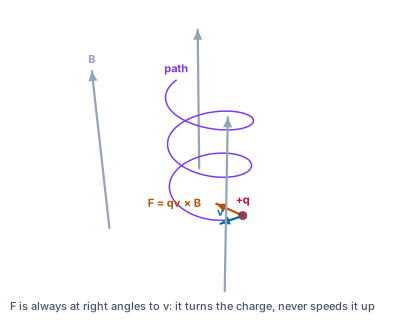
The radius grows with momentum, but the cyclotron frequency does not depend on speed at all. A velocity component along $\vec{B}$ is unaffected, so the general path is a helix.
Currents are charges in motion. The current density $\vec{J} = \rho\vec{v}$ gives the current through a surface as $I = \int\vec{J} \cdot d\vec{a}$, and charge conservation requires $\nabla \cdot \vec{J} = -\partial\rho/\partial t$. Summing the force on every moving charge in a wire gives $\vec{F} = I\int d\vec{l} \times \vec{B}$, which for a straight wire in a uniform field is $I\vec{L} \times \vec{B}$.
Another way: picture
Picture a charge rolling on a frictionless table, with the field pointing straight up out of the table. The magnetic force always pushes sideways, like a string tied to a post that always pulls toward the center of the turn. The charge swings around a circle at constant speed. Give it more speed and the circle widens, but it still takes exactly as long to go around.
Another way: steps
Checks. The speed must stay constant in a pure magnetic field. Heavier or slower particles curve less sharply only through their momentum. Positive and negative charges must circle in opposite senses. And the force on a wire must vanish when the wire lies along the field.
The power delivered by any force is $\vec{F} \cdot \vec{v}$. For the magnetic force this is $q(\vec{v} \times \vec{B}) \cdot \vec{v}$, and a cross product is perpendicular to each of its factors, so the result is zero at every instant. However strong the field, it cannot change a charge's kinetic energy.
Yet magnets lift paper clips and electric motors do work. In those cases the magnetic force redirects the charges in a wire sideways, and the wire's lattice, holding the charges in, is pushed; the energy comes from whatever maintains the current, such as a battery, acting through electric fields. Tracing the energy in a motor always leads back to an electric field doing the work, with the magnetic field acting as the go-between.
The figure shows the helix: the force turns the part of the velocity across B into a circle, and the part along B carries the charge up the field.
With a velocity component along the field, a charge spirals: circular motion across the field, steady drift along it. The pitch of the helix is the parallel speed times the period. Charged particles from the Sun follow such spirals along Earth's magnetic field lines toward the poles, where they excite the aurora.
Where field lines converge, the spiral tightens and the particle can be turned back: a magnetic mirror. Earth's field, strongest near the poles, traps particles bouncing between hemispheres in the Van Allen radiation belts, discovered by James Van Allen with the first American satellite, Explorer 1, in 1958. Fusion devices use the same principle to confine plasmas hotter than the Sun's core.
When electric and magnetic fields are perpendicular to each other and to a beam, the forces $qE$ and $qvB$ point in opposite directions. Only particles with $v = E/B$ feel no net force and pass straight through: a velocity selector. Followed by a region of pure magnetic field, where the radius is $r = mv/qB$, it becomes a mass spectrometer: every particle has the same speed, so the radius reveals $m/q$.
J. J. Thomson used crossed fields in 1897 to measure the electron's charge-to-mass ratio. Today mass spectrometers, often using time of flight or oscillating fields rather than circles, identify proteins, date rocks, detect drugs in athletes, and measure carbon-14 for radiocarbon dating.
A current is described at each point by $\vec{J}$, the charge flowing per unit area per unit time. For charge density $\rho$ moving at velocity $\vec{v}$, $\vec{J} = \rho\vec{v}$; in a copper wire carrying $1$ A through $1$ mm², $J = 10^6$ A/m². Because copper has about $8.5 \times 10^{28}$ free electrons per cubic meter, the drift speed is only about $0.07$ mm/s.
Charge is conserved locally: the charge leaving a small volume through its surface must come from inside it. The divergence theorem turns that into the continuity equation, $\nabla \cdot \vec{J} = -\partial\rho/\partial t$. In magnetostatics the currents are steady, charge does not pile up anywhere, and $\nabla \cdot \vec{J} = 0$. This condition is what the next lessons' laws for $\vec{B}$ depend on.
The force on a current element is $I\,d\vec{l} \times \vec{B}$. For a straight wire of length $L$ in a uniform field, $F = BIL\sin\theta$. For a closed loop in a uniform field the forces add to zero, but they produce a torque: $\vec{\tau} = \vec{m} \times \vec{B}$ with magnetic moment $\vec{m} = I\vec{A}$, the magnetic analog of an electric dipole's torque.
That torque turns the rotor of every electric motor. Two parallel wires carrying currents in the same direction attract, a force that until 2019 defined the ampere: the current that produces $2 \times 10^{-7}$ N per meter between wires a meter apart. The ampere is now defined by fixing the elementary charge, but the force between currents remains the basis of instruments that measure large currents.
At speeds near light, the momentum is $\gamma mv$ and the cyclotron frequency becomes $qB/2\pi\gamma m$, falling as the particle gains energy. A fixed-frequency cyclotron therefore falls out of step above a few tens of MeV for protons. Synchrocyclotrons lower the frequency during acceleration; synchrotrons raise the field instead, keeping the radius fixed as $r = p/qB$.
The Large Hadron Collider's protons have momenta of $6.8$ TeV/c, and its superconducting magnets, at $8.3$ T, bend them on arcs about $2.7$ km in radius. The same formula, $r = p/qB$, sizes the magnets of Fermilab's accelerators and of the proton-therapy centers that treat cancer in dozens of American hospitals.
The Lorentz force is also the basis of the most common magnetic sensor. In a Hall sensor, current flows through a thin semiconductor strip in a field; the magnetic force pushes the moving charges toward one edge until the resulting transverse electric field balances it. The transverse Hall voltage, proportional to the field, is measured directly.
Hall sensors are in every smartphone compass, in car anti-lock brakes that count the teeth of a spinning wheel, and in brushless motors that sense the rotor's position. The sign of the Hall voltage also reveals whether a material's current is carried by negative electrons or positive holes, a measurement that was central to understanding semiconductors.
Positron emission tomography images the metabolism of tumors and the brain using fluorine-18, a positron emitter with a $110$-minute half-life. It is too short-lived to ship far, so hundreds of hospitals and regional centers in the United States run compact cyclotrons that make it daily by bombarding oxygen-18-enriched water with protons of about $11$ to $18$ MeV.
The cyclotron's two hollow electrodes, the dees, sit in a uniform magnetic field of about $1$ to $2$ T. An alternating voltage between them kicks the protons each time they cross the gap. Because the cyclotron frequency $qB/2\pi m$ does not depend on speed, the protons stay in step with a fixed radio frequency, about $15.24$ MHz per tesla of field, as they spiral outward to full energy. Ernest Lawrence invented the device at Berkeley in 1930 and won the 1939 Nobel Prize for it.
In 1958, Explorer 1, the first American satellite, carried a Geiger counter built by James Van Allen's group at the University of Iowa. It found that at certain altitudes the counter saturated: Earth is surrounded by belts of energetic charged particles. The particles are trapped by the Lorentz force. They spiral around field lines, bounce between the magnetic mirrors near the poles, and drift slowly around the planet.
The belts are a hazard for satellites and astronauts, and NASA's twin Van Allen Probes, operating from 2012 to 2019, mapped how they swell and shrink during solar storms. Spacecraft passing through them, including those bound for the Moon, must shield their electronics and crews against particles whose paths are governed by $r = p/qB$ and the helical motion of this lesson.
Because a magnetic field can hold a particle in a circle or fling it off in a new direction, it is tempting to think it can also speed it up. It cannot: the force is always perpendicular to the velocity, so it does no work. Accelerators use electric fields to add energy and magnetic fields only to steer and focus. When a magnet seems to do work, as in a motor, the energy comes from the electrical source driving the current.
A second misconception is that faster particles circle more often. The radius grows in proportion to speed, so the circumference grows too, and the period stays exactly the same. That speed independence is what makes the cyclotron work.
An electron moves at $2.0 \times 10^{6}$ m/s perpendicular to a $1.0$ mT field. Write the radius.
$r = \dfrac{mv}{eB}$
Magnetic force supplies the centripetal force.
Substitute the values.
$r = \dfrac{9.11 \times 10^{-31} \times 2.0 \times 10^{6}}{1.602 \times 10^{-19} \times 1.0 \times 10^{-3}}$
SI units.
Evaluate the radius.
$r = 1.14 \times 10^{-2}\ \text{m} = 1.14\ \text{cm}$
A tight circle in a weak field.
Find the frequency.
$f = \dfrac{eB}{2\pi m} = \dfrac{1.602 \times 10^{-19} \times 10^{-3}}{2\pi \times 9.11 \times 10^{-31}} = 28\ \text{MHz}$
$28$ GHz per tesla for electrons.
Check the speed after one orbit.
$v = 2.0 \times 10^{6}\ \text{m/s}$
Unchanged: the field does no work.
Crossed fields $E = 20$ kV/m and $B = 0.10$ T select a speed.
$v = \dfrac{E}{B} = \dfrac{2.0 \times 10^{4}}{0.10} = 2.0 \times 10^{5}\ \text{m/s}$
Forces balance.
The ions then enter a pure field of $0.10$ T. Write the radius.
$r = \dfrac{mv}{qB}$
Circular motion.
Find the radius for carbon-12 ions with charge $+e$.
$r_{12} = \dfrac{12 \times 1.661 \times 10^{-27} \times 2.0 \times 10^{5}}{1.602 \times 10^{-19} \times 0.10} = 0.249\ \text{m}$
Mass $12$ u.
Find the radius for carbon-14 ions.
$r_{14} = \dfrac{14}{12}r_{12} = 0.290\ \text{m}$
Radius proportional to mass at fixed speed.
Find their separation after a half circle.
$2(r_{14} - r_{12}) = 2 \times 0.041 = 0.083\ \text{m}$
Landing $8$ cm apart.
Interpret the result.
$\text{isotopes resolved}$
The basis of radiocarbon counting by accelerator mass spectrometry.
A proton enters a $0.50$ T field at $3.0 \times 10^{5}$ m/s, at $60°$ to the field. Split the velocity.
$v_\parallel = v\cos 60° = 1.5 \times 10^{5}, \qquad v_\perp = v\sin 60° = 2.6 \times 10^{5}\ \text{m/s}$
Components along and across the field.
Find the radius from the perpendicular part.
$r = \dfrac{mv_\perp}{qB} = \dfrac{1.673 \times 10^{-27} \times 2.6 \times 10^{5}}{1.602 \times 10^{-19} \times 0.50} = 5.4\ \text{mm}$
Only $v_\perp$ bends.
Find the period.
$T = \dfrac{2\pi m}{qB} = \dfrac{2\pi \times 1.673 \times 10^{-27}}{1.602 \times 10^{-19} \times 0.50} = 1.31 \times 10^{-7}\ \text{s}$
Independent of speed.
Find the pitch.
$p = v_\parallel T = 1.5 \times 10^{5} \times 1.31 \times 10^{-7} = 2.0\ \text{cm}$
Distance advanced per turn.
Compare pitch and radius.
$\dfrac{p}{2\pi r} = \dfrac{2.0}{3.4} = 0.59$
A fairly tight helix.
Find the kinetic energy.
$K = \tfrac{1}{2}mv^2 = \tfrac{1}{2} \times 1.673 \times 10^{-27} \times (3.0 \times 10^5)^2 = 7.5 \times 10^{-17}\ \text{J}$
About $470$ eV.
Check that it stays constant.
$v_\parallel^2 + v_\perp^2 = v^2$
Both components keep their sizes.
Connect to the aurora.
$\text{spirals along field lines toward the poles}$
Solar-wind particles follow the same kind of path.
Write the cyclotron frequency.
$f = \dfrac{qB}{2\pi m}$
Independent of speed.
Use the proton's value per tesla.
$f = 15.24\ \text{MHz/T} \times 2.0$
$e/2\pi m_p = 15.24$ MHz/T.
Evaluate the frequency.
An electron moving at $86 \times 10^{5}$ m/s enters a region with only a uniform magnetic field. After it has traveled half a circle, what is its speed?
Complete the worked solution: a wire $0.1$ m long carrying $8$ A lies perpendicular to a field of $0.5$ T. Find the force, the force with double the current, and the force with the original current at $30°$ to the field, in newtons.
Multiply field, current and length.
$F = BIL =$ a
Perpendicular: $\sin 90° = 1$.
Double the current.
$F' = B(2I)L =$ c
Linear in current.
Tilt the wire to $30°$.
$F'' = BIL\sin 30° =$ d
Only the perpendicular part of the wire feels force.
Match each quantity to its expression.
| $mv/qB$ | $qB/2\pi m$ | $E/B$ | $I\vec{L} \times \vec{B}$ | |
|---|---|---|---|---|
| the radius | ||||
| the cyclotron frequency | ||||
| the selected speed | ||||
| the force on a wire |
An ion moving at speed $v$ in a uniform field circles with radius $8$ cm and period $27$ ns. Fill in the radius and period for the same ion at $v$, $2v$ and $3v$.
| radius (cm) | period (ns) | |
|---|---|---|
| speed $v$ | ||
| speed $2v$ | ||
| speed $3v$ |
A velocity selector has crossed fields $E = 16$ kV/m and $B = 10$ mT. At what speed do ions pass straight through, in units of $10^6$ m/s?
Answer: × 10⁶ m/s
A proton with kinetic energy $2$ MeV moves perpendicular to a uniform magnetic field of $0.2$ T. What is the radius of its circle, in cm? Use $m = 1.673 \times 10^{-27}$ kg and $e = 1.602 \times 10^{-19}$ C.
Answer: cm
Hospital cyclotrons accelerate protons to make fluorine-18 for PET scans. If the magnet's field is $2.1$ T, at what frequency, in MHz, must the accelerating voltage alternate? Use $e/(2\pi m_p) = 15.24$ MHz/T.
Answer: MHz
Lesson test: one question per skill, one attempt each, no hints. Your answers are checked when you submit.
An ion moving at speed $v$ in a uniform field circles with radius $4$ cm and period $82$ ns. Fill in the radius and period for the same ion at $v$, $2v$ and $3v$.
| radius (cm) | period (ns) | |
|---|---|---|
| speed $v$ | ||
| speed $2v$ | ||
| speed $3v$ |
You can apply the Lorentz force. Explain to someone why a magnetic field cannot change a charged particle's speed.
19. Your turn: at what frequency does a proton circle in a $2.0$ T field?, step 3
$f = 30.5\ \text{MHz}$
A radio frequency.