Back to the on-screen lesson ·
Poynting's theorem and $\vec{S} = \vec{E} \times \vec{B}/\mu_0$: energy flow into resistors, wave intensity, momentum and radiation pressure, and solar sails.
Paper packet. Every task here also exists on screen, where it is checked automatically; answers written on paper are not assessed by Nydus. When you are back at a device, enter your answers there.
By the end of this lesson you will be able to compute the Poynting vector and the energy flux of fields, find wave intensities from field amplitudes, and compute radiation pressure and forces.
You know the energy densities $\tfrac{1}{2}\varepsilon_0E^2$ and $B^2/2\mu_0$, Joule heating, and Maxwell's equations. From mechanics you know that conservation laws come with fluxes: mass and charge flow, momentum is transferred by forces. This lesson finds how energy and momentum flow through electromagnetic fields.
| Term | What it means |
|---|---|
| Poynting vector | $\vec{S} = \vec{E} \times \vec{B}/\mu_0$, energy per area per time carried by the field. |
| Poynting's theorem | $\partial u/\partial t + \nabla \cdot \vec{S} = -\vec{J} \cdot \vec{E}$, local energy conservation. |
| Intensity | $I = \langle S\rangle$, the time-averaged energy flux of a wave. |
| Radiation pressure | Force per area exerted by light: $I/c$ when absorbed, $2I/c$ when reflected. |
| Field momentum density | $\vec{g} = \vec{S}/c^2 = \varepsilon_0\vec{E} \times \vec{B}$. |
| Impedance of free space | $\mu_0c = 376.7$ Ω, relating $E$ and $H$ in a plane wave. |
| Solar constant | About $1361$ W/m², the intensity of sunlight above Earth's atmosphere. |
From Maxwell's equations, the rate of work done by fields on charges, $\vec{J} \cdot \vec{E}$ per volume, can be rewritten entirely in terms of fields:
$$\frac{\partial u}{\partial t} + \nabla \cdot \vec{S} = -\vec{J} \cdot \vec{E}, \qquad u = \tfrac{1}{2}\varepsilon_0E^2 + \frac{B^2}{2\mu_0}, \qquad \vec{S} = \frac{1}{\mu_0}\vec{E} \times \vec{B}.$$
This is Poynting's theorem: the field energy in a region decreases only by flowing out through its surface, at rate $\oint\vec{S} \cdot d\vec{a}$, or by doing work on charges inside. The Poynting vector $\vec{S}$ is the energy flux, in watts per square meter.
For a plane wave, $B = E/c$ and $\vec{S}$ points along the direction of travel; its average is the intensity $I = E_0^2/(2\mu_0c)$. Fields also carry momentum, with density $\vec{g} = \vec{S}/c^2$. Light absorbed by a surface transfers momentum flux $I/c$, a radiation pressure; reflected light transfers $2I/c$.
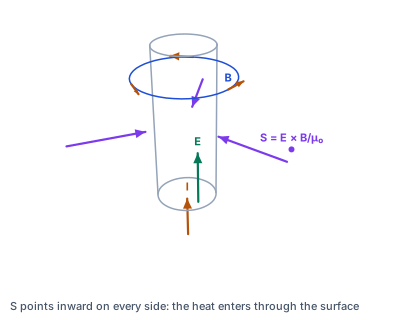
The Poynting vector also applies to steady circuits. At the surface of a resistor, $\vec{E}$ runs along the wire and $\vec{B}$ circles it, so $\vec{S}$ points inward, and the total flux into the resistor equals $I^2R$ exactly. The energy reaches the resistor through the space around the wires.
Another way: picture
Picture a battery connected to a bulb by two long wires. Around the wires, the battery's charges create an electric field between them, and the current makes a magnetic field circling each wire. Where both exist, the Poynting vector points from the battery toward the bulb, through the space between the wires. At the bulb it turns inward and enters the filament. The wires guide the energy; the fields carry it.
Another way: steps
Checks. The Poynting flux into a resistor must equal $I^2R$. Intensities must fall as $1/r^2$ from a point source. Sunlight, $1361$ W/m², corresponds to a peak field of about $1000$ V/m. And radiation pressures must be tiny: sunlight pushes with about $5$ μPa on an absorber, a hundred-billionth of atmospheric pressure.
Poynting's theorem comes from the curl equations. Dot Faraday's law with $\vec{B}$ and the Ampère–Maxwell law with $\vec{E}$, subtract, and use the identity $\nabla \cdot (\vec{E} \times \vec{B}) = \vec{B} \cdot (\nabla \times \vec{E}) - \vec{E} \cdot (\nabla \times \vec{B})$. The result is the continuity equation for energy, with $\vec{S}$ as the current and $\vec{J} \cdot \vec{E}$ as the rate at which the field gives energy to charges.
The consequences can be surprising. In a DC circuit the energy does not travel inside the copper, where $\vec{E}$ is tiny; it travels in the space around the wires and enters the resistor from the side. In a coaxial cable, the energy flows in the insulator between the conductors, which is why the cable's speed depends on the insulator. The wires shape the fields; the fields carry the power.
In a plane wave the electric and magnetic fields oscillate together, perpendicular to each other and to the direction of travel, with $B = E/c$. The electric and magnetic energy densities are equal, and the energy moves at $c$: $S = cu$. Averaged over a cycle, $I = \tfrac{1}{2}\varepsilon_0cE_0^2 = E_0^2/(2 \times 376.7\ \Omega)$.
The number $376.7$ Ω, the impedance of free space, relates electric and magnetic field strengths in any wave in vacuum. Antenna engineers use it constantly: a cell phone transmitting $1$ W from an antenna produces, a meter away, an intensity of about $0.08$ W/m² and a peak field near $8$ V/m. Federal Communications Commission exposure limits for the public are written in exactly these units.
Electromagnetic fields carry momentum as well as energy: a pulse of energy $U$ carries momentum $U/c$. When light is absorbed, that momentum goes into the absorber, which feels a pressure $I/c$; when light is reflected, the momentum reverses and the pressure doubles. Sunlight at Earth pushes on a perfect mirror with $2 \times 1361/(3 \times 10^8) = 9$ μPa.
Radiation pressure is feeble at everyday intensities but decisive elsewhere. It holds up the outer layers of massive stars, sets the maximum brightness of a star or quasar of a given mass (the Eddington limit), pushes comet dust tails away from the Sun, and in laser cooling slows atoms by the momentum of photons, as the quantum lesson on emission computed.
At a resistor's surface, $E = V/L$ along the axis and $B = \mu_0I/2\pi a$ circling it. The Poynting vector has magnitude $VI/(2\pi aL)$ and points inward. Multiplying by the surface area $2\pi aL$ gives $VI$, the Joule heating. At a battery the direction reverses: the battery's internal EMF pushes current against the field, and energy flows outward from the battery into the surrounding space.
This picture is not a curiosity. In high-voltage transmission lines, power engineers compute the power carried as the Poynting flux between the conductors and the ground, and the picture explains why the power delivered depends on the voltage between lines and the current in them together, even though the electrons themselves drift at millimeters per second.
Fields carry angular momentum too. Circularly polarized light carries angular momentum $\hbar$ per photon along its direction of travel, and a beam of power $P$ exerts a torque $P/\omega$ on a surface that absorbs it. Richard Beth measured this torque in 1936 with a quarter-wave plate hung on a quartz fiber, confirming that light's angular momentum is real.
Beams can also carry orbital angular momentum in twisted wavefronts, used in optical tweezers to spin microscopic particles and explored for multiplexing signals in optical communication. Even static fields store angular momentum: a charged capacitor in a magnetic field holds angular momentum in its fields, and discharging it makes the apparatus rotate, a demonstration known as Feynman's disk paradox.
The Sun radiates $3.8 \times 10^{26}$ W. Spread over a sphere of radius $1$ AU, that gives $1361$ W/m² above Earth's atmosphere, the solar constant, measured to better than a tenth of a percent by NASA's radiometers on satellites such as SORCE and TSIS-1. About $1000$ W/m² reaches the ground at noon on a clear day, after absorption and scattering in the air.
Solar panels convert about $20$ percent of that to electricity, so a square meter of panel yields about $200$ W in full sun. Mars, at $1.5$ AU, receives only $590$ W/m², which is why NASA's Mars rovers Curiosity and Perseverance use radioisotope generators instead of panels, while Jupiter-bound Juno, at $5$ AU where sunlight is $25$ times weaker than at Earth, carries enormous solar arrays.
In a plane wave, the electric energy density $\tfrac{1}{2}\varepsilon_0E^2$ equals the magnetic energy density $B^2/2\mu_0$ at every point, because $B = E/c$ and $c^2 = 1/\mu_0\varepsilon_0$. Half the wave's energy is electric and half is magnetic, and each field continually regenerates the other as the wave moves.
In quasi-static devices the balance tips. A capacitor's energy is almost entirely electric, an inductor's almost entirely magnetic, and an LC circuit sloshes energy between them at its resonant frequency — a wave trapped in a box. Microwave cavities, laser resonators and the superconducting qubits of quantum computers are all such resonators, their energy oscillating between electric and magnetic forms exactly as in the plane wave.
In 2019 The Planetary Society's LightSail 2, a small satellite with a $32$ m² reflective sail, raised its orbit using only sunlight, the first spacecraft in Earth orbit to do so. At $1$ AU, sunlight pushes such a sail with about $0.29$ mN — the weight of a few grains of sand — but the push never stops and needs no fuel. By tilting the sail as it orbits, like a sailboat tacking, the craft gained altitude on one half of each orbit.
NASA's Advanced Composite Solar Sail System, launched in 2024 with an $80$ m² sail on lightweight composite booms, tested larger designs, and solar sails have been proposed for missions to hover over the Sun's poles or to reach the outer solar system. JAXA's IKAROS was the first to sail between planets, in 2010. All of them depend on the momentum carried by electromagnetic fields, $2I/c$ per unit area.
The Federal Communications Commission limits public exposure to radio-frequency fields from cell towers, Wi-Fi routers and phones, with limits expressed as power density — the Poynting flux — in milliwatts per square centimeter, or equivalently as electric-field strength. For cellular frequencies near $2$ GHz, the general-population limit is $1$ mW/cm², or $10$ W/m², corresponding to a peak field of about $87$ V/m.
Typical exposures near homes are thousands of times lower. A cell tower transmitting a few hundred watts spreads its power over enormous areas, and by the inverse-square law the intensity on the ground a hundred meters away is well under a milliwatt per square meter. Engineers verify compliance by calculating $\vec{S}$ from the antenna's power and pattern and by measuring the field with calibrated probes.
It seems obvious that the energy delivered to a bulb flows through the copper wires. The Poynting vector says otherwise. Inside a good conductor the electric field is tiny, so $\vec{S}$ is nearly zero there. The energy flows through the space around and between the wires, where both fields are present, and enters the bulb's filament from the side. The wires act as guides that shape the fields.
A second misconception is that light cannot push because photons have no mass. Light carries momentum $U/c$ regardless, and exerts real forces: comet tails, radiation pressure in stars, and solar sails all show it.
A resistor of radius $1.0$ mm and length $10$ cm carries $2.0$ A with $12$ V across it. Find $E$.
$E = \dfrac{V}{L} = \dfrac{12}{0.10} = 120\ \text{V/m}$
Along the axis.
Find $B$ at the surface.
$B = \dfrac{\mu_0I}{2\pi a} = \dfrac{2 \times 10^{-7} \times 2.0}{1.0 \times 10^{-3}} = 4.0 \times 10^{-4}\ \text{T}$
Circling the wire.
Find the Poynting vector.
$S = \dfrac{EB}{\mu_0} = \dfrac{120 \times 4.0 \times 10^{-4}}{4\pi \times 10^{-7}} = 3.8 \times 10^{4}\ \text{W/m}^2$
Pointing inward.
Find the surface area.
$2\pi aL = 2\pi \times 10^{-3} \times 0.10 = 6.28 \times 10^{-4}\ \text{m}^2$
The curved side.
Find the total power in.
$P = 3.8 \times 10^{4} \times 6.28 \times 10^{-4} = 24\ \text{W} = VI$
Exactly the Joule heating.
Write the intensity in terms of the peak field.
$I = \dfrac{E_0^2}{2\mu_0c}$
Averaged over a cycle.
Solve for the peak field.
$E_0 = \sqrt{2\mu_0cI}$
Rearrange the equation.
Evaluate for sunlight above the atmosphere.
$E_0 = \sqrt{2 \times 376.7 \times 1361} = 1013\ \text{V/m}$
About a kilovolt per meter.
Find the peak magnetic field.
$B_0 = \dfrac{E_0}{c} = \dfrac{1013}{3.00 \times 10^{8}} = 3.4\ \mu\text{T}$
A fifteenth of Earth's static field.
Find the energy density.
$u = \dfrac{I}{c} = \dfrac{1361}{3.00 \times 10^{8}} = 4.5 \times 10^{-6}\ \text{J/m}^3$
Half electric, half magnetic.
Find the pressure on an absorber.
$P = \dfrac{I}{c} = 4.5\ \mu\text{Pa}$
Numerically equal to the energy density.
A reflecting sail of $32$ m² faces the Sun at $1$ AU. Find the pressure.
$P = \dfrac{2I}{c} = \dfrac{2 \times 1361}{2.998 \times 10^8} = 9.08\ \mu\text{Pa}$
Perfect reflection.
Find the force.
$F = PA = 9.08 \times 10^{-6} \times 32 = 0.29\ \text{mN}$
Pressure times area.
Find the acceleration of a $5$ kg spacecraft.
$a = \dfrac{F}{m} = \dfrac{2.9 \times 10^{-4}}{5} = 5.8 \times 10^{-5}\ \text{m/s}^2$
Newton's second law.
Find the speed gained in a day.
$\Delta v = at = 5.8 \times 10^{-5} \times 86{,}400 = 5.0\ \text{m/s}$
Small but continuous.
Find the speed gained in a year.
$\Delta v = 5.8 \times 10^{-5} \times 3.16 \times 10^{7} = 1.8\ \text{km/s}$
Comparable to a chemical rocket burn.
Account for the sail's angle.
$F = \dfrac{2IA}{c}\cos^2\theta$
Tilting reduces both the intercepted light and the normal component of the push.
Explain why tilting is still useful.
$\text{tilted force has a component along the orbit}$
Like a sailboat tacking, the sail can raise or lower its orbit.
Compare with the Sun's gravity on the craft.
$\dfrac{GM_\odot m}{r^2} = \dfrac{1.33 \times 10^{20} \times 5}{(1.50 \times 10^{11})^2} = 0.030\ \text{N}$
Light's push is one percent of gravity here; lighter sails do better.
Write the pressure on an absorber.
$P = \dfrac{I}{c}$
All the momentum is absorbed.
Substitute the values.
$P = \dfrac{3000}{3.00 \times 10^{8}}$
SI units.
Evaluate the pressure.
A steady current flows through a long cylindrical resistor. In which direction does the Poynting vector point at the resistor's surface?
Complete the worked solution: a beam of intensity $600$ W/m² strikes a surface head-on. Find the radiation pressure if it is absorbed and if it is reflected, in μPa, and the force on a $10$ m² mirror, in μN. Use $c = 3.00 \times 10^8$ m/s.
Divide the intensity by the speed of light.
$P_{\text{abs}} = \dfrac{I}{c} =$ p
Each absorbed photon delivers its momentum.
Double it for a mirror.
$P_{\text{ref}} = \dfrac{2I}{c} =$ q
Reflection reverses the momentum.
Multiply by the area.
$F = P_{\text{ref}}A =$ f
Force is pressure times area.
Match each quantity to its expression.
| $\vec{E} \times \vec{B}/\mu_0$ | $\tfrac{1}{2}\varepsilon_0E^2 + B^2/2\mu_0$ | $I/c$ | $2I/c$ | |
|---|---|---|---|---|
| the Poynting vector | ||||
| the energy density | ||||
| pressure on an absorber | ||||
| pressure on a mirror |
Sunlight has intensity $1361$ W/m² at Earth, $1$ AU from the Sun. Fill in the intensity, in W/m², at $0.5$ AU, $1$ AU and $2$ AU.
| intensity (W/m²) | |
|---|---|
| $0.5$ AU | |
| $1$ AU | |
| $2$ AU |
A plane electromagnetic wave has a peak electric field of $100$ V/m. What is its intensity, in W/m²? Use $\mu_0c = 376.7$ Ω.
Answer: W/m²
A cylindrical resistor of radius $0.5$ mm and length $5$ cm has $5$ V across it and carries $1$ A. What is the magnitude of the Poynting vector at its surface, in kW/m²?
Answer: kW/m²
A solar sail of area $1000$ m², perfectly reflecting and facing the Sun, is $1.5$ AU from the Sun. What force does sunlight exert on it, in mN? Use $1361$ W/m² at $1$ AU and $c = 2.998 \times 10^8$ m/s.
Answer: mN
Lesson test: one question per skill, one attempt each, no hints. Your answers are checked when you submit.
Complete the worked solution: a beam of intensity $600$ W/m² strikes a surface head-on. Find the radiation pressure if it is absorbed and if it is reflected, in μPa, and the force on a $17$ m² mirror, in μN. Use $c = 3.00 \times 10^8$ m/s.
Divide the intensity by the speed of light.
$P_{\text{abs}} = \dfrac{I}{c} =$ p
Each absorbed photon delivers its momentum.
Double it for a mirror.
$P_{\text{ref}} = \dfrac{2I}{c} =$ q
Reflection reverses the momentum.
Multiply by the area.
$F = P_{\text{ref}}A =$ f
Force is pressure times area.
You can follow energy and momentum through fields. Explain to someone how energy gets from a battery to a light bulb.
19. Your turn: what pressure does a beam of intensity $3000$ W/m² exert on a perfect absorber?, step 3
$P = 1.0 \times 10^{-5}\ \text{Pa}$
Ten micropascals.