Back to the on-screen lesson ·
One rule, the predictions it allows, how we see, and why a lit room is not evidence that light bends.
Paper packet. Every task here also exists on screen, where it is checked automatically; answers written on paper are not assessed by Nydus. When you are back at a device, enter your answers there.
You will use the rule that light travels in straight lines to say where light can and cannot reach, explain how light reflecting off an object lets you see it, and work out where a straight beam will be.
From the last lesson: sound needs something to travel through, and light does not — the bell in the emptied jar could be seen and not heard. This lesson is about what light does instead, and it is very simple and very useful.
You can also plot points on a graph and read a steady pattern from them. A beam of light makes exactly that kind of pattern: the same rise for every equal step along.
| Term | What it means |
|---|---|
| Ray | A straight line drawn to show the path light takes. |
| Beam | A bundle of rays traveling together. |
| Source | Something that makes its own light: a lamp, a flame, the Sun. |
| Reflect | To bounce light off a surface, sending it off in a new straight line. |
| Mirror | A very smooth surface that reflects light neatly. |
| Opaque | Blocks light completely, like wood or cardboard. |
| Transparent | Lets light straight through, like clear glass. |
Light leaves a source and travels in straight lines until it hits something. That is the whole rule.
It sounds too plain to be worth saying until you notice what it lets you do: predict. Line up a lamp, an object and a screen and you can say, before switching anything on, exactly where the dark part will be — by drawing straight lines from the lamp past the edges of the object.
The rule also says where light cannot get: anywhere you cannot draw a straight line to, from the source, without going through something solid. That is why you cannot see a flashlight around a corner.
And it says how you see anything at all: light from a source hits an object, reflects off it, and some of that light travels in a straight line into your eye. Every idea in this lesson, from sharp shadows to pinhole pictures to mirrors, comes from that one rule applied carefully, one straight leg at a time. Learn to draw those legs, and you can explain almost anything light does in everyday life, indoors or out.
Another way: action
Punch a hole in the middle of three cards and stand them up between a lamp and your eye. Nothing is seen until all three holes line up, and then the lamp appears at once. Thread a string through the three holes and pull it tight: it comes out straight.
Another way: steps
If light goes only in straight lines, why is the corner behind the sofa not pitch black?
Because light does not stop when it hits something — most of it bounces off and carries on, in a new straight line. Sunlight comes straight through the window, hits the ceiling, and leaves the ceiling in straight lines going everywhere, including behind the sofa.
So a lit room is not evidence that light bends. It is millions of straight journeys, each of them ending at a surface and starting again. Every single leg is straight, and a shadow is what you get where no leg can reach.
That also explains why shadows indoors are softer than shadows in direct sun: indoors, plenty of bounced light reaches the shadowed patch from the walls.
Your eyes do not send anything out. Seeing works the other way around: light comes into your eyes.
That is why you cannot see anything in a completely dark room, however hard you look: there is no light to bounce off the objects into your eyes. It is also why you can see the Moon. The Moon makes no light of its own; sunlight bounces off it and travels in straight lines to Earth.
Most surfaces are rough at a tiny scale, so they scatter light in every direction. A mirror is so smooth that it bounces light off in one neat direction.
The rule for a mirror is simple: the light leaves the mirror at the same angle it arrived at, like a ball bouncing off a wall. Shine a flashlight at a mirror from the left at a slant, and the beam leaves toward the right at the same slant.
Both legs of the journey are straight. The light travels straight to the mirror, turns at the mirror, and travels straight away from it. A periscope uses two mirrors this way to let a submarine crew see over the waves: the light makes three straight legs, turning twice.
What happens when light meets something depends on the stuff it meets.
| Material | What light does | Example |
|---|---|---|
| transparent | goes straight through | clear glass, clean water |
| translucent | gets through but scattered | frosted glass, wax paper |
| opaque | cannot get through at all | wood, cardboard, your hand |
Only opaque things make sharp, dark shadows, because they stop every ray that hits them. A translucent curtain makes a faint, blurry shadow, because some light still gets through, scattered in many directions. Clear glass makes almost no shadow at all.
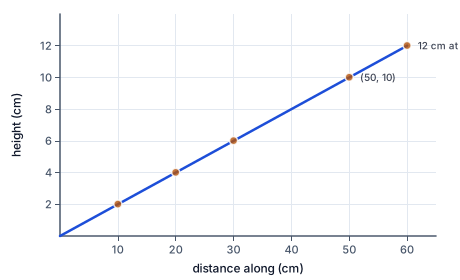
The figure plots the beam's points: they lie on one straight line, and following it up to 12 cm high lands at 60 cm along.
Because a beam goes straight, it rises (or falls) by the same amount for every equal step along. If a beam rises $2$ cm for every $10$ cm along a bench, then:
| Distance along | Height |
|---|---|
| 10 cm | 2 cm |
| 20 cm | 4 cm |
| 30 cm | 6 cm |
| 50 cm | 10 cm |
Plot those points and they lie on a straight line, which is what a straight beam looks like on a graph.
You can run the table backward too. To find where the beam reaches a shelf $12$ cm high, ask how many rises of $2$ cm make $12$: six. Six steps of $10$ cm is $60$ cm along. That is how engineers aim lasers and how architects work out where sunlight through a window will fall.
Whenever you explain where light goes, run three checks on the explanation.
First, is every leg straight? Draw each part of the journey with a ruler. If any part of your drawing curves, something is wrong, because light never curves on its own between one surface and the next.
Second, does every leg start at a source or a surface? A new straight leg can only begin where light leaves a lamp or bounces off something. Light does not start a new direction in the middle of empty air.
Third, for seeing, does the last leg end in the eye? If you are explaining how someone sees a thing, the final straight line must run from that thing into their eye, not out of their eye toward the thing.
An explanation that passes all three is almost always right. An explanation that fails one of them usually hides one of the two common mistakes: light bending around an edge, or eyes sending something out. Both are easy to spot once you ask these questions, and fixing them turns a guess into a prediction you can test with a lamp and a card.
Carpenters and builders use a laser level to mark straight lines across a wall or floor. The laser sends out a thin beam that travels perfectly straight, so a red line appears exactly level across a whole room.
Suppose the laser sits $100$ cm up a wall and is tilted to rise $1$ cm for every $50$ cm across. On the far wall, $400$ cm away, the beam is $400 \div 50 = 8$ steps along, so it has risen $8 \times 1 = 8$ cm, to $108$ cm. A carpenter installing a sloped railing up some stairs uses exactly this reasoning.
Surveyors use the same idea over much longer distances, aiming a laser across a field to measure how much the ground rises. None of it would work if light wandered about on the way.
The Moon makes no light of its own. What you see on a clear night is sunlight that traveled in a straight line from the Sun to the Moon, bounced off its gray rocks, and traveled in another straight line about $384{,}000$ km to your eye.
Light is so fast that this second leg takes only about $1.3$ seconds. The whole trip from the Sun to the Moon and then to Earth takes about $8.5$ minutes.
The Moon's phases come from the same straight lines. We only see the part of the Moon that is lit by the Sun and also turned toward us. As the Moon goes around the Earth, that part grows and shrinks, from a thin crescent to a full Moon and back again. Astronomers at NASA predict every phase years ahead by drawing straight lines between the Sun, the Moon and the Earth.
Drawing a shadow, learners often let a bit of the light curve around the edge of the object to soften it, or sketch light creeping around a corner into the next room. Both come from a true observation — dark places are rarely completely dark — and the wrong explanation for it.
The right explanation is bouncing, not bending. Light that reaches the hallway around the corner got there by hitting a wall and setting off again in a new straight line. Every leg of every journey is straight; there are simply a great many legs.
A second mistake is thinking eyes send out something to see with. They do not; light comes in. The test to apply is always the same: can you draw a straight line from the source to the place, without going through anything solid? If not, no light gets there directly — and anything that does arrive has bounced off something you can point to.
Line up the three things.
$\text{lamp, block, screen}$
On one straight bench.
Draw a ray past the top of the block.
$\text{lamp} \to \text{top edge} \to \text{screen}$
One straight ray.
Mark where it lands.
$\text{the top edge of the shadow}$
Everything above is lit; below, the block is in the way.
Do the same past the bottom.
$\text{the bottom edge of the shadow}$
Two rays give both edges.
Read the prediction.
$\text{dark between the two marks}$
You knew it before the lamp was switched on.
Draw a line to your eye.
$\text{flashlight} \to \text{eye}$
Try the direct route first.
Check what it hits.
$\text{the wall is in the way}$
So no light arrives directly.
Say what you see.
$\text{not the flashlight itself}$
No straight line reaches you from it.
Find a two-leg route.
$\text{flashlight} \to \text{far wall} \to \text{eye}$
The far wall is in view of both.
Explain the faint glow.
$\text{light reflected off the far wall}$
You see the lit wall, not the flashlight.
Check every leg.
$\text{two straight legs, not one bent one}$
The rule holds on each leg.
Find the source.
$\text{the ceiling light}$
It makes its own light.
Follow the first leg.
$\text{light} \to \text{book}$
A straight line down to the shelf.
Follow the bounce.
$\text{book reflects light in all directions}$
Its surface is rough at a tiny scale.
Follow the last leg.
$\text{book} \to \text{eye}$
A few rays happen to go straight into your eye.
Turn the light off.
$\text{no source: nothing seen}$
With no light to reflect, the book is invisible.
Put a box in the way.
$\text{box blocks the last leg}$
An opaque box stops the straight line to your eye.
State what seeing needs.
$\text{source, object, straight path to eye}$
Take away any one and the book cannot be seen.
Name how sunlight arrives.
$\text{in straight lines}$
From one very distant source.
Say what the object does.
Find the edge.
A flashlight is switched on in a hallway. You are standing around the corner, out of sight of it. Why can you not see the flashlight itself?
Complete the worked solution: a laser beam rises $6$ cm for every $20$ cm it travels along a table. How high is it at $40$ cm, $100$ cm and $160$ cm along?
Work out 40 cm along.
$\text{two steps} \times 6 =$ p cm
Forty centimeters is two steps of twenty.
Work out 100 cm along.
$\text{five steps} \times 6 =$ q cm
A straight beam adds the same rise every step.
Work out 160 cm along.
$\text{eight steps} \times 6 =$ s cm
Eight steps of twenty.
Match each everyday observation to what it shows about light.
| light does not curl around the edge of an object | the path light takes can be seen, and it is straight | light gets through exactly when a straight line can | light cannot reach a place no straight line reaches | |
|---|---|---|---|---|
| a shadow with a sharp edge | ||||
| a sunbeam showing up in dusty air | ||||
| a lamp seen through three holes only when they line up | ||||
| a flashlight around a corner that cannot be seen |
Three cards, each with a small hole punched in the middle, are stood up between a lamp and your eye. Put the steps of the demonstration in order.
Number the steps in order (write the number in the box):
A lamp shines past a block onto a screen. Click the part of the picture that shows the path the light took to get from the lamp to the top edge of the dark band.
This task has no paper form; do it on a device.
On a straight bench, a small wooden cube stands $25$ cm from the lamp and the screen is $100$ cm from the lamp. How far is the object from the screen?
Answer: unit: m / cm / km / mm
A narrow beam leaves a lamp at the corner of a grid and rises $3$ cm for every $2$ cm it goes along the bench. Mark where it is at $2$ cm, at $4$ cm and at $6$ cm along.
Plot your answer on the grid:
A narrow beam of light leaves a flashlight lying on a bench and rises $2$ cm for every $10$ cm it travels along the bench. Fill in its height above the bench at $30$ cm, $50$ cm and $80$ cm along, and how far along it is when it reaches a shelf $12$ cm high.
| value | |
|---|---|
| height at 30 cm along (cm) | |
| height at 50 cm along (cm) | |
| height at 80 cm along (cm) | |
| distance along to reach the shelf (cm) |
A closed box has a tiny hole in one end and thin paper across the other. Pointed at a candle, the paper shows a small picture of the flame — upside down. Why upside down?
Lesson test: one question per skill, one attempt each, no hints. Your answers are checked when you submit.
A narrow beam leaves a lamp at the corner of a grid and rises $2$ cm for every $2$ cm it goes along the bench. Mark where it is at $2$ cm, at $4$ cm and at $6$ cm along.
Plot your answer on the grid:
You can decide whether light reaches a place by asking whether a straight line does. Tell someone why a lit room is not evidence that light bends around things.
17. Your turn: why does a shadow on a sunny day have such a sharp edge?, step 2
$\text{stops the rays that would hit that patch}$
It is opaque.
17. Your turn: why does a shadow on a sunny day have such a sharp edge?, step 3
$\text{where the last unstopped line lands}$
Nothing curls around, so the edge is sharp.