Back to the on-screen lesson ·
A shadow as the patch a screen misses out on, its size as one division and one multiplication, and how sunlight shadows measure tall things.
Paper packet. Every task here also exists on screen, where it is checked automatically; answers written on paper are not assessed by Nydus. When you are back at a device, enter your answers there.
You will work out how tall a shadow will be from the object's height and the two distances from the lamp, predict what happens when something is moved, and use a shadow in sunlight to measure something too tall to reach.
From the last lesson: light goes in straight lines, and you can predict where it reaches by drawing them. A shadow is what you get where those lines cannot reach, so everything here is that one rule with a ruler attached.
You can also divide to find how many times bigger one number is than another, and multiply to make something that many times bigger. Those two moves are all the arithmetic shadows need.
| Term | What it means |
|---|---|
| Opaque | Something light cannot pass through. |
| Shadow | The part of a surface that an opaque object has kept light off. |
| Screen | Whatever the shadow falls on: a wall, a sheet of paper, the ground. |
| Multiplier | How many times bigger the shadow is than the object. |
| Parallel | Running side by side and never meeting, like train rails. |
| Point source | A light small enough that its rays spread from one spot. |
A flashlight, a 4 cm plastic figure and a white wall. Both distances are measured from the flashlight, and the shadow is measured on the wall.
| Flashlight to figure | Flashlight to wall | Shadow |
|---|---|---|
| 30 cm | 60 cm | 8 cm |
| 30 cm | 90 cm | 12 cm |
| 30 cm | 120 cm | 16 cm |
| 20 cm | 100 cm | 20 cm |
| 40 cm | 80 cm | 8 cm |
The same 4 cm figure in every row, never bent or swapped. So what decides the shadow?
Use the first three rows, where only the wall moves, to find a rule. Then test it on the last two, where both distances change — a rule that fits three rows and fails the fourth is not the rule. Then predict a row you have not been given: figure 25 cm from the flashlight, wall 75 cm from it.
Light leaves the lamp in straight lines. An opaque object stops some of them. The screen behind it gets light everywhere except in the patch those stopped lines were heading for — and that patch is the shadow.
So a shadow is not something the object emits, and it is not the object's own size. It is a gap, and its size is decided by where everything is standing.
The arithmetic is one division and one multiplication:
$$\text{how many times bigger} = \frac{\text{lamp to screen}}{\text{lamp to object}}$$
and then the shadow is the object's height multiplied by that. A 5 cm toy, 20 cm from a lamp, with the screen 60 cm from the lamp: $60 \div 20 = 3$, so the shadow is $5 \times 3 = 15$ cm tall.
Another way: action
Hold your hand between a flashlight and a wall. Near the flashlight, the shadow swallows the wall. Slide your hand until it nearly touches the wall and the shadow shrinks to about hand-sized. Your hand never changed.
Another way: steps
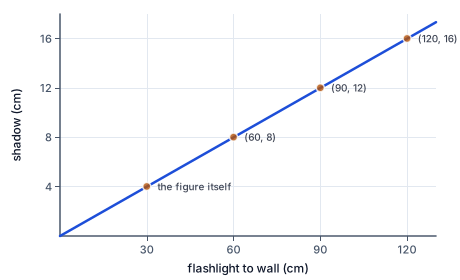
The figure plots the first three rows of the flashlight table: the shadow grows in a straight line with the distance to the wall, so twice the distance gives twice the shadow.
The rays leave the lamp from one point and spread apart as they go. Two rays that are 5 cm apart when they pass the object are 15 cm apart by the time they have gone three times as far, because they keep opening out at the same rate.
So the only question is how many times as far, and that is a division of the two distances — both of them measured from the lamp, which is the part most often got wrong. Measuring the object-to-screen gap instead gives the wrong multiplier every time.
Check it against the readings you started with. The fourth row there has the figure 20 cm from the flashlight and the wall 100 cm from it: five times as far, five times as tall, and the shadow was indeed 20 cm. The fifth row has the figure further out at 40 cm, only twice as far, and the shadow shrank to 8 cm — which is the rule anyone can check at home with a flashlight.
The Sun is about $150$ million kilometers away. From that far, the rays that reach a playground are, for all practical purposes, parallel: they arrive side by side instead of spreading from a nearby point.
That changes the rule. With parallel rays, a shadow does not grow the further away the ground is. Instead, at any one moment, every shadow is the same number of times the height of the thing casting it. If a $1$ m stick casts a $2$ m shadow, a $5$ m tree casts a $10$ m shadow, and a $9$ m flagpole casts an $18$ m shadow.
That gives a way to measure something too tall to reach. Measure a stick and its shadow, measure the tall thing's shadow, and divide. People have measured trees, towers and even pyramids this way for thousands of years.
In sunlight, the length of every shadow changes as the Sun moves across the sky.
| Time | Sun | Shadow of a 1 m stick |
|---|---|---|
| early morning | low in the east | long, pointing west |
| noon | highest in the south | shortest, pointing north |
| late afternoon | low in the west | long, pointing east |
A low Sun sends its rays in at a shallow slant, so the patch they miss behind an object is long. A high Sun sends them in steeply, so the patch is short. The shadow always points away from the Sun, because it is on the far side of the object from where the light comes. That is why people could tell the time with a sundial long before clocks were invented.
A very small lamp, like a single LED, makes a shadow with a sharp edge: every ray comes from one spot, so each part of the screen is either fully lit or fully blocked.
A big lamp, like a wide window or a large lampshade, makes a shadow with a fuzzy edge. Near the edge, some parts of the lamp are blocked and others are not, so the screen there is partly lit. The middle of the shadow, where the whole lamp is blocked, is fully dark; the fuzzy ring around it is partly dark.
Straight lines explain both. Draw rays from each edge of a big lamp past the object, and the fuzzy ring appears between them. Nothing bends; there are just rays coming from many places at once.
Run three checks on every shadow calculation.
In sunlight, the check is different: every shadow should be the same number of times its object's height. If your flagpole's shadow-to-height number does not match the stick's, one of the measurements has gone wrong.
In shadow puppet shows, performers hold flat puppets between a bright lamp and a white cloth screen. The audience sits on the other side and sees only the shadows.
A puppeteer can make a character grow or shrink without changing the puppet at all. With the lamp $2$ m from the screen, a $20$ cm puppet held $1$ m from the lamp casts a shadow $2 \div 1 = 2$ times its size: $40$ cm. Moving it to $50$ cm from the lamp makes the multiplier $200 \div 50 = 4$, so the shadow grows to $80$ cm, a giant looming over the audience.
Shadow theater is centuries old in China, Indonesia and Turkey, and the performers learned the rule by practice long before anyone wrote it as a division.
The Washington Monument in Washington, D.C., is about $169$ m tall. A class on a field trip could check that with a meter stick and the Sun.
Suppose, at one moment on a spring afternoon, the meter stick casts a shadow $0.8$ m long. The stick's shadow-to-height number is $0.8 \div 1 = 0.8$. At the same moment, the monument's shadow is paced out at about $135$ m. Working backward, its height is $135 \div 0.8 \approx 169$ m.
The ancient Greek thinker Thales is said to have measured the height of a pyramid in Egypt the same way, more than two and a half thousand years ago. The method works because the Sun is so far away that its rays arrive parallel, and straight parallel rays make every shadow scale alike.
The first idea most learners have is that a shadow is a dark copy of the thing, attached to it and the same size as it. Then a shadow that is three times too tall, or one that changes as somebody walks across the room, looks like a trick.
It is not. A shadow is a patch on a screen, and it belongs to the arrangement rather than to the object: move the lamp, the object or the screen and it changes. The only thing the object decides is which rays get stopped.
Two smaller errors come from the same idea. Measuring from the object instead of the lamp — both distances have to start at the lamp, because that is where the rays start spreading from. And expecting a shadow to be smaller than the object, as it would be if it were a copy seen from further away. With a nearby lamp it is always bigger, and the further the screen, the bigger it gets.
In sunlight a third slip appears: thinking a shadow shows a thing's height directly. A morning shadow can be twice as long as the tree that casts it and a noon shadow much shorter. Only the comparison with a measured stick turns a shadow into a height you can trust at any hour.
Read the measurements.
$5\ \text{cm tall}, \ 20\ \text{cm and } 60\ \text{cm from the lamp}$
Both distances from the lamp.
Divide the distances.
$60 \div 20 = 3$
The screen is three times as far.
Multiply the height.
$5 \times 3 = 15\ \text{cm}$
The shadow's height.
Check it is bigger.
$15 > 5$
A nearby lamp makes a bigger shadow.
State the final answer.
$\text{a } 15\ \text{cm shadow}$
Three times the soldier's height.
Read the new position.
$10\ \text{cm from the lamp, screen still at } 60\ \text{cm}$
Only the soldier moved.
Divide the distances.
$60 \div 10 = 6$
Now six times as far.
Multiply the height.
$5 \times 6 = 30\ \text{cm}$
The new shadow.
Compare with before.
$30 \text{ against } 15$
Twice as tall.
Explain the change.
$\text{half the distance, twice the multiplier}$
Halving the bottom of the division doubles the answer.
Check the moving rule.
$\text{closer to the lamp: bigger shadow}$
As the checks say it must.
Measure a stick and its shadow.
$1\ \text{m stick}, \ 1.5\ \text{m shadow}$
At one moment of the day.
Find the shadow-to-height number.
$1.5 \div 1 = 1.5$
Every shadow is 1.5 times its height right now.
Measure the tree's shadow.
$12\ \text{m}$
At the same moment.
Work backward to the height.
$12 \div 1.5 = 8\ \text{m}$
Divide to undo the multiplying.
Check the number.
$12 \div 8 = 1.5$
The same as the stick's.
Explain why it works.
$\text{the Sun's rays are parallel}$
So every shadow scales the same way.
State the final answer.
$\text{the tree is } 8\ \text{m tall}$
Measured without climbing it.
Divide the distances from the lamp.
$100 \div 25 = 4$
How many times as far.
Multiply the height.
Check it is bigger.
a matchbox is $30$ cm from the lamp, with the screen $60$ cm from the lamp, and its shadow is $10$ cm tall. The object is now slid closer to the lamp, with the lamp and screen left where they are. What happens to the shadow?
Complete the worked solution: a paper puppet $7$ cm tall is held $30$ cm from a lamp, and the screen is $90$ cm from the lamp. How tall is the shadow, and how tall if the screen is moved twice as far from the lamp?
Find the multiplier.
$90 \div 30 =$ a
How many times further the screen is.
Find the shadow's height.
$7 \times \text{multiplier} =$ b cm
The height, that many times over.
Move the screen twice as far.
$\text{twice the multiplier} \times 7 =$ c cm
Twice as far from the lamp doubles the multiplier, and so the shadow.
A lamp is $30$ cm from a pencil standing on its end and $90$ cm from the screen behind it. How many times further from the lamp is the screen than the object?
Answer:
A lamp shines past a block onto a screen. Click the shadow.
This task has no paper form; do it on a device.
Two arrangements on the same bench. Work out how many times bigger the shadow is, and then how tall it is.
| how tall the object is (cm) | lamp to object (cm) | lamp to screen (cm) | how many times bigger | how tall the shadow is (cm) | |
|---|---|---|---|---|---|
| a pencil standing on its end | 4 | 30 | 90 | ||
| an eraser | 2 | 15 | 60 |
a matchbox, $5$ cm tall, stands $30$ cm from a lamp. A screen is $60$ cm from the same lamp. How tall is the shadow on the screen?
Answer: unit: m / cm / km / mm
The screen is $90$ cm from the lamp. Mark how far from the lamp a pencil standing on its end must stand so that its shadow is exactly twice as tall as it is.
0 |——————————| 160
Mark the position with a cross, then write the value:
On a sunny morning, a student stands a stick $1$ m tall upright on the playground. Its shadow is $3$ m long. At the same moment, the school's flagpole casts a shadow $24$ m long. How tall is the flagpole?
Answer: unit: m / cm / km / mm
At a sleepover, you hold your hand in front of a small lamp to make a shadow puppet on the wall. Your hand is $11$ cm across. The wall is $2$ times as far from the lamp as your hand is. How wide is the shadow?
Answer: unit: m / cm / km / mm
Lesson test: one question per skill, one attempt each, no hints. Your answers are checked when you submit.
Two arrangements on the same bench. Work out how many times bigger the shadow is, and then how tall it is.
| how tall the object is (cm) | lamp to object (cm) | lamp to screen (cm) | how many times bigger | how tall the shadow is (cm) | |
|---|---|---|---|---|---|
| a paper cut-out of a cat | 6 | 40 | 120 | ||
| a small wooden cube | 3 | 25 | 100 |
You can predict a shadow's size before anyone switches the lamp on. Tell someone why holding your hand close to a flashlight makes such a big shadow.
17. Your turn: a 3 cm cube, 25 cm from the lamp, screen at 100 cm. How tall is the shadow?, step 2
$3 \times 4 = 12\ \text{cm}$
The shadow's height.
17. Your turn: a 3 cm cube, 25 cm from the lamp, screen at 100 cm. How tall is the shadow?, step 3
$12 > 3$
A nearby lamp makes a bigger shadow.