Back to the on-screen lesson ·
Measuring how a magnet's pull falls as the gap grows, with a fair test and a table.
Paper packet. Every task here also exists on screen, where it is checked automatically; answers written on paper are not assessed by Nydus. When you are back at a device, enter your answers there.
You will run a fair test of a magnet's pull at different gaps, record the readings, turn clips into grams, and describe and use the pattern: bigger gap, weaker pull.
From the last lesson: a magnet pulls on steel across a gap, and you can measure its strength by the mass of clips it holds. From earlier lessons you can take readings, write them in a table, and turn clips into grams.
This lesson asks what happens to that pull when the gap gets bigger, and answers it with measurements rather than a guess.
| Term | What it means |
|---|---|
| Gap | The distance between the magnet and the thing it pulls. |
| Spacer | A piece of cardboard used to make a gap of a set size. |
| Fair test | An experiment where only one thing is changed on purpose. |
| Pattern | The way a set of readings changes, such as always going down. |
| Cause | What was changed: here, the gap. |
| Effect | What changed because of it: here, the number of clips held. |
A class hangs steel paper clips from a magnet, one below another, until one more clip would make the chain fall. Then they slide a $1$ cm piece of cardboard between the magnet and the top clip and count again. Then $2$ cm, $3$ cm and $4$ cm.
| Gap between magnet and clips | Clips held |
|---|---|
| 0 cm | 12 |
| 1 cm | 8 |
| 2 cm | 5 |
| 3 cm | 3 |
| 4 cm | 2 |
Before reading on, decide three things.
What happens to the pull as the gap grows? Look down the second column.
Does it drop by the same number of clips each time? Work out each drop: $12$ to $8$, $8$ to $5$, and so on.
What would you expect at $5$ cm? Make a prediction from the pattern, and say why you think it is not zero.
A magnet's pull reaches across a gap, but it does not reach equally far in every direction forever. The bigger the gap, the weaker the pull.
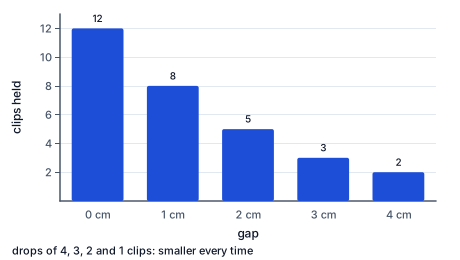
The measurements show more than that. The pull does not fall by the same amount each centimeter. It falls fast close to the magnet and slowly further away. In the class's table, the first centimeter cost $4$ clips, the second $3$, the third $2$, and the fourth only $1$.
In the language of science, the gap is the cause and the number of clips held is the effect. A fair test changes only the cause, keeps everything else the same, and records the effect every time.
Another way: action
Hold a magnet close to a paper clip on a table, then a little further, then further still. Find the distance where the clip just stops jumping to the magnet.
Another way: steps
What happens to the pull. It gets weaker. Every row down the table holds fewer clips than the row above.
Whether it drops by the same number. It does not. The drops are $4$, $3$, $2$ and $1$ clips. The pull falls fastest right next to the magnet, and more slowly the further away you go.
What to expect at 5 cm. Probably $1$ clip, or none. Each drop is smaller than the last, so the count creeps toward zero rather than crashing through it. A good prediction follows the pattern, and then the class can test it by adding one more spacer. If the reading agrees with the prediction, the pattern is more believable.
A result only tells you about the gap if the gap is the only thing that changed. So a careful class keeps these the same every time:
If a student switched to a bigger magnet halfway through, the count might go up even though the gap got bigger, and nobody could tell which change caused what. Changing one thing at a time is what lets you say the gap caused this.
Counting clips works, but grams let you compare with other experiments. If every clip is $2$ g, the table becomes:
| Gap | Clips | Mass held |
|---|---|---|
| 0 cm | 12 | 24 g |
| 1 cm | 8 | 16 g |
| 2 cm | 5 | 10 g |
Now another class using heavier clips can still compare: their magnet might hold $6$ clips of $4$ g, which is also $24$ g. Converting to a standard unit makes results from different people fit together, which is exactly why scientists agree on units.
The bar chart shows the class's table: each bar is shorter than the last, by less each time.
Plot the table with the gap along the bottom and the clips up the side. The points fall steeply at the left and then level out toward the right, making a curve like a slide that flattens at the bottom.
A straight line going down would mean the same drop every centimeter. The curve shows at a glance that the drops get smaller. That is the kind of pattern that is easy to miss in a list of numbers and easy to see in a picture.
Before you write the further away, the weaker the pull, run three checks.
The third check is what turns a list of numbers into science: a pattern that you can use to predict, and then check against a new measurement.
A good scientist asks whether the cardboard itself did anything. So the class tries the same test with spacers made of different things, all $1$ cm thick: cardboard, wood, plastic and a stack of paper.
Every one gives the same count, within a clip. The magnet does not pull on any of them, so none of them blocks or weakens the pull. What mattered was only how far they held the clips from the magnet.
Then someone tries a spacer made of a thin steel plate, and the result is completely different: the magnet grabs the steel plate itself, and hardly any clips hang below it. That is not a failed experiment. It is a new discovery: a magnetic material in the gap changes things in a way a nonmagnetic one does not. Testing more than one material is how the class found that out.
Picture a magnet's pull spreading out from its pole in every direction, like the light from a flashlight spreading across a room. Close to the pole, the pull is packed into a small space, so it is strong. Further away, the same pull is spread over a much bigger space, so any one spot gets only a little of it.
That is why the pull fades quickly at first. Moving the first centimeter away spreads the pull over a much bigger region than before. Moving from $3$ cm to $4$ cm spreads it only a little more, because it was already spread thin.
Gravity and the light from a lamp both behave in a similar way: strong close by, weaker and weaker further away. Scientists in later grades describe exactly how fast each one falls off. For now, the rule to remember is the one the table shows: bigger gap, weaker pull, falling fastest close up.
Many kitchen cabinets close with a small magnet on the frame and a steel plate on the door. When the door is shut, the gap is almost zero and the pull is strong enough to hold it closed. Pull the door open just $1$ cm and the pull drops sharply, so it swings open easily.
Designers choose the magnet so that it holds the door against a small bump but lets go when a person pulls. If the steel plate is mounted with a $2$ mm gap instead of touching, the latch might hold only half as well, and the door could drift open.
The whole design depends on the pattern in this lesson: strong at no gap, much weaker just a little way off.
A mechanic drops a steel bolt behind an engine where no hand can reach. They use a telescoping pick-up tool with a small magnet on the end. Held right against the bolt, the magnet lifts it easily. Held $3$ cm away, it barely stirs it.
Suppose the tool can lift $200$ g touching, $80$ g at $1$ cm, and $30$ g at $2$ cm. A $50$ g bolt can be lifted when the magnet touches it or is $1$ cm away, but not from $2$ cm. So the mechanic has to get the tip right up to the bolt.
Knowing how quickly a magnet's pull falls with distance tells you how close you need to get, which is exactly what this lesson measured.
Most people guess that a magnet loses the same pull for every centimeter: a straight line down. The measurements say otherwise. The pull falls quickly close to the magnet and slowly further out.
A second mistake is to think the cardboard itself weakens the magnet, as if it soaked up the pull. It does not. Cardboard is not magnetic; it only holds the clips further away. A plastic or wooden spacer of the same thickness gives the same result, which is a good test anyone can try.
A third is to trust one reading. If one count looks odd, measure it again. Patterns come from several careful readings, not from one.
A last mistake is claiming more than the test showed. The table shows what one magnet does with one kind of clip. A different magnet will hold different numbers, though its pull will still fall with distance. Say what you measured, and be careful before stretching it further. If you want to claim something about all magnets, test several magnets the same fair way and see whether each one follows the same pattern before you write your conclusion down in your science notebook for others.
Read the first two counts.
$12 \text{ at } 0\ \text{cm}, \ 8 \text{ at } 1\ \text{cm}$
No gap, then one spacer.
Find the first drop.
$12 - 8 = 4 \text{ clips}$
The first centimeter.
Find the second drop.
$8 - 5 = 3 \text{ clips}$
The second centimeter.
Find the third drop.
$5 - 3 = 2 \text{ clips}$
The third centimeter.
Describe the pattern.
$\text{smaller drops each time}$
The pull falls fastest close to the magnet.
Recall the mass of a clip.
$2\ \text{g}$
Weighed on a kitchen scale.
Convert no gap.
$12 \times 2 = 24\ \text{g}$
Clips times grams.
Convert 1 cm.
$8 \times 2 = 16\ \text{g}$
The same rule.
Convert 2 cm.
$5 \times 2 = 10\ \text{g}$
The same rule.
Find the grams lost over 2 cm.
$24 - 10 = 14\ \text{g}$
More than half the hold is gone.
Check the direction.
$10 < 24$
Bigger gap, less mass held.
List the last three counts.
$5, \ 3, \ 2$
At 2, 3 and 4 cm.
List the drops between them.
$2, \ 1$
Getting smaller.
Guess the next drop.
$\text{about } 1 \text{ or less}$
The drops keep shrinking.
Predict the count at 5 cm.
$2 - 1 = 1 \text{ clip}$
Following the pattern.
Test the prediction.
$\text{add a fifth spacer and count}$
A prediction is only useful if you check it.
Compare with the reading.
$\text{measured: } 1 \text{ clip}$
The reading agrees.
State the conclusion.
$\text{the pattern predicted the new reading}$
That makes it more believable.
Find the clips lost.
$15 - 10 = 5 \text{ clips}$
Subtract the counts.
Turn them into grams.
Say what caused it.
A magnet holds $14$ clips with no gap, $9$ with a $1$ cm gap and $6$ with a $2$ cm gap. What happens to its pull as the gap grows?
Complete the worked solution: as the gap grows one centimeter at a time from nothing, a magnet holds $18$, then $12$, then $7$, then $4$ clips. How many clips are lost at each step?
Find the first drop.
$18 - 12 =$ a clips
From no gap to 1 cm.
Find the second drop.
$12 - 7 =$ b clips
From 1 cm to 2 cm.
Find the third drop.
$7 - 4 =$ c clips
Each drop is smaller than the one before: the pull falls fastest close up.
Put the steps of a fair test of a magnet's pull at different gaps in order.
Number the steps in order (write the number in the box):
A magnet holds $18$ clips with no gap and $12$ clips with a $1$ cm gap. How many fewer clips does it hold with the gap?
Answer: clips
Each paper clip has a mass of 2 g. Fill in the mass the magnet holds at each gap.
| clips held | mass held (g) | |
|---|---|---|
| 0 cm gap | 10 | |
| 1 cm gap | 7 | |
| 2 cm gap | 4 | |
| 3 cm gap | 2 | |
| 4 cm gap | 1 |
Plot the readings: $15$ clips at $0$ cm, $10$ at $1$ cm, $6$ at $2$ cm, $4$ at $3$ cm and $2$ at $4$ cm.
Plot your answer on the grid:
A magnet holds $14$ paper clips with no gap, and $6$ clips with a $2$ cm cardboard gap. Each clip has a mass of $2$ g. How many grams less does the magnet hold with the $2$ cm gap?
Answer: unit: g
A small magnet holds one sheet of paper on a refrigerator door. A student pins five thick sheets under it, and the whole stack slides down. Why?
Lesson test: one question per skill, one attempt each, no hints. Your answers are checked when you submit.
Each paper clip has a mass of 2 g. Fill in the mass the magnet holds at each gap.
| clips held | mass held (g) | |
|---|---|---|
| 0 cm gap | 12 | |
| 1 cm gap | 8 | |
| 2 cm gap | 5 | |
| 3 cm gap | 3 | |
| 4 cm gap | 2 |
You can describe how a magnet's pull changes with distance. Tell someone why a stack of paper makes a refrigerator magnet slide.
19. Your turn: a magnet holds 15 clips with no gap and 10 with a 1 cm gap. How many grams less, at 2 g a clip?, step 2
$5 \times 2 = 10\ \text{g}$
Two grams a clip.
19. Your turn: a magnet holds 15 clips with no gap and 10 with a 1 cm gap. How many grams less, at 2 g a clip?, step 3
$\text{the 1 cm gap}$
Only the gap changed.