Back to the on-screen lesson ·
A pendulum's steady swing, what sets its time, and how a measured pattern predicts what comes next.
Paper packet. Every task here also exists on screen, where it is checked automatically; answers written on paper are not assessed by Nydus. When you are back at a device, enter your answers there.
You will time a repeating motion, find the time for one repeat, predict how long many repeats will take, and say what does and does not change a pendulum's swing time.
You have ridden a swing and watched it go back and forth, and you have seen a ball bounce lower and lower. You also know how to time things with a stopwatch, share a time equally, and multiply.
This lesson puts those together. When something moves in a pattern, measuring the pattern lets you predict what it will do next, before it happens.
| Term | What it means |
|---|---|
| Pattern | Something that happens again and again in the same way. |
| Pendulum | A weight hanging from a string or rod, free to swing. |
| Swing | One trip back and forth, ending where it started. |
| Predict | Say what will happen before it happens, using a pattern. |
| Evidence | Measurements that show whether something is true. |
| Variable | Something you can change in an experiment, like the string's length. |
Many things move in patterns: a pendulum swings back and forth, a wheel goes round and round, the Moon goes around the Earth. In a pattern, the same thing happens again and again.
A pendulum's pattern is special: every swing takes the same time. That makes it easy to predict. Time ten swings. If they take $20$ seconds, then one swing takes $20 \div 10 = 2$ seconds. Then fifty swings should take $50 \times 2 = 100$ seconds.
What sets the time of each swing? A class can find out by changing one thing at a time. The answer surprises most people: the length of the string matters, but the size of the push and the weight on the end hardly matter at all.
Another way: action
Tie a washer to a piece of string and let it swing. Count the swings while a friend times ten of them. Then shorten the string and time ten swings again.
Another way: steps
A single swing might take only $2$ seconds, and starting and stopping a stopwatch by hand is always a little late. That small error could be a big part of $2$ seconds.
Timing ten swings takes $20$ seconds. The same small start-and-stop error is now a tiny part of the total. Dividing by ten afterward gives a much more accurate time for one swing.
This is the same idea as repeated readings: measure more of the pattern, and your answer gets more trustworthy. Scientists timing the swings of real pendulums often time fifty or a hundred of them for the same reason.
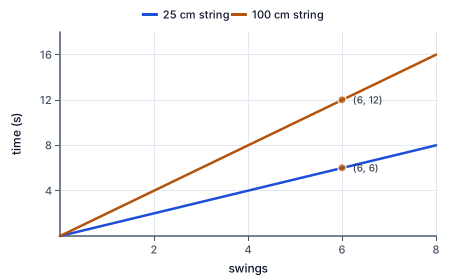
The figure plots total time against swings for both strings: two straight lines, and the longer string's is twice as steep.
A class tests one change at a time, timing ten swings each time:
| What they changed | Time for 10 swings |
|---|---|
| string 25 cm, small push | 10 s |
| string 25 cm, big push | 10 s |
| string 25 cm, heavy weight | 10 s |
| string 100 cm, small push | 20 s |
Pushing harder and adding weight left the time the same. Making the string four times longer doubled the time. So the length of the string is what sets the swing time. The Italian scientist Galileo noticed this more than 400 years ago, watching a lamp swing in a cathedral and timing it with his own pulse.
Once you know a pattern, you can use it to predict.
In each case, the evidence is a set of measurements that repeat in a steady way. A pattern you have measured is much more useful than one you have only guessed, because you can check your prediction and find out if the pattern still holds.
Why does a swinging pendulum keep going but slowly swing lower? At the top of each swing, the pull of the Earth brings it back down; at the bottom, it carries on moving past the middle. Those pulls keep the pattern going.
But air rubs against the weight a little on every swing. That small push against the motion is not balanced by anything, so each swing is a tiny bit smaller than the last, until the pendulum stops. A pendulum clock has a spring or a falling weight that gives it a tiny push each swing to keep it going.
When the pushes on something are balanced, its motion does not change. When they are unbalanced, it speeds up, slows down or changes direction. You will study that rule properly in a later course.
Run three checks on any prediction from a pattern.
Then test it: time the fifty swings and see whether the answer matches. A prediction that matches is evidence the pattern is real.
Drop a ball from $100$ cm and measure how high it bounces back each time. One class found $60$ cm, then $36$ cm, then about $22$ cm. Each bounce reached a little more than half the height of the one before.
That is a different kind of pattern from the pendulum. The pendulum's swings stay the same length of time; the ball's bounces get smaller in a steady way. But it is still a pattern, and it still lets you predict. If each bounce is about six tenths of the last, the next one after $22$ cm should be about $13$ cm.
Different balls have different patterns. A tennis ball keeps more of its bounce than a ball of clay, which hardly bounces at all. Measuring the pattern tells you which ball is bouncier, with numbers instead of a guess.
Picture a short pendulum and a long one, both pulled a little to the side and let go. The weight on the short string sits on a tight little curve, and the Earth's pull brings it back to the middle quickly. The weight on the long string sits on a wide, gentle curve, so it has further to travel and slopes back more gently. It takes longer to come back.
That is why length matters so much. It is also why a bigger push does not matter: starting further out means further to travel, but the steeper slope out there makes the weight move faster, and the two balance out.
Scientists in later courses write this as a formula. For now, the measured rule is enough: a longer pendulum makes slower swings, and a string four times as long makes each swing take twice as long.
Some of the most important patterns people have ever measured are in the sky. The Sun rises and sets once a day. The Moon goes through its phases, from new to full and back again, about every $29.5$ days. The seasons repeat every year.
Long before clocks, people used these patterns to predict. Farmers planted crops when the days grew longer in spring. Sailors timed voyages by the Moon's phases, because the Moon also drives the tides. Today astronomers at NASA predict eclipses hundreds of years ahead, using exactly the idea in this lesson: measure a pattern carefully, then use it to say what will happen next, and check.
A grandfather clock keeps time with a long pendulum. Each swing takes exactly one second, so the clock ticks sixty times a minute. Its pendulum is about one meter long, because that is the length that gives a one-second swing.
If the clock runs slow, losing a minute a day, its pendulum is a little too long. The owner turns a small nut under the weight to raise it and shorten the pendulum. If it runs fast, they lower the weight. In one day there are $86{,}400$ seconds, so a pendulum that is off by just one second in every $1{,}440$ swings loses a minute a day.
The whole clock depends on the pattern this lesson measured: every swing takes the same time, and the length decides what that time is.
Playground designers know that long swings feel slow and graceful, while short swings feel quick. A swing with $3$ m chains takes about $3.5$ seconds for a full swing; a toddler swing with $1$ m chains takes about $2$ seconds.
When you pump your legs to go higher, you make each swing wider, but the time for each swing hardly changes. That is why two friends on identical swings, pushed at different heights, can still swing in step with each other.
Next time you are on a swing, count your swings while a friend times you. Time ten of them, divide by ten, and predict how long twenty will take. Then check it. You will be doing exactly what Galileo did four hundred years ago.
Most people guess that pushing a swing harder makes each swing take longer, because it goes further. It does go further, but it also goes faster, and the two cancel out: each swing takes about the same time.
A second guess is that a heavier child on a swing swings more slowly. Measurements show that weight hardly matters. Two swings with chains of the same length keep time together, whoever is sitting on them.
What does change the time is the length of the string or chain. A longer pendulum swings more slowly. The only way to be sure of any of this is to test it: change one thing, time ten swings, and compare.
A last mistake is predicting from too few readings. One timing of ten swings might be a little off. Timing ten swings three times and using the best estimate gives a pattern you can trust before you use it to predict anything far ahead. The further ahead you predict, the more a small error in the time for one swing grows, so a careful measurement matters most for a long prediction, like the ticking of a clock over a whole week or even a month.
Time ten swings.
$20\ \text{s}$
Start and stop the watch as it passes the same point.
Notice the pattern.
$\text{every swing takes the same time}$
So the time can be shared equally.
Find one swing.
$20 \div 10 = 2\ \text{s}$
Ten equal swings.
Predict fifty swings.
$50 \times 2 = 100\ \text{s}$
Each swing adds two seconds.
Check the size.
$100 = 5 \times 20$
Five times as many swings, five times as long.
Time ten small swings.
$10\ \text{s}$
String 25 cm, a gentle push.
Change only the push.
$\text{a bigger push, same string}$
A fair test: one change.
Time ten wide swings.
$10\ \text{s}$
The same stopwatch method.
Compare the times.
$10 = 10$
No difference.
State the finding.
$\text{push size does not change swing time}$
It changes how wide the swing is.
Check against the other test.
$\text{longer string: } 20\ \text{s}$
Length changed the time; push did not.
Read the problem.
$\text{the clock loses time}$
Its swings are taking too long.
Find what sets swing time.
$\text{the pendulum's length}$
From the class's test.
Decide the change.
$\text{shorten the pendulum}$
Shorter means quicker swings.
Time ten swings before.
$21\ \text{s}$
It should be 20.
Shorten it a little and time again.
$20\ \text{s}$
Each swing now takes 2 seconds.
Check a longer prediction.
$1800 \text{ swings} \times 2 = 3600\ \text{s} = 1\ \text{h}$
One hour of ticks.
State the fix.
$\text{a shorter pendulum keeps better time}$
Clockmakers adjust it with a small screw.
Find one swing.
$15 \div 10 = 1.5\ \text{s}$
Ten equal swings.
Multiply by thirty.
Check the size.
A class wants each swing of their pendulum to take longer. Which change will do it?
Complete the worked solution: ten swings of a pendulum take $16$ seconds. How long does one swing take, and how long will twenty and forty swings take?
Find one swing.
$16 \div 10 =$ a s
Ten equal swings share the time.
Predict twenty swings.
$\text{one swing} \times \text{twenty} =$ b s
Twice the ten-swing time.
Predict forty swings.
$\text{one swing} \times \text{forty} =$ c s
Four times the ten-swing time.
Match each moving thing to the pattern it repeats.
| back and forth | round and round | up and down | |
|---|---|---|---|
| a clock's pendulum | |||
| a bicycle wheel spinning | |||
| a ball bouncing on the floor |
Ten swings of a pendulum take $12$ seconds. How long does one swing take?
Answer: unit: s
Ten swings of a pendulum take $20$ seconds. Fill in how long $5$, $20$ and $30$ swings should take.
| time (s) | |
|---|---|
| 5 swings | |
| 20 swings | |
| 30 swings |
Each swing of a pendulum takes $3$ seconds. Plot the total time after $2$, $4$ and $6$ swings.
Plot your answer on the grid:
A class times a pendulum: ten complete swings take $10$ seconds. Using the pattern, how long should $45$ swings take?
Answer: unit: s
On the playground, a small child and a big child sit on two identical swings hanging from the same bar, and are pushed gently. Whose swings take longer, back and forth?
Lesson test: one question per skill, one attempt each, no hints. Your answers are checked when you submit.
Ten swings of a pendulum take $15$ seconds. Fill in how long $5$, $20$ and $30$ swings should take.
| time (s) | |
|---|---|
| 5 swings | |
| 20 swings | |
| 30 swings |
You can predict from a pattern of motion. Tell someone why timing ten swings is better than timing one.
19. Your turn: ten swings take 15 seconds. How long do thirty swings take?, step 2
$30 \times 1.5 = 45\ \text{s}$
Each swing adds the same time.
19. Your turn: ten swings take 15 seconds. How long do thirty swings take?, step 3
$45 = 3 \times 15$
Three times as many swings.