Back to the on-screen lesson ·
Mass defects and binding energies from measured masses, the binding-energy curve and its peak near iron, nuclear radii and density, and why fusion and fission release energy.
Paper packet. Every task here also exists on screen, where it is checked automatically; answers written on paper are not assessed by Nydus. When you are back at a device, enter your answers there.
By the end of this lesson you will be able to compute mass defects and binding energies, read the binding-energy curve, and estimate nuclear sizes.
From unit 1 you know that mass and energy are equivalent, $E = mc^2$, and that a bound system has less rest energy than its parts. From chemistry you know atomic masses, isotopes and Avogadro's number. This lesson applies $E = mc^2$ to nuclei, where the effect is a million times larger than in chemistry and can be weighed directly.
| Term | What it means |
|---|---|
| Nucleon | A proton or neutron. |
| Mass number | $A = Z + N$, the number of nucleons. |
| Atomic mass unit | $1$ u $= 1.6605 \times 10^{-27}$ kg $= 931.5$ MeV/$c^2$, one-twelfth the mass of a carbon-12 atom. |
| Mass defect | $\Delta m = Zm_{\text{H}} + Nm_n - M$, the mass lost in forming the nucleus. |
| Binding energy | $\Delta mc^2$, the energy needed to separate a nucleus into its nucleons. |
| Binding energy per nucleon | $BE/A$, highest near iron and nickel at about $8.8$ MeV. |
| Strong force | The short-range attraction between nucleons that holds nuclei together. |
A helium-4 atom weighs $4.002603$ u, but two hydrogen atoms and two neutrons weigh $4.032980$ u. The difference, the mass defect, is the mass equivalent of the energy released when the nucleus formed, the energy that would have to be supplied to take it apart:
$$BE = \Delta m\,c^2, \qquad \Delta m = Zm_{\text{H}} + Nm_n - M.$$
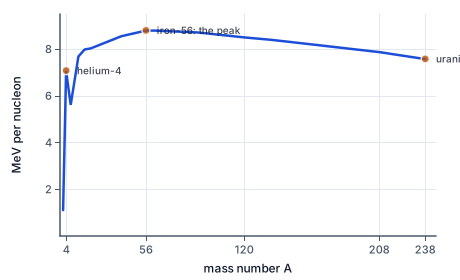
With $1$ u $= 931.5$ MeV/$c^2$, helium-4's mass defect of $0.030377$ u is a binding energy of $28.3$ MeV, or $7.07$ MeV per nucleon. Plotting binding energy per nucleon against $A$ gives a curve that rises steeply for light nuclei, peaks near iron-56 and nickel-62 at about $8.8$ MeV, and declines slowly to about $7.6$ MeV for uranium. Nuclei are also all about as dense: their radii grow as $R = 1.2A^{1/3}$ fm, so their volumes grow in proportion to $A$.
Another way: picture
Picture two magnets snapping together: they release energy as heat and sound, and afterward you must do work to pull them apart. The joined pair has less energy than the separate magnets, by exactly the energy released. For magnets the difference in mass is far too small to weigh; for nuclei it is almost one percent, and a good balance can measure it.
Another way: steps
Tables list the masses of whole atoms, including electrons, not bare nuclei. Adding $Z$ hydrogen atoms, each a proton plus an electron, instead of $Z$ bare protons, brings along exactly the $Z$ electrons that the atom contains, so the electron masses cancel. The tiny binding energies of the electrons, a few eV to keV, are negligible next to the MeV binding of the nucleus.
Mass defects are small differences between large numbers, so masses must be known to six or more decimal places. Mass spectrometers, such as the Penning traps at the Michigan State University accelerator facility, weigh ions to a few parts in a billion, fine enough to detect nuclear binding in a single measurement.
The figure shows the curve: a steep climb through the light nuclei, the peak near iron, and a long, slow fall to uranium.
Deuterium, one proton and one neutron, is barely bound: $2.2$ MeV in all. Helium-4 is unusually tight at $7.1$ MeV per nucleon, which is why alpha particles are emitted as a unit. Carbon and oxygen are near $7.7$ to $8.0$ MeV. The curve peaks at iron-56 and nickel-62, about $8.8$ MeV, then falls gently to $7.6$ MeV for uranium-238.
The shape has two causes. Each nucleon is attracted only by its nearest neighbors through the short-range strong force, so small nuclei, with many nucleons on the surface, are less bound. In large nuclei, the electrical repulsion among many protons, which acts across the whole nucleus, grows faster than the attraction and pulls the curve down.
Energy is released whenever nucleons end up more tightly bound. Joining two light nuclei, fusion, moves up the steep left side of the curve: four protons forming helium-4 release about $27$ MeV. Splitting a heavy nucleus, fission, moves up the gentle right side: uranium breaking into two middle-weight nuclei gains about $0.9$ MeV per nucleon, around $200$ MeV in all.
Nothing releases energy by fusing iron or splitting it, since iron sits at the peak. That is why stars that have made iron in their cores run out of fuel and collapse, and why elements heavier than iron are made mostly in the violent events of supernovas and neutron-star mergers.
Scattering experiments, first by Robert Hofstadter at Stanford in the 1950s, show that nuclei have radii $R = 1.2A^{1/3}$ fm. The volume therefore grows in proportion to $A$: every nucleus has about $0.14$ nucleons per cubic femtometer, the same density, like drops of a liquid.
That density is about $2 \times 10^{17}$ kg/m³. A teaspoon of nuclear matter would weigh about a billion tons. Neutron stars are made of it: the mass of the Sun packed into a sphere about $20$ km across. The constant density is one reason the liquid-drop model, with volume, surface and electrical terms, describes the binding-energy curve so well.
Checking an answer. Mass defects must be positive for any stable nucleus. Binding energies per nucleon must lie between about $1$ MeV, for deuterium, and $8.8$ MeV, at the peak. A result much above $9$ MeV means an arithmetic slip. And radii must be a few femtometers, growing slowly with $A$.
Treating the mass defect as binding energy uses $E = mc^2$ for a bound system at rest: its rest energy includes the negative potential energy of binding. This is not special to nuclei. A hydrogen atom is lighter than a proton and an electron by $13.6$ eV$/c^2$, but that is one part in $10^8$, below what chemistry can weigh.
The formula $R = 1.2A^{1/3}$ fm is an empirical fit to scattering data, good to about ten percent for nuclei beyond the lightest. It follows from nucleons packing at constant density, which itself reflects the short range of the strong force and its repulsive core at very small distances.
Burning a mole of methane releases about $890$ kJ. By $E = mc^2$ the products weigh less than the reactants by $890{,}000/(3 \times 10^8)^2 \approx 10^{-11}$ kg, about ten nanograms out of $80$ grams, a change of one part in ten billion. No chemical balance can see it, which is why chemists treat mass as conserved.
Nuclear reactions change mass by about a thousandth of the total, a million times more per reaction. That factor is why a nuclear power plant needs a few truckloads of fuel a year while a coal plant of the same output burns a trainload of coal every day.
Modern atomic masses come from Penning traps, which hold a single ion in magnetic and electric fields and measure its cyclotron frequency, $qB/2\pi m$. Comparing the frequencies of two ions in the same field gives their mass ratio to parts in a hundred billion.
Researchers at the Facility for Rare Isotope Beams at Michigan State University, opened in 2022, weigh short-lived nuclei that exist for only milliseconds, far from stability. Their masses, and so their binding energies, decide how heavy elements form in exploding stars, connecting a laboratory in East Lansing to the origin of the gold and uranium on Earth.
Because nuclei have constant density, like drops of liquid, their binding energy can be estimated term by term. A volume term gives every nucleon the same binding from its neighbors, about $16$ MeV each. A surface term takes some back, since nucleons at the surface have fewer neighbors, and the surface grows as $A^{2/3}$. An electrical term subtracts the repulsion of the protons, growing as $Z^2/A^{1/3}$. Further terms favor equal numbers of protons and neutrons and even numbers of each.
Carl Friedrich von Weizsäcker put these together in 1935, and with five fitted constants the formula reproduces the binding energies of hundreds of nuclei to within a percent. It explains the shape of the curve: surface losses pull down the light nuclei, electrical repulsion pulls down the heavy ones, and the balance peaks near iron. It also predicts that heavy nuclei, like drops that are too large, can lower their energy by splitting in two, which is exactly what Lise Meitner and Otto Frisch used it to explain when fission was discovered in 1938.
The National Nuclear Data Center at Brookhaven National Laboratory on Long Island maintains the reference tables of nuclear masses, binding energies and decays used by reactor designers, astrophysicists and medical physicists worldwide. Every binding energy in the table comes from a measured mass and the calculation in this lesson.
Breaking a mole of helium-4 nuclei into protons and neutrons would take about $2.7$ TJ, the energy of about $650$ tons of TNT; for iron-56, about $47$ TJ. Chemical bonds, by contrast, hold about a million times less per mole. That factor is the difference between chemistry and nuclear physics, and between a coal plant and a reactor.
The binding-energy curve explains the chemistry of the universe. Stars fuse hydrogen to helium, then helium to carbon and oxygen, climbing the curve, until massive stars reach iron in their cores. With no energy left to gain, the core collapses, and the explosion that follows scatters the elements.
Elements beyond iron, like gold and uranium, must be built by adding neutrons faster than they decay, in supernovas and in collisions of neutron stars. The LIGO detectors in Washington and Louisiana caught such a collision in 2017, and telescopes saw the glow of freshly made heavy elements, confirming where much of the gold on Earth was forged.
The name suggests energy held inside the nucleus, ready to come out. It is the reverse: binding energy is how much less energy the nucleus has than its separate parts, and it must be supplied to break the nucleus up. Nuclei with more binding energy per nucleon are more stable, not more explosive.
Energy is released in reactions that increase the total binding energy, by making products that are more tightly bound than the reactants. Fission and fusion both do this, from opposite ends of the curve.
Add the masses of two hydrogen atoms and two neutrons.
$2 \times 1.007825 + 2 \times 1.008665 = 4.032980\ \text{u}$
The separate parts.
Subtract helium-4's atomic mass.
$\Delta m = 4.032980 - 4.002603 = 0.030377\ \text{u}$
The mass defect.
Convert to energy.
$BE = 0.030377 \times 931.5 = 28.30\ \text{MeV}$
Binding energy.
Divide by the mass number.
$\dfrac{28.30}{4} = 7.07\ \text{MeV per nucleon}$
Unusually tight for so light a nucleus.
Find the fraction of mass lost.
$\dfrac{0.030377}{4.032980} = 0.75\%$
Weighable.
Iron-56 has $26$ protons and $30$ neutrons. Add the parts.
$26 \times 1.007825 + 30 \times 1.008665 = 56.463400\ \text{u}$
Hydrogen atoms and neutrons.
Subtract the atomic mass $55.934936$ u.
$\Delta m = 0.528464\ \text{u}$
The mass defect.
Convert to energy.
$BE = 0.528464 \times 931.5 = 492.3\ \text{MeV}$
Binding energy.
Divide by $56$.
$8.79\ \text{MeV per nucleon}$
Near the peak.
Find its radius.
$R = 1.2 \times 56^{1/3} = 4.6\ \text{fm}$
A few femtometers.
Explain its abundance.
$\text{the end point of fusion in massive stars}$
Nothing further releases energy.
Uranium-238 has $BE/A = 7.57$ MeV. Find its total binding energy.
$BE = 7.57 \times 238 = 1802\ \text{MeV}$
Per nucleon times $A$.
Suppose it splits into two nuclei of $A = 119$ at $8.5$ MeV per nucleon. Find their total binding.
$2 \times 119 \times 8.5 = 2023\ \text{MeV}$
Middle of the curve.
Find the energy released.
$2023 - 1802 = 221\ \text{MeV}$
More tightly bound products.
Convert to joules.
$221 \times 1.602 \times 10^{-13} = 3.5 \times 10^{-11}\ \text{J}$
Per fission.
Find the energy per kilogram of uranium.
$\dfrac{3.5 \times 10^{-11}}{238 \times 1.66 \times 10^{-27}} = 9 \times 10^{13}\ \text{J/kg}$
If every nucleus split.
Compare with coal.
$\dfrac{9 \times 10^{13}}{3 \times 10^7} = 3 \times 10^6$
Three million times more per kilogram.
Find the mass lost per kilogram.
$\dfrac{9 \times 10^{13}}{(3 \times 10^8)^2} = 1\ \text{g}$
One gram in a thousand becomes energy.
Add the parts.
$1.007825 + 1.008665 = 2.016490\ \text{u}$
A hydrogen atom and a neutron.
Subtract the atomic mass.
$\Delta m = 0.002388\ \text{u}$
The mass defect.
Convert to energy.
The total binding energy of a carbon-12 nucleus, with mass number $A = 12$, is $92.16$ MeV. What is its binding energy per nucleon?
Complete the worked solution: a nucleus has mass number $A = 27$. Using $R = 1.2A^{1/3}$ fm, find its radius in fm, its volume in fm³, and its number of nucleons per cubic femtometer.
Find the radius.
$R = 1.2A^{1/3} =$ r
Radius grows as the cube root.
Find the volume.
$V = \tfrac{4}{3}\pi R^3 =$ v
Proportional to $A$.
Divide the nucleon count by the volume.
$n = \dfrac{A}{V} =$ n
The same for every nucleus.
Interpret the result.
$\text{nuclei are drops of equal density}$
Nucleons pack like molecules in a liquid.
Match each binding-energy idea to its statement.
| $Zm_{\text{H}} + Nm_n - M$ | $\Delta m\,c^2$ | $931.5$ MeV per u | near iron and nickel | |
|---|---|---|---|---|
| mass defect | ||||
| binding energy | ||||
| conversion factor | ||||
| most tightly bound |
An atom of lithium-7 has $3$ protons, $4$ neutrons and mass $7.016003$ u. With $m_{\text{H}} = 1.007825$ u, $m_n = 1.008665$ u and $1$ u $= 931.5$ MeV/$c^2$, fill in the mass defect in u, the binding energy in MeV, and the binding energy per nucleon in MeV.
| value | |
|---|---|
| mass defect (u) | |
| binding energy (MeV) | |
| per nucleon (MeV) |
For carbon-12, the separate hydrogen atoms and neutrons that make it have a combined rest energy of $931.5(Zm_{\text{H}} + Nm_n) = 11270.09$ MeV. Write the binding energy, in MeV, as a formula in the measured atomic mass $M$ (u).
Answer:
An atom of deuterium, hydrogen-2 has $1$ protons, $1$ neutrons and mass $2.014102$ u. With $m_{\text{H}} = 1.007825$ u, $m_n = 1.008665$ u and $1$ u $= 931.5$ MeV/$c^2$, what is its binding energy per nucleon, in MeV?
Answer: MeV per nucleon
At Brookhaven National Laboratory's National Nuclear Data Center, a physicist compares binding energies with chemistry. Using the binding energy of helium-4 from the table of nuclides, how much energy would it take to break one mole of its nuclei into separate nucleons, in TJ? Take $N_A = 6.022 \times 10^{23}$ and $1$ MeV $= 1.602 \times 10^{-13}$ J.
Answer: TJ per mole
Lesson test: one question per skill, one attempt each, no hints. Your answers are checked when you submit.
For helium-4, the separate hydrogen atoms and neutrons that make it have a combined rest energy of $931.5(Zm_{\text{H}} + Nm_n) = 3756.70$ MeV. Write the binding energy, in MeV, as a formula in the measured atomic mass $M$ (u).
Answer:
You can compute nuclear binding energies. Explain to someone why both fusing light nuclei and splitting heavy ones release energy.
20. Your turn: deuterium, one proton and one neutron, has atomic mass $2.014102$ u. Find its binding energy., step 3
$BE = 0.002388 \times 931.5 = 2.22\ \text{MeV}$
Weakly bound.