Back to the on-screen lesson ·
The decay law $N = N_0 \, 2^{-t/T_{1/2}}$, whole and fractional half-lives, the decay constant and mean life, carbon-14 dating and planning medical doses.
Paper packet. Every task here also exists on screen, where it is checked automatically; answers written on paper are not assessed by Nydus. When you are back at a device, enter your answers there.
By the end of this lesson you will be able to apply the decay law forward and backward in time, and use it to date samples and plan doses.
From the last lesson you know that each nucleus of a given kind has the same probability $\lambda$ of decaying each second, and that a sample's activity is $A = \lambda N$. You also know logarithms and exponents from algebra. This lesson follows how a whole sample, and its activity, falls over time.
| Term | What it means |
|---|---|
| Half-life | $T_{1/2}$, the time for half of a sample's nuclei to decay. |
| Decay law | $N = N_0 \, 2^{-t/T_{1/2}} = N_0 e^{-\lambda t}$. |
| Decay constant | $\lambda = \ln 2/T_{1/2}$, the probability per unit time that a nucleus decays. |
| Mean life | $\tau = 1/\lambda$, the average lifetime of a nucleus, about $1.44$ half-lives. |
| Radiometric dating | Finding an age from how much of a radioactive isotope has decayed. |
| Background | Counts from natural radiation, subtracted before analysis. |
If every nucleus has the same chance $\lambda$ per second of decaying, the number decaying in a short time is proportional to the number present: $dN/dt = -\lambda N$. Its solution is the decay law
$$N = N_0 e^{-\lambda t} = N_0 \, 2^{-t/T_{1/2}},$$
where the half-life $T_{1/2} = \ln 2/\lambda \approx 0.693/\lambda$ is the time for half the sample to decay. After one half-life half remains, after two a quarter, after three an eighth: equal times take away equal fractions, never equal numbers. The activity $A = \lambda N$ falls in exactly the same way.
Another way: picture
Picture a jar of a million popcorn kernels in a pot where each kernel has a fifty-fifty chance of popping each minute. After a minute about half a million remain; after two, a quarter million; after ten, about a thousand. The last few linger unpredictably, but as long as there are many, each minute takes the same fraction.
Another way: steps
The simplest calculations involve whole numbers of half-lives. Iodine-131, used to treat thyroid disease, has a half-life of $8.02$ days. A patient's dose falls to half after about eight days, a quarter after sixteen, an eighth after twenty-four. After ten half-lives, about eighty days, a thousandth remains, which is why hospitals store iodine waste for a few months before disposal.
The same pattern holds for activity, which is proportional to the number of nuclei left. A source reading $1600$ counts per minute reads $800$ after one half-life, $400$ after two, and so on, halving every half-life.
Time does not have to come in whole half-lives. The decay law $N = N_0 \, 2^{-t/T_{1/2}}$ works for any $t$. After half a half-life, the fraction left is $2^{-0.5} \approx 0.707$, not $0.75$: the decay is faster at the start, when more nuclei are present, so a straight-line guess overestimates what remains.
Physicists often write the law with base $e$ instead: $N = N_0 e^{-\lambda t}$. The two forms are identical, since $e^{-\lambda t} = e^{-0.693t/T_{1/2}} = 2^{-t/T_{1/2}}$. Use the base-2 form when times are given in half-lives, the base-$e$ form when the decay constant is known.
To find how long a decay has been going on, solve for $t$. Taking logarithms of $N/N_0 = 2^{-t/T_{1/2}}$ gives
$$t = T_{1/2} \log_2 \frac{N_0}{N} = \frac{T_{1/2}}{0.693} \ln \frac{N_0}{N}.$$
This is the heart of radiometric dating. If you know how much of an isotope a sample started with and how much remains, you know its age. It also runs forward for planning: a pharmacy preparing a dose hours ahead multiplies the required activity by $2^{t/T_{1/2}}$ so that the right amount remains at injection.
Cosmic rays striking nitrogen in the upper atmosphere make carbon-14 steadily. It mixes into carbon dioxide, and every living thing takes in carbon at the same ratio, giving $15.3$ decays per minute per gram of carbon. At death, intake stops and the carbon-14 decays with a half-life of $5730$ years.
Willard Libby developed the method at the University of Chicago in the late 1940s, winning the 1960 Nobel Prize in Chemistry. It dates wood, bone, cloth and charcoal up to about fifty thousand years old; beyond that too little carbon-14 remains to measure. Modern laboratories count the carbon-14 atoms directly with accelerator mass spectrometers, needing only milligrams of sample.
Checking an answer. The fraction left must lie between the fractions for the whole numbers of half-lives on either side. Dates must be positive and younger than the method allows. A prepared dose must exceed the dose delivered.
The decay law follows from one assumption: each nucleus decays independently with a fixed probability per unit time. Then the expected number of decays in a short interval is $\lambda N \, dt$, and the only function whose rate of change is proportional to itself is the exponential.
For a large sample the law is extremely accurate, because random fluctuations are only about the square root of the number of decays counted. Counting $10{,}000$ decays gives a precision of one percent; counting $100$ gives only ten percent. That is why weak samples need long counting times, and why the law says nothing definite about a single nucleus.
The average lifetime of a nucleus, its mean life $\tau$, is $1/\lambda$. Because $\lambda = 0.693/T_{1/2}$, the mean life is about $1.44$ half-lives. After one mean life, a fraction $1/e \approx 0.368$ of the sample remains.
Particle physicists quote mean lives, nuclear physicists usually half-lives, but they carry the same information. The muon, for example, has a mean life of $2.2$ microseconds at rest; its half-life is $1.52$ microseconds. Both describe the same exponential decline, measured in different ways.
Carbon-14 is too short-lived for rocks, but long-lived isotopes are ideal. Uranium-238 decays to lead-206 with a half-life of $4.47$ billion years; potassium-40 decays to argon-40 with a half-life of $1.25$ billion years. Measuring the ratio of parent to daughter in a mineral gives the time since it crystallized.
In 1956 Clair Patterson at Caltech used lead isotopes in meteorites to find the age of the Earth, $4.55$ billion years, a figure that still stands. While cleaning his laboratory of lead contamination, he discovered how much lead from gasoline had spread through the environment, and his campaign led to the phase-out of leaded gasoline in the United States.
Half-life decides what an isotope is good for. Medical tracers need to last long enough to be made, shipped and imaged, but short enough to fade from the body quickly: technetium-99m, at six hours, is used in about forty thousand American scans a day. Fluorine-18, at under two hours, must be made near the hospital, usually in a cyclotron in the same city, and delivered by courier within the hour to the scanners that use it.
Power sources for spacecraft need decades: NASA's Voyager probes run on plutonium-238, half-life $87.7$ years, and still send data from beyond the solar system. Nuclear waste is hazardous for as long as its longest-lived isotopes remain, which for some is tens of thousands of years.
How is a half-life measured? For isotopes that decay in minutes to years, the answer is direct: count the activity at regular times, subtract the background, and plot the logarithm of the count rate against time. The points fall on a straight line whose slope is the negative of the decay constant, and the half-life follows from it. Physics students at many American colleges do exactly this with a short-lived barium-137m source milked from a cesium generator, whose activity halves every two and a half minutes.
For isotopes that live billions of years, no one can wait for the activity to fall. Instead physicists count the nuclei in a carefully weighed sample and measure its activity, then find the decay constant from the activity divided by the number of nuclei. That is how the half-life of uranium-238 is known to a fraction of a percent. For isotopes that vanish in microseconds, fast electronics time each decay after the nucleus is made, and the half-life comes from the distribution of those waiting times, which is itself exponential.
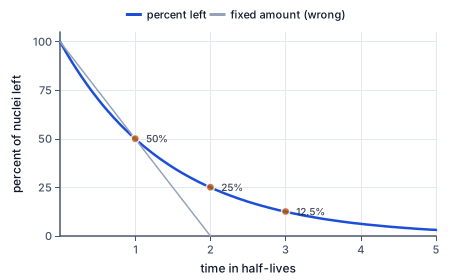
The chart plots the percent of a sample left against time counted in half-lives. The curve drops fast at first, when many nuclei are present, and ever more slowly as fewer remain, halving at every whole half-life: $50$, $25$, $12.5$, $6.25$ percent. The gray straight line is the common mistake, a fixed amount lost each half-life, which would empty the sample after two. The true curve never reaches zero by the rule; in practice the last few nuclei decay at random times. On a logarithmic vertical scale the same curve becomes a straight line, which is how laboratories read a half-life from their counts.
Radon-222, a gas with a half-life of $3.82$ days, seeps from uranium-bearing soil into basements. The Environmental Protection Agency estimates it causes about $21{,}000$ lung cancer deaths a year in the United States, more than any cause except smoking. Short-term test kits collect radon in charcoal for a few days and are then mailed to a laboratory.
Because the radon keeps decaying in transit, the laboratory uses the decay law to correct its count back to the collection date. A few days' delay can halve the reading, so kits are dated and must be mailed promptly. Homes above $148$ Bq per cubic meter are advised to install a venting fan, which typically cuts levels by eighty to ninety percent.
When the Dead Sea Scrolls were found in caves near Qumran starting in 1947, scholars argued over their age. Libby's new carbon-14 method, applied to the linen wrapping of one scroll in 1950, gave an age of about two thousand years, supporting their authenticity.
In the 1990s, accelerator mass spectrometry at the University of Arizona dated the parchment of individual scrolls using only a few milligrams each. The results clustered between the third century BC and the first century AD, matching estimates from handwriting styles. Laboratories now correct raw carbon ages with calibration curves built from tree rings, since the atmosphere's carbon-14 level has varied slightly over the centuries.
A common mistake is to think each half-life removes the same number of nuclei, so that two half-lives use up the whole sample. In fact each half-life removes half of whatever is left: after two half-lives a quarter remains, after three an eighth. The sample shrinks by equal fractions, never by equal amounts.
A related error is to think the decay law predicts when a particular nucleus will decay. It predicts only the behavior of large numbers; any single nucleus may decay in the next second or outlast the Sun.
A thyroid treatment uses $3700$ MBq of iodine-131, half-life $8.02$ days. Count the half-lives in $20$ days.
$n = \dfrac{20}{8.02} = 2.494$
Not a whole number.
Find the fraction left.
$2^{-2.494} = 0.178$
Between a quarter and an eighth.
Find the activity left.
$3700 \times 0.178 = 659\ \text{MBq}$
Activity scales with $N$.
Check with the decay constant.
$\lambda = \dfrac{0.693}{8.02} = 0.0864\ \text{day}^{-1}$
Per day.
Evaluate the exponential form.
$3700\,e^{-0.0864 \times 20} = 3700\,e^{-1.728} = 659\ \text{MBq}$
The same answer.
Charcoal decays at $9.2$ per minute per gram; living carbon at $15.3$. Find the ratio.
$\dfrac{A_0}{A} = \dfrac{15.3}{9.2} = 1.663$
How far it has decayed.
Take the natural log.
$\ln 1.663 = 0.509$
To bring down the exponent.
Divide by $\ln 2$.
$n = \dfrac{0.509}{0.693} = 0.734$
Number of half-lives.
Multiply by the half-life.
$t = 0.734 \times 5730 = 4205\ \text{years}$
The age.
Check the range.
$\text{between } 0 \text{ and } 5730 \text{ years}$
Less than one half-life, since more than half remains.
Estimate the counting precision.
$\sqrt{10{,}000} = 100: \ 1\%$
Count ten thousand decays for one percent.
A charcoal canister collects radon in a basement, then spends $4.0$ days in the mail before counting. Radon-222's half-life is $3.82$ days. Count the half-lives.
$n = \dfrac{4.0}{3.82} = 1.047$
Just over one.
Find the fraction left at the lab.
$2^{-1.047} = 0.484$
Just under half.
The lab measures $95$ Bq in the canister. Correct back to the day of collection.
$A_0 = \dfrac{95}{0.484} = 196\ \text{Bq}$
Work backward.
Find the decay constant per day.
$\lambda = \dfrac{0.693}{3.82} = 0.181\ \text{day}^{-1}$
For the exponential form.
Confirm with the exponential form.
$95\,e^{0.181 \times 4.0} = 95 \times 2.06 = 196\ \text{Bq}$
Consistent.
Explain why the lab corrects the reading.
$\text{the radon kept decaying in the mail}$
Otherwise the home's level would be underestimated.
Count the half-lives.
$n = \dfrac{30}{10} = 3$
Whole number.
Find the fraction left.
$2^{-3} = 0.125$
An eighth.
Find the count rate.
A sample of cobalt-60 has a half-life of 5.27 years. What percent of the original nuclei are still undecayed after 15.81 years?
Complete the worked solution: the medical tracer iodine-123 has a half-life of $13.22$ hours. Find its decay constant per hour, its mean life in hours, and the percent of a dose still present $6$ hours after injection, ignoring removal by the body.
Find the decay constant from the half-life.
$\lambda = \dfrac{0.693}{13.22} =$ l
Per hour.
Invert it for the mean life.
$\tau = \dfrac{1}{\lambda} =$ m
About $1.44$ half-lives.
Apply the decay law for six hours.
$100 \times 2^{-6/13.22} =$ p
Percent remaining.
Decide whether the tracer suits a scan.
$\text{long enough to image, short enough to fade}$
The design rule for tracers.
Match each quantity to what it measures.
| time for half a sample to decay | chance per second that one nucleus decays | average lifetime of a nucleus | number of decays per second in a sample | |
|---|---|---|---|---|
| half-life | ||||
| decay constant | ||||
| mean life | ||||
| activity |
A Geiger counter beside a radioactive source records $6400$ counts per minute. Fill in the count rate, in counts per minute, after one, two, three and four half-lives (ignore background).
| counts per minute | |
|---|---|
| after 1 half-life | |
| after 2 half-lives | |
| after 3 half-lives | |
| after 4 half-lives |
A sample of chromium-51 has activity $250$ MBq at time zero; take its half-life as $28$ days. Write its activity in MBq as a function of $t$, measured in days, using a power of 2.
Answer:
Carbon in living things decays at $15.3$ decays per minute per gram. Charcoal from an ancient hearth decays at $6.9$ per minute per gram. With a half-life of $5730$ years for carbon-14, how old is the charcoal, in years?
Answer: years
A hospital in Cleveland needs a bone-scan dose of technetium-99m, half-life $6.01$ hours, with an activity of $925$ MBq at injection. A radiopharmacy prepares it $1.5$ hours before. What activity, in MBq, must it have when prepared?
Answer: MBq
Lesson test: one question per skill, one attempt each, no hints. Your answers are checked when you submit.
A sample of phosphorus-32 has activity $185$ MBq at time zero; take its half-life as $14$ days. Write its activity in MBq as a function of $t$, measured in days, using a power of 2.
Answer:
You can work with half-lives. Explain to someone why two half-lives leave a quarter of a sample rather than none.
22. Your turn: a source reads $2400$ counts per minute and has a half-life of $10$ minutes. What does it read after $30$ minutes?, step 3
$2400 \times 0.125 = 300\ \text{per minute}$
Halved three times.