Back to the on-screen lesson ·
Standing-wave states $\psi_n = \sqrt{2/L}\sin(n\pi x/L)$, energies $n^2h^2/8mL^2$, transitions, probabilities within the box, dye molecules and quantum dots.
Paper packet. Every task here also exists on screen, where it is checked automatically; answers written on paper are not assessed by Nydus. When you are back at a device, enter your answers there.
By the end of this lesson you will be able to find a boxed particle's energies, transition wavelengths and position probabilities, and apply the model to dyes and quantum dots.
From the last lesson you can normalize wave functions and compute probabilities. From waves you know standing waves on a string fixed at both ends, and from unit 3 that confinement costs energy. This lesson solves Schrödinger's equation exactly for the simplest trap, a box, and finds quantized energies from nothing but the requirement that the wave fit.
| Term | What it means |
|---|---|
| Infinite square well | A region where the potential is zero, walled by infinitely high potential; a box. |
| Stationary state | A state of definite energy whose probability density does not change in time. |
| Node | A point inside the box where $\psi = 0$ and the particle is never found. |
| Quantization | Only certain energies allowed, here $E_n = n^2h^2/8mL^2$. |
| Zero-point energy | The ground-state energy $E_1$, never zero for a confined particle. |
| Quantum dot | A semiconductor crystal a few nanometers across that acts as a box for electrons. |
| Correspondence principle | At large $n$, quantum results approach classical ones. |
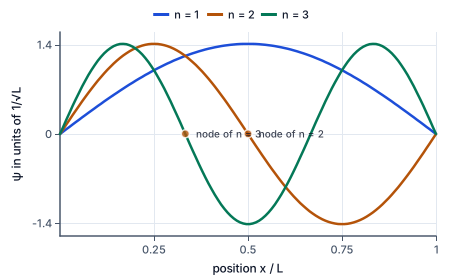
Inside a box from $x = 0$ to $x = L$, the potential is zero; outside it is infinite, so $\psi$ must be zero at both walls. Schrödinger's equation inside, $-\dfrac{\hbar^2}{2m}\psi'' = E\psi$, has sine and cosine solutions, and only sines that vanish at both walls survive:
$$\psi_n(x) = \sqrt{\frac{2}{L}}\sin\frac{n\pi x}{L}, \qquad n = 1, 2, 3, \ldots$$
Exactly $n$ half-wavelengths fit, so $\lambda_n = 2L/n$ and $p_n = h/\lambda_n = nh/2L$. The energy is $p^2/2m$:
$$E_n = \frac{n^2h^2}{8mL^2}.$$
For an electron, $h^2/8m_e = 0.376$ eV·nm², so $E_n = 0.376n^2/L^2$ eV. The ground state has $n = 1$, not zero, so the particle can never be at rest. State $n$ has $n - 1$ nodes inside the box.
Another way: picture
Picture a guitar string pinned at both ends. It can vibrate in its fundamental, one hump; in its second harmonic, two humps with a still point in the middle; and so on, but never in between. A particle in a box has exactly these patterns, and each pattern has its own energy, growing as the square of the number of humps.
Another way: steps
Inside the box, $\psi'' = -k^2\psi$ with $k = \sqrt{2mE}/\hbar$, so $\psi = A\sin kx + B\cos kx$. The wave function must vanish at $x = 0$, which forces $B = 0$, and at $x = L$, which forces $\sin kL = 0$, so $kL = n\pi$. Negative $n$ give the same states, and $n = 0$ gives $\psi = 0$ everywhere, no particle at all.
From $k = n\pi/L$, $E = \hbar^2k^2/2m = n^2\pi^2\hbar^2/2mL^2 = n^2h^2/8mL^2$. Normalizing, $\int_0^L A^2\sin^2(n\pi x/L)\,dx = A^2L/2 = 1$, so $A = \sqrt{2/L}$. Quantization came from the boundary conditions alone: a wave confined between walls can only have certain wavelengths.
The levels are $E_1$, $4E_1$, $9E_1$, $16E_1$, spreading apart as $n$ grows. A particle dropping from $n = 2$ to $n = 1$ emits $3E_1$; from $3$ to $2$, $5E_1$. For an electron in a box $1$ nm wide, $E_1 = 0.376$ eV and the $2 \to 1$ photon has $\lambda = 1100$ nm, in the near infrared.
Shrinking the box raises every level as $1/L^2$: a box of $0.5$ nm has $E_1 = 1.5$ eV. Atoms, about $0.1$ nm across, have electron energies of several eV, consistent with this scaling. The box is crude, but it gets the order of magnitude of atomic energies from a single length.
The probability density $|\psi_n|^2 = \dfrac{2}{L}\sin^2(n\pi x/L)$ is not uniform. In the ground state it peaks in the middle and falls to zero at the walls: the chance of finding the particle in the middle third is $0.61$, not $\tfrac{1}{3}$. In the state $n = 2$, there is a node at the center, where the particle is never found, and the middle third holds only $0.20$.
As $n$ grows, the humps become many and fine, and averaged over any region wider than a hump, the density becomes uniform, like a classical particle bouncing at constant speed. This is the correspondence principle again: quantum results approach classical ones at high quantum numbers.
Each $\psi_n$ is a stationary state: its full time-dependent wave function is $\psi_n(x)e^{-iE_nt/\hbar}$, and since the time factor has magnitude one, $|\psi_n|^2$ does not change. A particle in a single stationary state does not slosh back and forth; its probability distribution is frozen.
Motion appears only in superpositions of different $n$: then the time factors beat against each other at frequencies $(E_n - E_m)/h$, and the probability sloshes. Those beat frequencies are exactly the photon frequencies the particle can emit, which is how quantum mechanics connects the motion of charge to the emission of light.
Put $N$ electrons in a box and, by the exclusion principle, they fill levels two at a time. The highest filled level is $N/2$, and the lowest-energy absorption lifts an electron from $N/2$ to $N/2 + 1$, costing $0.376(N + 1)/L^2$ eV.
This free-electron model explains the colors of dyes built from long chains of alternating single and double bonds, along which electrons move freely. Longer chains absorb longer wavelengths. Beta-carotene, with $22$ mobile electrons along about $1.8$ nm, absorbs blue light and so looks orange, the color of carrots.
Checking an answer. Energies must scale as $n^2$ and $1/L^2$. Probabilities over the whole box must be one, and over symmetric regions must reflect $|\psi|^2$'s shape. Wavelengths of transitions in nanometer boxes must fall in the visible or infrared. And the ground energy must never be zero.
The infinite walls are an idealization: real potentials are finite, and the wave function leaks a little into the walls, lowering the energies somewhat. For deep wells the correction is small, and the box captures the essential physics: confinement quantizes energy and raises it as $1/L^2$.
Filling levels with non-interacting electrons ignores their repulsion. For dyes and quantum dots, the model still predicts trends correctly, and with a fitted effective length or mass it predicts colors to within ten or twenty percent, remarkably good for so simple a picture.
A quantum dot is a crystal of semiconductor a few nanometers across. An electron excited across the band gap, and the hole it leaves, are confined by the dot's walls, adding a box energy that grows as $1/L^2$ to the bulk band gap. Smaller dots emit bluer light; larger ones redder.
Louis Brus at Bell Labs in New Jersey discovered the size effect in the early 1980s, and Moungi Bawendi at MIT learned to make dots of precise sizes in 1993. They shared the 2023 Nobel Prize in Chemistry with Alexei Ekimov. Quantum dots now color the pixels of television screens and tag molecules in medical imaging.
A particle in a rectangular box has quantum numbers for each direction, and its energy adds the three: $E = \dfrac{h^2}{8m}\left(\dfrac{n_x^2}{L_x^2} + \dfrac{n_y^2}{L_y^2} + \dfrac{n_z^2}{L_z^2}\right)$. In a cube, different combinations give the same energy: $(2, 1, 1)$, $(1, 2, 1)$ and $(1, 1, 2)$ are three distinct states with equal energy, called degenerate.
Degeneracy from symmetry appears throughout quantum physics. In the hydrogen atom, the several $l$ and $m_l$ states sharing one $n$ are degenerate for the same reason: the Coulomb potential is spherically symmetric. Breaking the symmetry, by stretching the box or applying a field, splits the degenerate levels apart, as the Zeeman effect showed.
The chart draws the first three wave functions across the box. The ground state is a single hump: the particle is most likely in the middle and never at the walls. The second state has a node at the center, so a particle in it is found on the left or the right but never in the exact middle, even though it is found on both sides. The third state has two nodes. Each extra node shortens the wavelength, raises the momentum, and so raises the energy, which is why the energies climb as $n^2$: one hump, four times the energy for two, nine times for three. Squaring each curve gives the probability density, which is never negative, and the humps of the squared curves have equal areas within each state.
Quantum-dot televisions and monitors, using dots developed by companies such as Nanosys in Milpitas, California, convert blue backlight into pure green and red by passing it through films of dots of two sizes. Cadmium selenide dots about $3$ nm across emit near $575$ nm; dots about $5$ nm across, near $655$ nm.
The size sets the color through the box energy, which adds $3.7/L^2$ eV to the bulk gap of $1.74$ eV. Because every dot of a given size emits the same narrow color, the screens show more saturated colors than older displays. Manufacturers control dot size to within a few tenths of a nanometer, which holds the color to within a few nanometers of wavelength.
Beta-carotene, the pigment of carrots and sweet potatoes, has $22$ electrons free to move along a chain of alternating single and double bonds about $1.8$ nm long. Modeled as a box, its highest filled level is $11$, and lifting an electron to level $12$ costs about $0.376 \times 23/1.8^2 = 2.7$ eV, light near $460$ nm.
Absorbing blue, the molecule reflects the rest, and looks orange. The measured absorption peak is near $450$ nm, within a few percent of this simple estimate. Food scientists and dye chemists use the same reasoning: lengthening a chain of alternating bonds shifts a molecule's color toward the red.
A classical particle bouncing between walls at constant speed spends equal time everywhere, so it is equally likely to be found anywhere. A quantum particle in a stationary state is not: in the ground state it is most likely near the middle, and in excited states it is never found at the nodes, even though it is found on both sides of them.
A related error is to think the particle can have zero energy, sitting still at the bottom of the box. The lowest allowed energy is $E_1 = h^2/8mL^2$, the zero-point energy, because a wave confined to the box must have at least half a wavelength.
Find the ground-state energy of an electron in a $1.0$ nm box.
$E_1 = \dfrac{0.376}{1.0^2} = 0.376\ \text{eV}$
$h^2/8m_eL^2$.
Find the next two energies.
$E_2 = 1.50\ \text{eV}, \quad E_3 = 3.38\ \text{eV}$
$4E_1$ and $9E_1$.
Find the photon for $3 \to 1$.
$\Delta E = 3.01\ \text{eV}, \quad \lambda = 412\ \text{nm}$
Violet.
Find the photon for $3 \to 2$.
$\Delta E = 1.88\ \text{eV}, \quad \lambda = 660\ \text{nm}$
Red.
Count the nodes in state 3.
$2$
$n - 1$.
Write the ground-state density.
$|\psi_1|^2 = \dfrac{2}{L}\sin^2\dfrac{\pi x}{L}$
Normalized.
Rewrite with the half-angle identity.
$\dfrac{1}{L}\left(1 - \cos\dfrac{2\pi x}{L}\right)$
$\sin^2\theta = \tfrac{1}{2}(1 - \cos 2\theta)$.
Integrate over the left quarter.
$P = \dfrac{1}{4} - \dfrac{1}{2\pi}\sin\dfrac{\pi}{2} = 0.25 - 0.159 = 0.091$
From $0$ to $L/4$.
Find the probability in the middle half.
$P = 1 - 2 \times 0.091 = 0.818$
By symmetry.
Compare with a classical particle.
$P_{\text{classical}} = 0.5$
The quantum particle prefers the middle.
Find the most likely position.
$x = L/2$
Where $\sin^2$ peaks.
A chain molecule has $8$ mobile electrons along $1.0$ nm. Find the highest filled level.
$n = 4$
Two electrons per level.
Find the energy of level 4.
$E_4 = 0.376 \times 16 = 6.02\ \text{eV}$
$0.376n^2/L^2$.
Find the energy of level 5.
$E_5 = 0.376 \times 25 = 9.40\ \text{eV}$
The lowest empty level.
Find the jump energy.
$\Delta E = 3.38\ \text{eV}$
$0.376 \times 9$.
Find the wavelength absorbed.
$\lambda = \dfrac{1240}{3.38} = 366\ \text{nm}$
Near ultraviolet: the dye looks colorless.
Lengthen the chain to $1.4$ nm with $12$ electrons.
$\Delta E = \dfrac{0.376 \times 13}{1.96} = 2.49\ \text{eV}, \ \lambda = 497\ \text{nm}$
Now absorbing blue-green.
Predict its color.
$\text{red-orange}$
The complement of the absorbed light.
Find the ground-state energy.
$E_1 = \dfrac{0.376}{0.25} = 1.50\ \text{eV}$
$0.376/L^2$.
Find the energy released.
$\Delta E = 3E_1 = 4.51\ \text{eV}$
$E_2 - E_1$.
Convert to a wavelength.
An electron in a box has ground-state energy $0.2$ eV. The box is made half as wide. What is the new ground-state energy?
Complete the worked solution: a chain molecule has $8$ mobile electrons moving along a chain $1.0$ nm long, modeled as a box. Two electrons fit in each level. With $h^2/8m_e = 0.376$ eV·nm² and $hc = 1240$ eV·nm, find the highest filled level, the energy to lift an electron to the next level in eV, and the wavelength of light that does it in nm.
Fill the levels two at a time.
$n_{\text{top}} = \dfrac{N}{2} =$ h
Pauli exclusion, two spins per level.
Find the jump energy.
$\Delta E = \dfrac{0.376}{L^2}\left[(n_{\text{top}} + 1)^2 - n_{\text{top}}^2\right] =$ e
To the lowest empty level.
Convert to a wavelength.
$\lambda = \dfrac{1240}{\Delta E} =$ w
The light the molecule absorbs.
Note the trend.
$\text{longer chains absorb longer wavelengths}$
Which is why long dyes are colored.
Match each property of the particle in a box to its statement.
| $n^2h^2/8mL^2$ | $\sqrt{2/L}\sin(n\pi x/L)$ | $n - 1$ | never zero | |
|---|---|---|---|---|
| energies | ||||
| wave functions | ||||
| nodes inside | ||||
| lowest energy |
An electron is trapped in a box $2$ nm wide. With $h^2/8m_e = 0.376$ eV·nm² and $hc = 1240$ eV·nm, fill in the ground-state energy in eV, the first excited energy in eV, and the wavelength of the photon emitted in the drop from $n = 2$ to $n = 1$, in nm.
| value | |
|---|---|
| E₁ (eV) | |
| E₂ (eV) | |
| 2 → 1 wavelength (nm) |
An electron is confined to a box $1$ nm wide. With $h^2/8m_e = 0.376$ eV·nm², write the energy of level $n$, in eV, as a formula in $n$.
Answer:
A particle in a box of width $L$ is in the state $n = 4$. What is the probability of finding it in the middle third of the box, from $L/3$ to $2L/3$?
Answer: probability
A display maker in Silicon Valley tunes the color of cadmium selenide quantum dots by their size. Modeling a dot of width $6$ nm as a box for both the electron and the hole, its emitted photon has energy $E = 1.74 + 3.728/L^2$ eV. With $hc = 1240$ eV·nm, at what wavelength does it glow, in nm?
Answer: nm
Lesson test: one question per skill, one attempt each, no hints. Your answers are checked when you submit.
An electron is confined to a box $2$ nm wide. With $h^2/8m_e = 0.376$ eV·nm², write the energy of level $n$, in eV, as a formula in $n$.
Answer:
You can solve the particle in a box. Explain to someone why a smaller quantum dot glows a bluer color.
21. Your turn: an electron in a $0.50$ nm box drops from $n = 2$ to $n = 1$. Find the photon's wavelength., step 3
$\lambda = \dfrac{1240}{4.51} = 275\ \text{nm}$
Ultraviolet.