Back to the on-screen lesson ·
The four quantum numbers $n$, $l$, $m_l$, $m_s$, angular momentum $\sqrt{l(l + 1)}\hbar$ and its quantized orientation, the Pauli exclusion principle, shell capacities and electron configurations.
Paper packet. Every task here also exists on screen, where it is checked automatically; answers written on paper are not assessed by Nydus. When you are back at a device, enter your answers there.
By the end of this lesson you will be able to enumerate electron states, compute angular momenta and their orientations, and build electron configurations.
From the last lesson you know Bohr's model needed replacing and that the new quantum mechanics adds angular momentum quantum numbers and electron spin. From chemistry you know electron shells and the periodic table. This lesson gives the four numbers that label every electron state and shows how they build the periodic table.
| Term | What it means |
|---|---|
| Principal quantum number | $n = 1, 2, 3, \ldots$, setting a shell's energy and size. |
| Orbital quantum number | $l = 0, 1, \ldots, n - 1$, setting the shape; letters $s, p, d, f$. |
| Magnetic quantum number | $m_l = -l, \ldots, l$, setting orientation, $L_z = m_l\hbar$. |
| Spin quantum number | $m_s = \pm\tfrac{1}{2}$, the electron's intrinsic spin up or down. |
| Pauli exclusion principle | No two electrons in an atom share all four quantum numbers. |
| Subshell | The states with the same $n$ and $l$; it holds $2(2l + 1)$ electrons. |
| Hund's rule | Electrons fill a subshell's orbitals singly, with parallel spins, before pairing. |
The Schrödinger equation for hydrogen gives states labeled by three numbers, and the electron's spin adds a fourth:
The Pauli exclusion principle allows only one electron in each state. A subshell therefore holds $2(2l + 1)$ electrons, and a shell $2n^2$: 2, 8, 18, 32. Filling states in order of energy, with shielding shifting that order, builds the periodic table.
Another way: picture
Picture a hotel for electrons. The floor is $n$; each floor has suites of different shapes, labeled by $l$; each suite has rooms facing different directions, labeled by $m_l$; and each room has two beds, spin up and spin down. The rule of the hotel is one guest per bed. Counting beds floor by floor gives 2, 8, 18, 32.
Another way: steps
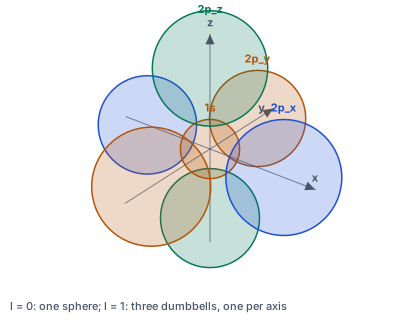
The quantum numbers of an electron in hydrogen label distinct states, and two of them have shapes you can see. The number $l$ sets the orbital's shape: $l = 0$ is an $s$ orbital, a sphere with no preferred direction, like the $1s$ drawn at the center. $l = 1$ is a $p$ orbital, two lobes on opposite sides of the nucleus. The number $m_l$ picks how the orbital is oriented, and for $l = 1$ there are three $p$ orbitals, drawn along the three axes. Together they make a spherically symmetric set, which is why a full $p$ subshell has no preferred direction.
Solving the Schrödinger equation for an electron in the Coulomb field of a nucleus, in spherical coordinates, separates into three equations, one for each coordinate. Requiring each solution to be finite and single-valued allows only whole-number values: $n$ from the radial equation, $l$ from the polar angle, $m_l$ from the azimuthal angle. The same logic of confinement that gives standing waves on a string gives quantum numbers in three dimensions.
The restrictions $l \le n - 1$ and $|m_l| \le l$ come out of the mathematics. For hydrogen's pure $1/r$ potential the energy depends only on $n$, a special symmetry; in other atoms it depends on $l$ too, which is why $4s$ fills before $3d$.
An electron with orbital number $l$ has angular momentum of size $\sqrt{l(l + 1)}\,\hbar$, and its $z$-component can only be $m_l\hbar$. Since the largest component, $l\hbar$, is less than the size, the vector can never point exactly along the $z$-axis. It lies on a cone at angle $\theta$ with $\cos\theta = m_l/\sqrt{l(l + 1)}$, with its $x$- and $y$-components undetermined.
This is the uncertainty principle again: the three components of angular momentum cannot all have definite values at once. For $l = 1$, the three allowed cones make angles of $45°$, $90°$ and $135°$ with the $z$-axis. Otto Stern and Walther Gerlach saw space quantization directly in 1922, splitting a beam of silver atoms in a nonuniform magnetic field.
Stern and Gerlach's silver beam split into two, not the odd number $2l + 1$ that orbital angular momentum would give. The explanation, proposed by Samuel Goudsmit and George Uhlenbeck in 1925, is that the electron has an intrinsic angular momentum, spin, with $s = \tfrac{1}{2}$ and two possible components, $m_s = \pm\tfrac{1}{2}$.
Spin is not literal spinning; a point particle cannot rotate. But it behaves like angular momentum, carries a magnetic moment of about one Bohr magneton, and doubles the number of states. Dirac's relativistic quantum theory of 1928 showed that spin follows naturally from combining quantum mechanics with special relativity.
Wolfgang Pauli proposed in 1925 that no two electrons in an atom can share all four quantum numbers. Without it, every electron would fall into the $1s$ state and all atoms would behave alike. With it, electrons stack into shells: helium fills $1s$, neon fills $n = 2$ with $2 + 6 = 8$ electrons, argon fills $3s$ and $3p$.
The rows of the periodic table follow the filling order, $1s$, $2s$, $2p$, $3s$, $3p$, $4s$, $3d$, $4p$, and so on, with shielding putting $4s$ below $3d$. Elements in a column share their outer configuration and so their chemistry: the alkali metals each have one $s$ electron outside a filled shell. Chemistry is, in this sense, quantum numbers plus Pauli.
Checking an answer. Shell capacities must be 2, 8, 18, 32. No angle between $\vec{L}$ and $z$ can be zero unless $l = 0$. Counts must be whole numbers. And an electron configuration must add up to the atomic number.
The ranges of the quantum numbers are results of the Schrödinger equation, confirmed by spectra: the number of lines into which a level splits in a magnetic field matches $2l + 1$, and the fine-structure pairs match spin. The exclusion principle is an experimental law, later derived from relativistic quantum field theory as a property of all particles with half-integer spin.
Hund's rule is an empirical rule with a physical reason: electrons with parallel spins must occupy different orbitals, which keeps them farther apart on average and lowers their repulsion. It predicts the magnetism of transition metals and rare earths.
Unpaired electron spins make materials magnetic. Iron's $3d$ subshell holds six electrons with four unpaired; neodymium's $4f$ holds four unpaired. Neodymium–iron–boron magnets, invented in 1982 by General Motors and Sumitomo independently, are the strongest permanent magnets, used in electric vehicle motors, wind turbines and hard drives.
Spin also runs the spintronic memory in modern computers and the readout of MRI scanners, which flip nuclear spins. And the colors of fireworks and neon signs are jumps between states labeled by these same four numbers.
Not every pair of states can be connected by emitting a single photon. A photon carries one unit of angular momentum, so in the most common transitions $l$ must change by exactly one and $m_l$ by $0$ or $\pm 1$. Jumps from $2p$ to $1s$ are allowed and fast; jumps from $2s$ to $1s$, with no change in $l$, are forbidden for a single photon.
These rules explain which lines appear in spectra and which are missing, something Bohr's model could never do. They also explain why some excited states are long-lived, the key to lasers and to the extraordinarily stable transitions used in optical atomic clocks at NIST and JILA in Boulder. Knowing the rules lets physicists choose transitions that are both slow enough to be sharp and fast enough to measure.
The motors of electric vehicles built in Michigan and elsewhere use neodymium–iron–boron magnets, often with some dysprosium added to keep them strong at high temperatures. Their strength comes from rare-earth $4f$ electrons: neodymium ions have four unpaired, dysprosium ions also four, arranged by Hund's rule with their spins aligned.
Each unpaired spin contributes about one Bohr magneton, and the crystal structure locks the moments in one direction. The United States is working to rebuild domestic production of these magnets and their rare-earth ingredients, because the motors of electric cars, wind turbines and military systems depend on quantum numbers counted in the $4f$ subshell.
At JILA and NIST in Boulder, Colorado, optical clocks use transitions in strontium and ytterbium atoms between states whose quantum numbers make single-photon decay nearly forbidden. The upper state lives for many seconds, so the transition's frequency is defined with extraordinary sharpness.
These clocks keep time to about one second in the age of the universe, and are so sensitive that raising one by a centimeter changes its rate measurably, through general relativity. They may soon redefine the second. Their precision rests on selection rules, which follow from the quantum numbers of this lesson. A network of such clocks could even detect changes in the Earth's gravity from moving magma or melting ice.
It is tempting to read $l$ as the angular momentum in units of $\hbar$. The size is $\sqrt{l(l + 1)}\,\hbar$, larger than $l\hbar$, while $l\hbar$ is the largest possible $z$-component. Because the size exceeds any component, the vector can never point exactly along an axis; it lies on a cone.
A related error is to forget spin when counting, giving $n^2$ electrons per shell instead of $2n^2$. Each orbital holds two electrons with opposite spins.
List the allowed $l$ for $n = 3$.
$l = 0, 1, 2 \ (3s, 3p, 3d)$
$0$ to $n - 1$.
Count the orbitals in each.
$1, 3, 5$
$2l + 1$.
Find the total orbitals.
$1 + 3 + 5 = 9 = 3^2$
$n^2$.
Find the electron capacity.
$2 \times 9 = 18$
$2n^2$.
Find the capacity of $3d$.
$2 \times 5 = 10$
The transition-metal subshell.
Find $|L|$ for $l = 2$.
$|L| = \sqrt{6}\,\hbar = 2.45\hbar$
$\sqrt{l(l + 1)}$.
List the allowed $L_z$.
$-2\hbar, -\hbar, 0, \hbar, 2\hbar$
$m_l\hbar$.
Find the smallest angle to $z$.
$\cos\theta = \dfrac{2}{2.45} = 0.816, \ \theta = 35.3°$
$m_l = 2$.
Find the angle for $m_l = 0$.
$\theta = 90°$
Perpendicular to $z$.
Convert $|L|$ to SI.
$2.45 \times 1.055 \times 10^{-34} = 2.58 \times 10^{-34}\ \text{J·s}$
Tiny.
Explain why it cannot point along $z$.
$L_z \le 2\hbar < 2.45\hbar$
The largest component is less than the size.
Write the configuration of sodium, $Z = 11$.
$1s^2\,2s^2\,2p^6\,3s^1$
Fill lowest energy first.
Check the count.
$2 + 2 + 6 + 1 = 11$
Equals the atomic number.
Write iron's, $Z = 26$.
$[\text{Ar}]\,4s^2\,3d^6$
$4s$ before $3d$.
Place iron's six $3d$ electrons by Hund's rule.
$\uparrow\downarrow\ \uparrow\ \uparrow\ \uparrow\ \uparrow$
Singly first, then pair.
Count the unpaired electrons.
$4$
The source of iron's magnetism.
Find neon's configuration.
$1s^2\,2s^2\,2p^6$
A filled shell: inert.
Explain why sodium reacts and neon does not.
$\text{sodium's lone } 3s \text{ electron is easily removed}$
$5.1$ eV versus $21.6$ eV for neon.
Identify the orbital number.
$f: l = 3$
Letter to number.
Count the orientations.
$2l + 1 = 7$
$m_l = -3, \ldots, 3$.
Double for spin.
How many electrons can the shell with principal quantum number $n = 2$ hold?
Complete the worked solution: for the shell $n = 5$, find the number of orbitals (sets of $n$, $l$, $m_l$), the number of electrons it can hold, and the capacity of its largest subshell.
Add the orientations over all $l$.
$\sum_{l=0}^{n-1}(2l + 1) = n^2 =$ o
Orbitals in the shell.
Double for spin.
$2n^2 =$ c
Electron capacity.
Find the largest subshell's capacity.
$2(2(n - 1) + 1) =$ b
With $l = n - 1$.
Note the chemistry.
$\text{shells fill in a different order from } n$
Shielding changes the energies, as the last lesson showed.
Match each quantum number to what it determines.
| shell energy and size | shape and size of angular momentum | orientation of angular momentum | spin up or down | |
|---|---|---|---|---|
| n | ||||
| l | ||||
| m_l | ||||
| m_s |
For the p subshell, $l = 1$, fill in the number of allowed $m_l$ values, the number of electrons it can hold, and the size of the orbital angular momentum in units of $\hbar$.
| value | |
|---|---|
| number of m_l values | |
| electrons held | |
| |L| in units of ħ |
In the shell with principal number $n$ (at least $4$), how many electron states have $m_l = 3$? Count both spins, and write the answer as a formula in $n$.
Answer:
An electron in a state with $l = 3$ and $m_l = 3$ has an orbital angular momentum vector at a fixed angle to the $z$-axis. What is that angle, in degrees?
Answer: degrees
Motor engineers in Michigan use rare-earth magnets whose strength comes from unpaired $4f$ electrons. An ion of dysprosium has $10$ electrons in its $4f$ subshell. By Hund's rule, how many of them are unpaired?
Answer: unpaired electrons
Lesson test: one question per skill, one attempt each, no hints. Your answers are checked when you submit.
In the shell with principal number $n$ (at least $2$), how many electron states have $m_l = 1$? Count both spins, and write the answer as a formula in $n$.
Answer:
You can use quantum numbers. Explain to someone why the second shell holds eight electrons and the third eighteen.
20. Your turn: how many electrons can the $4f$ subshell hold?, step 3
$2 \times 7 = 14$
The rare-earth row.