Back to the on-screen lesson ·
Einstein's $K_{\max} = hf - \phi$, work functions and thresholds, stopping voltages, Millikan's test, and why intensity changes the number but not the energy of photoelectrons.
Paper packet. Every task here also exists on screen, where it is checked automatically; answers written on paper are not assessed by Nydus. When you are back at a device, enter your answers there.
By the end of this lesson you will be able to find maximum photoelectron energies, stopping voltages and thresholds, and explain the evidence for photons.
From the last lesson you know that a photon of frequency $f$ carries energy $hf$, and how to compute it from a wavelength with $hc = 1240$ eV·nm. From the circuits and potential lessons you know the electron volt and how a voltage slows a charge. This lesson shows the experiment that proved photons exist.
| Term | What it means |
|---|---|
| Photoelectric effect | The ejection of electrons from a material by light. |
| Work function | $\phi$, the least energy needed to pull an electron out of a metal's surface. |
| Threshold frequency | $f_0 = \phi/h$, below which no electrons are ejected. |
| Threshold wavelength | $\lambda_0 = hc/\phi$, above which no electrons are ejected. |
| Stopping voltage | $V_s$, the reverse voltage that turns back the fastest photoelectrons. |
| Photocurrent | The current carried by ejected electrons. |
| Photomultiplier | A tube that turns one photoelectron into millions by repeated collisions. |
When light strikes a metal, each electron that escapes has absorbed the energy of a single photon. It must spend at least the work function $\phi$ to get out, so the fastest electrons leave with
$$K_{\max} = hf - \phi.$$
Three facts follow, all confirmed by experiment and all impossible to explain with light as a smooth wave. Below the threshold frequency $f_0 = \phi/h$, no electrons come out, however bright the light. Above it, electrons appear instantly, even in dim light. And the maximum energy depends on the frequency, not the intensity: brighter light gives more electrons, not faster ones. The stopping voltage that turns back the fastest electrons is $V_s = K_{\max}/e$, so measuring $V_s$ at several frequencies gives a straight line of slope $h/e$.
Another way: picture
Picture a fairground game where you must throw a ball hard enough to knock a coconut off its stand. Throwing more balls too gently never works, however many you throw. One ball thrown hard enough does it at once, and any extra speed goes into the coconut's flight. Photons are the balls, the work function is how firmly the coconut sits, and the frequency sets how hard each ball is thrown.
Another way: steps
If light were only a wave, its energy would arrive spread smoothly over the metal. Brighter light, with a larger electric field, should shake electrons harder and eject faster ones. Light of any frequency, if bright enough, should eventually eject electrons. And in very dim light, an electron should need to soak up energy for a while, seconds or minutes, before it had enough to escape.
Every one of these predictions failed. Philipp Lenard's measurements around 1902 showed the electrons' energy did not depend on intensity at all. Einstein's 1905 explanation with photons, for which he won the 1921 Nobel Prize, accounted for every feature.
Robert Millikan at the University of Chicago set out to disprove Einstein's photon equation. Over ten years he built apparatus to measure stopping voltages on clean metal surfaces cut in a vacuum, at several wavelengths from a mercury lamp. In 1916 he published the result: $V_s$ plotted against $f$ is a straight line, exactly as $eV_s = hf - \phi$ predicts, with a slope giving $h$ within half a percent of Planck's value.
Millikan remained skeptical of photons for years, but his data settled the question. He received the 1923 Nobel Prize, partly for this work. The slope of the line gives $h/e$; its intercept gives the work function.
The work function depends on the metal and the state of its surface. Cesium's is about $2.1$ eV, so visible light as red as $590$ nm can eject electrons from it. Sodium's is about $2.3$ eV; zinc's and copper's are over $4$ eV, needing ultraviolet. A thin layer of oxide or grease can change the work function noticeably, which is why Millikan scraped his metals clean inside a vacuum.
Work functions are closely related to the energy needed to ionize an isolated atom, but smaller, because electrons in a metal are shared among many atoms. The same energies govern how easily metals give up electrons in chemical reactions, which is why the alkali metals, with the smallest work functions, are the most reactive.
Not all ejected electrons leave with $K_{\max}$. Many come from deeper in the metal and lose energy on the way out, emerging slower. The formula gives the maximum, for electrons at the surface that lose only $\phi$. That is why the experiment measures the stopping voltage, which turns back even the fastest electrons.
Increasing the reverse voltage cuts off slower electrons first; the current falls to zero only when the voltage reaches $V_s$. Brighter light raises the current at every voltage, but the cutoff $V_s$ stays where it was, which is the clearest single sign that each electron's energy comes from one photon.
Checking an answer. $K_{\max}$ must never be negative; if it would be, no electrons come out. A longer wavelength must give a smaller $K_{\max}$. Changing intensity must leave $K_{\max}$ alone. And electron speeds for a few eV must be around $10^6$ m/s, far below $c$.
Treating the photon's energy as going to one electron is the core physical claim, confirmed by the instant response even in faint light: electrons appear within a nanosecond of the light arriving, far too fast for a wave to deliver enough energy to any one electron.
Converting $K_{\max}$ in eV directly to a stopping voltage in volts uses the definition of the electron volt: an electron crossing $1$ V changes its energy by $1$ eV. Using Newton's kinetic energy for the electrons is safe because a few eV is tiny compared with the electron's rest energy of $511{,}000$ eV.
The photoelectric effect, and its cousin inside semiconductors, runs a great deal of technology. Photomultiplier tubes turn a single photon into a measurable pulse: the first photoelectron is accelerated into a plate, knocking out several more, which are accelerated into the next, until a million electrons emerge.
Such tubes watch for faint flashes in neutrino detectors, medical scanners and particle experiments. Older television cameras, light meters, and the sensors that open automatic doors used photocathodes; modern cameras use the internal photoelectric effect in silicon, where a photon frees an electron within the material instead of from its surface.
By 1900 the wave theory of light seemed complete: Maxwell's equations explained reflection, refraction, interference and polarization, and Hertz had made radio waves. The photoelectric effect showed that light also has a grainy, particle-like side. It was the first of a series of experiments that forced physicists to accept that both pictures are needed.
Einstein's photon paper was the most radical of his 1905 papers, more so than relativity. Many physicists, including Planck and Millikan, resisted it for years. Only after Arthur Compton's 1923 experiments at Washington University in St. Louis, treated in lesson 8, did the photon become generally accepted.
Sunlight striking a spacecraft ejects electrons from its sunlit surfaces, leaving them positively charged by a few volts, while shaded surfaces charge differently. Engineers at NASA design coatings and grounding to keep the difference small, since sparks between differently charged parts can damage electronics.
The same effect charges dust on the Moon's surface. Astronauts on the Apollo missions reported a glow on the horizon at lunar sunset, probably dust levitated by photoelectric charging, and future missions plan instruments to study it. What began as a laboratory puzzle about zinc plates shapes the environment of every airless world in the solar system.
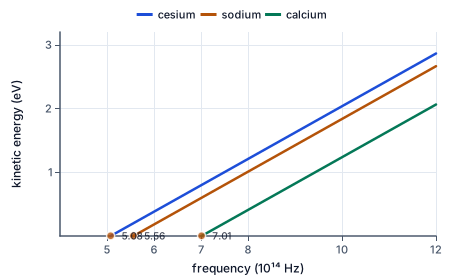
The figure plots the three metals of this lesson: parallel lines with Planck's constant as their slope, each starting at its own threshold frequency.
Plot the stopping voltage against the light's frequency and the photoelectric equation becomes a straight line, $V_s = (h/e)f - \phi/e$. Every metal gives a line with the same slope, $h/e = 4.14 \times 10^{-15}$ V·s, because the slope depends only on the photon's energy per unit frequency, a property of light, not of the metal. The lines for different metals are parallel, shifted sideways by their different work functions.
The line crosses the frequency axis at the threshold frequency $f_0$, and extended backward it would cross the voltage axis at $-\phi/e$. A student with a lamp, a set of color filters and a sensitive voltmeter can reproduce Millikan's measurement and find Planck's constant to a few percent, as many college physics laboratories do.
The graph also shows what intensity does not do. Brighter light at the same frequency raises the current but leaves the point on the line where it was. No classical wave theory can produce a straight line whose slope is the same universal constant for every material, which is why this simple plot was so persuasive.
The IceCube Neutrino Observatory, operated by the University of Wisconsin–Madison, is a cubic kilometer of Antarctic ice threaded with $5160$ light sensors. When a neutrino strikes the ice, the charged particles it makes emit faint blue Cherenkov light, photons of around $400$ nm, about $3$ eV each.
Each sensor holds a photomultiplier whose photocathode has a work function near $2$ eV, so a blue photon frees an electron with up to about $1$ eV to spare, and the tube's chain of plates multiplies it into a pulse of ten million electrons. Timing thousands of such single-photon pulses traces the neutrino's path back to its source in space.
Sunlight at the ground contains almost no photons above $4.1$ eV, because the ozone layer absorbs the ultraviolet below about $300$ nm. Copper's work function is about $4.7$ eV and aluminum's $4.1$ eV, so sunlight ejects few electrons from ordinary metals outdoors.
In space, above the ozone, the full solar ultraviolet does eject electrons, and satellites charge up by a few volts on their sunlit sides. Designers at NASA's Goddard Space Flight Center in Maryland specify conductive coatings to spread the charge evenly, because sparks between surfaces at different voltages can damage instruments.
In a wave picture, brighter light means a stronger field that should shake electrons out with more energy. Experiment says no: the maximum energy of photoelectrons does not change with intensity. Brighter light only ejects more of them, because it delivers more photons.
The complementary error is to think that dim light below threshold might eventually eject electrons if left on long enough. It never does: each photon must individually carry at least $\phi$, and photons do not pool their energy.
Light of $400$ nm strikes sodium, $\phi = 2.3$ eV. Find the photon energy.
$E = \dfrac{1240}{400} = 3.1\ \text{eV}$
Violet light.
Find the maximum kinetic energy.
$K_{\max} = 3.1 - 2.3 = 0.8\ \text{eV}$
Einstein's equation.
Find the stopping voltage.
$V_s = 0.8\ \text{V}$
Volts equal eV per electron.
Find the threshold wavelength.
$\lambda_0 = \dfrac{1240}{2.3} = 539\ \text{nm}$
Green light is the limit.
Try $600$ nm light instead.
$E = 2.07\ \text{eV} < 2.3\ \text{eV}: \text{no electrons}$
Below threshold, at any brightness.
Stopping voltages of $1.60$ V at $8.00 \times 10^{14}$ Hz and $0.36$ V at $5.00 \times 10^{14}$ Hz are measured. Find the difference in voltage.
$\Delta V = 1.60 - 0.36 = 1.24\ \text{V}$
Between the two frequencies.
Find the difference in frequency.
$\Delta f = 3.00 \times 10^{14}\ \text{Hz}$
Between the two lamps.
Find the slope.
$\dfrac{h}{e} = \dfrac{1.24}{3.00 \times 10^{14}} = 4.13 \times 10^{-15}\ \text{V·s}$
From $eV_s = hf - \phi$.
Find Planck's constant.
$h = 4.13 \times 10^{-15} \times 1.60 \times 10^{-19} = 6.61 \times 10^{-34}\ \text{J·s}$
Multiply by $e$.
Find the work function.
$\phi = hf - eV_s = 4.13 \times 10^{-15} \times 8.00 \times 10^{14} - 1.60 = 1.70\ \text{eV}$
In eV.
Find the threshold frequency.
$f_0 = \dfrac{1.70}{4.13 \times 10^{-15}} = 4.12 \times 10^{14}\ \text{Hz}$
Where the line crosses zero.
Light of $200$ nm strikes copper, $\phi = 4.7$ eV. Find the photon energy.
$E = \dfrac{1240}{200} = 6.2\ \text{eV}$
Deep ultraviolet.
Find the maximum kinetic energy.
$K_{\max} = 6.2 - 4.7 = 1.5\ \text{eV}$
Einstein's equation.
Convert to joules.
$K = 1.5 \times 1.60 \times 10^{-19} = 2.4 \times 10^{-19}\ \text{J}$
For the speed formula.
Find the speed.
$v = \sqrt{\dfrac{2 \times 2.4 \times 10^{-19}}{9.11 \times 10^{-31}}} = 7.3 \times 10^5\ \text{m/s}$
Newtonian.
Check that relativity is not needed.
$\beta = 0.0024$
Far below $c$.
Find the de Broglie wavelength for lesson 9.
$\lambda = \dfrac{h}{mv} = \dfrac{6.63 \times 10^{-34}}{9.11 \times 10^{-31} \times 7.3 \times 10^5} = 1.0\ \text{nm}$
Electrons have wavelengths too.
Explain why copper looks unaffected by sunlight.
$\text{sunlight at the ground has almost no photons above } 4.7\ \text{eV}$
The ozone layer removes them.
Find the photon energy.
$E = \dfrac{1240}{250} = 4.96\ \text{eV}$
In eV.
Subtract the work function.
$K_{\max} = 4.96 - 2.1$
Einstein's equation.
State the stopping voltage.
Ultraviolet light shining on a zinc plate ejects electrons with a maximum kinetic energy of $0.9$ eV. The light is made three times as intense, at the same wavelength. What happens?
Complete the worked solution: cesium has work function $2.1$ eV. With $h = 4.136 \times 10^{-15}$ eV·s and $hc = 1240$ eV·nm, find its threshold frequency in units of $10^{14}$ Hz, its threshold wavelength in nm, and the maximum kinetic energy of electrons ejected by $250$ nm light, in eV.
Divide the work function by Planck's constant.
$f_0 = \dfrac{\phi}{h} =$ f
The lowest frequency that ejects electrons.
Divide $hc$ by the work function.
$\lambda_0 = \dfrac{hc}{\phi} =$ t
The longest wavelength that works.
Find the energy at $250$ nm.
$K_{\max} = \dfrac{1240}{250} - \phi =$ k
$4.96$ eV photons.
Check that the frequency and wavelength agree.
$f_0\lambda_0 = c$
They describe the same threshold.
Match each photoelectric quantity to its expression or behavior.
| $hf - \phi$ | $\phi/h$ | $K_{\max}/e$ | proportional to intensity | |
|---|---|---|---|---|
| maximum kinetic energy | ||||
| threshold frequency | ||||
| stopping voltage | ||||
| photocurrent |
Light of wavelength $400$ nm falls on cesium, whose work function is $2.1$ eV. With $hc = 1240$ eV·nm, fill in the photon energy in eV, the maximum kinetic energy of the ejected electrons in eV, and the metal's threshold wavelength in nm.
| value | |
|---|---|
| photon energy (eV) | |
| maximum kinetic energy (eV) | |
| threshold wavelength (nm) |
Light of wavelength $L$ nm falls on sodium, whose work function is $2.3$ eV. With $hc = 1240$ eV·nm, write the stopping voltage, in volts, as a formula in $L$, for wavelengths short enough to eject electrons.
Answer:
Ultraviolet light of wavelength $300$ nm strikes a metal with work function $2.3$ eV. With $hc = 1240$ eV·nm, $e = 1.60 \times 10^{-19}$ C and $m_e = 9.11 \times 10^{-31}$ kg, how fast are the fastest ejected electrons, in units of $10^5$ m/s?
Answer: × 10⁵ m/s
The IceCube neutrino observatory, run from the University of Wisconsin–Madison, watches Antarctic ice with photomultiplier tubes whose photocathodes have a work function of about $2.0$ eV. A blue photon of $450$ nm strikes one. With $hc = 1240$ eV·nm, what is the largest kinetic energy an electron it frees can have, in eV?
Answer: eV maximum
Lesson test: one question per skill, one attempt each, no hints. Your answers are checked when you submit.
Light of wavelength $L$ nm falls on calcium, whose work function is $2.9$ eV. With $hc = 1240$ eV·nm, write the stopping voltage, in volts, as a formula in $L$, for wavelengths short enough to eject electrons.
Answer:
You can apply Einstein's photoelectric equation. Explain to someone why dim ultraviolet light ejects electrons that bright red light cannot.
21. Your turn: light of $250$ nm strikes cesium, $\phi = 2.1$ eV. Find the stopping voltage., step 3
$V_s = 2.86\ \text{V}$
Numerically equal to $K_{\max}$ in eV.