Back to the on-screen lesson ·
Acceleration as the rate velocity changes, speeding up and slowing down by sign, and the three constant-acceleration equations.
Paper packet. Every task here also exists on screen, where it is checked automatically; answers written on paper are not assessed by Nydus. When you are back at a device, enter your answers there.
By the end of this lesson you will be able to find accelerations and use the constant-acceleration equations with correct signs.
From the last lesson you know signed positions and velocities along a line, and that at constant velocity position changes as $x = x_0 + vt$. This lesson lets the velocity change, introducing acceleration and the three equations that describe motion whenever the acceleration is constant.
| Term | What it means |
|---|---|
| Acceleration | $a = \Delta v/\Delta t$, the rate velocity changes, in m/s², with a sign. |
| Speeding up | Velocity and acceleration point the same way. |
| Slowing down | Velocity and acceleration point opposite ways. |
| Velocity equation | $v = v_0 + at$. |
| Position equation | $x = x_0 + v_0t + \tfrac{1}{2}at^2$. |
| Time-free equation | $v^2 = v_0^2 + 2a\Delta x$. |
Acceleration is how fast velocity changes: $a = \Delta v/\Delta t$, in meters per second per second. Like velocity, it has a sign. Whether an object speeds up or slows down depends on the signs together: the same sign means speeding up, opposite signs mean slowing down, whichever direction it moves.
When acceleration is constant, three equations describe the motion:
$$v = v_0 + at, \qquad x = x_0 + v_0t + \tfrac{1}{2}at^2, \qquad v^2 = v_0^2 + 2a\Delta x.$$
Choose the one that contains the quantities you know and the one you want.
Another way: picture
Picture a car's speedometer needle. Acceleration is how fast the needle moves. Press the gas while driving forward and it climbs; press the brake and it falls. Now put the car in reverse and press the gas: the car speeds up backward, its velocity growing more negative. The acceleration is negative, yet the car is speeding up.
Another way: steps
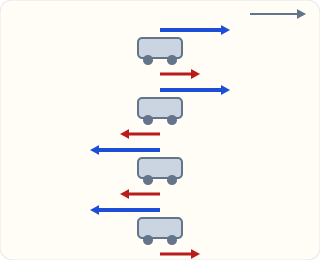
The figure shows four identical carts, each with a blue velocity arrow and a red acceleration arrow, with right positive. When both point right, the cart speeds up moving right. Velocity right and acceleration left: it slows down. Both left: it speeds up moving left. Velocity left and acceleration right: it slows down while moving left.
Only the comparison of the two arrows decides speeding up or slowing down. A negative acceleration can speed a cart up, in the third row, and a positive one can slow it down, in the fourth.
Acceleration is measured in meters per second per second, m/s². An acceleration of $3$ m/s² means the velocity changes by $3$ m/s every second: $0$, $3$, $6$, $9$ m/s after one, two, three seconds. Gravity near Earth's surface gives $9.8$ m/s², the acceleration of a dropped object, often called $g$.
Everyday accelerations range from a gentle elevator start, about $1$ m/s², through a car pulling away briskly, $3$ m/s², to hard braking, about $7$ to $8$ m/s² on dry pavement. Fighter pilots and roller coaster riders feel several $g$ in tight turns.
With constant acceleration, velocity changes steadily: $v = v_0 + at$. On a velocity-time graph that is a straight line. The displacement is the area under that line, a rectangle for $v_0t$ plus a triangle for $\tfrac{1}{2}at^2$, which gives the position equation.
Eliminating time between the two gives $v^2 = v_0^2 + 2a\Delta x$, useful when the time is neither known nor wanted, as in braking-distance problems. All three are consequences of one assumption: the acceleration does not change during the motion.
A car braking from speed $v_0$ with deceleration $a$ stops in a distance $v_0^2/(2a)$. The square is the important part: doubling the speed quadruples the braking distance. A car that stops in $22$ m from $15$ m/s, about $34$ mph, needs $90$ m from $30$ m/s, about $67$ mph.
Add the reaction time, about $1.5$ s during which the car keeps going at full speed, and the total stopping distance grows further. That is why highway following distances are much larger than city ones, and why speed limits drop near schools.
Checking an answer. An object slowing down must have $v$ and $a$ of opposite signs. Braking distances must grow as speed squared. The average velocity must be the mean of $v_0$ and $v$.
The equations hold only while the acceleration is constant. For motion in stages, such as speeding up and then cruising, apply them to each stage separately, using the final velocity of one as the initial velocity of the next.
Average velocity equals the mean of the initial and final velocities only for constant acceleration, because the velocity-time line is straight, so its average height is halfway between its ends. For varying acceleration the average must come from the area under the curve.
Average acceleration over an interval is $\Delta v/\Delta t$; instantaneous acceleration is the same ratio over a vanishingly short interval, the slope of the velocity-time graph at one moment. When the acceleration is constant, the two are the same.
A phone's accelerometer measures instantaneous acceleration many times a second, using a tiny mass on microscopic springs. Its readings turn a phone screen when you rotate it, count steps, and in newer phones detect car crashes and call emergency services automatically.
You feel acceleration, not velocity. On a smooth jet at $550$ mph you feel nothing, but during takeoff you are pressed back into your seat. In an elevator you feel heavier as it starts upward and lighter as it slows at the top, because your body must be accelerated along with it.
Theme-park engineers design rides around acceleration: launched roller coasters at Cedar Point in Ohio reach $120$ mph in about four seconds, an average of over $1.3$ $g$. The sensation of speed comes from changes in velocity, which is why the launch is the thrill.
An object thrown upward slows, stops for an instant at the top, and falls back. At the top its velocity is zero, but its acceleration is still $9.8$ m/s² downward; otherwise it would stay there. Zero velocity does not mean zero acceleration.
The same happens to a ball rolling up a ramp or a car reversing direction. The constant-acceleration equations handle the whole trip, up and back, in one go, as long as the acceleration stays the same, with the sign of the velocity telling which leg the object is on.
The Insurance Institute for Highway Safety in Virginia crash-tests vehicles and studies how speed affects crashes. The energy a car carries grows as the square of its speed, just as its braking distance does, so a crash at $70$ mph is about twice as violent as one at $50$.
Automatic emergency braking, now standard on most new American cars, uses radar or cameras to measure the gap to the car ahead and how fast it is closing, and brakes if the driver does not. The equations of this lesson, run in a computer many times a second, decide when.
Many motions consist of stages with different constant accelerations: a train leaving a station speeds up, cruises and brakes. Treat each stage separately, carrying the velocity and position from the end of one into the start of the next.
A subway train might accelerate at $1.2$ m/s² for $15$ s, reaching $18$ m/s, cruise for $60$ s, then brake at $1.5$ m/s² for $12$ s. The distances add: $135$ m, $1080$ m and $108$ m, a total of $1323$ m between stations, found with the same three equations applied three times.
Galileo Galilei was the first to describe uniformly accelerated motion correctly, around 1604. Unable to time falling objects precisely, he rolled balls down gentle ramps, which slowed the motion enough to measure with water clocks and musical beats. He found that the distances covered in successive equal times grew as the odd numbers, one, three, five, seven, so the total distance grew as the square of the time.
That is exactly what the position equation predicts for an object starting from rest: $x = \tfrac{1}{2}at^2$, so after one, two, three and four seconds the distances are in the ratio one, four, nine, sixteen, and the gaps between them are one, three, five and seven. Galileo's ramps established that acceleration, not velocity, is what a steady push or gravity produces, a step on the way to Newton's laws.
American car magazines and reviewers rate acceleration by the time to reach $60$ mph, $26.82$ m/s, from a standstill. A family sedan taking $6.0$ s averages $4.5$ m/s², a pickup truck at $8.5$ s about $3.2$ m/s², and a high-performance electric car at $2.3$ s nearly $11.7$ m/s², more than one $g$.
Electric cars excel because their motors deliver full force from zero speed, while gasoline engines must build up revolutions. The limit is traction: tires can push the road only as hard as friction allows, about one $g$ for ordinary tires, which is why the quickest cars use sticky tires and all-wheel drive to spread the force over four contact patches.
Driver's education courses in every state teach stopping distances. At $65$ mph, about $29$ m/s, a car braking hard at $7$ m/s² needs $v^2/(2a) \approx 60$ m to stop, and during the driver's $1.5$ s reaction time it covers another $44$ m before the brakes even engage.
That total, over $100$ m, is longer than a football field. On wet pavement the deceleration may fall to $4$ m/s², raising the braking distance to over $100$ m on its own. That is the physics behind the three-second following rule, and behind the lower speed limits in work zones, where a stopped car may appear with little warning.
It is natural to equate negative acceleration with slowing down. Negative only means the acceleration points in the negative direction. An object already moving in that direction speeds up; one moving the other way slows down. Compare the signs of velocity and acceleration to decide.
A related error is to think an object at rest has no acceleration. A ball at the top of its flight is momentarily at rest, but gravity is still accelerating it downward, which is why it falls back.
A car moving east at $24$ m/s brakes at $6.0$ m/s². Sign the quantities with east positive.
$v_0 = +24, \quad a = -6.0$
Opposite signs: slowing.
Find the time to stop.
$0 = 24 - 6.0t \Rightarrow t = 4.0\ \text{s}$
$v = v_0 + at$.
Find the stopping distance.
$\Delta x = \dfrac{24^2}{2 \times 6.0} = 48\ \text{m}$
Time-free equation.
Check with the position equation.
$24 \times 4.0 - \tfrac{1}{2} \times 6.0 \times 4.0^2 = 48\ \text{m}$
Consistent.
Find the average velocity.
$\bar{v} = \dfrac{24 + 0}{2} = 12\ \text{m/s}$
Midpoint rule.
A ball starts up a ramp at $6.0$ m/s and slows at $2.0$ m/s². Take up the ramp as positive and sign the quantities.
$v_0 = +6.0, \quad a = -2.0$
Slowing on the way up.
Find when it stops.
$0 = 6.0 - 2.0t \Rightarrow t = 3.0\ \text{s}$
Top of its path.
Find how far up it goes.
$\Delta x = 6.0 \times 3.0 - \tfrac{1}{2} \times 2.0 \times 3.0^2 = 9.0\ \text{m}$
Position equation.
Find its velocity at $5.0$ s.
$v = 6.0 - 2.0 \times 5.0 = -4.0\ \text{m/s}$
Rolling back down.
Find its position at $5.0$ s.
$x = 6.0 \times 5.0 - \tfrac{1}{2} \times 2.0 \times 25 = 5.0\ \text{m}$
Partway back down.
Decide whether it is speeding up then.
$v < 0, a < 0 \Rightarrow \text{speeding up}$
Same signs.
A train accelerates from rest at $1.2$ m/s² for $15$ s. Find its speed.
$v = 1.2 \times 15 = 18\ \text{m/s}$
$v = v_0 + at$.
Find the distance while accelerating.
$\tfrac{1}{2} \times 1.2 \times 15^2 = 135\ \text{m}$
From rest.
It cruises for $60$ s. Find that distance.
$18 \times 60 = 1080\ \text{m}$
Constant velocity.
It brakes at $1.5$ m/s². Find the braking time.
$t = \dfrac{18}{1.5} = 12\ \text{s}$
Down to zero.
Find the braking distance.
$\dfrac{18^2}{2 \times 1.5} = 108\ \text{m}$
Time-free equation.
Add the stages.
$135 + 1080 + 108 = 1323\ \text{m}$
Station to station.
Find the change in velocity.
$\Delta v = 8.0 - 2.0 = 6.0\ \text{m/s}$
Final minus initial.
Divide by the time.
$a = \dfrac{6.0}{3.0}$
Rate of change.
Evaluate the acceleration.
A cart has velocity $-8$ m/s and a constant acceleration of $-3$ m/s², with positive meaning east. What is its velocity $2$ s later, in m/s?
Complete the worked solution: a car on a highway on-ramp speeds up steadily from $12$ m/s to $30$ m/s over $210$ m. Find its acceleration in m/s², the time taken in s, and its average velocity in m/s.
Find the acceleration.
$a = \dfrac{v^2 - v_0^2}{2\Delta x} =$ a
From $v^2 = v_0^2 + 2a\Delta x$.
Find the time.
$t = \dfrac{v - v_0}{a} =$ t
From $v = v_0 + at$.
Find the average velocity.
$\bar{v} = \dfrac{v_0 + v}{2} =$ m
Constant acceleration.
Check the distance.
$\Delta x = \bar{v}\,t$
Should give back the ramp length.
Match each combination of velocity and acceleration to the motion it gives.
| speeding up | slowing down | moving at constant velocity | momentarily at rest while turning around | |
|---|---|---|---|---|
| velocity and acceleration in the same direction | ||||
| velocity and acceleration in opposite directions | ||||
| zero acceleration | ||||
| zero velocity, nonzero acceleration |
A cart starts at $4$ m/s with a constant acceleration of $2$ m/s². Fill in its velocity after $5$ s in m/s, its displacement in that time in m, and its average velocity in m/s.
| value | |
|---|---|
| final velocity (m/s) | |
| displacement (m) | |
| average velocity (m/s) |
A cart leaves the origin at $4$ m/s with a constant acceleration of $2$ m/s². Write its position, in meters, as a function of time $t$ in seconds.
Answer:
A car traveling at $15$ m/s brakes with a constant deceleration of $5$ m/s². How far does it travel before stopping, in m?
Answer: m
Car magazines test how fast a car reaches $60$ mph, which is $26.82$ m/s, from rest. If a high-performance electric car does it in $2.3$ s, what is its average acceleration, in m/s²?
Answer: m/s²
Lesson test: one question per skill, one attempt each, no hints. Your answers are checked when you submit.
A cart leaves the origin at $4$ m/s with a constant acceleration of $2$ m/s². Write its position, in meters, as a function of time $t$ in seconds.
Answer:
You can work with acceleration. Explain to someone how a car with negative acceleration can be speeding up.
23. Your turn: a bike speeds up from $2.0$ m/s to $8.0$ m/s in $3.0$ s. What is its acceleration?, step 3
$a = 2.0\ \text{m/s}^2$
Speeding up.