Back to the on-screen lesson ·
Angular momentum is $I\omega$ for a turning object and $mvr_\perp$ for a moving particle; a net torque changes it at the rate $\tau = \Delta L/\Delta t$.
Paper packet. Every task here also exists on screen, where it is checked automatically; answers written on paper are not assessed by Nydus. When you are back at a device, enter your answers there.
By the end of this lesson you will be able to compute angular momentum for turning objects and moving particles, and use torque to find how it changes.
You know linear momentum, $p = mv$, and that force is its rate of change. You can use rotational inertia and $\tau = I\alpha$. This lesson defines the rotational counterpart of momentum, and shows how torque changes it.
| Term | What it means |
|---|---|
| Angular momentum | Rotational momentum: $L = I\omega$ for a turning object, $L = mvr_\perp$ for a particle. |
| Perpendicular distance | The distance from the axis to a line of motion, $r_\perp$. |
| Angular impulse | Torque times time, $\tau\Delta t$, equal to the change in $L$. |
| Units of angular momentum | kg·m²/s. |
| Axis | The line about which angular momentum is measured. |
| Gyroscope | A spinning wheel whose angular momentum resists changes in direction. |
A turning object has angular momentum
$$L = I\omega.$$
A particle moving with momentum $mv$ has angular momentum about an axis
$$L = mvr_\perp,$$
where $r_\perp$ is the perpendicular distance from the axis to its line of motion.
Another way: picture
Picture a merry-go-round at rest and a child running past it in a straight line, then grabbing a rail. The ride starts turning. Before the grab, nothing was spinning, but the running child already had angular momentum about the ride's axle, and it was shared with the ride.
Another way: steps
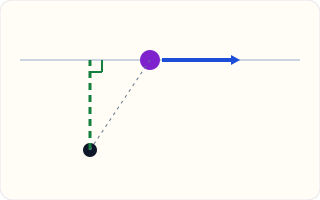
The figure shows a ball moving in a straight line past an axis. The dashed line from the axis meets the ball's path at a right angle; its length is the perpendicular distance. The ball's angular momentum about the axis is its momentum times that distance.
The distance from the axis to the ball itself changes as the ball moves, but the perpendicular distance to the path does not. So a ball moving at steady velocity has constant angular momentum about any axis, even though it is not turning.
Every piece of a turning object moves in a circle, with momentum $mr\omega$ at distance $r$. Its angular momentum is $mr^2\omega$. Adding over all pieces gives $L = (\sum mr^2)\omega = I\omega$.
The formula mirrors $p = mv$: rotational inertia replaces mass and angular velocity replaces velocity. A heavy flywheel spinning fast has a large angular momentum and is hard to stop or turn.
Newton's second law for rotation can be written as $\tau_{\text{net}} = \Delta L/\Delta t$. A torque acting for a time delivers an angular impulse, $\tau\Delta t$, equal to the change in angular momentum.
This is the rotational version of the impulse-momentum theorem. Stopping a spinning wheel quickly needs a large torque; the same stop spread over a longer time needs a smaller torque.
Angular momentum points along the axis. By the right-hand rule, curl the fingers of your right hand in the direction of turning, and your thumb points along $L$. A wheel turning counterclockwise, seen from above, has $L$ pointing up.
In one-axis problems, it is enough to call counterclockwise positive and clockwise negative, just as with torque. Contributions in opposite senses subtract.
A spinning wheel with large angular momentum resists changes to the direction of its axis. A gyroscope mounted in gimbals keeps pointing the same way however its support is turned, which is why gyroscopes guide ships, aircraft and spacecraft.
Bicycles are easier to balance when moving partly because their spinning wheels have angular momentum. A torque on a spinning wheel tilts its axis sideways rather than tipping it over, an effect called precession.
Checking an answer. Units must be kg·m²/s. A particle moving straight toward the axis has zero angular momentum. Doubling speed or distance doubles $L$.
For a particle, $L = mvr_\perp$ is the momentum times the lever arm, just as torque is force times lever arm. Taking the rate of change, $\Delta L/\Delta t = F r_\perp = \tau$, so torque is the rate of change of angular momentum.
For a rigid object, adding over all particles gives $I\omega$, and the internal torques cancel in pairs. Only external torques change the total angular momentum.
A planet orbiting the Sun has angular momentum $mvr_\perp$ about the Sun. Gravity pulls straight toward the Sun, so it has no lever arm and exerts no torque. The planet's angular momentum stays constant.
That explains Kepler's second law: a planet moves faster when closer to the Sun, since a smaller distance needs a larger speed to keep $mvr$ the same. Comets swing around the Sun at high speed and crawl through the outer solar system.
A football thrown in a tight spiral has angular momentum along its long axis. That angular momentum keeps the ball's axis pointing steadily through the air, cutting drag and making it easier to catch.
A thrown frisbee's spin keeps it level, so it glides. A rifled gun barrel spins its projectile for the same reason. Without spin, these objects tumble.
Starting a merry-go-round, a motor on a fan or a turbine all involve torque changing angular momentum. The angular impulse, torque times time, sets how much the angular momentum changes.
Helicopters show the reverse: the engine applies torque to the main rotor, and the rotor applies an equal and opposite torque to the body. The tail rotor provides a sideways push to cancel that torque, keeping the body from spinning.
Angular momentum is measured in kg·m²/s. A spinning top has about $10^{-3}$; a bicycle wheel at speed, about $1$; a large wind turbine rotor, tens of millions. Earth's spin has about $7 \times 10^{33}$.
Convert rpm to rad/s before computing $I\omega$. And remember that angular momentum and rotational kinetic energy are different: one is $I\omega$, the other $\tfrac{1}{2}I\omega^2$.
The total angular momentum of a system is the sum of its parts, each measured about the same axis. A spinning wheel carried by a person walking past a pole has both its spin angular momentum and its angular momentum from moving past the pole.
Choosing the axis carefully keeps problems simple. For a merry-go-round and a child who jumps on, take the ride's axle as the axis, so both contributions are measured from the same point.
When no net outside torque acts, angular momentum stays the same, whatever happens inside the system. The next lesson follows this principle through spinning skaters, divers and collapsing stars.
The same principle keeps a satellite's orientation fixed in space. Engineers use reaction wheels inside the satellite: spinning a wheel one way turns the satellite the other way, while the total angular momentum stays constant.
Three errors come up again and again. Using the straight-line distance to a moving particle, rather than the perpendicular distance to its path, gives an angular momentum that seems to change when it does not.
Forgetting to convert rpm, or mixing up $I\omega$ with $\tfrac{1}{2}I\omega^2$, gives answers wrong by large factors. Checking units, kg·m²/s for angular momentum and joules for energy, catches most of these.
Every idea in this lesson has a partner from the momentum unit. Momentum becomes angular momentum, mass becomes rotational inertia, velocity becomes angular velocity, and force becomes torque. An impulse changes momentum; an angular impulse changes angular momentum.
Keeping the table of partners in mind makes new problems feel familiar. If you know how to stop a sliding cart with a force over a time, you already know how to stop a spinning wheel with a torque over a time. Only the names and the units change.
Unlike momentum, angular momentum depends on the chosen axis. The same ball has a large angular momentum about a post far from its path, a small one about a post close to it, and none at all about a point on its path.
A problem that asks for angular momentum without naming an axis is incomplete. For a wheel spinning on an axle, the axle is the natural choice; for a moving particle, the problem must say which point to measure from.
The wind farms stretching across Iowa, Kansas and Texas use turbines whose three blades may each be over fifty meters long and weigh more than ten metric tons. Turning at about fifteen rpm, a rotor carries tens of millions of kg·m²/s of angular momentum.
That enormous angular momentum makes the rotor turn smoothly despite gusty wind, because a gust's torque changes $L$ only a little each second. Control systems pitch the blades to adjust the torque from the wind, speeding up or slowing the rotor gradually. When a turbine must stop in a storm, brakes and blade pitching apply a torque for many seconds, since stopping all that angular momentum quickly would strain the gearbox and tower.
A quarterback throwing a football gives it a fast spin about its long axis, several hundred rpm. The spin's angular momentum points along the ball, and because air drag produces only small torques, the axis stays nearly steady in flight.
A ball thrown without spin wobbles and tumbles, presenting a broad side to the air and slowing quickly. A tight spiral keeps its narrow nose forward, cutting drag and flying farther and truer. The same physics makes rifle bullets, frisbees and spinning satellites hold their orientation, and NASA spins some spacecraft for stability during long journeys.
It is natural to think only spinning objects have angular momentum. But any object moving past an axis, not straight toward it, has angular momentum $mvr_\perp$ about that axis. A running child has angular momentum about a merry-go-round's axle before ever touching it.
A second error is to use the straight-line distance to the object instead of the perpendicular distance to its path. The perpendicular distance stays the same as the object moves, which is why its angular momentum stays constant.
A $1.2$ kg bicycle wheel, treated as a hoop of radius $0.34$ m, spins at $25$ rad/s. Find its rotational inertia.
$I = 1.2 \times 0.34^2 = 0.139\ \text{kg·m}^2$
Hoop: $MR^2$.
Find its angular momentum.
$L = 0.139 \times 25 = 3.47\ \text{kg·m}^2\text{/s}$
$L = I\omega$.
A brake applies $0.70$ N·m. Find the time to stop.
$\Delta t = \dfrac{3.47}{0.70} = 4.96\ \text{s}$
$\tau\Delta t = \Delta L$.
Find the stopping time with twice the torque.
$\Delta t = 2.48\ \text{s}$
Half the time.
Compare the rotational energy.
$K = \tfrac{1}{2} \times 0.139 \times 25^2 = 43.4\ \text{J}$
A different quantity.
A $0.40$ kg ball rolls at $5.0$ m/s along a line passing $2.0$ m from a post. Find its momentum.
$p = 0.40 \times 5.0 = 2.0\ \text{kg·m/s}$
Mass times velocity.
Find its angular momentum about the post.
$L = 2.0 \times 2.0 = 4.0\ \text{kg·m}^2\text{/s}$
Times the perpendicular distance.
Find its distance from the post $3.0$ m farther along.
$r = \sqrt{2.0^2 + 3.0^2} = 3.6\ \text{m}$
Pythagorean theorem.
Find the angular momentum there.
$L = 2.0 \times 2.0 = 4.0\ \text{kg·m}^2\text{/s}$
Same perpendicular distance.
Find it for a path aimed at the post.
$L = 0$
No lever arm.
Explain why it is constant.
$\text{no torque about the post}$
No force acts.
A potter's wheel is a $20$ kg disk of radius $0.30$ m at rest. Find its rotational inertia.
$I = \tfrac{1}{2} \times 20 \times 0.30^2 = 0.90\ \text{kg·m}^2$
Solid disk.
A motor applies $4.5$ N·m for $6.0$ s. Find the angular impulse.
$\tau\Delta t = 4.5 \times 6.0 = 27\ \text{kg·m}^2\text{/s}$
Torque times time.
Find the final angular momentum.
$L = 0 + 27 = 27\ \text{kg·m}^2\text{/s}$
From rest.
Find the angular velocity.
$\omega = \dfrac{27}{0.90} = 30\ \text{rad/s}$
$L/I$.
Convert to rpm.
$\dfrac{30 \times 60}{2\pi} = 286\ \text{rpm}$
Revolutions per minute.
Check with $\tau = I\alpha$.
$\alpha = \dfrac{4.5}{0.90} = 5.0,\ \omega = 5.0 \times 6.0 = 30$
The same.
Find the rim speed.
$v = 0.30 \times 30 = 9.0\ \text{m/s}$
$v = r\omega$.
Write the formula.
$L = I\omega$
Rotational momentum.
Substitute the values.
$L = 0.20 \times 15$
SI units.
Evaluate the angular momentum.
A uniform solid disk of mass $2$ kg and radius $0.3$ m spins at $20$ rad/s about its axle. What is its angular momentum, in kg·m²/s?
Complete the worked solution: a $0.3$ kg ball whirls in a horizontal circle on a string $1.5$ m long at $9$ m/s. Treating the ball as a point, find its angular velocity in rad/s, its rotational inertia about the center in kg·m², and its angular momentum in kg·m²/s.
Find the angular velocity.
$\omega = \dfrac{v}{r} =$ w
Speed over radius.
Find the rotational inertia.
$I = mr^2 =$ i
A point mass.
Find the angular momentum.
$L = I\omega =$ l
Also equal to $mvr$.
Check with the particle formula.
$L = mvr$
The two agree.
Match each situation to the angular momentum relation it uses.
| $L = I\omega$ | $L = mvr_\perp$ | $\tau = \Delta L/\Delta t$ | $L$ stays constant | |
|---|---|---|---|---|
| a spinning bicycle wheel | ||||
| a ball moving in a straight line past an axis | ||||
| a motor spinning up a flywheel | ||||
| a satellite spinning freely in space |
A $1.5$ kg ball moves at $6$ m/s along a straight line that passes $2$ m from an axis at its closest. Fill in its momentum in kg·m/s, its angular momentum about the axis in kg·m²/s, and its angular momentum in kg·m²/s if its speed doubles.
| value | |
|---|---|
| momentum (kg·m/s) | |
| angular momentum (kg·m²/s) | |
| angular momentum at double speed (kg·m²/s) |
A flywheel with rotational inertia $0.5$ kg·m² spins at $16$ rad/s when a motor starts applying a steady net torque of $2$ N·m in the direction of spin. Write its angular momentum, in kg·m²/s, as a function of the time $t$ in seconds since the motor started.
Answer:
A bicycle wheel, treated as a uniform disk of mass $10$ kg and radius $0.2$ m, spins at $30$ rad/s on a repair stand. A brake stops it steadily in $4$ s. What torque does the brake exert, in N·m?
Answer: N·m
A wind turbine in Iowa has three blades, each about $12$ metric tons and $50$ m long, turning at $15$ rpm. Treating each blade as a thin rod turning about one end, what is the rotor's angular momentum, in millions of kg·m²/s?
Answer: million kg·m²/s
Lesson test: one question per skill, one attempt each, no hints. Your answers are checked when you submit.
A flywheel with rotational inertia $0.8$ kg·m² spins at $25$ rad/s when a motor starts applying a steady net torque of $4$ N·m in the direction of spin. Write its angular momentum, in kg·m²/s, as a function of the time $t$ in seconds since the motor started.
Answer:
You can compute and change angular momentum. Explain to someone why a ball moving in a straight line has angular momentum about a post it passes.
27. Your turn: a wheel with $I = 0.20$ kg·m² spins at $15$ rad/s. What is its angular momentum?, step 3
$L = 3.0\ \text{kg·m}^2\text{/s}$
Along the axle.