Back to the on-screen lesson ·
The buoyant force equals the weight of the fluid displaced; an object floats when its average density is less than the fluid's.
Paper packet. Every task here also exists on screen, where it is checked automatically; answers written on paper are not assessed by Nydus. When you are back at a device, enter your answers there.
By the end of this lesson you will be able to compute buoyant forces, decide whether objects float, and use buoyancy to find volumes and densities.
You know that pressure in a liquid grows with depth, $P = P_0 + \rho gh$, and pushes in every direction. You know density, mass per volume. This lesson shows how that growing pressure produces an upward push on anything in a fluid.
| Term | What it means |
|---|---|
| Buoyant force | The net upward push of a fluid on an object in it. |
| Archimedes' principle | The buoyant force equals the weight of the fluid displaced. |
| Displaced fluid | The fluid pushed aside by the submerged part of an object. |
| Apparent weight | An object's weight minus the buoyant force on it. |
| Average density | An object's total mass over its total volume, including air spaces. |
| Neutral buoyancy | Neither rising nor sinking: buoyancy equals weight when fully submerged. |
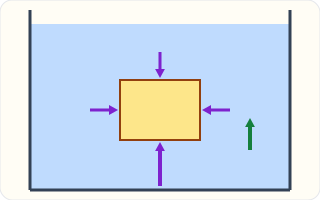
A fluid pushes on every face of a submerged object. Because pressure grows with depth, the push on the bottom exceeds the push on the top. The difference is the buoyant force, given by Archimedes' principle:
$$F_b = \rho_{\text{fluid}}V_{\text{sub}}g.$$
Another way: picture
Picture pushing a beach ball under water. The deeper you push it, the harder it pushes back, until it is fully under; after that the push stays the same. The ball is pushing aside water, and the water pushes back with the weight of all the water the ball has displaced.
Another way: steps
The figure shows a block held under water with arrows for the water's push on each face. The side pushes are equal and opposite, and cancel. The top face feels a push down; the bottom face, deeper, feels a larger push up.
The difference between the bottom and top pushes is the net upward force, the buoyant force, shown by the green arrow. It exists only because pressure grows with depth; in a fluid with the same pressure everywhere there would be no buoyancy.
The buoyant force on any object equals the weight of the fluid it displaces. To see why, imagine replacing the object with a blob of the same fluid. That blob would float in place, so the water around it must push up with exactly its weight.
The surrounding water cannot tell whether it is pushing on the blob or on the object, so the object feels the same push. This holds for any shape and any material, and for gases as well as liquids.
An object sinks if its weight exceeds the buoyant force when fully submerged, that is, if its average density exceeds the fluid's. It floats if its density is less, rising until only enough of it is under the surface to displace its own weight.
A floating object's submerged fraction equals the ratio of its density to the fluid's. Wood of density $600$ kg/m³ floats sixty percent submerged in fresh water; ice, about ninety percent submerged.
A steel ship floats even though steel is nearly eight times denser than water. The hull encloses a large volume of air, so the ship's average density, its total mass over its total volume, is less than water's.
If the hull is breached and water floods in, the average density rises. Once it exceeds the water's, the ship sinks. Watertight compartments limit how much of the hull can flood.
An object held under water seems lighter. A spring scale supporting it reads the weight minus the buoyant force, called the apparent weight. That is why lifting a friend in a swimming pool is easy.
Archimedes is said to have used this to test a king's crown. Weighing it in air and in water gives the buoyant force, and so its volume, and so its density, which reveals whether it is pure gold.
Checking an answer. The buoyant force can never exceed the weight of the fluid the whole object could displace. A floater's submerged fraction must be less than one. Liters must be converted to cubic meters.
Buoyancy follows directly from pressure growing with depth. For a box of height $h$ and top area $A$, the bottom's push exceeds the top's by $\rho ghA = \rho gV$: the weight of fluid that would fill the box.
For any shape, the replacement argument gives the same result. The principle applies only while the fluid is at rest or moving slowly, and it ignores surface tension, which matters only for very small objects.
Ice is about nine tenths as dense as seawater, so about nine tenths of an iceberg lies hidden below the surface. Only a tenth shows, which is the origin of the phrase the tip of the iceberg.
The hidden part can extend far beyond what is visible, which made icebergs deadly to ships like the Titanic. The U.S. Coast Guard's International Ice Patrol has tracked icebergs in the North Atlantic ever since.
A submarine controls its depth by pumping water into and out of ballast tanks. Filling the tanks raises its average density so it sinks; blowing them out with compressed air lowers it so it rises.
Many fish do the same with a gas-filled swim bladder. By adjusting the gas, they achieve neutral buoyancy, hovering without effort at any depth. Scuba divers use an inflatable vest for the same purpose.
Air is a fluid too, and it buoys up everything in it. A helium balloon floats because helium is much less dense than air: the balloon displaces air weighing more than the balloon and its helium together.
The Goodyear blimps flying over American stadiums use the same principle, holding thousands of cubic meters of helium. Hot-air balloons at the Albuquerque International Balloon Fiesta rise because hot air is less dense than the cool air around it.
The human body has an average density close to water's. With lungs full of air, most people float, with just the top of the head above water; with lungs empty, many sink slowly.
Floating is easier in salt water, which is denser. In Utah's Great Salt Lake, with water much saltier than the ocean, swimmers float high with little effort, their bodies displacing their own weight with less volume submerged.
Weighing an object in air and then fully in water gives its density without measuring its volume directly. The weight lost in water equals the buoyant force, which equals the weight of water with the object's volume.
Dividing the weight in air by the weight lost gives the density relative to water. Jewelers and geologists use this simple test to identify metals and minerals.
Three errors are common. Using the object's density instead of the fluid's in Archimedes' principle gives the object's weight, not the buoyant force. Using the whole volume for a floating object ignores the part above the surface.
Forgetting to convert liters or cubic centimeters to cubic meters gives answers a thousand or a million times too large. A liter of water weighs about ten newtons, a useful check.
Air is about eight hundred times less dense than water, so its buoyant force on everyday objects is tiny, but it is never zero. A person displaces about seventy liters of air, which weighs a little under one newton, so a bathroom scale reads slightly less than the true weight.
The effect matters for precise weighing. Laboratories that calibrate standard masses, such as the National Institute of Standards and Technology, correct every measurement for the buoyancy of the air, which depends on the day's temperature and pressure.
Floating is not the same as floating upright. A tall, narrow object may float but roll onto its side, because tipping lowers its center of mass. Ships are designed so that when they roll, the buoyant force shifts toward the low side and pushes them back upright.
The USS Gerald R. Ford, the U.S. Navy's newest aircraft carrier, has a mass of about one hundred thousand metric tons, yet it floats. Its hull, over three hundred meters long, displaces nearly a hundred thousand cubic meters of seawater, whose weight equals the ship's.
The steel hull is mostly air inside, so the ship's average density is well below seawater's. Loading fuel, aircraft and supplies makes it sit deeper, since it must displace more water to support the extra weight. Naval architects mark load lines on the hull showing how deep a ship may safely ride, and they design watertight compartments so that a single breach cannot flood enough of the hull to sink it.
Utah's Great Salt Lake is several times saltier than the ocean in places, giving it a density up to about seventeen percent greater than fresh water. Visitors wading in find themselves floating high, with far more of their bodies above the surface than in a pool.
Archimedes' principle explains why: a floating body displaces its own weight, and in denser water that takes less volume. The same effect lets ships ride higher in salt water than in fresh. Great Lakes freighters, which sail in fresh water, have separate load-line marks for fresh and salt water, since they sink noticeably deeper in fresh water with the same cargo.
It is natural to think heavy things sink and light things float. But a massive aircraft carrier floats while a small pebble sinks. What matters is density: an object floats if its average density, mass over total volume, is less than the fluid's.
A related error is to think the buoyant force depends on the object's weight or material. It depends only on the volume of fluid displaced and the fluid's density. A lead brick and a wooden block of the same size, both fully submerged, feel the same buoyant force.
A $3.0$ kg rock has a volume of $1.2$ L. Convert the volume.
$V = 1.2 \times 10^{-3}\ \text{m}^3$
Cubic meters.
Find the buoyant force in fresh water.
$F_b = 1000 \times 1.2 \times 10^{-3} \times 9.8 = 11.76\ \text{N}$
Weight of displaced water.
Find the rock's weight.
$W = 3.0 \times 9.8 = 29.4\ \text{N}$
In air.
Find its apparent weight.
$W' = 29.4 - 11.76 = 17.64\ \text{N}$
Lighter in water.
Decide whether it floats.
$29.4 > 11.76 \Rightarrow \text{sinks}$
Denser than water.
A log of density $700$ kg/m³ and volume $0.40$ m³ floats in a river. Find its mass.
$m = 700 \times 0.40 = 280\ \text{kg}$
Density times volume.
Find the water it must displace.
$m_w = 280\ \text{kg}$
Its own mass.
Find the submerged volume.
$V_{\text{sub}} = \dfrac{280}{1000} = 0.28\ \text{m}^3$
Water's density.
Find the fraction submerged.
$\dfrac{0.28}{0.40} = 0.70$
Equals the density ratio.
Find the extra load that sinks it to the surface.
$\Delta m = 1000 \times 0.12 = 120\ \text{kg}$
The rest of its volume.
Check the total.
$280 + 120 = 400 = 1000 \times 0.40$
Fully submerged balance.
A crown weighs $14.7$ N in air and $13.72$ N in water. Find the buoyant force.
$F_b = 14.7 - 13.72 = 0.98\ \text{N}$
Weight lost.
Find the volume.
$V = \dfrac{0.98}{1000 \times 9.8} = 1.0 \times 10^{-4}\ \text{m}^3$
From Archimedes' principle.
Find the mass.
$m = \dfrac{14.7}{9.8} = 1.5\ \text{kg}$
Weight over $g$.
Find the density.
$\rho = \dfrac{1.5}{1.0 \times 10^{-4}} = 15000\ \text{kg/m}^3$
Mass over volume.
Compare with pure gold.
$15000 < 19300$
Too light for gold.
Suggest what it contains.
$\text{gold mixed with a lighter metal}$
Such as silver.
Find the density ratio directly.
$\dfrac{14.7}{0.98} = 15$
Weight over weight lost.
Write Archimedes' principle.
$F_b = \rho Vg$
Weight of displaced water.
Substitute the values.
$F_b = 1025 \times 0.50 \times 9.8$
SI units.
Evaluate the force.
A $3$ kg object with a volume of $0.5$ L is held completely under fresh water. With $g = 9.8$ m/s² and $\rho = 1000$ kg/m³, what buoyant force does the water exert on it, in N?
Complete the worked solution: a gold crown weighs $18.914$ N in air and $17.934$ N when hung fully under fresh water. With $g = 9.8$ m/s² and $\rho_w = 1000$ kg/m³, find the buoyant force in N, the object's volume in cm³, and its density in kg/m³.
Find the buoyant force.
$F_b = W - W' =$ b
Weight lost in water.
Find the volume.
$V = \dfrac{F_b}{\rho_wg} =$ v
Converted to cubic centimeters.
Find the density.
$\rho = \dfrac{W}{gV} =$ d
Mass over volume.
Identify the metal.
$\text{compare with known densities}$
Archimedes' test.
Match each idea to its statement.
| buoyant force equals the weight of fluid displaced | buoyant force equals its weight | its weight exceeds the largest buoyant force | its density divided by the fluid's | |
|---|---|---|---|---|
| Archimedes' principle | ||||
| a floating object | ||||
| a sinking object | ||||
| the fraction of a floater below the surface |
A block with density $917$ kg/m³ and volume $0.5$ m³ floats in fresh water of density $1000$ kg/m³. Fill in its mass in kg, the fraction of its volume below the surface, and the volume below the surface in m³.
| value | |
|---|---|
| mass (kg) | |
| fraction below the surface | |
| volume below the surface (m³) |
A $5$ kg metal block hangs from a spring scale and is slowly lowered into fresh water. With $g = 9.8$ m/s² and $\rho = 1000$ kg/m³, write the scale's reading, in N, as a function of the volume $V$ of the block under water, in m³.
Answer:
Ice with density $900$ kg/m³ floats in water with density $1025$ kg/m³. What percent of the ice's volume sits above the water?
Answer: %
Fully loaded, the battleship USS Missouri has a mass of about $45000$ metric tons and floats in water of density $1025$ kg/m³. What volume of water does it displace, in m³?
Answer: m³
Lesson test: one question per skill, one attempt each, no hints. Your answers are checked when you submit.
A $20$ kg metal block hangs from a spring scale and is slowly lowered into fresh water. With $g = 9.8$ m/s² and $\rho = 1000$ kg/m³, write the scale's reading, in N, as a function of the volume $V$ of the block under water, in m³.
Answer:
You can apply Archimedes' principle. Explain to someone why a steel aircraft carrier floats while a steel bolt sinks.
26. Your turn: a $0.50$ m³ box is held fully under seawater of density $1025$ kg/m³. What is the buoyant force?, step 3
$F_b = 5022.5\ \text{N}$
Upward.