Back to the on-screen lesson ·
The center of mass is the mass-weighted average position; only outside forces can change its motion, so it carries the whole system's momentum.
Paper packet. Every task here also exists on screen, where it is checked automatically; answers written on paper are not assessed by Nydus. When you are back at a device, enter your answers there.
By the end of this lesson you will be able to locate the center of mass of a system and use its motion to predict where parts of a system end up.
You know that momentum is conserved in an isolated system, and that a projectile under gravity alone follows a parabola. This lesson introduces a single point, the center of mass, that moves as if the whole system's mass were concentrated there, tying those ideas together.
| Term | What it means |
|---|---|
| Center of mass | The mass-weighted average position of a system's parts. |
| Balance point | Where an object can be supported without tipping; its center of mass. |
| Barycenter | The center of mass of two orbiting bodies, which both circle. |
| Uniform object | An object whose mass is spread evenly. |
| Internal force | A force between parts of the system, which cannot move its center of mass. |
| Weighted average | An average in which each value counts in proportion to its weight. |
For objects along a line, the center of mass is
$$x_{\text{cm}} = \dfrac{m_1x_1 + m_2x_2 + \cdots}{m_1 + m_2 + \cdots}.$$
So when parts of a system collide, push apart or explode, the center of mass keeps moving exactly as before.
Another way: picture
Picture two children on a seesaw. A heavy child must sit closer to the pivot than a light child for the board to balance. The pivot then sits at the center of mass of the two children, nearer the heavier one, just as the weighted-average formula says.
Another way: steps
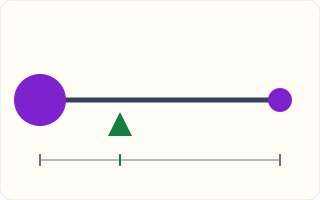
The figure shows a light rod with a large ball on one end and a small ball on the other. The balance point, marked by the triangle, sits one third of the way from the large ball, because the large ball has twice the mass.
The weighted average explains this. With the large ball at $0$ and the small one at $L$, $x_{\text{cm}} = mL/(2m + m) = L/3$. The heavier ball pulls the average toward itself. With equal masses, the balance point would be exactly in the middle.
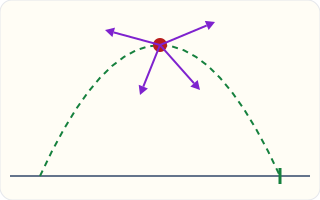
The figure shows a firework shell following a parabola and bursting at the top. The fragments fly off in all directions, but the dashed curve, the path of their center of mass, continues smoothly to where the unburst shell would have landed.
The burst forces are internal: every push on one fragment has an equal and opposite push on another. Only gravity acts from outside, so the center of mass keeps accelerating at $g$, exactly as before the burst.
Add up Newton's second law for every part of a system. The internal forces cancel in third-law pairs, leaving the external forces equal to the total mass times the acceleration of the center of mass.
This means the system as a whole behaves like one particle of mass $M$ at the center of mass. It is why we can treat a car, a planet or a person as a point in the earlier lessons, even though they are made of countless moving parts.
The total momentum of a system equals its total mass times the velocity of its center of mass. So conservation of momentum is the same statement as saying the center of mass of an isolated system moves at constant velocity.
If a system starts at rest, its center of mass stays put forever, no matter how the parts move. When a person walks forward on a floating canoe, the canoe slides back just enough to keep the center of mass in place.
For a uniform object with a center of symmetry, such as a rod, a sphere or a rectangular block, the center of mass is at that center. A uniform meter stick balances at its $50$ cm mark.
The center of mass need not lie inside the material. A ring or a boomerang has its center of mass in empty space. A high jumper arching over the bar can send their center of mass under the bar while their body passes over it.
Checking an answer. The center of mass must lie between the extreme parts and nearer the heavier ones. Moving the origin shifts every position equally but leaves the physical point unchanged.
The center of mass is defined as the weighted average, chosen so that $Mx_{\text{cm}} = \sum m_ix_i$. Taking rates of change, $Mv_{\text{cm}}$ is the total momentum and $Ma_{\text{cm}}$ is the net force on all parts, of which only the external forces survive.
In two or three dimensions, the same formula applies to each coordinate separately. For objects with continuous mass, the sums become integrals, which a calculus-based course develops.
An object resting on a base stays upright as long as its center of mass is above the base. Tilt it until the center of mass passes beyond the edge, and it tips over. Low, wide objects are hard to tip.
Sport utility vehicles have higher centers of mass than sedans, so they tip more easily in sharp turns. Federal rollover ratings compare the height of the center of mass with the width between the wheels.
Before 1968, high jumpers went over the bar forward. Dick Fosbury, at the Mexico City Olympics, went over backward, arching so his center of mass passed below the bar. He could clear a higher bar with the same jump.
Ballet dancers performing a grand jeté raise their arms and legs at the top of the leap. Their center of mass follows a parabola, but their head and torso stay level for a moment, creating the illusion of floating.
Two orbiting bodies both circle their common center of mass, the barycenter. For Earth and the Moon, it lies about $4700$ km from Earth's center, inside Earth, so Earth wobbles slightly each month.
For the Sun and Jupiter, the barycenter lies just outside the Sun's surface. Astronomers detect planets around other stars by watching the stars wobble around such barycenters, a method that found many of the first known exoplanets.
When a cannon fires, the cannonball flies forward and the cannon recoils backward. Both started at rest, so their center of mass stays put during the firing, even though both parts move.
The same reasoning applies to an astronaut throwing a tool during a spacewalk. The tool and astronaut drift apart, but their shared center of mass stays where it was. Only an external force, such as a tether's pull, can move it.
In a plane, find the $x$ and $y$ coordinates of the center of mass separately, each as a weighted average. For an L-shaped piece of plywood, split it into two rectangles, find each rectangle's center, and combine them as two point masses.
This splitting method works for any object built from simple shapes. Engineers use it to locate the center of mass of aircraft, loading cargo so that it stays within safe limits for stable flight.
If a net external force acts, the center of mass accelerates as a single particle would under that force. A diver's body may twist and somersault, but their center of mass traces a clean parabola from the board to the water.
This lets coaches and physicists separate a complicated motion into two simple parts: the center of mass moving under the external forces, and the parts moving around the center of mass under the internal ones.
Truck drivers and aircraft loaders must keep the center of mass within limits. A tractor-trailer loaded too far back takes weight off the steering wheels; an aircraft loaded too far aft can pitch up uncontrollably.
Before every airline flight, the load planner computes the center of mass of passengers, bags, cargo and fuel as a weighted average of their positions, and the Federal Aviation Administration requires it to fall inside a certified range.
Every planet and its star orbit their shared center of mass. For the Sun and Jupiter, that barycenter sits just outside the Sun's surface, so the Sun circles it once every twelve years, moving at about $13$ m/s.
Astronomers at observatories such as the W. M. Keck Observatory in Hawaii measure tiny back-and-forth shifts in starlight caused by such wobbles. From the size and period of a star's wobble, the center-of-mass relation gives the unseen planet's mass and orbit. This radial-velocity method found many of the first known exoplanets in the 1990s, and it still confirms planets discovered by NASA's space telescopes.
At the 1968 Olympics, American high jumper Dick Fosbury won gold by going over the bar backward, head first, with his back arched. Coaches were baffled, but the physics is center-of-mass reasoning.
A jumper's legs push the center of mass up to a height set by takeoff speed. By arching over the bar, a Fosbury jumper lets different parts of the body cross it at different times, while the center of mass itself passes up to about twenty centimeters below the bar. The same jump clears a higher bar. Within a decade nearly every elite high jumper used the technique, and it remains the standard in high school and college track and field across the country.
It is natural to place the center of mass halfway between two objects. That is true only when their masses are equal. With unequal masses, the center of mass lies nearer the heavier one, in inverse proportion to the masses.
A second error is to think internal forces can move the center of mass, for example that a person inside a stalled car can push it forward by shoving the dashboard. The push is internal, and the car and person's center of mass stays put.
A $30$ kg child sits $2.0$ m from a seesaw's pivot. Where must a $45$ kg adult sit to balance?
$\text{center of mass at the pivot}$
Balance condition.
Set the weighted positions equal.
$30 \times 2.0 = 45 \times d$
Pivot as origin.
Solve for the adult's distance.
$d = \dfrac{60}{45} = 1.33\ \text{m}$
Closer to the pivot.
Check the center of mass.
$\dfrac{30 \times 2.0 + 45 \times (-1.33)}{75} = 0$
At the pivot.
Explain why the heavier person sits closer.
$\text{more mass, smaller distance}$
Equal weighted positions.
Masses of $2.0$ kg, $3.0$ kg and $5.0$ kg sit at $0$ m, $2.0$ m and $4.0$ m. Find the total mass.
$M = 2.0 + 3.0 + 5.0 = 10\ \text{kg}$
Add them up.
Find each weighted position.
$0,\ 6.0,\ 20\ \text{kg·m}$
Mass times position.
Add the weighted positions.
$\sum m_ix_i = 26\ \text{kg·m}$
Weighted sum.
Divide by the total mass.
$x_{\text{cm}} = \dfrac{26}{10} = 2.6\ \text{m}$
Weighted average.
Compare with the simple average.
$\dfrac{0 + 2.0 + 4.0}{3} = 2.0\ \text{m}$
Wrong: ignores mass.
Explain the difference.
$\text{the heaviest mass is at } 4.0\ \text{m}$
It pulls the average toward itself.
A $70$ kg person stands at one end of a $210$ kg raft at rest, $6.0$ m long. Note the key fact.
$x_{\text{cm}} \text{ stays fixed}$
No outside horizontal force.
The person walks to the other end. Let the raft move back $d$.
$\text{person moves } 6.0 - d \text{ forward}$
Relative to the water.
Balance the weighted shifts.
$70(6.0 - d) = 210d$
The center of mass does not move.
Expand the equation.
$420 - 70d = 210d$
Distribute.
Solve for the raft's slide.
$d = \dfrac{420}{280} = 1.5\ \text{m}$
Backward.
Find the person's shift relative to the water.
$6.0 - 1.5 = 4.5\ \text{m}$
Forward.
Check the momentum picture.
$70 \times 4.5 = 210 \times 1.5$
Equal and opposite shifts.
Write the weighted sum.
$\sum m_ix_i = 4.0 \times 0 + 2.0 \times 3.0 = 6.0\ \text{kg·m}$
Mass times position.
Divide by the total mass.
$x_{\text{cm}} = \dfrac{6.0}{6.0}$
Weighted average.
Evaluate the position.
A light rod $2$ m long has a $6$ kg ball on one end and a $2$ kg ball on the other. How far from the $6$ kg ball is the center of mass, in m?
Complete the worked solution: a firework shell would have landed $150$ m from its launch point, but at the top of its path it bursts into two pieces of $2$ kg and $3$ kg that fly apart horizontally and land at the same time. The $2$ kg piece lands $120$ m from the launch point. Find the total mass times the landing point in kg·m, the first piece's mass times its position in kg·m, and where the second piece lands in m.
Find the total mass times the landing point.
$(m_1 + m_2)R =$ s
Where the center of mass lands.
Find the first piece's contribution.
$m_1x_1 =$ p
Mass times position.
Find where the second piece lands.
$x_2 = \dfrac{(m_1 + m_2)R - m_1x_1}{m_2} =$ w
The rest of the weighted sum.
Explain why the center of mass is unaffected.
$\text{the burst forces are internal}$
Only gravity acts from outside.
Match each situation to the fact about its center of mass.
| its center of mass is at the middle | its center of mass keeps a constant velocity | total momentum divided by total mass | its center of mass keeps following the same parabola | |
|---|---|---|---|---|
| a uniform rod | ||||
| two skaters pushing apart on ice | ||||
| the velocity of a system's center of mass | ||||
| a firework shell bursting in flight |
Three small masses lie along a meter stick's line: $4$ kg at $x = 0$ m, $2$ kg at $x = 3$ m and $2$ kg at $x = 5$ m. Fill in the total mass in kg, the sum of mass times position in kg·m, and the center of mass in m.
| value | |
|---|---|
| total mass (kg) | |
| sum of mass times position (kg·m) | |
| center of mass (m) |
A $40$ kg canoe has its own center of mass at $x = 0$. A $60$ kg paddler sits at position $x$ along it, in meters. Write the center of mass of canoe and paddler, in m, as a function of $x$.
Answer:
A $80$ kg person stands at the back of a $120$ kg rowboat floating at rest on a still lake, and walks $5$ m forward along the boat. Ignoring water resistance, how far does the boat slide backward, in m?
Answer: m
The bodies Pluto and its moon Charon have masses of about $1.303 \times 10^{22}$ kg and $1.586 \times 10^{21}$ kg, and their centers are about $19596$ km apart. How far from the center of the larger body is their center of mass, the barycenter they both orbit, in km?
Answer: km
Lesson test: one question per skill, one attempt each, no hints. Your answers are checked when you submit.
A $50$ kg canoe has its own center of mass at $x = 0$. A $75$ kg paddler sits at position $x$ along it, in meters. Write the center of mass of canoe and paddler, in m, as a function of $x$.
Answer:
You can locate and reason with the center of mass. Explain to someone why a canoe slides backward when its paddler walks forward.
25. Your turn: a $4.0$ kg mass sits at $x = 0$ and a $2.0$ kg mass at $x = 3.0$ m. Where is their center of mass?, step 3
$x_{\text{cm}} = 1.0\ \text{m}$
Nearer the heavier mass.