Back to the on-screen lesson ·
Steady motion around a circle needs a net inward force of $mv^2/r$ from real forces, and gravity weakens with the square of the distance.
Paper packet. Every task here also exists on screen, where it is checked automatically; answers written on paper are not assessed by Nydus. When you are back at a device, enter your answers there.
By the end of this lesson you will be able to find the inward force an object needs to move in a circle, name the real forces that supply it, and use Newton's law of gravitation to compare pulls and orbits.
You can apply $F_{\text{net}} = ma$ with free-body diagrams, and you know that acceleration is any change in velocity, including a change of direction. This lesson applies the second law to motion around a circle and introduces the force that keeps planets and satellites in orbit.
| Term | What it means |
|---|---|
| Uniform circular motion | Motion around a circle at constant speed. |
| Centripetal acceleration | The acceleration toward the center, $a = v^2/r$. |
| Centripetal force | The net inward force, $mv^2/r$, supplied by real forces. |
| Period | The time for one full trip around the circle, $T = 2\pi r/v$. |
| Gravitational constant | $G = 6.67 \times 10^{-11}$ N·m²/kg². |
| Orbit | The path of an object moving under gravity alone around a larger body. |
An object moving around a circle of radius $r$ at steady speed $v$ is accelerating, because its direction changes. The acceleration points toward the center:
$$a_c = \dfrac{v^2}{r}.$$
By the second law, the net force must point inward too, with size $mv^2/r$. That net force is not a new kind of force; real forces such as friction, tension, normal forces or gravity supply it.
Gravity between any two masses follows Newton's law, $F = Gm_1m_2/r^2$, weakening with the square of the distance between their centers.
Another way: picture
Picture whirling a ball on a string over your head. You feel the string pulling your hand outward, and the string pulls the ball inward. Let go, and the ball does not fly straight out from the center; it flies off along the line it was moving at that instant, straight ahead, because nothing now turns it.
Another way: steps
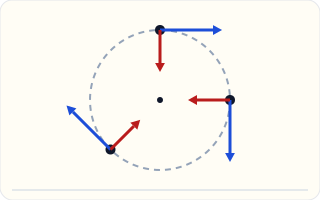
The figure shows an object at three points of a circle. At each point the velocity arrow lies along the circle, and the acceleration arrow points at the center, at right angles to the velocity. Both arrows keep the same length because the speed is steady.
A force at right angles to the motion changes direction without changing speed. That is exactly what uniform circular motion needs: a net force always pointing inward, turning the velocity a little at every instant.
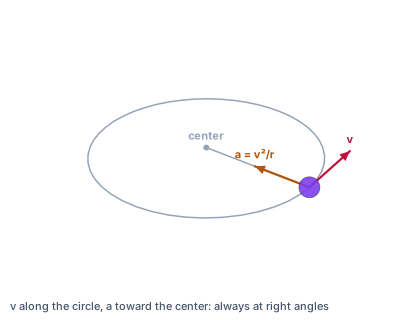
The flat diagram freezes one instant; this figure lets the ball go around. Watch the two arrows as it turns: the velocity always lies along the circle, the acceleration always points along the string to the center, and the angle between them stays a right angle.
The string's tension supplies the inward force. Cut it and the ball leaves along the velocity arrow in a straight line, exactly what an object with no net force does.
In a short time $\Delta t$ the object moves an arc $v\Delta t$ and its velocity turns through the same angle, $v\Delta t/r$. The change in velocity is a small arrow of length $v$ times that angle, $v^2\Delta t/r$, pointing toward the center. Dividing by $\Delta t$ gives $a = v^2/r$.
The formula makes sense in its limits: faster motion turns the velocity faster and has a larger velocity to turn, so $a$ grows as $v^2$. A larger circle turns gently, so $a$ shrinks as $1/r$.
For a car on a flat curve, static friction from the road points toward the center. For a ball on a string, the tension does. For the Moon, Earth's gravity does. On a banked track, part of the normal force helps.
At the top of a roller-coaster loop, the seat's push and the rider's weight both point down, toward the center, and together make $mv^2/r$. At the bottom, the seat pushes up and the weight pulls down, so the seat must push harder than the weight.
Every pair of masses attracts with a force $F = Gm_1m_2/r^2$, where $r$ is the distance between their centers. $G$ is tiny, which is why you do not feel pulled toward a wall; it takes a planet's mass to give a pull you notice.
Reason in ratios: double one mass and the force doubles; double the distance and it drops to a quarter; triple the distance and it drops to a ninth. At a planet's surface, the force on a mass $m$ is its weight, so $g = GM/R^2$.
A satellite in a circular orbit has only gravity acting on it, so gravity must be the whole centripetal force: $GMm/r^2 = mv^2/r$. The satellite's mass cancels, leaving $v^2 = GM/r$. Every object at a given radius moves at the same speed, and higher orbits are slower.
An orbiting spacecraft is falling toward Earth the whole time. It moves sideways fast enough that the ground curves away as fast as it falls. Everything inside falls with it, which is why astronauts float.
Checking an answer. The net force must point inward. A normal force cannot be negative; if it comes out negative, the object has left the surface. Doubling the speed must quadruple the inward force needed.
The second law holds along any direction, so it holds along the line to the center. For uniform circular motion there is no acceleration along the path, so the forces along the path balance, and only the inward direction matters.
Newton's law of gravitation treats spheres as if their mass sat at their centers, a result Newton proved for uniform spherical shells. That is why distances are measured from Earth's center, not its surface.
Highway engineers bank curves so that the normal force tilts inward. On a curve banked at angle $\theta$, the horizontal part of the normal force supplies the centripetal force, and at the design speed no friction is needed at all: $\tan\theta = v^2/(rg)$.
The Daytona International Speedway in Florida banks its turns at about $31$ degrees, letting stock cars corner at over $80$ m/s. Interstate ramps are banked much less, with friction making up the difference at other speeds.
Astronauts on the International Space Station float, but not because gravity is absent. At $400$ km up, gravity is about ninety percent as strong as on the ground. The station and everything in it are in free fall together, so nothing pushes on the astronauts and they feel weightless.
The same feeling happens briefly at the top of a roller-coaster hill, or in NASA's reduced-gravity aircraft, which flies arcs that let passengers fall freely for about twenty-five seconds at a time.
The time for one full trip around a circle is the period, $T = 2\pi r/v$. Combining this with $a = v^2/r$ gives $a = 4\pi^2 r/T^2$, handy when the period is known, such as for a spinning washing machine drum or a planet's orbit.
For orbits, combining $T = 2\pi r/v$ with $v^2 = GM/r$ gives $T^2 = 4\pi^2 r^3/GM$: Kepler's third law, which Newton explained. The Moon, at about sixty Earth radii, takes $27.3$ days to go around once.
When a car turns sharply, you feel thrown outward. From the road's point of view, nothing pushes you outward: your body tends to keep going straight, and the door or seat pushes you inward to turn you with the car.
The outward centrifugal force appears only if you insist on analyzing from inside the turning car, a non-inertial frame. In the ground's frame, used throughout this course, the only forces are real ones, and the net force points in.
The International Space Station circles Earth about $420$ km up, at a speed near $7.7$ km/s, completing an orbit every ninety-two minutes. At that height gravity is still about ninety percent of its surface value; it supplies exactly the centripetal force needed for that speed and radius.
Higher satellites move more slowly. GPS satellites, about $20{,}000$ km up, travel at under $4$ km/s and circle twice a day. NOAA's GOES weather satellites orbit at the one radius, about $42{,}000$ km from Earth's center, where the period is exactly one day, so they hover over the same spot and watch hurricanes form over the Atlantic. All of these follow the same rule, $v = \sqrt{GM/r}$, whatever their mass.
Early looping roller coasters used perfect circles, and riders at the bottom felt crushing forces: entering fast enough to clear the top meant a seat push many times the rider's weight at the bottom. Modern loops, such as those at Six Flags parks, use a teardrop shape called a clothoid.
The tight curve at the top lets the train pass slowly while still needing a positive seat push, $N = mv^2/r - mg$. The wide curves near the bottom lower $v^2/r$ where the train is fastest, keeping the push under about four times the weight. Designers compute the inward force at every point of the track, making sure it is always supplied by the seat, the restraints and gravity together, so riders feel thrilled but stay safe.
The most common error in circular motion is to draw the real forces and then add one more arrow labeled centripetal. Ask what object exerts it, and the problem shows itself: there is none. For a car on a flat curve, friction is the centripetal force; drawing both counts the same push twice.
The opposite error is the outward force that seems to fling you on a merry-go-round. From the ground, nothing pushes you outward: you tend to go straight, and the ride pulls you inward to turn you.
A $0.20$ kg ball whirls in a horizontal circle of radius $0.80$ m at $4.0$ m/s. Find the acceleration.
$a = \dfrac{4.0^2}{0.80} = 20\ \text{m/s}^2$
Toward the center.
Find the net inward force.
$F = 0.20 \times 20 = 4.0\ \text{N}$
Second law.
Identify its source.
$T = 4.0\ \text{N}$
The string's tension.
Find the tension at double the speed.
$T = 4 \times 4.0 = 16\ \text{N}$
Speed squared.
Find the period at $4.0$ m/s.
$T_p = \dfrac{2\pi \times 0.80}{4.0} = 1.26\ \text{s}$
Circumference over speed.
A $1200$ kg car takes a flat curve of radius $50$ m with $\mu_s = 0.8$. Find the normal force.
$N = 1200 \times 9.8 = 11760\ \text{N}$
Level road.
Find the largest static friction.
$f_{\max} = 0.8 \times 11760 = 9408\ \text{N}$
The static ceiling.
Set friction equal to the inward force.
$\dfrac{1200 v^2}{50} = 9408$
At the top speed.
Solve for the squared speed.
$v^2 = 392$
The mass cancels.
Find the top speed.
$v = 19.8\ \text{m/s}$
About $44$ mph.
Find the top speed on a wet road with $\mu_s = 0.4$.
$v = \sqrt{0.4 \times 9.8 \times 50} = 14.0\ \text{m/s}$
Slower in the rain.
The Moon orbits $3.84 \times 10^8$ m from Earth's center. Earth's $GM$ is $3.986 \times 10^{14}$ m³/s². Write the orbit condition.
$v^2 = \dfrac{GM}{r}$
Gravity is the centripetal force.
Substitute the values.
$v^2 = \dfrac{3.986 \times 10^{14}}{3.84 \times 10^8}$
SI units.
Evaluate the squared speed.
$v^2 = 1.038 \times 10^6\ \text{m}^2/\text{s}^2$
Divide.
Take the square root.
$v = 1019\ \text{m/s}$
About $1$ km/s.
Find the period.
$T = \dfrac{2\pi \times 3.84 \times 10^8}{1019} = 2.37 \times 10^6\ \text{s}$
Circumference over speed.
Convert to days.
$T = \dfrac{2.37 \times 10^6}{86400} = 27.4\ \text{days}$
Matches the observed month.
Find the Moon's acceleration.
$a = \dfrac{1019^2}{3.84 \times 10^8} = 0.0027\ \text{m/s}^2$
About $g/3600$, since it is sixty times farther.
Write the centripetal force.
$F = \dfrac{mv^2}{r}$
Mass times $v^2/r$.
Substitute the values.
$F = \dfrac{2.0 \times 3.0^2}{1.5}$
SI units.
Evaluate the force.
A $1500$ kg car rounds a flat highway curve of radius $60$ m at a steady $12$ m/s. How large is the sideways friction force on its tires, in N?
Complete the worked solution: a planet has $6$ times Earth's mass and $2$ times Earth's radius. A $50$ kg lander sits on its surface. With $g = 9.8$ m/s² on Earth, find how many times Earth's surface gravity the planet has, its surface gravity in m/s², and the lander's weight there in N.
Find the scale factor.
$\dfrac{M/M_E}{(R/R_E)^2} =$ f
Mass over radius squared.
Find the surface gravity.
$g_p = \text{factor} \times g =$ g
Scale Earth's value.
Find the lander's weight.
$W = mg_p =$ w
Weight on that planet.
Note what stays the same.
$\text{the lander's mass}$
Mass does not depend on place.
Match each motion to the real force or forces that pull it toward the center.
| static friction from the road | tension in the string | gravity | the seat's push plus the weight | |
|---|---|---|---|---|
| a car on a flat curve | ||||
| a ball whirled on a string | ||||
| the Moon orbiting Earth | ||||
| a rider at the top of a loop |
A $100$ kg probe is carried away from Earth. With $g = 9.8$ m/s² at the surface, fill in its weight in N at the surface, at twice Earth's radius from the center, and at ten times Earth's radius.
| weight | |
|---|---|
| at the surface (N) | |
| at two Earth radii (N) | |
| at ten Earth radii (N) |
A $1500$ kg car takes a flat curve of radius $50$ m at a steady speed $v$, in m/s. Write the sideways friction force the tires must supply, in N, as a function of $v$.
Answer:
A $50$ kg rider passes upside down through the top of a roller-coaster loop of radius $5$ m at $10$ m/s. With $g = 9.8$ m/s², how hard does the seat push on the rider, in N?
Answer: N
a GPS satellite orbits Earth in a nearly circular orbit of radius $26571$ km, measured from Earth's center. With $GM = 3.986 \times 10^{5}$ km³/s² for Earth, what is its orbital speed, in km/s?
Answer: km/s
Lesson test: one question per skill, one attempt each, no hints. Your answers are checked when you submit.
A $1600$ kg car takes a flat curve of radius $64$ m at a steady speed $v$, in m/s. Write the sideways friction force the tires must supply, in N, as a function of $v$.
Answer:
You can explain circular motion with real forces and reason about gravity in ratios. Tell someone why an astronaut on the space station floats although gravity there is almost as strong as on the ground.
23. Your turn: a $2.0$ kg mass moves at $3.0$ m/s around a circle of radius $1.5$ m. What net inward force does it need?, step 3
$F = 12\ \text{N}$
Toward the center.