Back to the on-screen lesson ·
Momentum is conserved in every collision; elastic collisions also keep kinetic energy, and sticking collisions lose the most.
Paper packet. Every task here also exists on screen, where it is checked automatically; answers written on paper are not assessed by Nydus. When you are back at a device, enter your answers there.
By the end of this lesson you will be able to classify collisions, find velocities after elastic and sticking collisions, and compute the kinetic energy lost.
You can apply conservation of momentum to collisions and explosions, and you can compute kinetic energy, $\tfrac{1}{2}mv^2$. You know that friction turns kinetic energy into thermal energy. This lesson sorts collisions by what happens to kinetic energy while momentum is conserved.
| Term | What it means |
|---|---|
| Elastic collision | A collision in which total kinetic energy is conserved. |
| Inelastic collision | A collision in which some kinetic energy is lost. |
| Perfectly inelastic collision | A collision in which the objects stick together. |
| Coefficient of restitution | The ratio of separation speed to approach speed. |
| Ballistic pendulum | A hanging block used to measure a projectile's speed. |
| Head-on collision | A collision along the line joining the objects' centers. |
In every collision of an isolated system, momentum is conserved. Kinetic energy depends on the type of collision:
For a sticking collision, $m_1u_1 + m_2u_2 = (m_1 + m_2)v$ gives the final velocity directly.
Another way: picture
Picture dropping a steel ball and a lump of clay onto a hard floor. The steel ball bounces nearly back to your hand: an almost elastic collision. The clay splats and stays: a perfectly inelastic one. In both cases Earth absorbs the momentum, but only the clay turns all its kinetic energy into heat and squashing.
Another way: steps
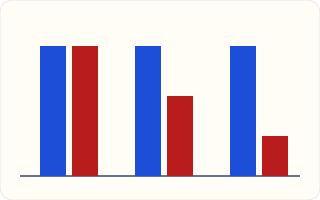
The figure compares kinetic energy before and after three collisions. In the elastic one the bars match. In the inelastic one, where the objects bounce apart, a little over half remains. In the sticking collision, less than a third remains.
Momentum is the same before and after in all three. What differs is how much energy goes into bending, heating and sound. Sticking together loses the most, because the objects end with no motion relative to each other.
When objects stick, they share one final velocity, and momentum alone gives it: $v = (m_1u_1 + m_2u_2)/(m_1 + m_2)$. No extra information about the collision is needed.
When a moving object hits an equal mass at rest and sticks, the speed halves and half the kinetic energy is lost. If the target is much heavier, nearly all the kinetic energy is lost; if it is much lighter, very little is.
For an elastic collision, both momentum and kinetic energy are conserved. When object 1 hits object 2 at rest head-on, solving the two equations gives $v_1 = \dfrac{m_1 - m_2}{m_1 + m_2}u$ and $v_2 = \dfrac{2m_1}{m_1 + m_2}u$.
These results have striking limits. Equal masses swap velocities: the striker stops and the target leaves at the striker's speed. A light object bouncing off a heavy one reverses at nearly its original speed. A heavy object hitting a light one sends it off at nearly twice its own speed.
In any one-dimensional elastic collision, the objects separate at the same relative speed at which they approached. This follows from combining the two conservation laws, and it is often quicker than solving the energy equation.
For inelastic collisions the separation speed is smaller. The ratio of separation to approach speed, the coefficient of restitution, is one for elastic collisions and zero for sticking ones. Sports governing bodies test balls against it.
The kinetic energy lost in an inelastic collision is not destroyed. It becomes thermal energy in the colliding objects, sound, and energy stored in permanent bending. Crushed metal in a car crash is warm afterward.
Explosions run the other way: stored chemical or spring energy becomes kinetic energy, so the total kinetic energy afterward is larger than before, while the total momentum is still unchanged.
Checking an answer. Kinetic energy after a collision can never exceed kinetic energy before, unless stored energy is released. Objects cannot pass through each other: after a head-on collision, the rear object cannot be moving faster forward than the front one.
Momentum is conserved because the collision forces are internal third-law pairs and act for the same time. Kinetic energy is conserved only if the forces during contact are like perfect springs, returning all the energy they store as the objects separate.
Real materials are never perfect springs, so real collisions are always somewhat inelastic. The elastic model is still useful for hard objects like billiard balls, and exact for collisions between atoms and subatomic particles.
Before electronic timers, the speed of a fast projectile was measured by firing it into a heavy hanging block. The projectile sticks, and the block swings up. Measuring the height of the swing gives the speed.
The calculation has two stages. Across the brief collision, momentum is conserved but energy is not, since the projectile sticks. During the swing afterward, energy is conserved but momentum is not, since the strings pull on the block. Mixing up the stages is the classic mistake.
In a Newton's cradle, a row of steel balls hangs touching. Pull one ball back and release it, and one ball flies off the far end while the rest barely move. Two balls in give two balls out.
This happens because the collisions are nearly elastic and the balls have equal masses, so each collision swaps velocities down the line. Only one ball leaving at the original speed conserves both momentum and kinetic energy.
A golf ball leaves a driver faster than the club head is moving, because the club is much heavier than the ball and the collision is fairly elastic: the ball can reach about one and a half times the club's speed.
The United States Golf Association limits how springy a driver's face may be, because a more elastic collision would send balls farther. Baseball's governing bodies limit the springiness of aluminum bats for the same reason.
Car crashes are strongly inelastic. Modern cars are designed so the kinetic energy lost goes into crushing the crumple zones, not into the passenger compartment. The more energy the front absorbs, the less reaches the people inside.
In a rear-end crash into a stopped car of equal mass, momentum conservation means the pair moves at half the striking car's speed, and half the original kinetic energy must be absorbed by the two cars' bodies.
Gas molecules collide billions of times a second. These collisions are elastic on average, which is why a gas in a sealed container does not cool down by itself. Physicists studying particles in accelerators rely on the same conservation laws.
When a neutron collides elastically with a much heavier nucleus, it bounces off with almost the same speed. With a nucleus of similar mass, such as hydrogen, it can lose nearly all its speed in one hit, which is why nuclear reactors use water to slow neutrons.
Every collision problem starts with momentum conservation. If the objects stick, that one equation is enough. If the collision is elastic, add kinetic energy conservation or the equal-relative-speed rule. If it is inelastic but not sticking, you need one final velocity measured or given.
Never assume kinetic energy is conserved unless the problem says elastic or the objects are hard and springy. Assuming it wrongly gives speeds that violate momentum conservation.
When two objects collide off-center, they fly apart at angles. Momentum is still conserved, separately along each axis, so two equations link the four unknown velocity components after the collision.
A special case occurs in pool: when a moving ball hits an equal ball at rest in a glancing elastic collision, the two balls leave at right angles to each other. Experienced players use this ninety-degree rule to predict where the cue ball will go after a cut shot.
A regulation bowling pin weighs about $1.5$ kg, and a bowling ball up to $16$ pounds, about $7.3$ kg. When the heavy ball strikes a pin nearly head-on, the collision is close to elastic, and the pin flies off faster than the ball was rolling, up to nearly twice as fast.
The ball keeps most of its speed, because it is so much heavier, and plows on through the rack. That is why heavier balls knock down more pins: they lose less speed in each collision and send pins flying into their neighbors. The United States Bowling Congress limits ball weight to sixteen pounds, and professional bowlers choose between fourteen and sixteen to balance control against pin action.
When a pickup truck rear-ends a stopped sedan, investigators treat the crash as nearly perfectly inelastic if the vehicles lock together. Momentum conservation links the striking truck's speed to the speed of the wreckage, which they find from skid marks after the impact.
The kinetic energy lost tells engineers how much crushing the vehicles absorbed. The Insurance Institute for Highway Safety uses crash tests to measure how well bumpers and crumple zones soak up that energy at low speeds. A bumper that bounces the cars apart elastically would reduce damage but jolt the occupants more, so designers aim for controlled, inelastic crushing at higher speeds.
Because momentum is conserved in every collision, it is tempting to conserve kinetic energy too. But kinetic energy is conserved only in elastic collisions. When objects stick or deform, some kinetic energy becomes heat, sound and bending, even though momentum is unchanged.
In a ballistic pendulum, applying energy conservation across the collision gives a projectile speed far too small. Use momentum across the collision and energy only for the swing that follows.
A $20{,}000$ kg railcar at $3.0$ m/s couples with a $10{,}000$ kg car at rest. Find the momentum before.
$p = 20000 \times 3.0 = 60000\ \text{kg·m/s}$
Moving car only.
Find the shared speed.
$v = \dfrac{60000}{30000} = 2.0\ \text{m/s}$
Momentum conserved.
Find the kinetic energy before.
$K_i = \tfrac{1}{2} \times 20000 \times 3.0^2 = 90000\ \text{J}$
Moving car only.
Find the kinetic energy after.
$K_f = \tfrac{1}{2} \times 30000 \times 2.0^2 = 60000\ \text{J}$
Both cars.
Find the fraction lost.
$\dfrac{30000}{90000} = \tfrac{1}{3}$
Equal to $m_2/(m_1 + m_2)$.
A $0.30$ kg glider at $2.0$ m/s hits a $0.10$ kg glider at rest elastically. Find the first glider's velocity after.
$v_1 = \dfrac{0.30 - 0.10}{0.40} \times 2.0 = 1.0\ \text{m/s}$
Keeps moving forward.
Find the second glider's velocity after.
$v_2 = \dfrac{2 \times 0.30}{0.40} \times 2.0 = 3.0\ \text{m/s}$
Faster than the striker.
Check the momentum.
$0.30 \times 1.0 + 0.10 \times 3.0 = 0.60\ \text{kg·m/s}$
Equals $0.30 \times 2.0$.
Check the kinetic energy before.
$\tfrac{1}{2} \times 0.30 \times 2.0^2 = 0.60\ \text{J}$
Striker only.
Check the kinetic energy after.
$\tfrac{1}{2} \times 0.30 \times 1.0^2 + \tfrac{1}{2} \times 0.10 \times 3.0^2 = 0.60\ \text{J}$
Conserved.
Check the relative speeds.
$3.0 - 1.0 = 2.0\ \text{m/s}$
Separation equals approach.
A $0.020$ kg dart sticks in a $1.98$ kg block, which swings up $0.20$ m. Find the block's speed after the hit.
$V = \sqrt{2 \times 9.8 \times 0.20} = 1.98\ \text{m/s}$
Energy during the swing.
Find the total mass.
$M = 0.020 + 1.98 = 2.00\ \text{kg}$
Dart plus block.
Find the momentum after the collision.
$p = 2.00 \times 1.98 = 3.96\ \text{kg·m/s}$
Just after.
Find the dart's speed.
$v = \dfrac{3.96}{0.020} = 198\ \text{m/s}$
Momentum before equals after.
Find the dart's kinetic energy.
$K_i = \tfrac{1}{2} \times 0.020 \times 198^2 = 392\ \text{J}$
Before the hit.
Find the kinetic energy after.
$K_f = \tfrac{1}{2} \times 2.00 \times 1.98^2 = 3.92\ \text{J}$
Just after the hit.
Find the fraction kept.
$\dfrac{3.92}{392} = 0.01$
Only one percent survives.
Find the momentum before.
$p = 4.0 \times 5.0 = 20\ \text{kg·m/s}$
Moving cart only.
Divide by the total mass.
$v = \dfrac{20}{5.0}$
Both carts.
Evaluate the speed.
On a frictionless track, a $2$ kg cart moving at $5$ m/s runs into a $3$ kg cart at rest, and they stick together. How much kinetic energy is lost in the collision, in J?
Complete the worked solution: a $1200$ kg car moving at $25$ m/s rear-ends a $800$ kg car stopped at a light, and the cars lock together. Find their shared speed just after the crash in m/s, the kinetic energy before in kJ, and the kinetic energy lost in kJ.
Find the shared speed.
$v = \dfrac{m_1u}{m_1 + m_2} =$ v
Momentum is conserved.
Find the kinetic energy before.
$K_i = \tfrac{1}{2}m_1u^2 =$ k
Moving car only.
Find the kinetic energy lost.
$K_i - \tfrac{1}{2}(m_1 + m_2)v^2 =$ l
Crushed metal, heat and sound.
Note where the energy went.
$\text{into bending the cars}$
Crumple zones absorb it.
Match each kind of event to what happens to the total kinetic energy.
| kinetic energy is unchanged | some kinetic energy is lost | the most kinetic energy momentum allows is lost | kinetic energy increases | |
|---|---|---|---|---|
| an elastic collision | ||||
| an inelastic collision in which the objects separate | ||||
| a collision in which the objects stick | ||||
| an explosion |
A $8$ kg glider moving right at $5$ m/s hits a $2$ kg glider at rest on an air track, in a perfectly elastic head-on collision. With right as positive, fill in the first glider's velocity after in m/s, the second glider's velocity after in m/s, and the total kinetic energy after in J.
| value | |
|---|---|
| first glider after (m/s) | |
| second glider after (m/s) | |
| total kinetic energy after (J) |
A $2$ kg cart moving at speed $u$, in m/s, runs into a $3$ kg cart at rest, and they stick together. Write the kinetic energy of the pair after the collision, in J, as a function of $u$.
Answer:
In a lab, a $0.02$ kg dart fired horizontally sticks in a $4$ kg wooden block hanging from strings. The block and dart swing up $0.2$ m. With $g = 9.8$ m/s², how fast was the dart moving, in m/s?
Answer: m/s
A $14$ lb bowling ball, $6.35$ kg, rolling at $7.5$ m/s strikes a $1.53$ kg pin head-on. Treating the hit as a one-dimensional elastic collision, how fast does the pin fly off, in m/s?
Answer: m/s
Lesson test: one question per skill, one attempt each, no hints. Your answers are checked when you submit.
A $2$ kg cart moving at speed $u$, in m/s, runs into a $3$ kg cart at rest, and they stick together. Write the kinetic energy of the pair after the collision, in J, as a function of $u$.
Answer:
You can analyze elastic and inelastic collisions. Explain to someone why two carts that stick together lose kinetic energy but not momentum.
25. Your turn: a $4.0$ kg cart at $5.0$ m/s couples with a $1.0$ kg cart at rest. What is their shared speed?, step 3
$v = 4.0\ \text{m/s}$
Shared.