Back to the on-screen lesson ·
Draw the boundary around what moves together to find the acceleration, then around one part to find the force between parts.
Paper packet. Every task here also exists on screen, where it is checked automatically; answers written on paper are not assessed by Nydus. When you are back at a device, enter your answers there.
By the end of this lesson you will be able to find the shared acceleration of connected objects and the tension or contact force between them.
You can draw free-body diagrams and apply $F_{\text{net}} = ma$ to a single object, and you know that third-law forces come in pairs acting on different objects. This lesson applies the same laws to several objects moving together, joined by strings, couplings or contact.
| Term | What it means |
|---|---|
| System | The object or objects you choose to analyze together. |
| System boundary | The imaginary line separating the system from everything else. |
| External force | A force on the system from something outside the boundary. |
| Internal force | A force between two parts inside the boundary; its pair cancels it. |
| Tension | The pull a string, rope or coupling exerts along its length. |
| Atwood machine | Two masses hung from a string over a single pulley. |
When objects move together with one acceleration, you can analyze them in two ways:
$$a = \dfrac{F_{\text{ext}}}{M_{\text{total}}}.$$
Use the whole system to find the acceleration, then one part to find the force between parts.
Another way: picture
Picture a child pulling two sleds tied in a line across smooth snow. The rope from the child accelerates both sleds, but the rope between the sleds only accelerates the rear one, so it is slacker. Drawing the boundary around both sleds hides the middle rope; drawing it around the rear sled alone brings the middle rope into view.
Another way: steps
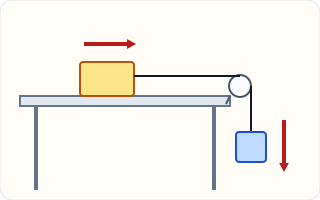
The figure shows a block on a table tied by a string over a pulley to a hanging mass. The block moves right while the hanging mass moves down, but because the string does not stretch, both have the same size of acceleration. The pulley simply turns the direction of the string.
Measuring positions along the string, the system is a single line of mass. On a frictionless table the only external force along that line is the hanging mass's weight $hg$. The table's push cancels the block's weight, and the tension is internal. So the acceleration is $hg/(b + h)$.
Inside the boundary, every force has its third-law partner also inside. The string pulls the block toward the pulley and pulls the hanging mass upward with the same tension; within the system these pulls balance out. That is why a system's acceleration depends only on external forces.
This is also why you cannot lift yourself by pulling on your own shoelaces. Your hands pull up on the laces, the laces pull down on your hands, and both forces are inside the system of you. Only an external force, such as the floor's push, can change your motion.
The system approach gives the acceleration but hides the forces between parts. To find one, draw a new boundary around a single part. For the block on the table, the only horizontal force on the block alone is the tension, so $T = ba$.
The same method works for the hanging mass, whose own equation is $hg - T = ha$. Both give the same tension, which makes a useful check. Choose whichever part has fewer forces on it, since that gives the shorter equation.
Checking an answer. A string between two parts pulls less than the force pulling the whole train. The tension holding a falling mass must be less than its weight. The acceleration must not exceed $g$ for anything pulled only by gravity.
Adding the second-law equations of every part gives the system equation: the internal forces appear once with each sign and drop out, leaving the external forces on the left and the total mass times the shared acceleration on the right. The system method is simply that sum done in one step.
The shared acceleration relies on an inextensible string and parts that stay in contact. A light, frictionless pulley passes the same tension to both sides. A real pulley with mass needs a torque analysis, which comes in the rotation unit.
When you push a row of blocks, the push accelerates all of them, but the contact force between the first and second block only has to accelerate the blocks from the second onward. Each contact force further along is smaller.
Pushing a $4$ kg block against a $2$ kg block with $30$ N gives an acceleration of $5$ m/s². The contact force on the $2$ kg block is only $10$ N. Swap the order, pushing on the $2$ kg block, and the contact force becomes $20$ N: the same acceleration, but now it must move the heavier block.
A freight train is a line of cars joined by couplings, each carrying tension. The coupling right behind the locomotive pulls every car, so it carries the most tension; the last coupling pulls only one car. Train engineers must keep the front couplings within their strength limits.
Very long American freight trains, over three kilometers long, sometimes place extra locomotives in the middle or at the rear. These distributed engines share the pulling, so no single coupling carries the whole train's accelerating force.
George Atwood built his machine in 1784 to slow down free fall so it could be measured with the clocks of his day. Two nearly equal masses over a pulley accelerate at a small fraction of $g$, since the driving force is only their difference in weight while the whole mass must accelerate.
With $5$ kg and $3$ kg, the driving force is $2 \times 9.8$ N acting on $8$ kg, giving $2.45$ m/s², a quarter of $g$. Measuring that acceleration let early experimenters test the second law directly.
If the table has friction, the friction force on the block is external to the system and joins the equation. The driving force becomes the hanging weight minus friction, and if friction is large enough the system does not move at all.
The same approach handles a truck towing a trailer uphill: gravity along the slope and rolling friction on both vehicles are external, while the hitch force is internal. The next lesson looks at friction and drag in more detail.
An elevator car and its passengers form a connected system. The cable's tension accelerates both; the floor's push on each passenger is internal to the whole but external to the passenger. Find the acceleration from the cable, then the floor's push from the passenger alone.
The same two-boundary approach explains why a coffee cup on a tray in an accelerating train needs friction to stay put: the friction is the only horizontal force that can give the cup the train's acceleration.
Use the system boundary whenever you want the acceleration and the forces between parts are unknown. Use a single-part boundary whenever you want one of those forces, or when the parts do not share an acceleration.
If the parts can move differently, for example a block sliding on top of a moving cart, the system approach cannot give one acceleration. Then every part needs its own equation, linked by the third law at each contact.
When a string turns a corner over a pulley, the parts move in different directions in space, yet they move together along the string. Pick one positive direction along the string, such as the direction the hanging mass falls, and use it for every part. The block's rightward motion and the mass's downward motion are then both positive.
With that choice, a weight pulling along the positive direction counts as a driving force and one pulling against it counts as a resisting force. In an Atwood machine, the heavier weight drives and the lighter one resists, which is exactly why their difference appears in the numerator.
A Union Pacific coal train crossing Nebraska can have more than a hundred cars, each loaded with over a hundred metric tons of coal. The whole train may exceed fifteen thousand tons, and the coupling just behind the lead locomotives must carry the force that accelerates all of it.
Accelerating such a train at only $0.05$ m/s² already needs about $750$ kN in that first coupling. Real couplings are rated for a few thousand kilonewtons, and grades add the force needed against gravity. Railroads therefore place extra locomotives in the middle or at the rear, so each set pulls only its share of the cars, and the coupling forces stay safely below the limit. Engineers also start slowly, letting slack run out of the couplings one at a time to avoid sudden jerks.
In a skyscraper elevator, the cable holds the car, its counterweight system and every passenger. When the car accelerates upward, the cable tension must exceed the total weight by the total mass times the acceleration, and building codes require several times that load as a safety margin.
Each passenger feels only their own share: the floor's push on them is their mass times $g + a$, the same result whether the car holds one person or twenty. Engineers treat the car and its load as one system to size the motor and cable, and each passenger as a separate system to judge ride comfort. The American Society of Mechanical Engineers' elevator code sets the rules both calculations must meet.
It is tempting to think a pull passes unchanged along a chain of carts, so the string between them pulls as hard as your hand. But the hand accelerates every cart, while the middle string accelerates only the carts behind it. With less mass to move, it pulls less.
A second error is counting an internal force as external. Writing the system equation with the middle string's tension included adds a force whose partner was left out, and gives an acceleration that is too large.
A child pulls two sleds of $10$ kg and $6$ kg in a line with $48$ N on frictionless snow. Find the total mass.
$M = 10 + 6 = 16\ \text{kg}$
Both sleds move together.
Find the shared acceleration.
$a = \dfrac{48}{16} = 3.0\ \text{m/s}^2$
External force over total mass.
Isolate the rear $6$ kg sled.
$T = 6 \times 3.0 = 18\ \text{N}$
The middle rope's tension.
Check with the front sled.
$48 - 18 = 10 \times 3.0$
Both sides give $30$ N.
Compare the two ropes.
$18\ \text{N} < 48\ \text{N}$
The middle rope pulls less.
A $4.0$ kg cart on a frictionless track is tied over a pulley to a $1.0$ kg hanging mass. Find the driving force.
$F = 1.0 \times 9.8 = 9.8\ \text{N}$
The hanging weight.
Find the total mass.
$M = 4.0 + 1.0 = 5.0\ \text{kg}$
Both move together.
Find the acceleration.
$a = \dfrac{9.8}{5.0} = 1.96\ \text{m/s}^2$
Second law for the system.
Isolate the cart for the tension.
$T = 4.0 \times 1.96 = 7.84\ \text{N}$
Only the string pulls it.
Check with the hanging mass.
$9.8 - 7.84 = 1.0 \times 1.96$
Both sides agree.
Find the speed after $1.5$ s.
$v = 1.96 \times 1.5 = 2.94\ \text{m/s}$
From rest.
Masses of $3.0$ kg and $2.0$ kg hang over a light pulley. Find the driving force.
$F = (3.0 - 2.0) \times 9.8 = 9.8\ \text{N}$
The difference in weights.
Find the total mass.
$M = 3.0 + 2.0 = 5.0\ \text{kg}$
Both masses move.
Find the acceleration.
$a = \dfrac{9.8}{5.0} = 1.96\ \text{m/s}^2$
Heavier side down.
Isolate the lighter mass.
$T - 2.0 \times 9.8 = 2.0 \times 1.96$
Up positive for it.
Solve for the tension.
$T = 19.6 + 3.92 = 23.52\ \text{N}$
Between the two weights.
Check that the tension lies between the weights.
$19.6 < 23.52 < 29.4$
A sensible result.
Find the distance fallen in $1.0$ s.
$d = \tfrac{1}{2} \times 1.96 \times 1.0^2 = 0.98\ \text{m}$
From rest.
Find the total mass.
$M = 5 + 4 = 9\ \text{kg}$
Both blocks move together.
Apply the second law to the system.
$a = \dfrac{36}{9}$
External force over total mass.
Evaluate the acceleration.
On a frictionless floor, a horizontal $30$ N push acts on a $4$ kg block, which pushes a $2$ kg block ahead of it. How hard, in N, does the front block push on the rear block?
Complete the worked solution: a $8$ kg cart on a frictionless track is tied by a string over a light pulley to a $2$ kg hanging mass and released from rest. With $g = 9.8$ m/s², find the acceleration in m/s², the string tension in N, and the cart's speed after $2$ s in m/s.
Find the shared acceleration.
$a = \dfrac{m_h g}{m_b + m_h} =$ a
The whole system.
Find the string tension.
$T = m_b a =$ t
The cart alone.
Find the cart's speed.
$v = at =$ v
From rest.
Check the tension against the weight.
$T < m_h g$
The hanging mass accelerates down.
Match each connected set-up to its acceleration, ignoring friction and the pulleys' mass.
| $F/(m_1 + m_2)$ | $hg/(b + h)$ | $(m_1 - m_2)g/(m_1 + m_2)$ | $T = m_{\text{last}}\, a$ | |
|---|---|---|---|---|
| two blocks pushed along a floor | ||||
| a block on a table pulled by a hanging mass | ||||
| two masses hung over one pulley | ||||
| the coupling to a train's last car |
A locomotive pulls three freight cars of $60$, $40$ and $30$ metric tons, in that order from the front, with an acceleration of $0.2$ m/s² on level track. Ignoring rolling friction, fill in the tension in kN in each coupling, from the one behind the locomotive to the one before the last car.
| tension | |
|---|---|
| first coupling (kN) | |
| second coupling (kN) | |
| third coupling (kN) |
A $5$ kg block on a frictionless table is tied by a string over a light pulley to a $3$ kg hanging mass. A lab kit for a Mars rover team repeats this on worlds with different gravitational field strengths $g$. Write the acceleration as a function of $g$.
Answer:
An Atwood machine hangs a $6$ kg mass and a $4$ kg mass from the two ends of a light string over a frictionless pulley. Released from rest, with $g = 9.8$ m/s², what is the acceleration of the masses in m/s²?
Answer: m/s²
In a Chicago office building, a $1000$ kg elevator car carries a $80$ kg passenger, and its cable pulls up with $12960$ N. With $g = 9.8$ m/s², how hard does the floor push on the passenger, in N?
Answer: N
Lesson test: one question per skill, one attempt each, no hints. Your answers are checked when you submit.
A $6$ kg block on a frictionless table is tied by a string over a light pulley to a $2$ kg hanging mass. A lab kit for a Mars rover team repeats this on worlds with different gravitational field strengths $g$. Write the acceleration as a function of $g$.
Answer:
You can solve a connected system by choosing boundaries deliberately. Explain to someone why the string between two carts pulls less hard than the hand pulling the front cart.
23. Your turn: a $36$ N push moves a $5$ kg block and a $4$ kg block together on a frictionless floor. What is their acceleration?, step 3
$a = 4.0\ \text{m/s}^2$
Along the push.