Back to the on-screen lesson ·
In steady flow the volume passing each section per second is the same, $A_1v_1 = A_2v_2$, so liquids speed up where pipes narrow.
Paper packet. Every task here also exists on screen, where it is checked automatically; answers written on paper are not assessed by Nydus. When you are back at a device, enter your answers there.
By the end of this lesson you will be able to compute flow rates and use the continuity equation to find speeds in pipes, rivers and blood vessels.
You know density and how to compute areas and volumes. You have seen that liquids are nearly incompressible. This lesson uses that fact to link the speed of a flowing liquid to the size of the pipe or channel it moves through.
| Term | What it means |
|---|---|
| Volume flow rate | The volume passing a section each second, $Q = Av$, in m³/s. |
| Mass flow rate | The mass passing each second, $\rho Av$, in kg/s. |
| Continuity equation | $A_1v_1 = A_2v_2$ for an incompressible fluid. |
| Cross-sectional area | The area of a slice across a pipe or channel. |
| Incompressible | Keeping the same density under pressure, as liquids nearly do. |
| Steady flow | Flow whose speed at each point does not change with time. |
In steady flow of a liquid, the volume passing any section each second is the same:
$$Q = A_1v_1 = A_2v_2.$$
This follows because a liquid cannot pile up or thin out inside a full pipe.
Another way: picture
Picture putting your thumb over the end of a garden hose. The opening gets smaller, and the water shoots out much faster and farther. The faucet is still sending the same volume each second, so it must leave through the smaller opening at a higher speed.
Another way: steps
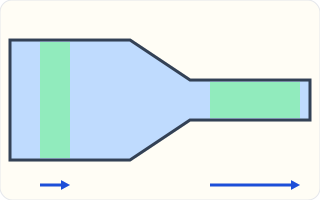
The figure shows a pipe that narrows to a third of its height. In the wide part, a thin slab of water is shaded; in the narrow part, a slab three times as long holds the same volume. Each slab passes its section in one second.
Because the narrow slab is three times as long, the water there must travel three times as far each second: it moves three times as fast. The blue arrows under the slabs show exactly that.
The volume flow rate is the area of a section times the speed of the liquid through it, $Q = Av$. A pipe of area $0.01$ m² carrying water at $2$ m/s delivers $0.02$ m³/s, twenty liters every second.
Flow rates in the United States are often given in gallons per minute or cubic feet per second. Converting to cubic meters per second before calculating keeps units consistent.
Liquids are nearly incompressible: pushing on water barely changes its volume. So in a full pipe, water cannot bunch up or spread out. Whatever volume enters one end each second must leave the other.
In terms of mass, the mass flow rate $\rho Av$ is the same at every section. For a liquid, $\rho$ is constant, so $Av$ is the same too. Gases can compress, so for fast gas flows the density changes along the pipe.
For round pipes, area is $\pi d^2/4$, so the speed depends on the diameter squared. Halving a pipe's diameter cuts its area to a quarter and quadruples the speed. Doubling the diameter drops the speed to a quarter.
That is why a small nozzle on a hose gives such a fast jet, and why water mains use wide pipes: the same flow at lower speed means less friction and less pressure lost along the way.
When a pipe splits into several branches, the flow rate into the junction equals the total flow rate out. The total area of the branches, not the area of any one branch, sets the speed in them.
If the branches together have more area than the main pipe, the flow slows. That is what happens in the body: blood slows dramatically in the capillaries because their combined area is huge.
Checking an answer. A narrower section must have faster flow. The flow rate must be the same everywhere. Squaring the diameter ratio is easy to forget.
Continuity is conservation of mass applied to a flowing fluid. In steady flow, the amount of fluid between two sections does not change, so what enters one section each second must leave the other.
The equation uses the average speed across each section. Real flow is faster in the middle of a pipe and slower near the walls, but the average speed times the area gives the correct flow rate.
A river narrows and deepens through gorges and widens and shallows across plains. Its flow rate stays about the same along a stretch without tributaries, so the water speeds up in narrow places and slows in wide ones.
The U.S. Geological Survey runs thousands of stream gauges that measure river flow rates across the country. Engineers use the data to plan dams, bridges and flood defenses, and the public checks it before rafting or fishing.
The heart pumps about five liters of blood a minute. In the aorta, with an area of a few square centimeters, blood moves at about thirty centimeters per second. In the capillaries, with a total area thousands of times larger, it crawls at under a millimeter per second.
That slow crawl gives time for oxygen and nutrients to pass through the capillary walls into the tissues. Continuity explains why the body's plumbing works as it does.
A fire hose nozzle narrows the flow to produce a high-speed jet that reaches upper-floor windows. Lawn sprinklers use small holes for the same reason, turning a modest flow into fast jets that spread water widely.
Pressure washers go further, forcing water through a tiny orifice at speeds high enough to strip paint. In each case the flow rate is set by the supply; the nozzle only trades area for speed.
The continuity idea applies beyond fluids. On a highway, the number of cars passing each point per minute stays the same along a stretch without exits. Where lanes merge, cars must speed up or, more often, they bunch up and slow down.
Unlike water, cars are compressible: they can pack closer together. That is why lane closures cause traffic jams rather than faster driving, and why traffic engineers study flow with modified versions of the continuity equation.
Flow meters in homes and water plants often measure speed through a pipe of known area and multiply. Others collect the water for a timed interval and measure its volume, the bucket-and-stopwatch method.
The simplest home measurement fills a bucket of known volume and times it. A shower filling a ten-liter bucket in about forty seconds delivers about a quarter liter per second, a typical low-flow showerhead.
Three errors are common. Using the diameter ratio without squaring it gives a speed too small by a factor equal to that ratio. Using the diameter instead of the radius in $\pi r^2$ makes the area four times too big.
Mixing units, such as square centimeters with meters per second, gives flow rates off by factors of ten thousand. Converting everything to SI units first avoids all three.
Continuity works for open channels as well as pipes, as long as the flow is steady. The cross-sectional area is then the width times the depth of the water. Where an irrigation canal narrows at a gate, the water either speeds up or rises, or both, so that width times depth times speed stays the same.
Farmers in California's Central Valley and the Great Plains rely on networks of canals whose flow is set by these rules. Engineers size each channel so the water moves fast enough to carry away silt but slow enough not to erode the banks.
A continuity problem compares two sections of the same flow. Pick one where both the area and the speed are known, or can be found, and one where the unknown sits. Nothing between the two sections matters, provided no water enters or leaves along the way.
If a branch adds or removes water between the sections, add or subtract its flow rate before comparing. The flow rate, not the speed, is the quantity that is shared.
The U.S. Geological Survey operates more than ten thousand stream gauges on rivers across the country. At each, technicians measure the channel's cross-section and the water's speed at many points across it, then multiply area by average speed to get the flow rate.
The Mississippi near New Orleans carries on average about seventeen thousand cubic meters every second, while the Colorado at Lees Ferry, below Glen Canyon Dam, carries a few hundred. Continuity lets hydrologists predict how fast water will rush through a narrow bridge opening during a flood, and so how high it will rise and how hard it will push on the bridge supports.
Each minute, the heart pumps about five liters of blood into the aorta, a vessel a couple of centimeters across. There the blood moves at about thirty centimeters per second. It then branches into billions of capillaries, each narrower than a hair, but with a combined cross-sectional area thousands of times larger.
Continuity says the same flow through so much more area must move far more slowly, under a millimeter per second. Doctors use this in reverse too: a narrowed artery forces blood through faster, and ultrasound devices detect that jet of fast flow, revealing a blockage before it causes a heart attack or stroke.
It seems natural that squeezing water into a narrow pipe would slow it down, like a crowd pushing through a doorway. But water cannot bunch up in a full pipe. The same volume must pass each section every second, so where the area is smaller, the water moves faster.
A related error is to scale the speed by the diameter ratio instead of the area ratio. Halving the diameter quarters the area, so the speed goes up four times, not two.
Water flows at $1.2$ m/s in a hose $2.0$ cm across. Find the hose's area.
$A_1 = \pi \times 0.010^2 = 3.14 \times 10^{-4}\ \text{m}^2$
Radius $1.0$ cm.
Find the flow rate.
$Q = 3.14 \times 10^{-4} \times 1.2 = 3.77 \times 10^{-4}\ \text{m}^3\text{/s}$
Area times speed.
Convert to liters per second.
$Q = 0.377\ \text{L/s}$
A thousand liters per cubic meter.
The nozzle is $0.50$ cm across. Find the diameter ratio.
$\dfrac{2.0}{0.50} = 4$
Four times narrower.
Find the jet's speed.
$v_2 = 1.2 \times 4^2 = 19.2\ \text{m/s}$
Sixteen times faster.
Water flows at $3.0$ m/s in a pipe $5.0$ cm across that widens to $10$ cm. Find the diameter ratio.
$\dfrac{5.0}{10} = 0.5$
Twice as wide.
Find the area ratio.
$\dfrac{A_1}{A_2} = 0.5^2 = 0.25$
Square it.
Find the speed in the wide part.
$v_2 = 3.0 \times 0.25 = 0.75\ \text{m/s}$
A quarter as fast.
Find the flow rate.
$Q = \pi \times 0.025^2 \times 3.0 = 5.9 \times 10^{-3}\ \text{m}^3\text{/s}$
About six liters per second.
Check with the wide part.
$\pi \times 0.05^2 \times 0.75 = 5.9 \times 10^{-3}$
The same.
Find the time to fill a $200$ L tank.
$t = \dfrac{0.200}{5.9 \times 10^{-3}} = 34\ \text{s}$
Volume over rate.
A main pipe of area $20$ cm² carries water at $2.0$ m/s into four branches of $3.0$ cm² each. Find the flow rate.
$Q = 20 \times 10^{-4} \times 2.0 = 4.0 \times 10^{-3}\ \text{m}^3\text{/s}$
Main pipe.
Find the total branch area.
$A_b = 4 \times 3.0 = 12\ \text{cm}^2$
All four together.
Convert the branch area.
$A_b = 12 \times 10^{-4}\ \text{m}^2$
Square meters.
Find the speed in the branches.
$v_b = \dfrac{4.0 \times 10^{-3}}{12 \times 10^{-4}} = 3.33\ \text{m/s}$
Faster: less total area.
Find the flow in each branch.
$Q_b = 1.0 \times 10^{-3}\ \text{m}^3\text{/s}$
A quarter each.
Find the speed if the branches totaled $40$ cm².
$v_b = \dfrac{4.0 \times 10^{-3}}{40 \times 10^{-4}} = 1.0\ \text{m/s}$
Slower: more area.
Relate this to capillaries.
$\text{huge total area, slow flow}$
The same principle.
Write the continuity equation.
$A_1v_1 = A_2v_2$
Same flow rate.
Solve for the speed.
$v_2 = 0.5 \times \dfrac{40}{10}$
Area ratio.
Evaluate the speed.
Water flows at $0.8$ m/s through a pipe $10$ cm across, which narrows to $5$ cm across. How fast does the water move in the narrow section, in m/s?
Complete the worked solution: blood leaves the heart through the aorta, of radius $1.05$ cm, at an average $32$ cm/s. It then spreads through capillaries whose total cross-sectional area is about $3000$ cm². Find the aorta's area in cm², the blood flow rate in cm³/s, and the average speed in the capillaries in cm/s.
Find the aorta's area.
$A = \pi r^2 =$ a
A circle.
Find the flow rate.
$Q = Av =$ q
Area times speed.
Find the capillary speed.
$v_c = \dfrac{Q}{A_c} =$ u
Same flow, far more area.
Explain why slow is useful.
$\text{time to exchange oxygen}$
Slow flow in the capillaries.
Match each idea to its statement.
| area times speed | the flow rate is the same at every section | the water speeds up | density times area times speed | |
|---|---|---|---|---|
| volume flow rate | ||||
| the continuity equation | ||||
| a pipe narrowing | ||||
| mass flow rate |
Water flows at $2$ m/s through a garden hose $2.5$ cm across. Fill in the hose's cross-sectional area in cm², the flow rate in L/s, and the time in s to fill a $20$ L container.
| value | |
|---|---|
| area (cm²) | |
| flow rate (L/s) | |
| fill time (s) |
A pipe $4$ cm across narrows to $2$ cm across. Water moves at speed $v$, in m/s, in the wide section. Write its speed in the narrow section, in m/s, as a function of $v$.
Answer:
A river $40$ m wide and $2$ m deep flows at $0.5$ m/s. Downstream it squeezes through a gorge $10$ m wide and $4$ m deep. Treating both sections as rectangles, how fast does the water flow in the gorge, in m/s?
Answer: m/s
The U.S. Geological Survey measures an average flow of about $7500$ m³/s in the Columbia River at The Dalles, Oregon, where the channel's cross-sectional area is roughly $7000$ m². What is the water's average speed, in m/s?
Answer: m/s
Lesson test: one question per skill, one attempt each, no hints. Your answers are checked when you submit.
A pipe $6$ cm across narrows to $2$ cm across. Water moves at speed $v$, in m/s, in the wide section. Write its speed in the narrow section, in m/s, as a function of $v$.
Answer:
You can apply the continuity equation. Explain to someone why covering part of a hose's end makes the water shoot farther.
26. Your turn: water at $0.5$ m/s in a pipe of area $40$ cm² flows into a section of area $10$ cm². How fast is it there?, step 3
$v_2 = 2.0\ \text{m/s}$
Four times faster.