Back to the on-screen lesson ·
With only gravity and springs doing work, kinetic and potential energy trade while their total stays fixed.
Paper packet. Every task here also exists on screen, where it is checked automatically; answers written on paper are not assessed by Nydus. When you are back at a device, enter your answers there.
By the end of this lesson you will be able to use conservation of mechanical energy to find speeds, heights and spring compressions.
You can compute the work done by a force and use the work-energy theorem, $W_{\text{net}} = \Delta K$. You have seen that gravity's work depends only on the height change, and that a spring's work is $\tfrac{1}{2}kx^2$. This lesson turns those works into stored energies that trade with kinetic energy.
| Term | What it means |
|---|---|
| Kinetic energy | Energy of motion, $K = \tfrac{1}{2}mv^2$. |
| Gravitational potential energy | Energy of height, $U_g = mgh$, measured from a chosen level. |
| Spring potential energy | Energy stored in a stretched or compressed spring, $U_s = \tfrac{1}{2}kx^2$. |
| Mechanical energy | The sum of kinetic and potential energies, $E = K + U$. |
| Conservative force | A force whose work depends only on the start and end points, like gravity. |
| Reference level | The height chosen as zero for gravitational potential energy. |
When only gravity and springs do work, the total mechanical energy stays constant:
$$K_i + U_i = K_f + U_f.$$
As an object falls, potential energy becomes kinetic; as it rises, kinetic becomes potential. Comparing two points needs no forces, times or path details.
Another way: picture
Picture a skateboarder in a half-pipe. At the top of one side they pause for an instant, all energy stored as height. Swooping down, they speed up as height turns into motion, fastest at the bottom. Climbing the other side, they slow down, and without friction they would rise to exactly the height they started from.
Another way: steps
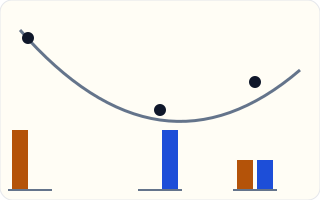
The figure shows a cart on a frictionless track at three places, with a pair of bars under each: amber for gravitational potential energy and blue for kinetic energy. At the start the cart is at rest high up, so all its energy is potential.
At the bottom of the dip, all the potential energy has become kinetic, and the cart moves fastest. Partway up the far side, the energy is split evenly. The two bars always add up to the same height, which is the whole idea of conservation.
Lifting an object a height $h$ at steady speed takes work $mgh$. That energy is not lost; it is stored in the object's position and can be recovered by letting it fall. The stored amount is the gravitational potential energy, $U_g = mgh$.
Only changes in potential energy matter, so you may choose any convenient level as zero: the floor, the ground, or the lowest point of the motion. Heights above it are positive and below it negative, and the answers for speeds come out the same.
Compressing or stretching a spring takes work $\tfrac{1}{2}kx^2$, which is stored in the spring. Released, the spring gives it back as kinetic energy, as in a toy launcher, a pogo stick or a car's suspension.
Because the energy depends on $x^2$, doubling the compression stores four times the energy. A spring compressed or stretched by the same amount stores the same energy either way, since $x^2$ is positive for both.
For a falling object, $mgh = \tfrac{1}{2}mv^2$, and $m$ appears on both sides. Dividing it out leaves $v = \sqrt{2gh}$: every object dropped from the same height reaches the same speed, if friction and air resistance are negligible.
This is Galileo's discovery expressed in energy. A bowling ball and a marble rolling without friction down the same slide reach the bottom at the same speed. The heavier ball has more energy, but it also needs more energy to move at a given speed.
The speed at the bottom of a frictionless track depends only on the height dropped, not on the shape of the track. A steep drop and a gentle winding slope of the same height give the same final speed, although they take different times.
This is why energy methods are so powerful: you do not need to know the forces at every point along a curved path. Gravity and springs are conservative forces, whose work depends only on the start and end points.
Checking an answer. A speed must be real, so the kinetic energy can never be negative; a height the object cannot reach gives a negative $v^2$. The object can never rise higher than its total energy allows, and the mass should cancel for gravity problems.
Conservation follows from the work-energy theorem. Gravity's work from one point to another is $-\Delta U_g$, and a spring's is $-\Delta U_s$. If these are the only forces doing work, $\Delta K = -\Delta U$, so $K + U$ does not change.
Forces that do no work, such as the normal force from a frictionless track or the tension in a pendulum string, may act without breaking conservation. Only friction, drag, and pushes from outside the system change the mechanical energy.
Friction does negative work and turns mechanical energy into thermal energy in the surfaces. The energy equation then gains a term: $K_i + U_i = K_f + U_f + fd$, where $fd$ is the energy lost to heat over a sliding distance $d$.
Total energy, including heat, is still conserved; only the mechanical part shrinks. That is why a real roller coaster's hills must each be lower than the first, and why a swing slowly stops unless someone keeps pushing.
A pendulum bob trades potential and kinetic energy twice each swing. At the ends it stops for an instant with all its energy potential; at the bottom it moves fastest with all its energy kinetic. The string's tension is always perpendicular to the motion, so it does no work.
Released from a height $h$ above its lowest point, the bob reaches $\sqrt{2gh}$ at the bottom, whatever the length of the string. A longer string gives a slower swing, but not a faster speed at the bottom.
Far from Earth, $mgh$ no longer applies, because gravity weakens with distance. The full potential energy is $-GMm/r$, which rises toward zero far away. A rocket must have enough kinetic energy to climb all the way to zero.
Setting $\tfrac{1}{2}mv^2 = GMm/R$ gives the escape speed from Earth's surface, about $11.2$ km/s. NASA's Artemis missions to the Moon need nearly that much speed after launch, a large part of why their rockets are so enormous.
A pole vaulter converts running kinetic energy into bending energy in the pole, and then into height. At about $10$ m/s running speed, the energy balance allows a rise of about $5$ m. Adding the vaulter's own push and the height of their center of mass at takeoff gives the six-meter world-class vaults.
Divers, ski jumpers and trampoline athletes all use the same accounting. Coaches use it to estimate the speed a skier will reach from the height of a jump's start ramp.
Energy methods are fastest when a problem asks for a speed at one point, a height reached, or a spring's compression, and when the path is curved or complicated. They cannot give times directly, nor the direction of motion.
Force methods are needed for accelerations, times, and forces such as the normal force at the top of a loop. Many problems use both: energy to find the speed at a point, then Newton's second law to find a force there.
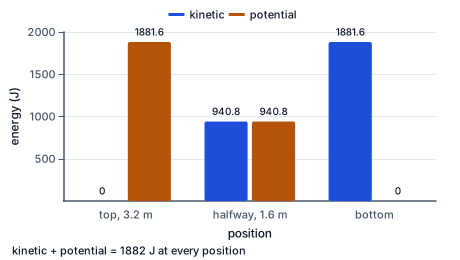
The figure draws the bars for the skateboarder in the first worked example: all potential at the top, half and half at the middle, all kinetic at the bottom, and the same total every time.
A quick way to set up a conservation problem is an energy bar chart: one bar for each kind of energy at the start and another set at the end, with heights showing their sizes. The total height must match on both sides, unless friction or an outside push adds a bar for energy leaving or entering.
Drawing the bars before writing equations shows at a glance which terms are zero, such as kinetic energy at rest or potential energy at the reference level. It also catches sign mistakes, since no bar can have negative height except gravitational energy below the chosen zero.
Cedar Point in Sandusky, Ohio, calls itself the roller-coaster capital of the world. Its Millennium Force drops $91$ m, and energy conservation predicts a speed at the bottom of about $42$ m/s, $95$ miles per hour. The ride's measured top speed, about $41$ m/s, is only slightly less, because modern steel tracks lose little energy to friction.
Designers use exactly this accounting to plan every hill. Each later hill must be lower than the first, since some energy leaves as heat and sound, and the train must still crest it. Launched coasters such as Kingda Ka in New Jersey skip the lift hill, using hydraulic or magnetic launches to supply the kinetic energy that then carries the train up a $139$ m tower.
At the Bath County Pumped Storage Station in Virginia, the largest in the United States, water is pumped uphill at night, when electricity is cheap, into a reservoir about $380$ m above a lower one. During the day, it flows back down through turbines, turning gravitational potential energy into electricity.
Each cubic meter of water, $1000$ kg, stores about $3.7$ MJ at that height. The plant can deliver about three gigawatts, as much as several large power stations, for hours. Losses in the pumps and turbines mean it returns about eighty percent of the energy used, but it lets the grid store energy on a huge scale, which matters more as solar and wind power grow.
It seems natural that a heavier object sliding down a frictionless slope should arrive faster, since it has more energy. But it also needs proportionally more energy for each bit of speed. In $mgh = \tfrac{1}{2}mv^2$ the mass cancels, and every object reaches the same speed.
A second error is to treat energy as lost when it changes form. Friction does not destroy energy; it turns mechanical energy into thermal energy, and the total, counting heat, stays constant.
A $60$ kg skateboarder starts from rest $3.2$ m above the bottom of a half-pipe. Find the potential energy.
$U = 60 \times 9.8 \times 3.2 = 1881.6\ \text{J}$
Relative to the bottom.
Write the energy at the bottom.
$\tfrac{1}{2} \times 60 \times v^2 = 1881.6$
All kinetic.
Solve for the speed.
$v = \sqrt{62.72} = 7.92\ \text{m/s}$
At the bottom.
Find the speed $1.6$ m above the bottom.
$v = \sqrt{2 \times 9.8 \times 1.6} = 5.6\ \text{m/s}$
Half the height dropped.
Find how high the far side lets them rise.
$h = 3.2\ \text{m}$
Same total energy.
A $0.50$ kg block is pushed against a spring with $k = 200$ N/m, compressing it $0.15$ m. Find the stored energy.
$U_s = \tfrac{1}{2} \times 200 \times 0.15^2 = 2.25\ \text{J}$
Spring potential energy.
Released on a frictionless floor, write the energy balance.
$2.25 = \tfrac{1}{2} \times 0.50 \times v^2$
All becomes kinetic.
Solve for the speed.
$v = \sqrt{9} = 3.0\ \text{m/s}$
Leaving the spring.
The block then climbs a frictionless ramp. Write the balance at the top.
$2.25 = 0.50 \times 9.8 \times h$
All becomes height.
Solve for the height.
$h = 0.459\ \text{m}$
Where it stops.
Find the speed halfway up the ramp.
$v = \sqrt{\dfrac{2 \times 1.125}{0.50}} = 2.12\ \text{m/s}$
Half the energy remains kinetic.
A $40$ kg sled starts from rest at the top of a hill $8.0$ m high. Find the potential energy.
$U = 40 \times 9.8 \times 8.0 = 3136\ \text{J}$
Relative to the bottom.
Find the speed at the bottom with no friction.
$v = \sqrt{2 \times 9.8 \times 8.0} = 12.5\ \text{m/s}$
Ideal case.
The sled actually reaches $10$ m/s. Find its kinetic energy.
$K = \tfrac{1}{2} \times 40 \times 10^2 = 2000\ \text{J}$
Measured.
Find the energy turned to heat.
$3136 - 2000 = 1136\ \text{J}$
Lost to friction.
The slope is $40$ m long. Find the average friction.
$f = \dfrac{1136}{40} = 28.4\ \text{N}$
Work divided by distance.
Find the fraction of energy kept.
$\dfrac{2000}{3136} = 0.64$
About two thirds.
Check the total energy.
$2000 + 1136 = 3136\ \text{J}$
Nothing disappears.
Write the energy balance.
$v^2 = 2gh$
Potential becomes kinetic.
Substitute the values.
$v^2 = 2 \times 9.8 \times 1.8 = 35.28$
In m²/s².
Take the square root.
A child starts from rest at the top of a frictionless water slide $5$ m high. With $g = 9.8$ m/s², how fast is the child moving at the bottom, in m/s?
Complete the worked solution: a $3$ kg pendulum bob is released from rest $0.45$ m above its lowest point. With $g = 9.8$ m/s², find its energy relative to the lowest point in J, its speed at the lowest point in m/s, and its speed when it has dropped half of that height in m/s.
Find the starting energy.
$U = mgh =$ u
All potential at release.
Find the speed at the bottom.
$v = \sqrt{2gh} =$ v
All kinetic at the bottom.
Find the speed halfway down.
$v_{1/2} = \sqrt{2g \cdot \tfrac{h}{2}} = \sqrt{gh} =$ w
Half the height dropped.
Explain why tension does no work.
$\text{it is perpendicular to the motion}$
The bob moves along the arc.
Match each kind of energy to its formula or rule.
| $\tfrac{1}{2}mv^2$ | $mgh$ | $\tfrac{1}{2}kx^2$ | stays constant | |
|---|---|---|---|---|
| kinetic energy | ||||
| gravitational potential energy | ||||
| spring potential energy | ||||
| mechanical energy with no friction |
A $300$ kg roller-coaster car starts from rest at the top of a $45$ m hill and runs along a frictionless track. With $g = 9.8$ m/s², fill in its gravitational potential energy at the top in kJ, its speed at ground level in m/s, and its speed at a later hilltop $5$ m high in m/s.
| value | |
|---|---|
| energy at the top (kJ) | |
| speed at ground level (m/s) | |
| speed on the later hill (m/s) |
A cart moves along a frictionless track. At a height of $20$ m it is moving at $2$ m/s. With $g = 9.8$ m/s², write the square of its speed, $v^2$ in m²/s², as a function of its height $y$ in meters.
Answer:
A toy launcher's spring, with $k = 250$ N/m, is compressed $0.2$ m and fires a $0.25$ kg ball straight up. Ignoring air resistance, how high above the launch point does the ball rise, in m? Use $g = 9.8$ m/s².
Answer: m
The roller coaster Kingda Ka in New Jersey has a first drop of about $127$ m. If the train starts the drop nearly at rest and friction is ignored, how fast is it moving at the bottom, in m/s? Use $g = 9.8$ m/s².
Answer: m/s
Lesson test: one question per skill, one attempt each, no hints. Your answers are checked when you submit.
A cart moves along a frictionless track. At a height of $15$ m it is moving at $8$ m/s. With $g = 9.8$ m/s², write the square of its speed, $v^2$ in m²/s², as a function of its height $y$ in meters.
Answer:
You can apply conservation of mechanical energy. Explain to someone why a heavy and a light cart released from the same height on a frictionless track reach the bottom at the same speed.
24. Your turn: a ball is dropped from $1.8$ m. How fast is it moving just before it hits the floor?, step 3
$v = 5.94\ \text{m/s}$
Just before impact.