Back to the on-screen lesson ·
An oscillator trades energy between elastic and kinetic forms while the total, $\tfrac{1}{2}kA^2$, stays fixed; the speed is largest at equilibrium.
Paper packet. Every task here also exists on screen, where it is checked automatically; answers written on paper are not assessed by Nydus. When you are back at a device, enter your answers there.
By the end of this lesson you will be able to track energy through an oscillation and find speeds and amplitudes from energy conservation.
You know elastic potential energy, $\tfrac{1}{2}kx^2$, kinetic energy, and conservation of mechanical energy. You know the period of a spring-mass oscillator and its angular frequency, $\omega = \sqrt{k/m}$. This lesson follows the energy as it sloshes back and forth during each cycle.
| Term | What it means |
|---|---|
| Elastic potential energy | Energy stored in a stretched or compressed spring, $\tfrac{1}{2}kx^2$. |
| Total mechanical energy | For an oscillator, $E = \tfrac{1}{2}kA^2$, constant without friction. |
| Turning point | An extreme of the motion, where the object momentarily stops. |
| Maximum speed | The speed at equilibrium, $v_{\max} = A\omega$. |
| Energy diagram | A graph of energy against displacement. |
| Tuned mass damper | A heavy oscillator added to a structure to absorb its sway. |
In a frictionless oscillator, the total mechanical energy stays constant:
$$\tfrac{1}{2}mv^2 + \tfrac{1}{2}kx^2 = \tfrac{1}{2}kA^2.$$
The speed at any displacement follows from $v = \omega\sqrt{A^2 - x^2}$.
Another way: picture
Picture a child on a swing. At the top of each arc, the child pauses: all the energy is stored as height. Swooping through the bottom, the child moves fastest: all the energy is motion. The energy trades back and forth twice every cycle, and without friction the total never changes.
Another way: steps
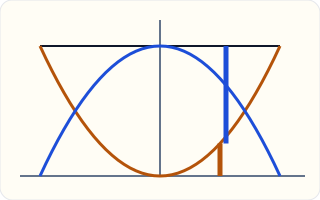
The graph plots energy against displacement. The amber U-shaped curve is the elastic potential energy, zero at equilibrium and largest at the extremes. The blue upside-down U is the kinetic energy, largest at equilibrium and zero at the extremes. The flat black line is the total.
At every displacement, the two curves add up to the black line. Halfway out, the amber bar holds a quarter of the total and the blue bar the other three quarters, because elastic energy depends on the square of the displacement.
At an extreme, the object stops, so all its energy is elastic: $E = \tfrac{1}{2}kA^2$. This total stays the same throughout the motion if there is no friction. Doubling the amplitude quadruples the energy.
This explains why large oscillations are so much more energetic than small ones. A bridge swaying twice as far stores four times the energy, and its supports must withstand much larger forces.
At equilibrium, all the energy is kinetic: $\tfrac{1}{2}mv_{\max}^2 = \tfrac{1}{2}kA^2$. Solving gives $v_{\max} = A\sqrt{k/m} = A\omega$. The largest speed is proportional to the amplitude and to the angular frequency.
A stiff, light oscillator swinging widely moves very fast; a soft, heavy one swinging a little moves slowly. The same result follows from differentiating $x = A\cos(\omega t)$, which is a good consistency check.
Subtracting the elastic energy from the total gives the kinetic energy at any displacement, and so the speed: $v = \omega\sqrt{A^2 - x^2}$. The speed falls smoothly from its maximum at the center to zero at the extremes.
At half the amplitude the speed is still about eighty-seven percent of the maximum, since only a quarter of the energy has become elastic. The object slows sharply only near the turning points.
For a pendulum, the potential energy is gravitational, $mgh$, rather than elastic. At the top of each swing it is all potential; at the bottom, all kinetic. For small swings, the height behaves like $\tfrac{1}{2}(mg/L)x^2$, matching the spring model with $k = mg/L$.
So everything in this lesson applies to pendulums too, with the effective spring constant in place of $k$. A pendulum released from a greater height swings through the bottom faster.
Checking an answer. The speed can never exceed $A\omega$. At half the amplitude, the elastic energy is a quarter of the total, not half. Kinetic and elastic energy must always add up to the total.
The spring force is conservative: its work depends only on the start and end positions, and it can be written as the change in elastic potential energy. With no friction, the only force doing work is the spring, so mechanical energy is conserved.
The normal force and gravity on a horizontal glider do no work, since they are perpendicular to the motion. That is why the air-track glider is such a clean example of energy exchange.
The energy sloshes between elastic and kinetic twice in every period: at each extreme it is all elastic, and at each pass through the middle it is all kinetic. So the energy oscillates at twice the frequency of the motion.
The total energy depends on amplitude, but the period does not. A widely swinging oscillator carries more energy through each cycle but takes the same time to complete it.
Tall buildings sway in the wind with periods of several seconds. Some have a tuned mass damper: a heavy block on springs near the top, tuned to the building's own period. As the building sways, the block swings the opposite way.
The damper soaks up the building's sway energy into its own oscillation, and shock absorbers turn that energy into heat. Skyscrapers in New York and other cities use dampers weighing hundreds of tons to keep upper floors comfortable.
A plucked guitar string and a struck tuning fork are oscillators whose energy sloshes between elastic and kinetic forms hundreds of times a second. Each cycle, a little energy leaks out as sound, which is why the note fades.
The loudness depends on the energy, and so on the square of the amplitude. Plucking a string twice as hard gives four times the energy and a noticeably louder note, but the pitch, set by the frequency, stays the same.
Atoms in a molecule are held together by bonds that act like tiny springs. The atoms vibrate about their equilibrium spacing, trading energy between the bond's stretch and the atoms' motion, just like a mass on a spring.
Chemists identify molecules by the frequencies at which they absorb infrared light, which match these vibrations. Carbon dioxide's vibrations, absorbing Earth's outgoing infrared radiation, are why it is a greenhouse gas.
Real oscillators lose energy each cycle to friction and air drag. The total energy falls, so the amplitude shrinks, since $A = \sqrt{2E/k}$. A swing left alone slowly comes to rest.
Clocks and swings are kept going by small pushes that replace the lost energy each cycle. The next lesson looks at how quickly oscillations die away, and at what happens when they are driven at their natural frequency.
An energy diagram shows at a glance where an oscillator can go. Draw the total energy as a horizontal line across the potential energy curve. The object can move only where the line lies above the curve; where they cross are the turning points.
The gap between the line and the curve at any position is the kinetic energy there. The widest gap, at the bottom of the curve, is where the object moves fastest.
Because an oscillator moves slowly near the turning points and quickly through the middle, it spends most of each cycle near the extremes. A photograph taken at a random moment is more likely to catch a pendulum near the end of its swing than at the bottom.
This matters in the lab. Marking a position is easiest at the turning points, where the object nearly stops, while timing is easiest as it passes through the middle, where its position changes fastest and the moment of passing is sharp.
Every energy in this lesson is measured in joules, a newton meter. The spring constant times a squared length gives newtons per meter times square meters, which is newton meters, as it should. A mass times a squared speed gives kilograms times square meters per square second, also joules.
Supertall buildings sway in strong winds, sometimes by a meter or more at the top, with periods of several seconds. Occupants on upper floors can feel queasy. Many towers in New York, Chicago and Boston carry tuned mass dampers: blocks of steel or concrete weighing hundreds of tons, mounted on springs and shock absorbers.
Tuned to the building's own period, the damper swings opposite to the building's sway. Energy that would have gone into the building's motion passes into the damper, whose shock absorbers turn it into heat. Engineers size the damper using the same energy accounting as a block on a spring: its top speed is $A\omega$ and its energy grows as the square of its swing.
A guitarist plucking a string pulls it sideways, storing elastic energy. Released, the string vibrates hundreds of times a second, its energy sloshing between stretch and motion. The body of the guitar picks up these vibrations and turns a small part of the energy into sound each cycle.
Plucking harder increases the amplitude, and the energy grows as its square, so the note is louder. The pitch depends only on the frequency, set by the string's tension, mass and length, not by how hard it is plucked. As energy leaks away as sound, the amplitude shrinks and the note fades, while the pitch stays steady.
It is natural to think that halfway out, the energy is split evenly between elastic and kinetic. But elastic energy depends on the square of the displacement. At half the amplitude it is a quarter of the total, and the kinetic energy is three quarters.
A related error is to think the object moves at a steady speed. It speeds up toward the center and slows toward the ends, which is why it lingers at the turning points and rushes through the middle.
A $0.40$ kg glider on a spring with $k = 160$ N/m oscillates with amplitude $0.10$ m. Find the total energy.
$E = \tfrac{1}{2} \times 160 \times 0.10^2 = 0.80\ \text{J}$
From the amplitude.
Find the largest speed.
$v_{\max} = \sqrt{\dfrac{2 \times 0.80}{0.40}} = 2.0\ \text{m/s}$
All kinetic.
Find the elastic energy at $0.05$ m.
$U = \tfrac{1}{2} \times 160 \times 0.05^2 = 0.20\ \text{J}$
A quarter of the total.
Find the kinetic energy there.
$K = 0.80 - 0.20 = 0.60\ \text{J}$
Three quarters.
Find the speed there.
$v = \sqrt{\dfrac{2 \times 0.60}{0.40}} = 1.73\ \text{m/s}$
Most of the top speed.
A $1.0$ kg block on a spring with $k = 400$ N/m passes equilibrium at $3.0$ m/s. Find the kinetic energy there.
$K = \tfrac{1}{2} \times 1.0 \times 3.0^2 = 4.5\ \text{J}$
The total energy.
Set it equal to the elastic energy at the extreme.
$4.5 = \tfrac{1}{2} \times 400 \times A^2$
All elastic there.
Solve for the amplitude.
$A = \sqrt{\dfrac{9.0}{400}} = 0.15\ \text{m}$
Positive root.
Check with $v_{\max} = A\omega$.
$\omega = \sqrt{400} = 20,\ 0.15 \times 20 = 3.0$
Consistent.
Find the speed at $0.09$ m.
$v = 20\sqrt{0.15^2 - 0.09^2} = 2.4\ \text{m/s}$
$\omega\sqrt{A^2 - x^2}$.
Find where the speed is half its maximum.
$x = A\sqrt{\tfrac{3}{4}} = 0.13\ \text{m}$
Far out from the middle.
A $2.0$ kg pendulum bob is pulled up $0.20$ m above its lowest point. Find the energy.
$E = 2.0 \times 9.8 \times 0.20 = 3.92\ \text{J}$
All gravitational.
Find the speed at the bottom.
$v = \sqrt{\dfrac{2 \times 3.92}{2.0}} = 1.98\ \text{m/s}$
All kinetic.
Find the energy at $0.05$ m high.
$U = 2.0 \times 9.8 \times 0.05 = 0.98\ \text{J}$
A quarter of the height.
Find the kinetic energy there.
$K = 3.92 - 0.98 = 2.94\ \text{J}$
Three quarters.
Find the speed there.
$v = \sqrt{\dfrac{2 \times 2.94}{2.0}} = 1.71\ \text{m/s}$
Still fast.
Double the starting height and find the bottom speed.
$v = 1.98 \times \sqrt{2} = 2.80\ \text{m/s}$
Twice the energy.
Compare the period.
$\text{unchanged for small swings}$
Energy changes, period does not.
Write the formula.
$E = \tfrac{1}{2}kA^2$
All elastic at the extreme.
Substitute the values.
$E = \tfrac{1}{2} \times 300 \times 0.20^2$
SI units.
Evaluate the energy.
A $2$ kg block on a frictionless floor oscillates on a spring with $k = 50$ N/m and an amplitude of $0.12$ m. What is its largest speed, in m/s?
Complete the worked solution: a $0.5$ kg block on a spring with $k = 200$ N/m passes through equilibrium at $2$ m/s on a frictionless floor. Find its total energy in J, its amplitude in m, and its elastic potential energy at half the amplitude in J.
Find the total energy.
$E = \tfrac{1}{2}mv_{\max}^2 =$ e
All kinetic at equilibrium.
Find the amplitude.
$A = \sqrt{\dfrac{2E}{k}} =$ a
All elastic at the extreme.
Find the elastic energy at half amplitude.
$U = \tfrac{1}{4}E =$ u
Energy goes as $x^2$.
State the kinetic energy there.
$K = \tfrac{3}{4}E$
The rest of the total.
Match each position of a frictionless oscillator to how its energy is split.
| all elastic potential energy | all kinetic energy | one quarter elastic, three quarters kinetic | $\tfrac{1}{2}kA^2$ | |
|---|---|---|---|---|
| at either extreme | ||||
| at equilibrium | ||||
| at half the amplitude | ||||
| the total at any point |
A block on a spring with $k = 250$ N/m oscillates with an amplitude of $0.08$ m on a frictionless floor. When it is $0.04$ m from equilibrium, fill in the total energy in J, the elastic potential energy in J, and the kinetic energy in J.
| value | |
|---|---|
| total energy (J) | |
| elastic potential energy (J) | |
| kinetic energy (J) |
A block on a spring with $k = 200$ N/m oscillates on a frictionless floor with an amplitude of $0.1$ m. Write its kinetic energy, in J, as a function of its displacement $x$ from equilibrium, in meters.
Answer:
A $0.25$ kg glider on an air track oscillates on a spring with $k = 100$ N/m and an amplitude of $0.05$ m. How fast is it moving when it is $0.03$ m from equilibrium, in m/s?
Answer: m/s
A skyscraper in Chicago has a tuned mass damper, a heavy block on springs near the top, that oscillates with a period of $7.5$ s. In a strong wind it swings with an amplitude of $1.2$ m. What is its largest speed, in m/s?
Answer: m/s
Lesson test: one question per skill, one attempt each, no hints. Your answers are checked when you submit.
A block on a spring with $k = 200$ N/m oscillates on a frictionless floor with an amplitude of $0.1$ m. Write its kinetic energy, in J, as a function of its displacement $x$ from equilibrium, in meters.
Answer:
You can track energy in an oscillator. Explain to someone why a block halfway out has only a quarter of its energy stored in the spring.
26. Your turn: a spring with $k = 300$ N/m oscillates with amplitude $0.20$ m. What is the total energy?, step 3
$E = 6.0\ \text{J}$
Joules.