Back to the on-screen lesson ·
Along a steady, frictionless flow, $P + \tfrac{1}{2}\rho v^2 + \rho gh$ stays constant: faster fluid has lower pressure, and falling fluid speeds up.
Paper packet. Every task here also exists on screen, where it is checked automatically; answers written on paper are not assessed by Nydus. When you are back at a device, enter your answers there.
By the end of this lesson you will be able to apply Bernoulli's equation to jets, Venturi meters, pumps and wind over roofs.
You know conservation of energy, pressure in fluids, and the continuity equation, $A_1v_1 = A_2v_2$. This lesson combines them into one statement about moving fluids: how pressure, speed and height trade off along a flow.
| Term | What it means |
|---|---|
| Bernoulli's equation | $P + \tfrac{1}{2}\rho v^2 + \rho gh$ is constant along a streamline. |
| Streamline | The path a small parcel of fluid follows in steady flow. |
| Dynamic pressure | The kinetic energy per volume, $\tfrac{1}{2}\rho v^2$. |
| Torricelli's theorem | Fluid leaves a hole at $\sqrt{2gh}$ below the surface. |
| Venturi meter | A narrowed pipe whose pressure drop measures the flow. |
| Ideal fluid | Incompressible, frictionless and flowing steadily. |
For an ideal fluid in steady flow, along any streamline:
$$P + \tfrac{1}{2}\rho v^2 + \rho gh = \text{constant}.$$
Bernoulli's equation is energy conservation for a flowing fluid.
Another way: picture
Picture holding two sheets of paper a few centimeters apart and blowing between them. You might expect them to fly apart, but they pull together. The fast air between them has lower pressure than the still air outside, which pushes the sheets inward.
Another way: steps
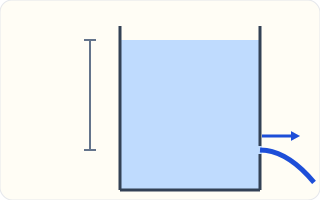
The figure shows water leaving a hole in the side of a tank. At the surface, the pressure is atmospheric and the water barely moves. At the hole, the pressure is again atmospheric, since the jet is open to the air, but the water moves fast.
Bernoulli's equation then says the height energy lost becomes kinetic energy: $\rho gh = \tfrac{1}{2}\rho v^2$, so $v = \sqrt{2gh}$. The water leaves as fast as if it had fallen freely through the height $h$, a result Evangelista Torricelli found in the 1600s.
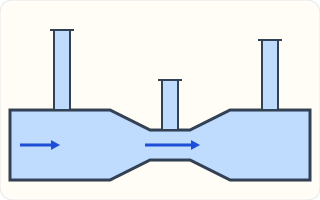
The figure shows water flowing through a pipe with a narrow throat, with three thin tubes rising from it. By continuity, the water speeds up in the throat. By Bernoulli, its pressure drops there.
The water in the tube above the throat stands lowest, showing the lowest pressure. Measuring the pressure difference between the wide part and the throat gives the speed, and so the flow rate. Water utilities use Venturi meters to measure flow in large mains.
Consider a parcel of fluid moving along a pipe. The fluid behind it pushes it forward, doing work equal to the pressure times the volume moved. The fluid ahead pushes back. The net work changes the parcel's kinetic and gravitational energy.
Dividing everything by the parcel's volume gives Bernoulli's equation. It is just the work-energy theorem, written per cubic meter of fluid.
In a level pipe, $P + \tfrac{1}{2}\rho v^2$ is constant. Where the fluid speeds up, its pressure must drop. This surprises many people, who expect fast-moving fluid to push harder.
The key is that the pressure in Bernoulli's equation is the pressure within the fluid, pushing sideways on pipe walls. A fast jet hitting a wall pushes hard because it is stopped, not because its internal pressure is high.
When a fluid is at rest, Bernoulli's equation reduces to the hydrostatic result: $P + \rho gh$ is constant, so pressure rises as height falls. The fluid statics of earlier lessons are a special case.
In a moving fluid, height, speed and pressure all trade off. Water pumped up a building loses pressure as it rises; a hose aimed downhill gains speed or pressure as it descends.
Checking an answer. Where the speed rises on a level pipe, pressure must fall. Open surfaces and free jets are at atmospheric pressure. The result for a still fluid must match $P_0 + \rho gh$.
Bernoulli's equation follows from energy conservation, assuming the fluid is incompressible, has no friction, and flows steadily. Under those conditions, no energy is lost to heat, so the total energy per volume stays constant.
Real fluids have viscosity, which dissipates energy, so pressure drops along long pipes even at constant speed. Bernoulli's equation works well for short, smooth flows and gives a useful first estimate elsewhere.
Air flowing over an airplane wing is turned downward, and in the process it moves faster over the top surface than under the bottom. The pressure above the wing is lower, giving an upward net force, lift.
Bernoulli's equation relates the speeds and pressures, while Newton's laws explain the downward turning of the air. Both describe the same flow, and engineers at NASA and Boeing use both in designing wings.
When a hurricane's winds sweep over a house, the fast air above the roof has lower pressure than the still air inside. The difference pushes the roof upward, and in strong storms it can lift the roof off entirely.
After Hurricane Andrew in 1992, Florida strengthened its building code to require metal straps tying roofs to walls. Opening windows does not help; it lets wind inside, adding to the damage.
Wind blowing across the top of a chimney lowers the pressure there, drawing smoke up and out. This is why chimneys draw better on windy days.
Prairie dogs use the same effect. Their burrows have openings at mounds of different heights and shapes, so wind blowing across them creates a pressure difference that pulls fresh air through the tunnels.
Perfume atomizers and old-fashioned spray bottles blow fast air across the top of a thin tube dipping into liquid. The low pressure in the fast air draws the liquid up the tube, where the air stream breaks it into a spray.
Carburetors in older car engines worked the same way, using a Venturi throat to draw fuel into the incoming air. Modern engines use fuel injection instead.
Bernoulli's equation assumes steady flow with no friction. It fails for thick, sticky fluids like honey, for turbulent flows full of swirls, and across pumps and turbines, which add or remove energy.
It also applies only along a streamline, or throughout a region where every streamline starts with the same energy. Comparing points on different streamlines requires care.
The kinetic term, $\tfrac{1}{2}\rho v^2$, is called the dynamic pressure. For air at highway speed, thirty meters per second, it is about $540$ Pa, half a percent of atmospheric pressure. For water at the same speed, it is nearly five atmospheres.
Because water is so much denser, even modest water speeds produce large pressure changes, which is why water hammer can burst pipes when a valve slams shut.
A spinning baseball drags a thin layer of air around with it. On one side the spin adds to the air rushing past, and on the other it subtracts, so the air moves faster on one side than the other. The pressure difference pushes the ball sideways, and a pitcher's curveball breaks toward the side where the air moves fastest.
The same effect lets a soccer player bend a free kick around a wall of defenders, and a tennis player's topspin make the ball dip sharply into the court.
The fluids unit links four ideas. Pressure grows with depth, buoyancy comes from that growth, continuity keeps the flow rate fixed, and Bernoulli's equation tracks energy along the flow. Most real problems use two or three of them at once, such as continuity to find a speed and Bernoulli to turn it into a pressure.
When a hurricane makes landfall on the Gulf Coast or in Florida, winds of fifty meters per second or more sweep over houses. The fast air above a roof has lower pressure than the still air inside, so the roof feels a net upward push. Over a typical roof, that push can exceed two hundred kilonewtons, the weight of many cars.
After Hurricane Andrew devastated South Florida in 1992, the state rewrote its building code to require hurricane straps and clips that tie roof trusses to the walls. Engineers compute the uplift with Bernoulli's equation, $\tfrac{1}{2}\rho v^2$ times the roof's area, and size the connections to hold. Damage surveys after later storms showed the stronger connections saved many roofs.
Water towers across the United States use gravity to supply pressure. A tank thirty meters high gives about three atmospheres of pressure at street level. As water flows through the mains and up into buildings, Bernoulli's equation tracks how that pressure is spent on lifting the water and speeding it up.
A faucet on the fifth floor delivers water at lower pressure than one at ground level, because some of the tower's height energy has gone into lifting it. Tall buildings in New York and Chicago need their own pumps and rooftop tanks, because city pressure alone cannot push water past the sixth floor or so, just as Bernoulli's equation predicts.
It seems natural that fast-moving air or water pushes harder, because a jet hitting your hand stings. But that force comes from stopping the jet. Within a steady flow, the pressure is lower where the fluid moves faster, as Bernoulli's equation shows.
A related error is to apply Bernoulli's equation across a pump or fan, which adds energy, or along a long pipe where friction removes it. The equation holds only where no energy is added or lost.
A water tower's surface is $12$ m above a small leak. Find the leak's jet speed.
$v = \sqrt{2 \times 9.8 \times 12} = 15.3\ \text{m/s}$
Torricelli's result.
The hole has area $1.0$ cm². Find the flow rate.
$Q = 1.0 \times 10^{-4} \times 15.3 = 1.53 \times 10^{-3}\ \text{m}^3\text{/s}$
Area times speed.
Convert to liters per second.
$Q = 1.53\ \text{L/s}$
Times a thousand.
Find the water lost in an hour.
$1.53 \times 3600 = 5508\ \text{L}$
Over five thousand liters.
Find the jet speed when the level drops to $3.0$ m.
$v = \sqrt{2 \times 9.8 \times 3.0} = 7.7\ \text{m/s}$
Half the speed.
Water flows at $2.0$ m/s in a pipe that narrows to a quarter of its area. Find the throat speed.
$v_2 = 2.0 \times 4 = 8.0\ \text{m/s}$
Continuity.
Find the kinetic energy per volume in the wide part.
$\tfrac{1}{2} \times 1000 \times 2.0^2 = 2000\ \text{Pa}$
Dynamic pressure.
Find it in the throat.
$\tfrac{1}{2} \times 1000 \times 8.0^2 = 32000\ \text{Pa}$
Much larger.
Find the pressure drop.
$\Delta P = 32000 - 2000 = 30000\ \text{Pa}$
Bernoulli.
The wide pressure is $150$ kPa. Find the throat pressure.
$P_2 = 150 - 30 = 120\ \text{kPa}$
Lower in the throat.
Find the water column difference in the tubes.
$\Delta h = \dfrac{30000}{1000 \times 9.8} = 3.06\ \text{m}$
What the tubes show.
Water enters a building at $300$ kPa gauge and $1.0$ m/s. It rises $20$ m to a faucet. Find the height term.
$\rho gh = 1000 \times 9.8 \times 20 = 196000\ \text{Pa}$
Lifting cost.
Assume the faucet pipe has the same area. Find the speed there.
$v_2 = 1.0\ \text{m/s}$
Continuity.
Write Bernoulli's equation.
$300000 = P_2 + 196000$
Kinetic terms cancel.
Solve for the upstairs pressure.
$P_2 = 104000\ \text{Pa} = 104\ \text{kPa}$
Gauge pressure.
Find the jet speed when the faucet opens fully.
$v = \sqrt{\dfrac{2 \times 104000}{1000}} = 14.4\ \text{m/s}$
All pressure to speed.
Find the highest floor the water can reach.
$h = \dfrac{300000}{9800} = 30.6\ \text{m}$
Pressure runs out.
Explain rooftop pumps and tanks.
$\text{tall buildings need them}$
City pressure is not enough.
Write Torricelli's result.
$v = \sqrt{2gh}$
From Bernoulli.
Substitute the values.
$v = \sqrt{2 \times 9.8 \times 3.2} = \sqrt{62.72}$
SI units.
Evaluate the speed.
A wide, open water tank has a small hole in its side $0.8$ m below the water surface. With $g = 9.8$ m/s², how fast does the water leave the hole, in m/s?
Complete the worked solution: a wide, open tank has a hole of area $2$ cm² in its side, $0.8$ m below the water surface and $0.45$ m above the ground. With $g = 9.8$ m/s², find the speed of the jet in m/s, the flow rate in L/s, and how far from the tank the jet lands, in m.
Find the jet speed.
$v = \sqrt{2gh} =$ v
Torricelli's result.
Find the flow rate.
$Q = av =$ q
Hole area times speed.
Find the landing distance.
$x = v\sqrt{\dfrac{2H}{g}} = 2\sqrt{hH} =$ r
Speed times fall time.
Note the effect of draining.
$h \downarrow \Rightarrow v \downarrow$
The jet weakens.
Match each term of Bernoulli's equation to its meaning.
| pressure energy per volume | kinetic energy per volume | gravitational energy per volume | constant along a streamline | |
|---|---|---|---|---|
| $P$ | ||||
| $\tfrac{1}{2}\rho v^2$ | ||||
| $\rho gh$ | ||||
| the sum of all three |
Water flows at $1.5$ m/s and $120$ kPa through the wide part of a level Venturi meter, whose throat has $\tfrac{1}{2}$ of the wide area. With $\rho = 1000$ kg/m³, fill in the throat speed in m/s, the pressure drop in kPa, and the throat pressure in kPa.
| value | |
|---|---|
| throat speed (m/s) | |
| pressure drop (kPa) | |
| throat pressure (kPa) |
Water flows through a level pipe of varying width. At one point its pressure is $200000$ Pa and its speed $3$ m/s. With $\rho = 1000$ kg/m³ and no friction, write the pressure, in Pa, as a function of the local speed $v$ in m/s.
Answer:
A pump pushes water up a pipe to a faucet $10$ m higher. The water moves at $0.5$ m/s at the pump and leaves the faucet at $5.5$ m/s into the open air. Ignoring friction, with $\rho = 1000$ kg/m³ and $g = 9.8$ m/s², how much greater than atmospheric must the pressure at the pump be, in kPa?
Answer: kPa
In a Category 3 hurricane in Florida, wind blows over a house's roof at $50$ m/s while the air inside stays still. The roof's area is $150$ m², and air has density $1.2$ kg/m³. Using Bernoulli's equation, what net upward force acts on the roof, in kN?
Answer: kN
Lesson test: one question per skill, one attempt each, no hints. Your answers are checked when you submit.
Water flows through a level pipe of varying width. At one point its pressure is $150000$ Pa and its speed $2$ m/s. With $\rho = 1000$ kg/m³ and no friction, write the pressure, in Pa, as a function of the local speed $v$ in m/s.
Answer:
You can apply Bernoulli's equation. Explain to someone why blowing between two sheets of paper pulls them together.
26. Your turn: water leaves a hole $3.2$ m below the surface of an open tank. How fast does it leave?, step 3
$v = 7.92\ \text{m/s}$
Like falling $3.2$ m.