Back to the on-screen lesson ·
Choose a system boundary; the work done by outside forces equals the change in kinetic, potential and thermal energy.
Paper packet. Every task here also exists on screen, where it is checked automatically; answers written on paper are not assessed by Nydus. When you are back at a device, enter your answers there.
By the end of this lesson you will be able to choose a system boundary, sort forces into internal and external, and balance an energy account that includes thermal energy.
You can compute work, including negative work by friction, and you can use conservation of mechanical energy when only gravity and springs act. You have seen that friction makes a sled arrive slower than $\sqrt{2gh}$. This lesson shows where that energy goes and how to keep a complete account.
| Term | What it means |
|---|---|
| System | The objects you choose to include in an energy account. |
| Isolated system | A system with no work done on it from outside. |
| Thermal energy | Energy of the random motion of particles, raised by friction. |
| External work | Work done on the system by forces from outside the boundary. |
| Energy ledger | A list of every energy change, which must balance. |
| Dissipation | Conversion of mechanical energy into thermal energy. |
For any system, the total energy changes only by the work done on it from outside:
$$W_{\text{ext}} = \Delta K + \Delta U + \Delta E_{\text{th}}.$$
Count each interaction once: as work if its source is outside, as an energy change if it is inside.
Another way: picture
Picture a bank account. Money moves between checking and savings without changing your total, just as energy moves between kinetic, potential and thermal inside a system. Only deposits and withdrawals from outside, like external work, change the total. Counting a transfer between your own accounts as a deposit would double your money on paper.
Another way: steps
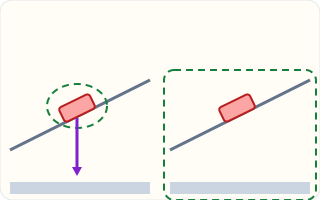
The figure shows the same sled on a slope inside two different boundaries. On the left, the boundary surrounds only the sled. Earth is outside, so gravity is an external force, and it does work on the sled as it slides down.
On the right, the boundary surrounds both the sled and Earth. Now gravity is an interaction inside the system and appears as gravitational potential energy. Both accounts give the same answer, but using both at once counts gravity twice.
When a box slides across a floor and stops, its kinetic energy does not vanish. The surfaces warm slightly: the atoms at the contact jiggle faster. That jiggling is thermal energy, and friction produces exactly $fd$ of it over a sliding distance $d$.
If both surfaces are inside the system, friction is an internal interaction, and its effect is to move energy from kinetic into thermal. The total energy of the system stays the same.
A force from outside the system changes its total energy. A person pushing a crate up a ramp does positive external work, adding energy that shows up as height and heat. A hand catching a ball does negative external work, removing energy.
Which forces are external depends on the boundary you choose. Choose it to make the account simple: include objects whose energy changes you can calculate, and leave out those whose forces you know.
If no outside force does work, the system is isolated, and its total energy is constant. The universe as a whole is the ultimate isolated system, which is why energy conservation is one of the most basic laws of physics.
Practically, a system is close to isolated when outside forces are small or do little work. A sled, the hill and Earth together are nearly isolated; the air's drag is small at low speeds, and can be included as more thermal energy.
Checking an answer. Thermal energy from friction is never negative. Gravity must appear once, either as work or as potential energy. The final kinetic energy with friction must be less than without it.
The equation follows from applying the work-energy theorem to each object and grouping the internal forces. Gravity's internal work becomes $-\Delta U$. Friction's internal work on the two surfaces together is $-fd$, which becomes $+\Delta E_{\text{th}}$.
Friction between two objects does unequal work on each, because the surfaces slide relative to one another. That is why its effect cannot be split neatly between them, and why a system containing both is the simplest choice.
The most common error in energy accounts is to include both gravity's work and gravitational potential energy. They describe the same interaction. With Earth outside the system, use gravity's work, $mgh$ for a fall. With Earth inside, use $\Delta U$.
Writing both makes a sled at the bottom of a hill appear to have twice the energy it should. A quick check: if your answer is larger than $\sqrt{2gh}$ for a sled starting from rest, gravity has almost certainly been counted twice.
Ordinary brakes turn a car's kinetic energy into thermal energy in the pads and rotors. A $1500$ kg car stopping from $30$ m/s dumps $675$ kJ of heat, enough to raise the rotors' temperature by over a hundred degrees Celsius.
Electric and hybrid cars use regenerative braking: the motor runs as a generator, turning much of the kinetic energy back into chemical energy in the battery. The energy account is the same, but the energy goes somewhere useful instead of heating the brakes.
When you know the speeds and heights at two points, any energy missing from the account went into thermal energy. Dividing by the distance traveled gives the average resistive force, without ever measuring friction or drag directly.
Engineers use this approach to measure rolling resistance and drag, by timing cars coasting down a known road. Bobsled teams use it to compare runners and sled designs, since any energy not lost to resistance becomes speed at the finish.
Your body is a system that takes in chemical energy as food and gives out work and heat. Only about a quarter of the chemical energy used by muscles becomes useful work; the rest becomes thermal energy, which is why exercise warms you.
A cyclist delivering $250$ W to the pedals is burning about $1000$ W of food energy, and shedding about $750$ W as heat through sweat and breathing. The energy account balances, but most of it ends up warming the rider and the air.
A car engine is a system that takes in chemical energy from fuel, delivers work to the wheels, and releases the rest as heat in the exhaust and radiator. Tracking every joule shows why engines are only about thirty percent efficient.
Power plants follow the same account on a larger scale. Energy from fuel or falling water crosses into the plant; electrical energy crosses out; the difference heats rivers or the air through cooling towers.
A good boundary makes the unknowns easy to see. To find a speed after sliding, include the object, the surface and Earth, so there is no external work. To find the work a person does, leave the person outside and put the rest in.
When forces act from objects you cannot model, such as a road pushing a car's tires, it often helps to leave that object outside and treat its force as external work. Every valid choice gives the same physical answer.
Air resistance works like friction in the energy account. As a ball flies or a cyclist rides, the air is pushed aside and stirred into swirls, and that motion soon becomes thermal energy of the air. With the air inside the system, drag moves energy from kinetic into thermal; with it outside, drag does negative external work.
Unlike sliding friction, drag depends on speed, so the thermal energy it produces is not simply a fixed force times a distance. The average-force method still works: any energy missing between two points, divided by the distance, gives the average resistance over that stretch.
The bobsled track at Lake Placid, New York, used for the 1980 Winter Olympics and for World Cup races, drops about $128$ m over roughly $1.5$ km. A four-man sled with its crew weighs about $630$ kg. After a pushed start at about $11$ m/s, it finishes near $40$ m/s.
Energy accounting shows where the rest of the energy went. Without resistance, the drop would add enough energy for over $50$ m/s at the finish. The difference, more than three hundred kilojoules, went into warming the ice and pushing air aside, an average resistance of over two hundred newtons. Teams spend heavily on polished runners and aerodynamic shells, since every joule saved from resistance is kept as speed, and races are won by hundredths of a second.
When a conventional car stops, its kinetic energy becomes heat in the brakes and is lost. A hybrid or electric car, such as those now common on American roads, puts its motor into reverse as a generator, turning much of that energy back into stored chemical energy in the battery.
In city driving, with frequent stops, regenerative braking can recover a large share of the braking energy and noticeably extend range. The energy ledger is the same for both cars: kinetic energy leaves the car's motion. What differs is the destination, thermal energy in brake rotors, or chemical energy ready to drive the car forward again. Friction brakes still handle hard stops, when energy arrives faster than the battery can take it.
It is easy to write gravity's work on a falling object and also its loss of potential energy, as if they were two separate effects. They are the same interaction described two ways. With Earth outside the system, use the work; with Earth inside, use the potential energy, never both.
A related error is to say friction destroys energy. It moves energy from motion into thermal energy of the surfaces. The mechanical energy falls, but the total energy does not change.
A $4.0$ kg box slides at $6.0$ m/s across a floor with $\mu_k = 0.30$. Find its kinetic energy.
$K = \tfrac{1}{2} \times 4.0 \times 6.0^2 = 72\ \text{J}$
At the start.
Find the friction force.
$f = 0.30 \times 4.0 \times 9.8 = 11.76\ \text{N}$
$\mu_k mg$.
Choose box and floor as the system.
$W_{\text{ext}} = 0$
No outside work horizontally.
Balance the account at the stop.
$0 = -72 + 11.76\, d$
Kinetic becomes thermal.
Solve for the distance.
$d = 6.12\ \text{m}$
Where it stops.
A $70$ kg skier starts from rest and descends $50$ m of height over $400$ m of slope, with $30$ N of friction and drag. Find the potential energy lost.
$mgh = 70 \times 9.8 \times 50 = 34300\ \text{J}$
Height dropped.
Find the thermal energy.
$\Delta E_{\text{th}} = 30 \times 400 = 12000\ \text{J}$
Along the slope.
Find the kinetic energy at the bottom.
$K = 34300 - 12000 = 22300\ \text{J}$
The rest.
Solve for the speed.
$v = \sqrt{\dfrac{2 \times 22300}{70}} = 25.2\ \text{m/s}$
At the bottom.
Compare with no friction.
$v = \sqrt{2 \times 9.8 \times 50} = 31.3\ \text{m/s}$
Ideal case.
Check the account.
$22300 + 12000 = 34300\ \text{J}$
Balanced.
A worker pushes a $30$ kg cart from rest up a ramp $5.0$ m long and $1.0$ m high, against $40$ N of friction. It ends at $2.0$ m/s. Choose the system.
$\text{cart} + \text{ramp} + \text{Earth}$
The worker is outside.
Find the potential energy gained.
$\Delta U = 30 \times 9.8 \times 1.0 = 294\ \text{J}$
Height gained.
Find the kinetic energy gained.
$\Delta K = \tfrac{1}{2} \times 30 \times 2.0^2 = 60\ \text{J}$
From rest.
Find the thermal energy.
$\Delta E_{\text{th}} = 40 \times 5.0 = 200\ \text{J}$
Along the ramp.
Find the worker's work.
$W = 294 + 60 + 200 = 554\ \text{J}$
Sum of changes.
Find the average push.
$F = \dfrac{554}{5.0} = 110.8\ \text{N}$
Along the ramp.
Find the fraction wasted as heat.
$\dfrac{200}{554} = 0.36$
About a third.
Write the thermal energy formula.
$\Delta E_{\text{th}} = fd$
Friction times distance.
Substitute the values.
$\Delta E_{\text{th}} = 5.0 \times 3.0$
Newtons times meters.
Evaluate the thermal energy.
A $50$ kg sled starts from rest at the top of a hill $5$ m high and reaches the bottom at $8$ m/s. With $g = 9.8$ m/s², how much thermal energy did friction produce in the sled and snow, in J?
Complete the worked solution: a $2000$ kg car moving at $15$ m/s brakes to a stop in $30$ m on a level road. Find the kinetic energy turned into heat in kJ, the average braking force in N, and the average deceleration in m/s².
Find the energy turned into heat.
$\Delta E_{\text{th}} = \tfrac{1}{2}mv^2 =$ k
All the kinetic energy.
Find the average braking force.
$F = \dfrac{\Delta E_{\text{th}}}{d} =$ f
Energy over distance.
Find the deceleration.
$a = \dfrac{F}{m} =$ a
Second law.
Note where the heat goes.
$\text{into the brake pads and rotors}$
They get hot.
A sled, the snow and Earth form one system. Match each item to how it enters the energy account.
| turns kinetic energy into thermal energy | appears as a change in potential energy | is work done on the system | its total energy stays constant | |
|---|---|---|---|---|
| friction between sled and snow | ||||
| gravity between sled and Earth | ||||
| a push from a person outside the system | ||||
| the system with no outside forces |
A $15$ kg block starts from rest and slides $6$ m down a ramp, dropping $3$ m in height against $25$ N of kinetic friction. With $g = 9.8$ m/s², fill in the change in potential energy in J, the thermal energy produced in J, and the kinetic energy at the bottom in J.
| value | |
|---|---|
| change in potential energy (J) | |
| thermal energy (J) | |
| kinetic energy at the bottom (J) |
A $4$ kg box is shoved across a level floor at $5$ m/s and slides with $\mu_k = 0.5$. With $g = 9.8$ m/s², write its kinetic energy, in J, as a function of the distance $d$ it has slid, in meters.
Answer:
Movers push a $80$ kg crate at steady speed up a ramp $3$ m long into a truck bed $1$ m high, against $150$ N of kinetic friction. With $g = 9.8$ m/s², how much work do they do, in J?
Answer: J
In a run by a four-man bobsled at Park City, Utah, the sled and crew have a total mass of $630$ kg. They start at $11$ m/s after the push, drop $104$ m over a $1335$ m track, and finish at $38$ m/s. With $g = 9.8$ m/s², what is the average resistive force from ice and air, in N?
Answer: N
Lesson test: one question per skill, one attempt each, no hints. Your answers are checked when you submit.
A $4$ kg box is shoved across a level floor at $5$ m/s and slides with $\mu_k = 0.5$. With $g = 9.8$ m/s², write its kinetic energy, in J, as a function of the distance $d$ it has slid, in meters.
Answer:
You can balance an energy account with friction. Explain to someone why gravity's work and gravitational potential energy must never both appear in the same account.
24. Your turn: a $2.0$ kg block slides $3.0$ m against $5.0$ N of friction. How much thermal energy is produced?, step 3
$\Delta E_{\text{th}} = 15\ \text{J}$
Warming the surfaces.