Back to the on-screen lesson ·
Pressure is force per area; in a liquid at rest it grows with depth as $P_0 + \rho gh$ and pushes equally in all directions.
Paper packet. Every task here also exists on screen, where it is checked automatically; answers written on paper are not assessed by Nydus. When you are back at a device, enter your answers there.
By the end of this lesson you will be able to find pressures at depth, forces on submerged surfaces, and the force a hydraulic press delivers.
You know forces, weight and density, and how to compute areas. You have felt your ears pop diving to the bottom of a pool. This lesson explains that feeling: how liquids push on everything in them, and why the push grows with depth.
| Term | What it means |
|---|---|
| Pressure | Force per unit area, $P = F/A$, in pascals. |
| Pascal | The unit of pressure: $1$ Pa $= 1$ N/m². |
| Atmospheric pressure | The air's pressure at sea level, about $101$ kPa. |
| Gauge pressure | Pressure above atmospheric, $P - P_0$. |
| Density | Mass per unit volume, $\rho$, in kg/m³. |
| Pascal's principle | A pressure change in an enclosed liquid reaches every part of it. |
Pressure is force per unit area:
$$P = \dfrac{F}{A}.$$
In a liquid at rest, pressure increases with depth because each layer supports the weight of the liquid above:
$$P = P_0 + \rho gh.$$
Another way: picture
Picture a tall stack of books. The bottom book carries the weight of every book above it, so it is squeezed hardest. Water behaves the same way: the deeper layer carries more water above it, so the pressure there is greater, and you feel it in your ears at the bottom of a pool.
Another way: steps
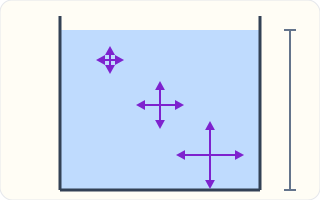
The figure shows three points in a tank of water, each deeper than the last. At each point, four equal arrows push up, down, left and right: the pressure acts equally in every direction.
The arrows get longer with depth. Near the surface the pressure is small; halfway down it is larger; near the bottom it is largest. The pressure grows steadily, in proportion to the depth, because each layer carries more water above it.
Imagine a column of water of cross-sectional area $A$ and height $h$. Its volume is $Ah$, its mass $\rho Ah$, and its weight $\rho Ahg$. Spread over the area $A$, that weight gives a pressure $\rho gh$ at the bottom of the column.
The formula does not depend on the width or shape of the container. A narrow pipe and a wide lake of the same depth have the same pressure at the bottom, a result called the hydrostatic paradox.
The air above a lake presses on its surface with about $101$ kPa, one atmosphere. That pressure is passed down through the water, so the absolute pressure at depth is $P_0 + \rho gh$.
Tire gauges and many instruments read gauge pressure, the amount above atmospheric. A tire at $220$ kPa gauge actually holds air at about $321$ kPa absolute. Every ten meters of water adds about one atmosphere.
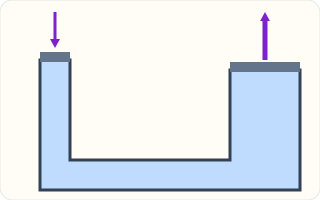
The figure shows a U-shaped vessel with a narrow piston on the left and a wide piston on the right. Pushing down on the narrow piston raises the pressure in the liquid, and by Pascal's principle that same pressure acts on the wide piston.
Because force is pressure times area, the wide piston receives a much larger force. With four times the diameter, it has sixteen times the area and receives sixteen times the force. Car lifts and brakes use this principle.
A hydraulic press multiplies force but not energy. When the small piston moves down, it pushes a volume of liquid into the large cylinder, which rises by only a small distance. Equal volumes mean the small piston moves much farther.
The work in, force times distance on the small piston, equals the work out on the large piston, apart from friction. The press trades distance for force, just like a lever.
Checking an answer. Every ten meters of water adds about $100$ kPa. Pressure must grow with depth. Areas in cm² must be converted to m² before dividing.
In a liquid at rest, every small parcel is in equilibrium. The forces on its sides must balance, so the pressure is the same in every horizontal direction. The force on its bottom must exceed that on its top by its weight, which is why pressure grows with depth.
Liquids are nearly incompressible, so their density stays the same with depth, and pressure grows in a straight line. In a gas, density changes with pressure, and the relation is more complicated.
Your blood pressure is a gauge pressure, measured in millimeters of mercury. A typical reading of $120$ over $80$ means the pressure in your arteries swings between about $16$ and $11$ kPa above atmospheric with each heartbeat.
Blood pressure is higher in your feet than in your head when you stand, because of the column of blood between them. That is why it is measured on the upper arm, at about heart level.
Divers breathe air at the same pressure as the water around them. At thirty meters, that is four atmospheres, and extra nitrogen dissolves into the blood. Rising too quickly lets the nitrogen form bubbles, causing decompression sickness.
Divers ascend slowly and make safety stops so the gas can leave the body gradually. Even snorkelers feel pressure in their ears within a meter or two of the surface.
A dam must resist the water's pressure, which grows with depth. That is why dams are much thicker at the bottom than at the top. Hoover Dam is about $200$ m thick at its base and only about $14$ m at its crest.
The force on a dam depends on the water's depth, not on how far back the reservoir stretches. A narrow canyon lake and a vast reservoir of the same depth push equally hard on each square meter of the dam.
Towns across the United States store water in elevated tanks. The height of the water above a home's faucet sets the pressure there, $\rho gh$. A tank thirty meters above the street gives about $300$ kPa, enough to push water up into second-floor showers.
Pumps fill the tanks at night, when demand is low. During the day, gravity alone keeps the pressure steady, and the town has a reserve for fighting fires.
A car's brake pedal pushes a small piston in the master cylinder. The pressure travels through brake fluid to larger pistons at each wheel, which squeeze the brake pads. A modest push on the pedal becomes a large clamping force.
Air bubbles in the brake lines ruin this, because air compresses instead of transmitting pressure. Mechanics bleed the brakes to remove air, restoring a firm pedal.
Pressure is measured in pascals, newtons per square meter. Weather reports in the United States often use inches of mercury; tire gauges use pounds per square inch, psi. One atmosphere is about $101$ kPa, $14.7$ psi, or $29.9$ inches of mercury.
A car tire at $32$ psi holds about $220$ kPa gauge. Converting between units is a common source of errors, so writing the unit on every number is a good habit.
A few benchmarks help. Standing on a floor, a person exerts about $20$ kPa through their shoes; high heels concentrate the same weight into far more. The bottom of a swimming pool's deep end adds about $40$ kPa to the atmosphere. The deepest ocean trench adds over a thousand atmospheres.
Comparing an answer with such benchmarks quickly shows whether a conversion was missed.
The Georgia Aquarium in Atlanta and the Monterey Bay Aquarium in California display ocean life behind enormous acrylic windows, some many meters across. The seawater presses on each window with a force of hundreds of thousands of newtons, growing with the window's depth and area.
Engineers compute the average pressure at the window's center, $\rho gh$, and multiply by its area to find the force, then size the acrylic to withstand it with a large safety margin. Deeper windows need thicker panels, often over thirty centimeters. Air pushes equally on both sides, so only the water's gauge pressure matters, and the shape of the tank behind the window makes no difference.
Crater Lake in Oregon, formed when a volcano collapsed, is the deepest lake in the United States, reaching nearly six hundred meters. At its bottom, the water pressure is nearly sixty times atmospheric pressure. Lake Tahoe and Lake Superior are nearly as deep.
Scientists studying these lakes send down instruments and robotic vehicles built to withstand such pressures. The hulls of deep submersibles are thick, often spherical, because a sphere spreads the pressure most evenly. The same calculation, $\rho gh$, tells engineers how strong every seal, window and hatch must be at the depth they intend to reach.
Because pressure comes from the weight of the water above, it is tempting to think it pushes only downward. But at any point in a still liquid, it pushes equally in every direction: up, down and sideways. That is why the sides of a pool feel the water's push and why a submerged ball is squeezed from all sides.
A related error is to think pressure depends on the amount of water, so a big lake pushes harder than a narrow tank of the same depth. Pressure depends only on depth and density.
A swimming pool's deep end is $4.0$ m deep. Find the gauge pressure at the bottom.
$P_g = 1000 \times 9.8 \times 4.0 = 39200\ \text{Pa}$
$\rho gh$.
Convert to kilopascals.
$P_g = 39.2\ \text{kPa}$
Divide by a thousand.
Find the absolute pressure.
$P = 101 + 39.2 = 140.2\ \text{kPa}$
Add the atmosphere.
Find the force on a $0.5$ m² drain cover.
$F = 39200 \times 0.5 = 19600\ \text{N}$
Gauge pressure times area.
Explain why drains need safety covers.
$\text{the suction force is huge}$
Federal law now requires them.
A hydraulic lift has pistons of $10$ cm² and $1000$ cm². A $150$ N push acts on the small one. Convert the small area.
$A_1 = 10 \times 10^{-4} = 0.001\ \text{m}^2$
Square meters.
Find the pressure.
$P = \dfrac{150}{0.001} = 150000\ \text{Pa}$
Force over area.
Find the large piston's force.
$F_2 = 150000 \times 0.1 = 15000\ \text{N}$
A hundred times larger.
Find the mass it can lift.
$m = \dfrac{15000}{9.8} = 1530\ \text{kg}$
A small car.
Find how far the small piston moves to lift the car $0.10$ m.
$d_1 = 0.10 \times 100 = 10\ \text{m}$
Many strokes of a pump.
Check the work.
$150 \times 10 = 15000 \times 0.10$
Both $1500$ J.
Water stands $50$ m deep behind a dam. Find the gauge pressure at the bottom.
$P = 1000 \times 9.8 \times 50 = 490000\ \text{Pa}$
Nearly five atmospheres.
Find the pressure halfway down.
$P = 245000\ \text{Pa}$
Half the depth.
Find the average pressure on the dam's face.
$\bar{P} = 245000\ \text{Pa}$
Grows steadily with depth.
The dam is $200$ m wide. Find the face's area.
$A = 50 \times 200 = 10000\ \text{m}^2$
Depth times width.
Find the total force.
$F = 245000 \times 10000 = 2.45 \times 10^9\ \text{N}$
Billions of newtons.
Explain the dam's shape.
$\text{thickest at the bottom}$
Pressure is greatest there.
Find the force if the reservoir were twice as long.
$\text{unchanged}$
Only depth matters.
Write the formula.
$P_g = \rho gh$
Hydrostatic pressure.
Substitute the values.
$P_g = 1000 \times 9.8 \times 15$
SI units.
Evaluate the pressure.
A diver swims $5$ m below the surface of a freshwater lake, where the air pressure at the surface is $101$ kPa. With $g = 9.8$ m/s² and $\rho = 1000$ kg/m³, what is the total pressure on the diver, in kPa?
Complete the worked solution: a research submarine sits $150$ m deep in seawater of density $1025$ kg/m³, with air at $101$ kPa inside. Its hatch has an area of $0.5$ m². With $g = 9.8$ m/s², find the gauge pressure outside in kPa, the absolute pressure outside in kPa, and the net force on the hatch in kN.
Find the gauge pressure.
$P_g = \rho gh =$ g
Water above the hatch.
Find the absolute pressure.
$P = P_g + 101 =$ b
Add the atmosphere.
Find the net force on the hatch.
$F = P_gA =$ f
Outside minus inside.
Explain why hatches open only at the surface.
$\text{the force is far too large}$
No crew could push it.
Match each idea to its statement.
| force divided by the area it acts on | the pressure above atmospheric pressure | a change in pressure reaches every part of an enclosed liquid | pushes equally in every direction | |
|---|---|---|---|---|
| pressure | ||||
| gauge pressure | ||||
| Pascal's principle | ||||
| pressure at a point in still water |
In a hydraulic lift, a $300$ N force pushes a small piston of area $20$ cm², and a large piston has area $800$ cm². Fill in the pressure in the oil in kPa, the force on the large piston in N, and how far the small piston must move, in cm, to raise the large one $3$ cm.
| value | |
|---|---|
| pressure (kPa) | |
| force on the large piston (N) | |
| small piston's travel (cm) |
At the surface of the Great Salt Lake in Utah, the air pressure is $87000$ Pa and the liquid has a density of $1170$ kg/m³. With $g = 9.8$ m/s², write the absolute pressure, in Pa, as a function of the depth $h$ in meters.
Answer:
A large aquarium has a viewing window of area $20$ m² whose center is $4$ m below the water surface. The seawater has density $1025$ kg/m³, and air presses on both sides. With $g = 9.8$ m/s², what net force does the water exert on the window, in kN?
Answer: kN
Crater Lake in Oregon reaches a depth of about $594$ m. With fresh water of density $1000$ kg/m³ and $g = 9.8$ m/s², what is the gauge pressure at that depth, in kPa?
Answer: kPa
Lesson test: one question per skill, one attempt each, no hints. Your answers are checked when you submit.
At the surface of the Great Salt Lake in Utah, the air pressure is $87000$ Pa and the liquid has a density of $1170$ kg/m³. With $g = 9.8$ m/s², write the absolute pressure, in Pa, as a function of the depth $h$ in meters.
Answer:
You can compute pressure in fluids. Explain to someone why a dam is thicker at the bottom than at the top.
25. Your turn: what is the gauge pressure $15$ m below the surface of fresh water?, step 3
$P_g = 147000\ \text{Pa} = 147\ \text{kPa}$
About one and a half atmospheres.