Back to the on-screen lesson ·
Drawing every force on one object from its source, choosing axes, and splitting weight into components along and into a slope.
Paper packet. Every task here also exists on screen, where it is checked automatically; answers written on paper are not assessed by Nydus. When you are back at a device, enter your answers there.
By the end of this lesson you will be able to draw free-body diagrams and find the components of forces on slopes and ropes.
From Physics with numbers you know that forces are pushes and pulls with directions, and that a net force causes acceleration along a line. From the kinematics lessons you know how to split vectors into components. This lesson draws all the forces on an object and splits them along convenient directions.
| Term | What it means |
|---|---|
| Free-body diagram | A sketch of one object with every force on it drawn as an arrow from it. |
| Weight | $W = mg$, Earth's gravitational pull, straight down. |
| Normal force | A surface's push, perpendicular to the surface. |
| Friction | A surface's push along it, opposing sliding or attempted sliding. |
| Tension | A rope's or cable's pull, along its length. |
| Components | Parts of a force along chosen axes, such as along and across a slope. |
To predict how an object moves, isolate it and draw a free-body diagram: the object as a dot or box, and every force acting on it as an arrow from it. Each force must have a source: weight from Earth, a normal force and friction from a surface it touches, tension from a rope.
Then choose axes that make the problem simple, often along and across a slope, and split any force that does not lie along them. On a slope of angle $\theta$, the weight splits into
$$mg\sin\theta \text{ down the slope}, \qquad mg\cos\theta \text{ into the slope}.$$
The normal force balances the part into the slope; friction and other forces act along it.
Another way: picture
Picture a tug-of-war with several teams pulling on one knot in different directions. To predict which way the knot moves, you list every team, the direction it pulls and how hard, and add them up. A free-body diagram is that list for any object, drawn so nothing is forgotten and nothing is counted twice.
Another way: steps
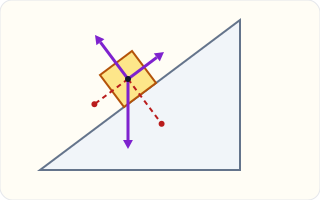
The figure shows a block resting on a slope that rises three units for every four along the ground, so the slope's sine is $0.6$ and its cosine $0.8$. Three forces act on the block: its weight straight down, the normal force perpendicular to the slope, and static friction up the slope.
The dashed lines split the weight: six tenths of it acts down along the slope, eight tenths into the slope. The normal force balances the part into the slope, and friction balances the part along it. The block stays put because each pair cancels.
A common error in free-body diagrams is drawing forces that do not exist, such as a force of motion that keeps a moving object going, or forgetting ones that do. The remedy is to name, for every arrow, what object exerts it. If you cannot name one, the force is not there.
Contact forces come only from things touching the object: the floor, a rope, a hand. The only non-contact force in everyday mechanics is gravity, from Earth. Forces the object exerts on other things belong on their diagrams, not on this one.
Any axes work, but some make the algebra easy. On a slope, tilting the axes to run along and across the slope means the normal force and friction each lie along an axis, and only the weight needs splitting. With horizontal and vertical axes, the normal force and friction would both need splitting instead.
For a crate pulled by a rope at an angle across a level floor, horizontal and vertical axes are best: only the rope's pull needs splitting, into $F\cos\theta$ along the floor and $F\sin\theta$ upward.
The normal force is not a fixed property of an object. It is whatever push the surface must supply to stop the object moving into it. On a level floor with no other vertical forces, it equals the weight. On a slope it is smaller, $mg\cos\theta$. If someone pulls the object partly upward, it shrinks further; push down on it and it grows.
Surfaces supply this push by deforming very slightly, like stiff springs. A table sags by a tiny amount under a book, and the harder it is pressed, the more it pushes back, up to the point where it breaks.
Checking an answer. Every arrow must have a named source. On a slope the normal force must be less than the weight. The components of a force must rebuild it by the Pythagorean theorem.
Forces are vectors, so they add by components. Splitting a force into parts along two perpendicular axes loses nothing: the parts together have exactly the same effect as the original force.
The slope angle reappears between the weight and the perpendicular to the slope because both are rotated from the vertical and horizontal by the same angle. That is why the downhill part uses sine and the into-slope part cosine, a fact worth checking at the extremes: a flat slope gives no downhill part, a vertical one gives the whole weight.
Static friction, like the normal force, supplies whatever is needed to prevent sliding, up to a limit. A block on a gentle slope needs only a little friction; tilt the slope and it needs more; past a certain angle, the needed friction exceeds the limit and the block slides.
That limit is $\mu_sN$, where $\mu_s$ is the coefficient of static friction for the two surfaces. For a block just on the verge of sliding, $\mu_s = \tan\theta$, a quick way to measure the coefficient: tilt a board until the block slips and read the angle.
Structural engineers draw free-body diagrams of every beam, joint and cable in a bridge or building. Each piece must be in balance under the loads it carries, and the diagrams reveal how large each force is so the pieces can be sized to carry it safely.
The same method designs everyday things: the angle of a ladder against a wall, the strength of a shelf bracket, the pull a tow strap must survive. Getting the diagram right is most of the work; the arithmetic that follows is simple.
The Americans with Disabilities Act sets the steepest slope for wheelchair ramps at one unit of rise for every twelve of run, about $4.8°$. At that angle the downhill part of the weight is only about a twelfth of the full weight, so a rider pushing a $100$ kg chair and body needs about $80$ N of push, manageable for many people.
Steeper ramps would be shorter but much harder to climb and more dangerous to descend. Long ramps must also have level landings at least every $30$ feet of run, giving riders a place to rest.
Every force on the free-body diagram of one object has a partner acting on another object: Newton's third law. The book pushes down on the table as the table pushes up on the book. The partner does not appear on the book's diagram, because it acts on the table.
Mixing up which force belongs to which diagram is a common source of error. The weight of a book and the table's normal force are not a third-law pair: both act on the book. The weight's partner is the book's gravitational pull on Earth.
A rope pulls on whatever it is attached to, along its own length, with the same tension throughout if the rope is light and runs over frictionless pulleys. A rope cannot push. In a free-body diagram, draw tension as an arrow away from the object along the rope.
Elevator cables, crane lines and tow ropes all carry tension. Engineers specify cables with safety factors of five to ten, able to carry many times the largest tension they will ever see, because a cable that snaps gives no warning.
Every new public building in the United States must be accessible, and the Americans with Disabilities Act standards set wheelchair ramps at a slope no steeper than $1$ in $12$. A free-body diagram shows why: the part of the rider's weight along the ramp is $mg\sin\theta$, and with $\sin\theta$ about $0.083$, a $100$ kg rider and chair need only about $81$ N of push to climb at steady speed.
Double the slope and the push doubles, beyond what many riders can sustain, and descending becomes dangerous. The standard also requires handrails on longer ramps and level landings every $30$ inches of rise, so a long climb is broken into manageable stages. Contractors check ramps with digital levels before an inspector signs off.
San Francisco's steepest streets, such as Filbert and 22nd Streets, reach grades of about $31$ percent, a rise of $31$ m per $100$ m, an angle of about $17°$. A parked $1500$ kg car there has a downhill pull of $mg\sin 17°$, about $4300$ N, which the parking brake and tires must hold with static friction.
The normal force on the tires is reduced to $mg\cos 17°$, about $95$ percent of the weight, which slightly lowers the maximum friction available. City law requires drivers to turn their wheels toward the curb when parking on hills, so that if the brake fails, the tires roll into the curb instead of into traffic.
It is natural to set the normal force equal to the weight in every problem. That holds only on a level surface with no other vertical forces. On a slope it is $mg\cos\theta$; with a rope pulling partly up, it is less; with someone pressing down, it is more. The normal force is whatever the surface must supply.
A related error is to draw a force of motion in the direction an object moves. Moving objects need no force to keep moving; only changes in motion need a net force, as the next lesson shows.
A $20$ kg sled rests on a snowy hill of $15°$. Find its weight.
$W = 20 \times 9.8 = 196\ \text{N}$
$mg$.
Find the part along the slope.
$196\sin 15° = 50.7\ \text{N}$
Downhill.
Find the part into the slope.
$196\cos 15° = 189.3\ \text{N}$
Balanced by the normal force.
State the normal force.
$N = 189.3\ \text{N}$
Less than the weight.
State the friction holding it.
$f = 50.7\ \text{N up the slope}$
Balances the downhill part.
A child pulls a $15$ kg wagon with $40$ N at $25°$ above horizontal. Find the horizontal part.
$F_x = 40\cos 25° = 36.3\ \text{N}$
Along the ground.
Find the vertical part.
$F_y = 40\sin 25° = 16.9\ \text{N}$
Upward.
Find the weight.
$W = 15 \times 9.8 = 147\ \text{N}$
Down.
Balance the vertical forces for the normal force.
$N = 147 - 16.9 = 130.1\ \text{N}$
Less than the weight.
Ignoring friction, find the acceleration.
$a = \dfrac{36.3}{15} = 2.42\ \text{m/s}^2$
Horizontal part only.
Compare with pulling horizontally.
$a = \dfrac{40}{15} = 2.67\ \text{m/s}^2$
More, but more friction too on a real floor.
A $4.0$ kg picture hangs from two wires, each at $30°$ above horizontal. Find the weight.
$W = 4.0 \times 9.8 = 39.2\ \text{N}$
Down.
Write the vertical balance.
$2T\sin 30° = 39.2$
Both wires lift.
Solve for the tension.
$T = \dfrac{39.2}{2 \times 0.5} = 39.2\ \text{N}$
Each wire.
Check the horizontal balance.
$T\cos 30° \text{ each way}$
They cancel.
Flatten the wires to $10°$. Find the tension.
$T = \dfrac{39.2}{2\sin 10°} = 112.9\ \text{N}$
Nearly three times more.
Explain the danger of taut wires.
$\theta \to 0: \ T \to \infty$
A straight wire cannot hold any weight.
Find the weight.
$W = 6.0 \times 9.8 = 58.8\ \text{N}$
$mg$.
Take the sine part.
$58.8\sin 20°$
Along the slope.
Evaluate the part.
A $10$ kg box rests on a ramp tilted $20°$ from horizontal. With $g = 9.8$ m/s², what is the normal force of the ramp on the box, in N?
Complete the worked solution: a $6$ kg block rests without sliding on a slope of $35°$. With $g = 9.8$ m/s², find the friction force holding it in N, the normal force in N, and the smallest coefficient of static friction that could hold it.
Balance the forces along the slope.
$f = mg\sin\theta =$ f
Friction holds it up the slope.
Balance the forces across the slope.
$N = mg\cos\theta =$ n
The ramp pushes back.
Find the least coefficient.
$\mu_s = \dfrac{f}{N} =$ u
Friction can be at most $\mu_sN$.
Note what the mass does.
$\mu_s = \tan\theta$
The mass cancels.
Match each force to its source and direction.
| Earth's pull, straight down | a surface's push, perpendicular to it | a surface's push along it, opposing sliding | a rope's pull, along the rope | |
|---|---|---|---|---|
| weight | ||||
| normal force | ||||
| friction | ||||
| tension |
A $4$ kg crate sits on a slope of $20°$. With $g = 9.8$ m/s², fill in its weight, the part of the weight along the slope, and the part into the slope, all in N.
| value | |
|---|---|
| weight (N) | |
| part along the slope (N) | |
| part into the slope (N) |
A ramp rises $1$ m for every $4$ m measured along its surface. With $g = 9.8$ m/s², write the part of an object's weight that acts down the ramp, in N, as a function of its mass $m$ in kg.
Answer:
A $10$ kg crate on a frictionless floor is pulled by a rope with a force of $50$ N, directed $30°$ above the horizontal. What is its acceleration, in m/s²?
Answer: m/s²
The Americans with Disabilities Act limits wheelchair ramps to a slope of $1$ in $12$: $1$ m of rise for every $12$ m of run. A wheelchair and rider have a combined mass of $100$ kg. Ignoring rolling friction, what push along the ramp keeps them moving up it at steady speed, in N?
Answer: N
Lesson test: one question per skill, one attempt each, no hints. Your answers are checked when you submit.
A ramp rises $4$ m for every $5$ m measured along its surface. With $g = 9.8$ m/s², write the part of an object's weight that acts down the ramp, in N, as a function of its mass $m$ in kg.
Answer:
You can draw free-body diagrams. Explain to someone why the normal force on a slope is less than the weight.
22. Your turn: a $6.0$ kg box sits on a $20°$ slope. What is the part of its weight along the slope?, step 3
$20.1\ \text{N}$
Down the slope.