Back to the on-screen lesson ·
Static friction matches a push up to a ceiling, kinetic friction has a fixed size, and drag grows with speed until it balances the weight.
Paper packet. Every task here also exists on screen, where it is checked automatically; answers written on paper are not assessed by Nydus. When you are back at a device, enter your answers there.
By the end of this lesson you will be able to decide whether an object slides, find the friction on it, and explain terminal velocity as drag balancing weight.
You can draw free-body diagrams, including the normal force, and apply $F_{\text{net}} = ma$ to one object or a connected system. This lesson gives rules for the two forces that oppose motion in everyday life: friction between surfaces and drag through air or water.
| Term | What it means |
|---|---|
| Static friction | Friction between surfaces that are not sliding; it matches the push up to $\mu_s N$. |
| Kinetic friction | Friction between sliding surfaces, of size $\mu_k N$. |
| Coefficient of friction | A number, $\mu$, describing how grippy two surfaces are. |
| Normal force | The perpendicular push of a surface, $N$. |
| Drag | A fluid's resistance to motion through it, growing with speed. |
| Terminal velocity | The steady speed at which drag balances weight. |
Friction between two surfaces comes in two kinds:
$$f_s \le \mu_s N.$$
Drag from air or water grows with speed. For everyday objects in air it is roughly $F_D = kv^2$. A falling object speeds up until drag equals its weight, then falls steadily at terminal velocity.
Another way: picture
Picture pushing a heavy dresser across a wood floor. At first it does not budge: static friction pushes back exactly as hard as you push. Push harder and it suddenly breaks free, and then it is a little easier to keep it moving, because kinetic friction is smaller than the static ceiling.
Another way: steps
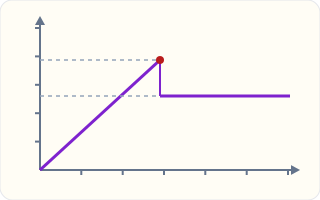
The graph shows the friction on a crate as the push on it grows from zero. At first the line climbs at forty-five degrees: friction equals the push, and the crate stays still. At the red dot the push reaches the static ceiling, $\mu_s N$. Just beyond it the crate breaks free.
Then friction drops to the kinetic value $\mu_k N$ and stays flat no matter how hard you push. Any push beyond that level now produces a net force and an acceleration. The single graph captures the whole behavior of dry friction.
Static friction is a responsive force: it takes whatever value is needed to prevent sliding, up to its limit. A book resting on a level table feels no friction at all, because nothing pushes it sideways. Tilt the table slightly, and friction appears, just enough to hold the book.
This is why the formula has a less-than-or-equal sign. Writing $f_s = \mu_s N$ for an object at rest is the most common friction mistake; it is true only at the instant the object is about to slip.
Once surfaces slide, kinetic friction has the fixed size $\mu_k N$, nearly independent of the speed and the contact area. The coefficients depend on the pair of surfaces: rubber on dry concrete has $\mu_k$ around $0.7$, steel on ice about $0.02$, and wood on wood about $0.3$.
Coefficients are measured, not derived. To find $\mu_k$, pull an object at steady speed and measure the pull: then friction equals the pull, and dividing by the normal force gives the coefficient.
Even polished surfaces are rough on a microscopic scale. They touch only at tiny high points, where atoms of the two surfaces bond briefly. Friction is the force needed to break and remake these bonds as the surfaces slide.
Pressing harder squeezes more high points into contact, which is why friction is proportional to the normal force. When sliding, the bonds have less time to form, which is one reason kinetic friction is usually lower than static.
An object moving through a fluid must push the fluid aside, and the fluid pushes back. For everyday objects in air, such as balls, cars and people, drag is roughly proportional to the square of the speed: doubling speed quadruples drag.
The constant $k$ depends on the fluid's density, the object's cross-sectional area and its shape. For very small or slow objects, such as dust in air or a bead sinking through honey, drag is instead proportional to speed itself.
When an object is dropped, drag starts at zero and the object accelerates at $g$. As it speeds up, drag grows, the net force shrinks, and the acceleration falls. Eventually drag equals the weight and the object falls steadily at terminal velocity, $v_t = \sqrt{mg/k}$.
A belly-down skydiver reaches about $55$ m/s, around $120$ miles per hour. Pulling in the arms and diving head-down shrinks $k$ and raises the terminal speed; opening a parachute enlarges $k$ enormously and brings it down to about $5$ m/s.
Checking an answer. Static friction can never exceed $\mu_s N$. Friction always opposes sliding or attempted sliding. At terminal speed the acceleration is zero, and a heavier object with the same shape has a higher terminal speed.
The friction laws are empirical models, first stated by Guillaume Amontons around 1700 and refined by Charles-Augustin de Coulomb. They hold well for dry, clean surfaces over a wide range of loads, but fail for lubricated or very soft surfaces.
The normal force, not the weight, sets friction. On level ground with no vertical push they are equal, but pushing down on a box raises the normal force and the friction, while pulling up at an angle lowers both.
Friction is not only a nuisance. Walking needs static friction: your foot pushes back on the ground and friction pushes you forward. A car's tires use static friction to accelerate, brake and turn, since the part of the tire touching the road is momentarily at rest.
Antilock brakes keep the wheels rolling rather than skidding, so the tires stay in static rather than kinetic contact with the road. Since $\mu_s$ exceeds $\mu_k$, the car can stop faster and keep steering.
A skidding car decelerates at $\mu_k g$, independent of its mass, so a truck and a compact car on the same road skid to a stop at the same rate. On wet pavement, $\mu_k$ may drop from about $0.7$ to $0.4$; on ice, to $0.1$ or less.
Stopping distance grows with the square of the speed and inversely with the coefficient. A car at $25$ m/s on ice might need over $300$ m to stop, which is why states lower speed limits and post warnings on bridges that ice over first.
Cyclists crouch low and wear smooth suits to shrink $k$, since at racing speeds most of their effort fights air drag. Car designers shape bodies to reduce drag and save fuel, and at highway speeds drag uses more than half of a car's energy.
Sometimes more drag is the goal. A parachute or the drag chute on a dragster raises $k$ to slow down quickly, and the dimples on a golf ball change how air flows around it, cutting drag so a drive can travel farther.
The same rules apply on a slope, but the normal force is $mg\cos\theta$ rather than $mg$. An object rests on an incline as long as the pull down the slope, $mg\sin\theta$, stays below $\mu_s mg\cos\theta$, which happens when $\tan\theta \le \mu_s$.
In a connected system, such as a block on a rough table pulled by a hanging mass, friction on the block is external to the system. It subtracts from the driving force, and if the hanging weight cannot overcome the static ceiling, nothing moves at all.
At drop zones such as Perris, California, jumpers leave the plane at about four thousand meters. For the first few seconds they accelerate at nearly $g$, but drag builds quickly. After about twelve seconds a belly-down jumper reaches a terminal speed of roughly $55$ m/s, and falls the rest of the way at that steady speed.
Skydivers control their speed by changing their shape. Spreading out raises the drag constant and slows the fall; tucking into a head-down dive can push the speed past $80$ m/s. In a group formation, each jumper adjusts their body to match the others' terminal speed. Opening the canopy at about fifteen hundred meters increases the drag constant a hundredfold, dropping the speed to about $5$ m/s for a gentle landing.
Traffic engineers use friction coefficients to set speed limits and design curves. The American Association of State Highway and Transportation Officials publishes design values for wet pavement, where tires grip less well, so that curves and stopping distances are safe in the rain.
Accident investigators work backward: from the length of skid marks and a measured friction coefficient, they calculate how fast a car was going when its wheels locked. A skid of $40$ m on dry asphalt with $\mu_k = 0.7$ means a speed of about $23$ m/s, roughly $52$ miles per hour. Because the mass cancels, the result is the same for a small car or a loaded pickup.
It is tempting to compute $\mu_s N$ and call it the friction on any object at rest. But $\mu_s N$ is a ceiling. A crate pushed gently feels exactly as much friction as the push, since the net force must be zero; only when the push reaches the ceiling does friction reach $\mu_s N$.
A related error is to think heavier objects fall faster because they are heavier. Without drag, all objects fall with the same acceleration. With drag, a heavier object of the same shape reaches a higher terminal speed, because it needs more drag to balance its weight.
A $50$ kg crate sits on a floor with $\mu_s = 0.5$ and $\mu_k = 0.3$. Find the normal force.
$N = 50 \times 9.8 = 490\ \text{N}$
Level floor.
Find the static ceiling.
$\mu_s N = 0.5 \times 490 = 245\ \text{N}$
Largest static friction.
A $200$ N push is applied. Test for sliding.
$200 < 245$
It does not slide.
Find the friction.
$f = 200\ \text{N}$
Matches the push.
Find the friction once a $300$ N push makes it slide.
$f = 0.3 \times 490 = 147\ \text{N}$
Kinetic value.
A student pulls a $2.0$ kg block at steady speed with a spring scale reading $5.9$ N. Find the net force.
$F_{\text{net}} = 0$
Steady speed.
Relate friction to the pull.
$f = 5.9\ \text{N}$
They balance.
Find the normal force.
$N = 2.0 \times 9.8 = 19.6\ \text{N}$
Level surface.
Find the coefficient.
$\mu_k = \dfrac{5.9}{19.6} = 0.30$
Friction over normal force.
Predict the pull with a $1.0$ kg mass added.
$f = 0.30 \times 29.4 = 8.8\ \text{N}$
Friction grows with $N$.
Predict the pull with the block on its side.
$f \approx 5.9\ \text{N}$
Area barely matters.
A $72$ kg skydiver has a drag constant of $0.25$ kg/m. Find the weight.
$mg = 72 \times 9.8 = 705.6\ \text{N}$
Pointing down.
Find the acceleration at the moment of the jump.
$a = 9.8\ \text{m/s}^2$
No drag yet.
Find the drag at $30$ m/s.
$F_D = 0.25 \times 30^2 = 225\ \text{N}$
Square the speed.
Find the acceleration at $30$ m/s.
$a = \dfrac{705.6 - 225}{72} = 6.7\ \text{m/s}^2$
Smaller than $g$.
Set drag equal to weight.
$0.25 v_t^2 = 705.6$
Terminal condition.
Find the terminal speed.
$v_t = \sqrt{2822.4} = 53.1\ \text{m/s}$
About $119$ mph.
Find the parachute's effect with $k = 30$ kg/m.
$v_t = \sqrt{\dfrac{705.6}{30}} = 4.85\ \text{m/s}$
A safe landing speed.
Find the normal force.
$N = 10 \times 9.8 = 98\ \text{N}$
Level floor.
Multiply by the coefficient.
$f = 0.4 \times 98$
$f = \mu_k N$.
Evaluate the friction.
A $30$ kg crate rests on a level warehouse floor, with $\mu_s = 0.7$ and $\mu_k = 0.5$. A worker pushes it horizontally with $100$ N. How large is the friction on the crate, in N? Use $g = 9.8$ m/s².
Complete the worked solution: a car moving at $23.52$ m/s locks its wheels and skids to a stop on a level road with $\mu_k = 0.6$. With $g = 9.8$ m/s², find the deceleration in m/s², the stopping time in s, and the skid distance in m.
Find the deceleration.
$a = \mu_k g =$ a
Friction over mass.
Find the stopping time.
$t = \dfrac{v_0}{a} =$ t
Speed falls steadily.
Find the skid distance.
$d = \dfrac{v_0^2}{2a} =$ d
From $v^2 = v_0^2 - 2ad$.
Note what the mass does.
$\text{it cancels}$
Heavy and light cars skid alike.
Match each resistive force or idea to its description.
| matches the push, up to a ceiling of $\mu_s N$ | has the fixed size $\mu_k N$ while surfaces slide | a fluid's resistance that grows with speed | the speed at which drag balances weight | |
|---|---|---|---|---|
| static friction | ||||
| kinetic friction | ||||
| drag | ||||
| terminal velocity |
A $25$ kg box slides across a level floor with $\mu_k = 0.2$ while pushed horizontally with $99$ N. With $g = 9.8$ m/s², fill in the normal force in N, the kinetic friction in N, and the acceleration in m/s².
| value | |
|---|---|
| normal force (N) | |
| kinetic friction (N) | |
| acceleration (m/s²) |
A $90$ kg skydiver falls belly-down through air that pulls back with a drag force of $0.25v^2$ newtons at speed $v$ in m/s. With down positive and $g = 9.8$ m/s², write the net force on the skydiver, in N, as a function of $v$.
Answer:
A $80$ kg crate sits unstrapped on the flat bed of a pickup truck, with $\mu_s = 0.35$ between crate and bed. What is the largest acceleration, in m/s², the truck can have without the crate sliding? Use $g = 9.8$ m/s².
Answer: m/s²
At a skydiving center in Perris, California, a belly-down instructor with a total mass of $70$ kg falls with a drag force of about $0.28v^2$ newtons. With $g = 9.8$ m/s², what is the terminal speed, in m/s?
Answer: m/s
Lesson test: one question per skill, one attempt each, no hints. Your answers are checked when you submit.
A $70$ kg skydiver falls belly-down through air that pulls back with a drag force of $0.25v^2$ newtons at speed $v$ in m/s. With down positive and $g = 9.8$ m/s², write the net force on the skydiver, in N, as a function of $v$.
Answer:
You can model static and kinetic friction and drag. Explain to someone why a crate that does not move under a gentle push has less friction on it than the maximum static friction.
23. Your turn: a $10$ kg box slides on a floor with $\mu_k = 0.4$. What is the kinetic friction on it?, step 3
$f = 39.2\ \text{N}$
Opposing the sliding.