Back to the on-screen lesson ·
Momentum is mass times velocity; the net impulse, force times time, equals the change in momentum, so a longer stop means a smaller force.
Paper packet. Every task here also exists on screen, where it is checked automatically; answers written on paper are not assessed by Nydus. When you are back at a device, enter your answers there.
By the end of this lesson you will be able to compute momentum and impulse, use force against time graphs, and apply the impulse-momentum theorem to collisions.
You can use Newton's second law, $F_{\text{net}} = ma$, and you know acceleration is the rate of change of velocity. You have also used areas under graphs, such as distance from a velocity graph. This lesson rewrites the second law in terms of momentum and time, which suits brief, violent forces like collisions.
| Term | What it means |
|---|---|
| Momentum | Mass times velocity, $\vec{p} = m\vec{v}$, a vector in kg·m/s. |
| Impulse | Force times the time it acts, $\vec{J} = \vec{F}\Delta t$, in N·s. |
| Impulse-momentum theorem | The net impulse on an object equals its change in momentum. |
| Contact time | How long a collision force acts. |
| Average force | The steady force that would give the same impulse in the same time. |
| Crumple zone | A part of a car built to crush slowly, lengthening the stopping time. |
Momentum is mass times velocity:
$$\vec{p} = m\vec{v}.$$
Newton's second law can be written as $\vec{F}_{\text{net}} = \Delta\vec{p}/\Delta t$. Multiplying by the time gives the impulse-momentum theorem:
$$\vec{F}_{\text{net}}\Delta t = \Delta\vec{p}.$$
Another way: picture
Picture catching a raw egg. Hold your hands stiff and it breaks, because it stops in a split second with a large force. Swing your hands back as you catch it and it survives: the same change in momentum spread over a longer time needs a smaller force.
Another way: steps
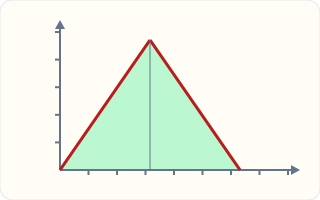
In a real collision the force is not steady. The graph shows a typical pulse: the force climbs from zero as the objects press together, peaks, and falls back to zero as they separate. The shaded area under the curve is the impulse.
For a triangular pulse, the area is half the peak force times the contact time. The average force is the steady force with the same area over the same time, here half the peak. Measuring the whole pulse is hard; finding its area from the momentum change is easy.
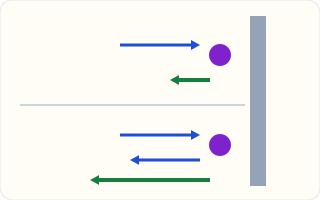
The figure compares the same ball stopping at a wall and bouncing off it. In the top picture the momentum only has to be removed. In the bottom picture it must be removed and then rebuilt in the opposite direction, so the change in momentum is larger.
If a ball arrives at $10$ m/s and leaves at $10$ m/s the other way, its velocity changes by $20$ m/s, twice as much as a dead stop. The wall must deliver twice the impulse, so bouncing is harder on the wall than stopping.
Momentum points the same way as velocity. In one dimension, choose a positive direction and give momenta signs. A $2$ kg ball moving left at $3$ m/s has momentum $-6$ kg·m/s if right is positive.
Changes in momentum must be computed with signs: final minus initial. A common slip is to subtract speeds instead of velocities, which gives the right answer only when the object keeps moving in the same direction.
Newton actually stated his second law in terms of momentum: the net force equals the rate of change of momentum, $F = \Delta p/\Delta t$. For constant mass this is the same as $F = ma$, since $\Delta p = m\Delta v$.
The momentum form is more general. It handles systems whose mass changes, such as a rocket burning fuel or a conveyor belt collecting sand, and it leads directly to the conservation of momentum in the next lesson.
When an object must be stopped, its change in momentum is fixed. The only thing you can change is the time. Doubling the stopping time halves the average force, which is why padding, cushions and flexible materials protect people and packages.
Gymnastics mats, bicycle helmets, bubble wrap and the knees you bend when landing from a jump all work this way. They do not reduce the impulse; they spread it over a longer time and so lower the peak force.
Coaches tell batters, golfers and tennis players to follow through. Keeping the bat or racket in contact with the ball longer increases the contact time, so the same force delivers a larger impulse and the ball leaves faster.
Contact times are tiny: about a millisecond for a baseball bat, half a millisecond for a golf club. Forces during contact reach thousands of newtons, far more than the ball's weight, which is why gravity can be ignored during the hit.
Checking an answer. The average force points along $\Delta p$. A bounce needs more impulse than a stop. Contact times of milliseconds give forces far larger than weights; if your collision force is only a few newtons, check the units.
The impulse-momentum theorem is Newton's second law multiplied by time. For a changing force, the impulse is the area under the force against time graph, found by adding up small pieces $F\Delta t$, just as distance is the area under a velocity graph.
Only the net force changes momentum. During a brief collision, the collision force is so much larger than gravity or friction that these can be neglected, and the collision force alone is taken as the net force.
In a crash, a car may stop in a tenth of a second, but an unbelted occupant keeps moving until hitting the dashboard or windshield, stopping in perhaps a hundredth of a second. The force would be ten times larger.
Seatbelts and airbags stretch the occupant's stopping time to match the car's and spread the force over the chest and head. Federal safety standards require frontal airbags in every new car and light truck sold in the United States.
Modern cars are designed to crush in a controlled way at the front and rear. The crumple zone lengthens the time the car takes to stop in a collision, lowering the force on the passenger compartment, which is built to stay rigid.
The National Highway Traffic Safety Administration crash-tests new cars by driving them into a rigid barrier at $35$ mph. Sensors in crash-test dummies record the force pulses, and the results appear as star ratings on window stickers.
Momentum is measured in kg·m/s and impulse in N·s. These are the same unit, since a newton is a kg·m/s². Checking that both sides of an equation carry the same unit is a quick way to catch errors.
Contact times are often given in milliseconds and masses in grams. Converting both to SI units before calculating avoids errors of a factor of a thousand, the most common mistake in impulse problems.
A rocket gains momentum by pushing exhaust gas backward. Each second, the engine gives a mass of gas a large backward momentum, and by the third law the rocket gains equal forward momentum. The thrust is the rate of momentum change of the exhaust.
A Falcon 9 first stage burns about $2500$ kg of propellant per second, ejected at about $3$ km/s, giving a thrust of roughly $7.5$ MN, matching the liftoff thrust met in the lesson on Newton's laws.
The National Highway Traffic Safety Administration's New Car Assessment Program crashes new models into a rigid barrier at $35$ mph, about $15.6$ m/s. The car's whole momentum is removed in roughly a tenth of a second, as its front end crumples by more than half a meter.
For a $1600$ kg sedan, that is an average force near $280$ kN, but spread over the crumple zone rather than delivered to the passenger compartment. Instrumented dummies record the force pulses on the head, chest and legs. Engineers tune the crumple zones to make the stopping time as long as possible within the space available, since every extra hundredth of a second lowers the peak force the occupants feel. The results become the star ratings shown on every new car's window sticker.
In American football, a collision between players can bring a helmeted head from several meters per second to rest in a few thousandths of a second. The helmet's shell spreads the force, and its foam or air-cell liner compresses to lengthen the stopping time.
The National Football League and Virginia Tech test helmets by dropping and striking them with instrumented head forms, measuring the acceleration pulse. A liner that doubles the stopping time halves the average force and acceleration of the head, reducing the risk of concussion. Helmet ratings based on these tests have pushed manufacturers toward thicker, softer liners, a direct application of the impulse-momentum theorem to player safety.
It seems natural that a ball that bounces off a wall has had less done to it than one that stops dead, since it keeps moving. But momentum is a vector. The bouncing ball's momentum must be canceled and then rebuilt in the opposite direction, so its change is larger and the wall pushes harder.
A related error is to think a softer landing means less impulse. The impulse is fixed by the change in momentum; padding lowers the force by lengthening the time, not by reducing the impulse.
A catcher stops a $0.145$ kg baseball moving at $40$ m/s. Find its momentum.
$p = 0.145 \times 40 = 5.8\ \text{kg·m/s}$
Toward the catcher.
Find the change in momentum.
$\Delta p = 0 - 5.8 = -5.8\ \text{kg·m/s}$
It stops.
The mitt stops it in $0.010$ s. Find the average force.
$F = \dfrac{5.8}{0.010} = 580\ \text{N}$
Size of the force.
Find the force with a stiff mitt, $0.002$ s.
$F = \dfrac{5.8}{0.002} = 2900\ \text{N}$
Five times larger.
Explain why catchers pull their hands back.
$\text{longer } \Delta t,\ \text{smaller } F$
Same impulse.
A $0.50$ kg ball hits a wall at $8.0$ m/s and bounces back at $6.0$ m/s. Choose away from the wall as positive.
$v_i = -8.0,\ v_f = +6.0$
Signs for direction.
Find the initial momentum.
$p_i = 0.50 \times (-8.0) = -4.0\ \text{kg·m/s}$
Toward the wall.
Find the final momentum.
$p_f = 0.50 \times 6.0 = 3.0\ \text{kg·m/s}$
Away from the wall.
Find the change in momentum.
$\Delta p = 3.0 - (-4.0) = 7.0\ \text{kg·m/s}$
Larger than either.
The contact lasts $0.020$ s. Find the average force.
$F = \dfrac{7.0}{0.020} = 350\ \text{N}$
Away from the wall.
Compare with a dead stop.
$F = \dfrac{4.0}{0.020} = 200\ \text{N}$
Bouncing needs more.
A foot's force on a $0.45$ kg soccer ball rises to $1800$ N and falls to zero as a triangle over $0.010$ s. Find the impulse.
$J = \tfrac{1}{2} \times 1800 \times 0.010 = 9.0\ \text{N·s}$
The triangle's area.
Relate impulse to momentum.
$\Delta p = 9.0\ \text{kg·m/s}$
Impulse-momentum theorem.
The ball starts at rest. Find its final speed.
$v = \dfrac{9.0}{0.45} = 20\ \text{m/s}$
Momentum over mass.
Find the average force.
$\bar{F} = \dfrac{9.0}{0.010} = 900\ \text{N}$
Half the peak.
Compare with the ball's weight.
$\dfrac{900}{0.45 \times 9.8} = 204$
Weight is negligible.
Find the speed with a $0.015$ s contact at the same peak.
$v = \dfrac{\tfrac{1}{2} \times 1800 \times 0.015}{0.45} = 30\ \text{m/s}$
Longer contact, faster ball.
Find the ball's kinetic energy.
$K = \tfrac{1}{2} \times 0.45 \times 20^2 = 90\ \text{J}$
At $20$ m/s.
Write the impulse formula.
$J = F\Delta t$
Steady force.
Substitute the values.
$J = 12 \times 3.0$
Newtons times seconds.
Evaluate the impulse.
When a racket hits a ball, the contact force rises steadily from zero to a peak of $800$ N and falls steadily back to zero over $25$ ms. What impulse does the racket give the ball, in N·s?
Complete the worked solution: a $0.145$ kg baseball arrives at $35$ m/s and leaves straight back at $45$ m/s after $0.001$ s of contact. Find the size of its change in momentum in kg·m/s, the average force in N, and the peak force in N if the force rises and falls as a triangle.
Find the change in momentum.
$\Delta p = m(v_{\text{in}} + v_{\text{out}}) =$ p
Reversal adds the speeds.
Find the average force.
$\bar{F} = \dfrac{\Delta p}{\Delta t} =$ f
Impulse over time.
Find the peak force.
$F_{\max} = 2\bar{F} =$ g
A triangle's average is half its peak.
Compare with the ball's weight.
$F \gg mg$
Gravity is negligible during contact.
Match each term to what it equals.
| mass times velocity | force times the time it acts | the change in momentum | the impulse of that force | |
|---|---|---|---|---|
| momentum | ||||
| the impulse of a steady force | ||||
| the net impulse on an object | ||||
| the area under a force against time graph |
A $0.15$ kg ball hits a wall at $20$ m/s and bounces straight back at $15$ m/s after $0.005$ s of contact. Fill in the size of its change in momentum in kg·m/s, the wall's average force in N, and the size of the change in momentum had it stopped dead, in kg·m/s.
| value | |
|---|---|
| change in momentum (kg·m/s) | |
| average force (N) | |
| change if it stopped (kg·m/s) |
A $0.5$ kg cart rolls along a frictionless track at $8$ m/s when a steady $1.5$ N push along its motion begins. Write its momentum, in kg·m/s, as a function of the time $t$ in seconds since the push began.
Answer:
In a crash, a $80$ kg driver moving at $12$ m/s is brought to rest by a seatbelt and airbag over $0.08$ s. What average force acts on the driver, in N?
Answer: N
In a federal frontal crash test at $35$ mph, $15.6$ m/s, a full-size pickup truck of $2300$ kg hits a rigid barrier and stops as its front crumples over $0.11$ s. What average force does the barrier exert on the vehicle, in kN?
Answer: kN
Lesson test: one question per skill, one attempt each, no hints. Your answers are checked when you submit.
A $0.5$ kg cart rolls along a frictionless track at $8$ m/s when a steady $1.5$ N push along its motion begins. Write its momentum, in kg·m/s, as a function of the time $t$ in seconds since the push began.
Answer:
You can apply the impulse-momentum theorem. Explain to someone why an airbag reduces the force on a driver without reducing the change in momentum.
23. Your turn: a steady $12$ N force acts on a cart for $3.0$ s. What impulse does it deliver?, step 3
$J = 36\ \text{N·s}$
Along the force.