Back to the on-screen lesson ·
With no net outside force, a system's total momentum stays constant; parts share it in collisions and carry equal and opposite momenta when they push apart.
Paper packet. Every task here also exists on screen, where it is checked automatically; answers written on paper are not assessed by Nydus. When you are back at a device, enter your answers there.
By the end of this lesson you will be able to use conservation of momentum to find velocities after collisions, couplings and explosions.
You know momentum, $p = mv$, and the impulse-momentum theorem, $F\Delta t = \Delta p$. You also know that forces come in third-law pairs, equal and opposite, acting on different objects. This lesson combines the two to show that the total momentum of an isolated system never changes.
| Term | What it means |
|---|---|
| Total momentum | The vector sum of the momenta of all objects in a system. |
| Isolated system | A system with no net external force. |
| Conservation of momentum | The total momentum of an isolated system stays constant. |
| Recoil | The backward motion of an object that pushes another forward. |
| Internal force | A force between two parts of the system. |
| Perfectly inelastic collision | A collision in which the objects stick together. |
When no net external force acts on a system, its total momentum does not change:
$$m_1\vec{v}_{1i} + m_2\vec{v}_{2i} = m_1\vec{v}_{1f} + m_2\vec{v}_{2f}.$$
Another way: picture
Picture two people on roller skates facing each other, then pushing apart. Before, neither moves: zero total momentum. After, one rolls left and the other right. The lighter person rolls faster, but their momenta are equal and opposite, so the total is still zero.
Another way: steps
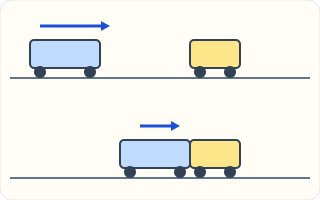
The figure shows a large cart rolling toward a smaller one at rest. After they couple, they roll together more slowly. The total momentum before, all in the large cart, equals the total momentum after, now shared by both.
Because the same momentum is spread over more mass, the shared velocity must be smaller: $v = m_1v_1/(m_1 + m_2)$. If the carts have equal masses, the speed halves; if the resting cart is much heavier, the pair barely moves.
During a collision, cart A pushes cart B and cart B pushes cart A with an equal and opposite force, for exactly the same time. The impulses are equal and opposite, so whatever momentum B gains, A loses.
The total momentum can change only through forces from outside the system. On a smooth, level track, gravity and the normal force cancel, and friction is small, so the carts form a nearly isolated system.
When a system starting at rest flies apart, its total momentum must remain zero. A rifle kicks backward when a bullet flies forward; a skater throwing a ball rolls backward; fireworks fragments fly out in all directions with momenta adding to zero.
The lighter piece always moves faster, because the momenta are equal in size: $m_1v_1 = m_2v_2$. A $50$ kg skater throwing a $2$ kg ball at $10$ m/s recoils at only $0.4$ m/s.
When objects move toward each other, their momenta have opposite signs. The total momentum is their difference, not their sum. After a sticking collision, the pair moves in the direction of the larger momentum.
If the two momenta are equal and opposite, the total is zero, and a sticking collision brings both objects to rest. This is why head-on collisions between equal cars at equal speeds are so severe: all the motion is stopped.
Momentum is a vector, so conservation holds separately along each axis. In a glancing collision on an air hockey table, the total $x$-momentum and the total $y$-momentum each stay the same.
To solve two-dimensional problems, split each momentum into components, write one conservation equation for each axis, and solve them together. Accident investigators use this to reconstruct crashes at intersections.
Checking an answer. The total momentum must be the same before and after, including signs. Objects that stick must share one velocity. Pieces flying apart from rest must move in opposite directions.
Adding the impulse-momentum theorem for every object in the system, the internal impulses cancel in third-law pairs, leaving the net external impulse equal to the change in total momentum. If the external impulse is zero, the total is constant.
Even when outside forces exist, momentum is nearly conserved during very brief collisions, because the collision forces are huge and the outside forces, such as friction or gravity, deliver little impulse in that short time.
Momentum is conserved in every collision of an isolated system. Kinetic energy is not: in a sticking collision, some is always turned into heat, sound and deformation. The next lesson sorts collisions by how much kinetic energy survives.
When two carts couple, the kinetic energy after is less than before, even though the momentum is the same. Momentum is the reliable quantity to conserve; energy needs extra information about the collision.
A rocket in empty space has nothing to push against, yet it accelerates. It pushes exhaust gas backward, and the gas pushes the rocket forward. The system of rocket plus exhaust keeps its total momentum.
This is why rockets work in a vacuum and why NASA's spacecraft can change course far from any planet. Each small thruster firing sends gas one way and nudges the spacecraft the other.
When a spacecraft docks with the International Space Station, the two become one object, a sticking collision. The station is so massive that its velocity barely changes, only a few millimeters per second, though the pilots still keep the closing speed very low.
Mission controllers plan for these nudges, and the station's thrusters or gyroscopes correct its orientation afterward. The same accounting governs when a spacecraft undocks and gently pushes away.
In American football, a tackle is a collision between two players. A $110$ kg linebacker running at $6$ m/s who wraps up a stationary receiver carries both players forward together, more slowly, with the same total momentum.
In billiards, a cue ball hitting a stationary ball head-on often stops dead while the other ball moves off at nearly the cue ball's speed, transferring almost all its momentum. Equal masses make this possible.
Momentum is conserved only for a system on which no net outside force acts. For a ball dropped to Earth, the ball alone gains momentum, but the ball plus Earth conserves it: Earth moves up, by an immeasurably small amount.
Choose a system large enough to contain every object involved in the collision. Leaving one out makes it look as if momentum appeared from nowhere or vanished.
A tidy way to organize any momentum problem is a small table with one row for each object and columns for mass, velocity before and velocity after. Filling in what is known, with signs, shows at once which entry is the unknown and what the two totals are.
The table also makes checking easy. Multiply along each row to get each momentum, add down each column to get the totals, and confirm that the before and after totals match. Most errors in collision problems come from a missing sign or a forgotten object, and the table exposes both.
Momentum conservation is exact only when the net outside force is zero, but it is useful whenever outside forces are small compared with the forces of the interaction. In a car crash lasting a tenth of a second, road friction on the tires changes the momentum far less than the crash forces do.
Over longer times the outside forces win. After two carts couple on a real track, friction slowly brings them to rest, and their momentum drains away into the ground. Apply conservation across the brief interaction itself, then use forces or energy to follow the motion afterward.
Conservation applies to any number of objects. A pool break scatters fifteen balls, yet the vector sum of their momenta just after the break equals the cue ball's momentum just before. A firework shell bursting into hundreds of pieces keeps its total momentum too.
With many objects, it is rarely practical to track each one. Instead, a later lesson introduces the center of mass, a single point whose motion carries the total momentum of the whole system and moves as if all the mass were concentrated there.
When a SpaceX Crew Dragon arrives at the International Space Station, it closes the last few meters at about ten centimeters per second, then latches on. The collision is perfectly inelastic: spacecraft and station move together afterward.
Because the station's mass, about $420{,}000$ kg, is over thirty times the capsule's, the station's velocity changes by only about three millimeters per second. Even that tiny change matters for the station's orientation, so its control gyroscopes absorb the bump. The same momentum accounting guides every docking and undocking, from Soyuz capsules to Northrop Grumman's Cygnus cargo ships, and it will apply to the Gateway station NASA plans to build in orbit around the Moon.
When two cars collide at an intersection, state highway patrol investigators can work out their speeds before the crash from where they ended up. Skid marks after the impact give the speed of the wreckage just after the collision, using friction and energy.
Conservation of momentum, applied separately north-south and east-west, then links that final velocity to the two cars' velocities before impact. If a $1500$ kg car heading north and a $2000$ kg truck heading east lock together and slide northeast, the direction of the slide reveals the ratio of their momenta. Investigators use this to decide which driver was speeding, and courts accept such reconstructions as evidence.
It is tempting to think each object keeps its own momentum, or that a slow, heavy object and a fast, light one cannot trade momentum evenly. In a collision, each object's momentum changes; only the sum stays the same. Whatever one gains, the other loses.
A second error is to forget signs. Objects moving in opposite directions have momenta of opposite sign, and adding their sizes instead of their signed values gives a total that is far too large.
A $30{,}000$ kg freight car rolling at $2.0$ m/s couples with a $20{,}000$ kg car at rest. Find the momentum before.
$p = 30000 \times 2.0 = 60000\ \text{kg·m/s}$
Only the moving car.
Find the total mass after.
$M = 30000 + 20000 = 50000\ \text{kg}$
Coupled together.
Find the shared velocity.
$v = \dfrac{60000}{50000} = 1.2\ \text{m/s}$
Conservation of momentum.
Find the kinetic energy before.
$K_i = \tfrac{1}{2} \times 30000 \times 2.0^2 = 60000\ \text{J}$
Moving car only.
Find the kinetic energy after.
$K_f = \tfrac{1}{2} \times 50000 \times 1.2^2 = 36000\ \text{J}$
Some energy is lost.
Skaters of $60$ kg and $40$ kg push apart from rest. The $60$ kg skater moves at $2.0$ m/s. Write the total before.
$p_{\text{total}} = 0$
Both at rest.
Choose the $60$ kg skater's direction as positive.
$60 \times 2.0 + 40v = 0$
Total stays zero.
Solve for the other skater's velocity.
$v = -\dfrac{120}{40} = -3.0\ \text{m/s}$
Opposite direction.
Compare the momenta.
$120 \text{ and } -120\ \text{kg·m/s}$
Equal and opposite.
Find the total kinetic energy.
$\tfrac{1}{2} \times 60 \times 2^2 + \tfrac{1}{2} \times 40 \times 3^2 = 300\ \text{J}$
Supplied by their muscles.
Check which skater got more energy.
$180\ \text{J} > 120\ \text{J}$
The lighter one.
A $1200$ kg car moving east at $20$ m/s hits a $1800$ kg truck moving west at $10$ m/s, and they lock together. Choose east as positive.
$v_1 = +20,\ v_2 = -10$
Signs for direction.
Find the car's momentum.
$p_1 = 1200 \times 20 = 24000\ \text{kg·m/s}$
East.
Find the truck's momentum.
$p_2 = 1800 \times (-10) = -18000\ \text{kg·m/s}$
West.
Find the total momentum.
$p = 24000 - 18000 = 6000\ \text{kg·m/s}$
Net east.
Find the total mass.
$M = 1200 + 1800 = 3000\ \text{kg}$
Locked together.
Find the velocity after.
$v = \dfrac{6000}{3000} = 2.0\ \text{m/s}$
East.
Find the car's change in velocity.
$\Delta v = 2.0 - 20 = -18\ \text{m/s}$
The lighter car changes most.
Find the momentum before.
$p = 2.0 \times 3.0 = 6.0\ \text{kg·m/s}$
Moving cart only.
Divide by the total mass.
$v = \dfrac{6.0}{3.0}$
Both carts together.
Evaluate the speed.
On a frictionless track, a $3$ kg cart rolling at $4$ m/s runs into a $1$ kg cart at rest, and they couple together. How fast do they move afterward, in m/s?
Complete the worked solution: two carts, $1.5$ kg and $1$ kg, sit at rest on a frictionless track with a compressed spring between them. Released, the $1.5$ kg cart moves off at $2$ m/s. Find the size of its momentum in kg·m/s, the other cart's speed in m/s, and the energy the spring released in J.
Find the first cart's momentum.
$p = m_1v_1 =$ p
Mass times speed.
Find the second cart's speed.
$v_2 = \dfrac{p}{m_2} =$ v
Equal and opposite momentum.
Find the spring's energy.
$E = \tfrac{1}{2}m_1v_1^2 + \tfrac{1}{2}m_2v_2^2 =$ e
All became kinetic energy.
Compare the two speeds.
$\text{the lighter cart moves faster}$
Same momentum, less mass.
Match each situation to what happens to the momentum of the system described.
| the total stays constant | it changes by the outside force's impulse | the total stays zero | each component is conserved separately | |
|---|---|---|---|---|
| two carts colliding on a frictionless track | ||||
| a ball falling under gravity, with the ball as the system | ||||
| a cannon and cannonball firing from rest | ||||
| two pucks in a glancing collision on an air table |
A $70$ kg skater stands at rest on smooth ice and throws a $5$ kg ball forward at $7$ m/s. With forward positive, fill in the ball's momentum in kg·m/s, the skater's momentum in kg·m/s, and the skater's recoil speed in m/s.
| value | |
|---|---|
| ball's momentum (kg·m/s) | |
| skater's momentum (kg·m/s) | |
| skater's recoil speed (m/s) |
A $76$ kg skater standing at rest on smooth ice catches a $4$ kg bag thrown horizontally toward them at speed $u$, in m/s. Write the speed of skater and bag together after the catch, in m/s, as a function of $u$.
Answer:
On a frictionless track, a $5$ kg cart moving right at $4$ m/s meets a $3$ kg cart moving left at $2$ m/s. They stick together. With right as positive, what is their velocity afterward, in m/s?
Answer: m/s
a SpaceX Crew Dragon of $12500$ kg approaches the $420{,}000$ kg International Space Station at $0.1$ m/s relative to it and latches on. By how much does the station's velocity change, in mm/s?
Answer: mm/s
Lesson test: one question per skill, one attempt each, no hints. Your answers are checked when you submit.
A $38$ kg skater standing at rest on smooth ice catches a $2$ kg bag thrown horizontally toward them at speed $u$, in m/s. Write the speed of skater and bag together after the catch, in m/s, as a function of $u$.
Answer:
You can apply conservation of momentum. Explain to someone why a skater who throws a ball forward rolls backward.
26. Your turn: a $2.0$ kg cart at $3.0$ m/s couples with a $1.0$ kg cart at rest. What is their shared speed?, step 3
$v = 2.0\ \text{m/s}$
Slower than before.