Back to the on-screen lesson ·
Inertia and the first law, $F_{\text{net}} = ma$, third-law pairs, and applying them to elevators, pushes, tows and rockets.
Paper packet. Every task here also exists on screen, where it is checked automatically; answers written on paper are not assessed by Nydus. When you are back at a device, enter your answers there.
By the end of this lesson you will be able to use Newton's laws to relate the forces on objects to their accelerations.
From the last lesson you can draw free-body diagrams and split forces into components. From the kinematics unit you know acceleration and the equations it feeds. This lesson connects the two: Newton's laws say how the forces on an object determine its acceleration.
| Term | What it means |
|---|---|
| Net force | The vector sum of all forces on an object. |
| Newton's first law | With no net force, an object keeps a constant velocity. |
| Newton's second law | $\vec{F}_{\text{net}} = m\vec{a}$. |
| Newton's third law | Forces come in equal, opposite pairs acting on two different objects. |
| Inertia | An object's resistance to changes in its motion, measured by its mass. |
| Newton | The unit of force: $1$ N $= 1$ kg·m/s². |
Newton's three laws connect forces and motion:
$$\vec{F}_{\text{net}} = m\vec{a}.$$
Motion does not need a force to continue; only changes in motion need a net force.
Another way: picture
Picture a hockey puck sliding on fresh ice. It glides almost forever, because nearly nothing pushes on it along the ice. Tap it with a stick and it changes speed or direction: a net force, briefly, causing an acceleration. The puck pushes back on the stick just as hard as the stick pushes on the puck, which the player feels as a jolt in the hands.
Another way: steps
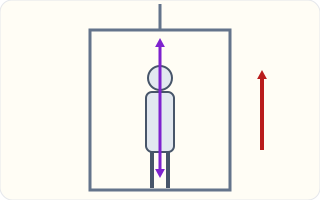
The figure shows a person in an elevator accelerating upward. Two forces act on the person: the floor's normal force up and their weight down. Because the acceleration is upward, the net force must be upward too, so the normal force is longer than the weight.
A bathroom scale on the floor would read that normal force: more than the person's weight while the elevator speeds up going up. As the elevator slows near the top, the acceleration points down and the scale reads less. At constant speed it reads exactly the weight.
Before Galileo and Newton, most people followed Aristotle in thinking that moving objects naturally slow down and stop. Newton's first law says they slow down only because forces, usually friction and air resistance, act on them. Remove those, as for a probe in deep space, and motion continues unchanged.
Inertia is the tendency to keep moving as you were. It is why passengers lurch forward when a bus brakes and why seatbelts matter: in a sudden stop, your body keeps moving at the car's old speed until something applies a force to stop it.
The second law says the acceleration is proportional to the net force and inversely proportional to the mass: double the push and the acceleration doubles; double the mass and it halves. The direction of the acceleration is always the direction of the net force, not necessarily the direction of motion.
A newton is the force that gives $1$ kg an acceleration of $1$ m/s². A medium apple weighs about one newton. Pushing a $40$ kg crate with a net force of $120$ N gives it $3$ m/s², reaching $15$ m/s in five seconds if nothing else changes.
Forces always come in pairs. When you push on a wall, the wall pushes back on you; when Earth pulls down on you, you pull up on Earth with an equal force. The two forces of a pair act on different objects, so they never cancel each other in one free-body diagram.
A rocket works by the third law: it pushes exhaust gas downward, and the gas pushes the rocket upward. Walking works the same way: your foot pushes backward on the ground, and friction from the ground pushes you forward.
Checking an answer. The net force must point the same way as the acceleration. An object at constant velocity must have zero net force. Third-law pairs must act on different objects and have equal sizes.
Newton's laws hold in inertial frames of reference: frames that are not accelerating. The ground is very nearly one for everyday motion. Inside an accelerating elevator, objects seem to feel extra forces unless the elevator's acceleration is included, which is why the analysis uses the ground's frame.
The second law applies to each axis separately, because forces and accelerations are vectors. It also applies to a whole system of objects, with only external forces counted, since internal third-law pairs cancel within the system.
Mass measures how much matter an object has and how hard it is to accelerate; it is the same everywhere. Weight is the gravitational force on it, $mg$, which depends on where it is. An astronaut with a mass of $80$ kg weighs $784$ N on Earth and $128$ N on the Moon, but is equally hard to shove sideways in both places.
In everyday speech people use pounds or kilograms for both, but physics keeps them separate. Bathroom scales measure the normal force and convert it to mass assuming Earth's gravity and no acceleration, which is why they give odd readings in elevators.
In a crash, a car stops in a fraction of a second, but its occupants keep moving by the first law until a force stops them. A seatbelt applies that force across the strong bones of the chest and hips; an airbag spreads it over the upper body and lengthens the stopping time, lowering the force.
The National Highway Traffic Safety Administration estimates that seatbelts save about fifteen thousand lives a year in the United States. Every state but New Hampshire requires adults to wear them, a law built on Newton's first.
At liftoff, a rocket's engines must produce more thrust than its weight, or it cannot rise. A Falcon 9 launching from Cape Canaveral has about $7600$ kN of thrust and a mass of about $550$ metric tons, so its net upward force gives an acceleration of about $4$ m/s².
As fuel burns, the mass drops while the thrust stays about the same, so the acceleration grows through the flight. Engineers throttle the engines near maximum aerodynamic stress, and again near the end of the burn, to keep the acceleration within what the payload and any crew can tolerate.
When several objects move together, such as a truck towing a trailer, the whole system can be treated as one object. The forces between truck and trailer are a third-law pair inside the system and cancel; only external forces, from the road and air, accelerate the system.
To find an internal force, such as the tension in the hitch, draw a free-body diagram for one part alone. That diagram includes the internal force as an external one on that part. The next lesson develops this approach for connected objects.
Everyday experience seems to contradict the first law: a pushed book slides a bit and stops. The book stops because friction from the table acts on it, a net force opposing its motion. Reduce the friction, as on an air hockey table, and the puck glides almost without slowing.
To keep a book sliding at steady speed, you must push with a force exactly equal to friction, so the net force is zero. The push does not cause the motion; it cancels the friction that would otherwise change it.
When a SpaceX Falcon 9 lifts off from Florida, its nine engines produce about $7600$ kN of thrust against a weight of about $5400$ kN. The net upward force, about $2200$ kN, acting on $549$ metric tons gives an acceleration of about $4$ m/s², less than half a $g$, so the rocket seems to climb slowly off the pad.
As the propellant burns, over two and a half minutes the first stage loses most of its mass, and with nearly the same thrust the acceleration climbs toward four $g$. Astronauts on crewed Dragon flights feel it as a steadily growing push into their seats. NASA's Saturn V, with $35{,}000$ kN of thrust and nearly $3000$ tons, left the pad at only about $2$ m/s².
The express elevators in tall American buildings, such as those in One World Trade Center in New York, reach speeds of about $10$ m/s. To keep riders comfortable, engineers limit the acceleration to about $1$ to $1.5$ m/s², so the scale reading of a passenger changes by only ten to fifteen percent.
A $70$ kg rider pressed up by $70 \times (9.8 + 1.2) = 770$ N while speeding up feels about twelve percent heavier, and about twelve percent lighter while slowing at the top. Sudden jerks, changes in acceleration, cause more discomfort than the acceleration itself, so modern controllers ramp the acceleration up and down smoothly over a second or two.
It is natural to think a moving object needs a force to keep it moving, because everyday objects slow down when we stop pushing. They slow because friction and air resistance act on them. With no net force, velocity stays constant; a force is needed only to change it.
A related error is to think the third-law pair of forces cancel, so nothing can move. They act on different objects: the horse pulls the cart and the cart pulls the horse, but each object's motion depends only on the forces acting on it.
A $65$ kg passenger rides an elevator that accelerates upward at $1.5$ m/s². Find the weight.
$mg = 65 \times 9.8 = 637\ \text{N}$
Earth's pull.
Find the normal force while speeding up.
$N = 65(9.8 + 1.5) = 734.5\ \text{N}$
Scale reads more.
At steady speed, find the normal force.
$N = 637\ \text{N}$
No acceleration.
Slowing at the top at $1.5$ m/s² downward, find the normal force.
$N = 65(9.8 - 1.5) = 539.5\ \text{N}$
Scale reads less.
Describe what the passenger feels.
$\text{heavier, normal, lighter}$
The normal force they feel changes.
Two friends push a $1000$ kg car with a total of $600$ N against $200$ N of rolling friction. Find the net force.
$F_{\text{net}} = 600 - 200 = 400\ \text{N}$
Forward.
Find the acceleration.
$a = \dfrac{400}{1000} = 0.40\ \text{m/s}^2$
Second law.
Find the speed after $10$ s.
$v = 0.40 \times 10 = 4.0\ \text{m/s}$
From rest.
They ease off to $200$ N. Find the new acceleration.
$a = 0$
Push equals friction.
Describe the motion then.
$\text{steady at } 4.0\ \text{m/s}$
First law.
Find the force the car exerts on the pushers.
$600\ \text{N backward}$
Third law.
A $0.50$ kg mass hangs from a spring scale in a car accelerating forward at $3.0$ m/s². Find the horizontal force needed.
$F_x = 0.50 \times 3.0 = 1.5\ \text{N}$
To accelerate the mass.
Find the vertical force needed.
$F_y = 0.50 \times 9.8 = 4.9\ \text{N}$
To hold it up.
Find the scale's tension.
$T = \sqrt{1.5^2 + 4.9^2} = 5.12\ \text{N}$
Pythagorean theorem.
Find the angle of the string from vertical.
$\theta = \tan^{-1}\dfrac{1.5}{4.9} = 17°$
Tilted back.
Explain the tilt.
$\text{the string must pull the mass forward}$
Net force along the acceleration.
Relate this to an accelerometer.
$a = g\tan\theta$
The angle measures acceleration.
Write the second law.
$a = \dfrac{F_{\text{net}}}{m}$
Force over mass.
Substitute the values.
$a = \dfrac{45}{15}$
Newtons over kilograms.
Evaluate the acceleration.
A $70$ kg student stands on a bathroom scale in an elevator whose acceleration is $-1.5$ m/s², with up positive. What does the scale read, in N? Use $g = 9.8$ m/s².
Complete the worked solution: a tow truck pulls a $2000$ kg car from rest with a horizontal cable, giving it an acceleration of $0.4$ m/s² against $500$ N of rolling drag. Find the net force on the car in N, the cable's tension in N, and the car's speed after $8$ s in m/s.
Find the net force.
$F_{\text{net}} = ma =$ n
Second law.
Find the tension.
$T = F_{\text{net}} + f =$ t
Tension minus drag is the net force.
Find the speed after the pull.
$v = at =$ v
From rest.
Apply the third law to the cable.
$\text{the car pulls back on the cable just as hard}$
Equal and opposite.
Match each law or idea to what it says.
| with no net force, velocity stays constant | net force equals mass times acceleration | forces come in equal, opposite pairs on two objects | a measure of how hard an object is to accelerate | |
|---|---|---|---|---|
| Newton's first law | ||||
| Newton's second law | ||||
| Newton's third law | ||||
| mass |
A worker pushes a $50$ kg crate across a warehouse floor with $320$ N, against $120$ N of kinetic friction. Starting from rest, fill in the net force in N, the acceleration in m/s², and the speed after $2.5$ s in m/s.
| value | |
|---|---|
| net force (N) | |
| acceleration (m/s²) | |
| speed after the time given (m/s) |
A $2$ kg block slides across a floor against $8$ N of kinetic friction while a horizontal force $F$, in newtons, pushes it forward. Write its acceleration, in m/s², as a function of $F$.
Answer:
Two ice skaters, $30$ kg and $60$ kg, stand face to face and push each other apart with a force of $90$ N for $0.6$ s. How fast does the $30$ kg skater move afterward, in m/s?
Answer: m/s
At liftoff from Florida, NASA's Space Launch System has a thrust of about $39100$ kN and a mass of about $2610$ metric tons. With $g = 9.8$ m/s², what is its upward acceleration just after liftoff, in m/s²?
Answer: m/s²
Lesson test: one question per skill, one attempt each, no hints. Your answers are checked when you submit.
A $4$ kg block slides across a floor against $10$ N of kinetic friction while a horizontal force $F$, in newtons, pushes it forward. Write its acceleration, in m/s², as a function of $F$.
Answer:
You can apply Newton's laws. Explain to someone why a hockey puck keeps sliding after the stick stops touching it.
22. Your turn: a net force of $45$ N acts on a $15$ kg cart. What is its acceleration?, step 3
$a = 3.0\ \text{m/s}^2$
Along the net force.