Back to the on-screen lesson ·
The simple harmonic model assumes small swings and no energy loss; large angles lengthen the period, and damping shrinks the amplitude each cycle.
Paper packet. Every task here also exists on screen, where it is checked automatically; answers written on paper are not assessed by Nydus. When you are back at a device, enter your answers there.
By the end of this lesson you will be able to judge when the simple harmonic model applies, correct a pendulum's period for large swings, and describe damping with a decay factor.
You can model springs and small-angle pendulums as simple harmonic oscillators, find their periods, and track their energy. This lesson tests the two assumptions behind that model, a force exactly proportional to displacement and no energy lost, and measures how wrong the model becomes when they fail.
| Term | What it means |
|---|---|
| Small-angle approximation | Using $\sin\theta \approx \theta$, accurate only for small angles in radians. |
| Damping | The loss of an oscillator's energy to friction and drag. |
| Decay factor | The fraction $r$ of amplitude kept each cycle. |
| Elastic limit | The stretch beyond which a spring no longer obeys Hooke's law. |
| Resonance | The growth of amplitude when pushes match the natural frequency. |
| Natural frequency | The frequency at which a system oscillates on its own. |
The simple harmonic model assumes:
Knowing when these assumptions hold tells you when the model's predictions can be trusted.
Another way: picture
Picture a child on a playground swing pulled back only a little: the swing keeps steady time, but each arc is a bit lower than the last until it stops. Pulled back very high, the swing takes noticeably longer to come back. Both effects are outside the simple model.
Another way: steps
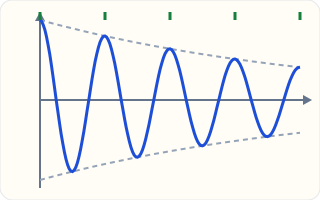
The graph shows a pendulum's position against time as air drag slowly steals its energy. Each peak is lower than the one before: every cycle keeps four fifths of the previous amplitude. The dashed curves trace the shrinking peaks.
The green tick marks at each peak are evenly spaced. Even as the swing dies away, the period stays the same. Light damping changes the amplitude but hardly touches the period, which is why a pendulum clock keeps good time even as its swing varies.
For a pendulum, the restoring force is $mg\sin\theta$. The simple model replaces $\sin\theta$ with $\theta$ in radians. At ten degrees the two differ by about half a percent; at thirty degrees, by about five percent; at sixty degrees, by about seventeen percent.
Because $\sin\theta$ is always less than $\theta$, the real restoring force is weaker than the model predicts. A weaker pull means slower motion and a longer period at large angles.
For moderate angles, the period grows roughly as $T \approx T_0(1 + \theta_0^2/16)$, with $\theta_0$ the release angle in radians. At fifteen degrees the correction is under half a percent; at sixty degrees, about seven percent.
This is why the period of a large swing depends on the amplitude, breaking the isochronism of the simple model. A clock whose pendulum is kicked into a larger swing runs slow.
Friction at the pivot and air drag on the bob remove a little energy each cycle. For light damping, each cycle keeps roughly the same fraction $r$ of the amplitude, so after $n$ cycles $A = A_0r^n$. The energy, proportional to $A^2$, keeps $r^2$ each cycle.
A swing that keeps ninety percent of its amplitude each cycle keeps eighty-one percent of its energy, and halves its amplitude in fewer than seven cycles.
Multiplying by the same factor every cycle gives exponential decay: the amplitude falls quickly at first and then more and more slowly, never quite reaching zero in the model. In practice, static friction eventually stops the motion.
The number of cycles to halve the amplitude is $\ln 0.5/\ln r$, independent of the starting amplitude. This half-life of the swing is a convenient way to describe how strongly an oscillator is damped.
Checking an answer. A large-angle period must exceed the small-angle one. A damped amplitude must shrink every cycle. The energy fraction must be smaller than the amplitude fraction.
The sine of a small angle in radians is very close to the angle itself, because the arc of a circle and its chord nearly coincide for small angles. That is the only step the simple pendulum model needs, and it fails gradually as the angle grows.
The constant fraction per cycle follows when the damping force is proportional to the velocity, as for slow motion through air or oil. Each cycle then removes the same fraction of the energy.
Hooke's law holds only for small stretches. Stretch a spring too far and its coils deform permanently, and the force no longer grows in proportion to the stretch. The spring no longer returns to its original length.
Real materials also stiffen or soften at large deformations. Rubber bands, for example, stretch easily at first and then resist strongly. Their oscillations are not simple harmonic.
A swing pushed at just the right moment each cycle builds up a large amplitude. Pushing at the oscillator's natural frequency adds energy every cycle faster than damping removes it, an effect called resonance.
Resonance can be useful, as in radio tuning and musical instruments, or dangerous. Engineers design bridges and buildings so their natural frequencies avoid the rhythms of wind, footsteps and traffic.
In 1940, the Tacoma Narrows Bridge in Washington State twisted itself apart in a moderate wind only four months after opening. The wind drove large twisting oscillations that grew until the deck collapsed.
Engineers now test bridge designs in wind tunnels and add stiffening and damping to prevent such runaway oscillations. The collapse, caught on film, is still shown in engineering and physics classes.
A car's springs alone would let it bounce for many cycles after every bump. Shock absorbers add strong damping, pushing oil through small holes so the energy becomes heat. A good suspension settles in about one cycle.
Too little damping gives a bouncy ride; too much gives a harsh one. Engineers aim for damping just below the point where the car would return without overshooting at all.
Clocks, swings and museum pendulums lose energy every cycle and need small, well-timed pushes to keep going. A pendulum clock's escapement gives the pendulum a tiny kick each swing from a falling weight or wound spring.
Museum Foucault pendulums use an electromagnet that gives the bob a nudge as it passes. The pushes replace exactly the energy lost to drag, keeping the amplitude steady.
Every model has limits, and knowing them is part of using it well. For a grandfather clock swinging a few degrees, the simple model is accurate to a fraction of a percent. For a playground swing pumped high, it can be off by ten percent.
Before trusting a prediction, check the angle and the damping. If both are small, use the simple formulas with confidence; if not, apply the corrections from this lesson.
Damping is easy to measure. Release a pendulum, and record the amplitude of each swing against a ruler or with a video camera. Dividing each amplitude by the one before gives the decay factor, which should stay roughly constant.
Adding a piece of cardboard to the bob increases air drag and lowers the decay factor. Plotting the amplitudes on a graph shows the smooth exponential decay that the model predicts.
Every physics model leaves something out. The simple harmonic model ignores friction and treats every restoring force as a perfect spring. That makes it easy to use and surprisingly accurate for small, gentle oscillations, which is why engineers reach for it first.
The skill is knowing when the leftovers matter. A good habit is to estimate the size of each neglected effect, such as the angle error or the fraction of energy lost per cycle, and keep the simple model only when those effects are smaller than the accuracy the problem needs.
The Foucault pendulums at Griffith Observatory, the Franklin Institute and the United Nations swing heavy bobs on long cables. Even so, air drag steals a little energy every swing. Left alone, such a pendulum loses about a quarter of its amplitude in an hour and would stop within a day.
To keep them going, museums use a Charron ring or an electromagnet that gives the bob a tiny push each swing, replacing exactly the energy drag removes. The swing angle is kept small, a few degrees, so the small-angle model holds and the period stays steady. The long period and heavy bob keep the damping gentle, so the pushes can be very small.
On November 7, 1940, the first Tacoma Narrows Bridge in Washington State began twisting in a steady wind. The motion grew until the deck tore apart and fell into Puget Sound. Film of the collapse is one of the most famous engineering failures in history.
The wind fed energy into a twisting oscillation faster than the structure's damping could remove it, so the amplitude grew far beyond the small-motion regime the designers expected. The replacement bridge, opened in 1950, used a deeper, stiffer deck with openings to let wind pass, and modern bridges are tested in wind tunnels to make sure their oscillations stay small and well damped.
It is tempting to use $T = 2\pi\sqrt{L/g}$ for any pendulum, however far it swings. But that formula assumes $\sin\theta \approx \theta$, which fails at large angles. At sixty degrees the true period is about seven percent longer, and the error grows quickly beyond that.
A related error is to think damping changes the period a lot. Light damping shrinks the amplitude steadily but leaves the period nearly unchanged, which is why the tick marks in the damped graph stay evenly spaced.
Convert $30°$ to radians.
$\theta = 30 \times \dfrac{\pi}{180} = 0.524\ \text{rad}$
Radians for comparison.
Find the sine.
$\sin 30° = 0.500$
Exact.
Find the percent error of the approximation.
$\dfrac{0.524 - 0.500}{0.500} = 4.7\%$
Noticeable.
Repeat at $10°$.
$\dfrac{0.1745 - 0.1736}{0.1736} = 0.5\%$
Negligible.
Repeat at $60°$.
$\dfrac{1.047 - 0.866}{0.866} = 21\%$
Large.
A $2.0$ m pendulum is released from $60°$. Find the small-angle period.
$T_0 = 2\pi\sqrt{\dfrac{2.0}{9.8}} = 2.84\ \text{s}$
Simple model.
Convert the angle.
$\theta_0 = 1.047\ \text{rad}$
Radians.
Find the correction factor.
$1 + \dfrac{1.047^2}{16} = 1.069$
Seven percent.
Find the corrected period.
$T = 2.84 \times 1.069 = 3.03\ \text{s}$
Longer.
Find the difference over an hour.
$\dfrac{3600}{2.84} - \dfrac{3600}{3.03} = 80\ \text{swings}$
Fewer swings.
Repeat for a $10°$ release.
$T = 2.84 \times 1.002 = 2.85\ \text{s}$
Hardly changed.
A swing starts with a $1.2$ m amplitude and keeps $0.85$ of it each cycle. Find the amplitude after one cycle.
$A_1 = 1.2 \times 0.85 = 1.02\ \text{m}$
Multiply once.
Find it after four cycles.
$A_4 = 1.2 \times 0.85^4 = 0.626\ \text{m}$
Multiply four times.
Find the energy fraction per cycle.
$0.85^2 = 0.7225$
Energy goes as $A^2$.
Find the energy left after four cycles.
$0.7225^4 = 0.27$
About a quarter.
Find the cycles to half amplitude.
$n = \dfrac{\ln 0.5}{\ln 0.85} = 4.3$
About four.
Find the cycles to a tenth.
$n = \dfrac{\ln 0.1}{\ln 0.85} = 14.2$
About fourteen.
Note the period.
$\text{about the same throughout}$
Light damping.
Write the rule.
$A_n = A_0r^n$
One factor per cycle.
Substitute the values.
$A_2 = 20 \times 0.9^2$
Two cycles.
Evaluate the amplitude.
A $1.2$ kg pendulum bob is pulled aside until its string makes $50°$ with the vertical. With $g = 9.8$ m/s², what is the exact restoring force along its path, in N?
Complete the worked solution: a swing left alone keeps $0.95$ of its amplitude after each cycle. Find the fraction of its energy kept each cycle, the percent of energy lost each cycle, and the number of cycles until its amplitude has halved.
Find the energy fraction kept.
$\dfrac{E_1}{E_0} = r^2 =$ e
Energy goes as $A^2$.
Find the percent lost.
$100(1 - r^2) =$ l
What leaks away.
Find the cycles to half amplitude.
$n = \dfrac{\ln 0.5}{\ln r} =$ n
Solve $r^n = 0.5$.
Note the period.
$\text{nearly unchanged}$
Light damping.
Match each departure from the simple model to its effect.
| the period grows with the amplitude | the amplitude shrinks each cycle | the force stops being proportional to the stretch | the amplitude builds up, resonance | |
|---|---|---|---|---|
| a pendulum swinging through a large angle | ||||
| friction and air drag | ||||
| a spring stretched past its elastic limit | ||||
| pushes timed to the natural frequency |
A pendulum starts swinging with an amplitude of $5$ cm, and air drag leaves it $0.7$ of its amplitude after each cycle. Fill in the amplitude after one cycle in cm, the amplitude after three cycles in cm, and the fraction of its energy kept each cycle.
| value | |
|---|---|
| amplitude after one cycle (cm) | |
| amplitude after three cycles (cm) | |
| fraction of energy kept each cycle |
A damped oscillator starts with an amplitude of $12$ cm and keeps $0.95$ of its amplitude each cycle. Write its amplitude, in cm, as a function of the number of completed cycles $n$.
Answer:
A pendulum $3$ m long is released from $50°$. Using the correction $T \approx T_0(1 + \theta_0^2/16)$, with $\theta_0$ in radians and $g = 9.8$ m/s², what is its period, in s?
Answer: s
The pendulum at the Smithsonian's Museum of American History has a period of $7.978$ s and, left unpushed, keeps $0.9994$ of its amplitude each cycle. What percent of its starting amplitude is left after one hour?
Answer: %
Lesson test: one question per skill, one attempt each, no hints. Your answers are checked when you submit.
A damped oscillator starts with an amplitude of $20$ cm and keeps $0.9$ of its amplitude each cycle. Write its amplitude, in cm, as a function of the number of completed cycles $n$.
Answer:
You can recognize the limits of the oscillation model. Explain to someone why a pendulum swung very high takes longer to swing back.
26. Your turn: a pendulum keeps $0.9$ of its amplitude each cycle, starting at $20$ cm. What is its amplitude after two cycles?, step 3
$A_2 = 16.2\ \text{cm}$
Shrinking.