Back to the on-screen lesson ·
The period of simple harmonic motion is set by the system, $2\pi\sqrt{m/k}$ or $2\pi\sqrt{L/g}$, and does not depend on the amplitude.
Paper packet. Every task here also exists on screen, where it is checked automatically; answers written on paper are not assessed by Nydus. When you are back at a device, enter your answers there.
By the end of this lesson you will be able to find periods and frequencies of springs and pendulums, and describe an oscillator's position as a function of time.
You know that a restoring force proportional to displacement, $F = -kx$, gives simple harmonic motion, and that a small-angle pendulum behaves like a spring with $k = mg/L$. This lesson finds how long each oscillation takes and how position changes in time.
| Term | What it means |
|---|---|
| Period | The time for one complete cycle, $T$, in seconds. |
| Frequency | Cycles per second, $f = 1/T$, in hertz. |
| Hertz | One cycle per second, Hz. |
| Amplitude | The largest displacement from equilibrium, $A$. |
| Angular frequency | $\omega = 2\pi f = \sqrt{k/m}$, in rad/s. |
| Isochronous | Having a period that does not depend on the amplitude. |
A simple harmonic oscillator repeats with a period fixed by its physical makeup:
$$T_{\text{spring}} = 2\pi\sqrt{\dfrac{m}{k}}, \qquad T_{\text{pendulum}} = 2\pi\sqrt{\dfrac{L}{g}}.$$
Released from rest at displacement $A$, the position follows $x = A\cos(\omega t)$ with $\omega = 2\pi/T$.
Another way: picture
Picture two children on identical swings, one pushed gently and one pushed high. You might expect the high swing to take longer, since it travels farther. But it also moves faster, and for small swings the two effects cancel exactly: both swings keep time together.
Another way: steps
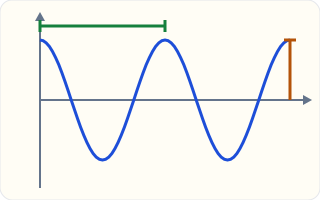
The graph shows position against time for a mass on a spring. The curve starts at its highest point, falls through the middle to its lowest point, and climbs back, repeating like a smooth wave.
The green bar from one peak to the next marks one period: the time for a full cycle. The amber bar from the time axis up to a peak marks the amplitude, measured from the middle, not from the bottom. A common error is to measure from peak to trough, which gives twice the amplitude.
A heavier mass responds more sluggishly to the same force, so it takes longer to swing. A stiffer spring pulls harder at each displacement, so it swings faster. The formula $T = 2\pi\sqrt{m/k}$ captures both.
Quadrupling the mass doubles the period; quadrupling the stiffness halves it. A car's body bouncing on its springs has a period of about one second, set by its mass and spring constants.
For a small-angle pendulum, the effective spring constant is $mg/L$. Putting it into $T = 2\pi\sqrt{m/k}$ gives $T = 2\pi\sqrt{L/g}$. The mass cancels: a heavy bob and a light one on the same string keep the same time.
A pendulum about one meter long has a period of about two seconds. Grandfather clocks use pendulums of this length, ticking once each second as the pendulum swings one way.
In simple harmonic motion, the period does not depend on the amplitude. A larger swing covers more distance, but the larger restoring force at the extremes makes it move proportionally faster, and the time comes out the same.
Galileo noticed this property, called isochronism, watching a lamp swing in the cathedral at Pisa. It is why pendulums made reliable clocks for three centuries.
Released from rest at displacement $A$, an oscillator's position is $x = A\cos(\omega t)$, where $\omega = 2\pi/T$. At $t = 0$ it is at $A$; a quarter period later it passes equilibrium; half a period later it is at $-A$.
If instead it starts at equilibrium moving outward, its position is $x = A\sin(\omega t)$. The choice of sine or cosine only reflects where the motion starts.
Checking an answer. More mass or length means a longer period. The period never depends on amplitude. Frequency and period must multiply to one.
The acceleration of a simple harmonic oscillator is $a = -\omega^2x$ with $\omega^2 = k/m$. The cosine function has exactly this property: its second derivative is $-\omega^2$ times itself. So $A\cos(\omega t)$ solves the equation of motion.
Because the equation involves only $x$ and its acceleration, scaling $x$ by any factor gives another solution with the same $\omega$. That is the mathematical reason the period does not depend on the amplitude.
Rearranging $T = 2\pi\sqrt{L/g}$ gives $g = 4\pi^2L/T^2$. Timing many swings of a pendulum of known length gives $g$ precisely. Geologists once used carefully made pendulums to map small variations in gravity across the United States.
Timing ten or twenty swings and dividing reduces the error from starting and stopping the stopwatch. A student can measure $g$ to within a percent this way with a string and a weight.
Pendulum clocks dominated timekeeping from the 1650s until the 1930s. Their accuracy depends on the pendulum's length staying fixed. Warm weather lengthens a metal rod slightly, slowing the clock, so precision clocks used special alloys or compensating designs.
Modern quartz watches use a tiny tuning fork of quartz vibrating $32{,}768$ times a second. Atomic clocks at the National Institute of Standards and Technology in Colorado use the vibrations of atoms, with periods measured in billionths of a second.
Oscillation frequencies span a vast range. A building sways once every few seconds; a hummingbird's wings beat about fifty times a second; a guitar string vibrates hundreds of times a second; the quartz in a watch, thousands.
Engineers design structures so their natural frequencies avoid the frequencies of wind, traffic or earthquakes, since matching frequencies can make oscillations grow dangerously, an effect called resonance.
Because a mass-spring system's period depends on its mass, it can measure mass where weight fails. Astronauts on the International Space Station measure their body mass by sitting in a spring-mounted chair and timing its oscillation.
Weightlessness would make an ordinary scale read zero, but inertia is unchanged in orbit, so the chair's period gives the astronaut's mass directly.
Three slips come up often. Inverting the ratio, writing $\sqrt{k/m}$ for the period, gives the angular frequency instead. Forgetting the $2\pi$ gives an answer about six times too small. Measuring amplitude peak to trough doubles it.
A quick sense check helps: a one-meter pendulum takes about two seconds per swing, and a kilogram on a household spring bounces about once or twice a second.
The formulas in this lesson assume no friction and small swings. Real pendulums slowly lose amplitude to air drag, but their period hardly changes. Large-angle swings, beyond about fifteen degrees, take noticeably longer than the formula predicts.
The last lesson of this unit looks at these limits: how quickly swings die away and how large an angle the simple model can handle before its predictions go wrong.
For a mass on a spring, the restoring force comes from the spring alone, so a heavier mass gets the same pull and responds more slowly. Its period grows with the square root of the mass.
For a pendulum, the restoring force comes from gravity, which pulls harder on a heavier bob in exact proportion to its mass. The larger force and the larger inertia cancel, so the period depends only on the length and the strength of gravity. On the Moon, where gravity is weaker, the same pendulum would swing about two and a half times more slowly.
Measuring a single period with a stopwatch is unreliable, because human reaction time adds an error of about a fifth of a second at each end. Timing ten or twenty full cycles and dividing spreads that error over many periods, making it small.
It also helps to start timing as the object passes through equilibrium, where it moves fastest and its position is easiest to judge, rather than at an extreme, where it lingers. Physics students across the country learn this trick in their first pendulum lab.
Frequencies above about twenty cycles a second can be heard as sound. A tuning fork marked A vibrates four hundred forty times a second, the pitch orchestras tune to before a concert.
Visitors to Griffith Observatory in Los Angeles, the Franklin Institute in Philadelphia and the United Nations in New York can watch a Foucault pendulum, a heavy ball on a long cable swinging slowly back and forth. Over the day, its plane of swing appears to turn, revealing Earth's rotation beneath it.
The long cables give long periods: a twelve-meter pendulum takes about seven seconds per swing, and a twenty-five-meter one about ten. The long period and heavy bob make each swing lose very little energy, so the pendulum keeps swinging for hours. The bob's mass, often over a hundred kilograms, does not affect the period at all, just as $T = 2\pi\sqrt{L/g}$ predicts.
On the International Space Station, bathroom scales are useless: everything floats. To track astronauts' health, NASA uses a body mass measurement device, a chair mounted on springs. The astronaut straps in and the chair oscillates back and forth.
The period depends on the total mass through $T = 2\pi\sqrt{m/k}$, and gravity plays no part. Measuring the period and knowing the spring constant gives the astronaut's mass to within a fraction of a kilogram. Newer systems use a linear motor to apply a known force instead, but the principle, using inertia rather than weight, is the same.
It seems natural that a pendulum pulled farther back, or a spring stretched more, takes longer to complete a cycle, since it travels farther. But it also moves faster, because the restoring force is larger. For simple harmonic motion the two effects cancel exactly, and the period is the same.
A related error is to think a heavier pendulum bob swings faster or slower. The mass cancels in $T = 2\pi\sqrt{L/g}$; only the length and gravity matter.
A $0.20$ kg mass hangs on a spring with $k = 20$ N/m. Find the ratio inside the root.
$\dfrac{m}{k} = \dfrac{0.20}{20} = 0.010\ \text{s}^2$
Mass over stiffness.
Find the period.
$T = 2\pi\sqrt{0.010} = 0.628\ \text{s}$
Under a second.
Find the frequency.
$f = \dfrac{1}{0.628} = 1.59\ \text{Hz}$
Cycles per second.
Find the period with $0.80$ kg.
$T = 2 \times 0.628 = 1.26\ \text{s}$
Four times the mass.
Find the period with twice the amplitude.
$T = 0.628\ \text{s}$
Unchanged.
A clock's pendulum should have a period of $2.00$ s. Write the length formula.
$L = \dfrac{gT^2}{4\pi^2}$
Rearranged.
Substitute the values.
$L = \dfrac{9.8 \times 2.00^2}{4\pi^2}$
SI units.
Evaluate the length.
$L = 0.993\ \text{m}$
About a meter.
Warmth lengthens it by $1.0$ mm. Find the new period.
$T = 2\pi\sqrt{\dfrac{0.994}{9.8}} = 2.001\ \text{s}$
Slightly slower.
Find the time lost per day.
$\dfrac{0.001}{2.00} \times 86400 = 43\ \text{s}$
Noticeable.
Explain the fix.
$\text{raise the bob slightly}$
Shorten the effective length.
A $0.50$ kg block on a spring with $k = 50$ N/m is pulled $0.08$ m and released. Find $\omega$.
$\omega = \sqrt{\dfrac{50}{0.50}} = 10\ \text{rad/s}$
Stiffness over mass.
Write the position function.
$x = 0.08\cos(10t)$
Released from rest.
Find the period.
$T = \dfrac{2\pi}{10} = 0.628\ \text{s}$
From $\omega$.
Find the position at $t = 0.157$ s.
$x = 0.08\cos(1.57) = 0$
A quarter period: equilibrium.
Find the position at $t = 0.314$ s.
$x = 0.08\cos(3.14) = -0.08\ \text{m}$
Half a period: the far side.
Find the largest speed.
$v_{\max} = A\omega = 0.08 \times 10 = 0.8\ \text{m/s}$
At equilibrium.
Find the largest acceleration.
$a_{\max} = A\omega^2 = 0.08 \times 100 = 8\ \text{m/s}^2$
At the extremes.
Write the formula.
$T = 2\pi\sqrt{\dfrac{L}{g}}$
Small-angle pendulum.
Substitute the values.
$T = 2\pi\sqrt{\dfrac{2.45}{9.8}} = 2\pi \times 0.5$
The root is $0.5$ s.
Evaluate the period.
A $0.4$ kg mass oscillates on a spring with $k = 90$ N/m. What is the period of its oscillation, in s?
Complete the worked solution: a $2$ kg mass oscillates on a spring with $k = 72$ N/m. Find its angular frequency in rad/s, its period in s, and its frequency in Hz.
Find the angular frequency.
$\omega = \sqrt{\dfrac{k}{m}} =$ w
Stiffness over mass.
Find the period.
$T = \dfrac{2\pi}{\omega} =$ t
One cycle is $2\pi$ radians.
Find the frequency.
$f = \dfrac{1}{T} =$ f
Cycles per second.
Note what the amplitude does.
$\text{nothing to } T$
Simple harmonic motion.
Match each term to its meaning.
| the time for one full cycle | the number of cycles each second | the largest displacement from equilibrium | $2\pi$ times the frequency | |
|---|---|---|---|---|
| period | ||||
| frequency | ||||
| amplitude | ||||
| angular frequency |
A simple pendulum is $0.5$ m long and swings through small angles. With $g = 9.8$ m/s², fill in its period in s, its frequency in Hz, and its period in s if the length is made four times as long.
| value | |
|---|---|
| period (s) | |
| frequency (Hz) | |
| period at four times the length (s) |
A $2$ kg block on a frictionless floor, attached to a spring with $k = 800$ N/m, is pulled $0.03$ m from equilibrium and released from rest at $t = 0$. Write its position, in m, as a function of the time $t$ in seconds.
Answer:
In a lab, a $2$ kg mass bouncing on a spring completes each cycle in $1.5$ s. What is the spring constant, in N/m?
Answer: N/m
The pendulum at United Nations headquarters in New York hangs on a cable about $22.9$ m long and swings through small angles. With $g = 9.8$ m/s², what is its period, in s?
Answer: s
Lesson test: one question per skill, one attempt each, no hints. Your answers are checked when you submit.
A $2$ kg block on a frictionless floor, attached to a spring with $k = 200$ N/m, is pulled $0.1$ m from equilibrium and released from rest at $t = 0$. Write its position, in m, as a function of the time $t$ in seconds.
Answer:
You can compute periods and frequencies. Explain to someone why a pendulum pulled back farther still keeps the same time.
27. Your turn: a pendulum $2.45$ m long swings through small angles. What is its period?, step 3
$T = 3.14\ \text{s}$
About three seconds.