Back to the on-screen lesson ·
Signed positions and displacements, distance, average velocity and average speed, and motion at constant velocity.
Paper packet. Every task here also exists on screen, where it is checked automatically; answers written on paper are not assessed by Nydus. When you are back at a device, enter your answers there.
By the end of this lesson you will be able to describe motion along a line with signed positions, displacements and velocities.
From Physics with numbers you know displacement as a change in position with a direction, speed as distance over time, and how to read a simple motion graph. This lesson sets up the coordinate habit the whole course runs on: pick an origin and a positive direction, and every motion along a line becomes signed numbers.
| Term | What it means |
|---|---|
| Position | $x$, where an object is, measured from a chosen origin along a chosen positive direction. |
| Displacement | $\Delta x = x_f - x_i$, signed, independent of the path. |
| Distance | The total length of path traveled, never negative. |
| Average velocity | $\bar{v} = \Delta x/\Delta t$, with a sign. |
| Average speed | Distance divided by time, never negative. |
| Constant velocity | Equal displacements in equal times: $x = x_0 + vt$. |
Along a straight line, choose an origin and a positive direction. Then an object's position $x$ is a signed number, its displacement is $\Delta x = x_f - x_i$, and its average velocity is
$$\bar{v} = \frac{\Delta x}{\Delta t},$$
positive when the object moves in the positive direction and negative when it moves the other way. Distance and speed ignore direction: distance adds up every meter traveled, and average speed is distance over time. At constant velocity, position changes linearly with time: $x = x_0 + vt$.
Another way: picture
Picture a number line painted along a hallway, with zero at a door and numbers growing toward the window. Anyone walking the hallway has a position that is a number on the line, and every step toward the window adds, every step toward the door subtracts. Velocity is how fast that number changes, and its sign tells which way.
Another way: steps
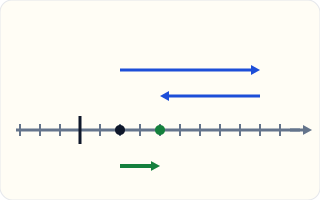
The figure shows a walker on a track marked in meters. She starts at $2$ m, walks right to $9$ m, then back left to $4$ m. The long arrow above the track is her first leg, the shorter arrow below her second, and the green arrow underneath her displacement: from $2$ m to $4$ m, just $+2$ m.
She walked $7 + 5 = 12$ m in all, her distance. If the trip took $10$ s, her average speed was $1.2$ m/s but her average velocity only $0.2$ m/s. The turnaround in the middle does not enter the displacement at all; only the start and the finish do.
Once a positive direction is chosen, a minus sign means the other way. A velocity of $-3$ m/s means three meters per second toward smaller positions. A displacement of $-5$ m means the object ended five meters on the negative side of where it began.
The choice of direction is ours, but it must be made and kept. Choose east as positive and a car driving west has negative velocity; choose west and the same car has positive velocity. The physics is the same; only the bookkeeping changes. Every later topic, from projectiles to collisions, relies on this habit.
Average velocity divides the displacement by the time; average speed divides the distance. For a trip in one direction without turning back, they have the same size. Whenever the object reverses, the distance exceeds the size of the displacement, and average speed exceeds the size of average velocity.
At the extreme, a runner who finishes a lap where she started has a displacement of zero and so an average velocity of zero, however fast she ran. Her average speed, though, might be five meters per second. The two quantities answer different questions: how far along, and how much ground covered.
An object moving at constant velocity covers equal displacements in equal times. Its position grows, or shrinks, steadily: $x = x_0 + vt$. On a graph of position against time, that is a straight line whose slope is the velocity and whose intercept is the starting position.
Real objects rarely hold a perfectly constant velocity, but many come close for a while: a car on cruise control, a walker on a moving walkway, a ship at sea. Where velocity changes, the next lesson's acceleration takes over.
Checking an answer. Average speed can never be less than the size of the average velocity. A trip ending at its start must have zero displacement. Velocities must carry a sign that matches the direction of motion.
Displacement depends only on the endpoints because it is a difference of positions; whatever happened in between cancels out. Distance, by contrast, adds up the size of every small movement, so it depends on the whole path.
Averages over a time interval smooth over what happened inside it. A car's average velocity over an hour says nothing about whether it stopped at lights. The instantaneous velocity, the slope of the position graph at one moment, is what a speedometer shows, and the next lessons use it.
When a trip has legs at different speeds, the average is not simply the mean of the speeds. Riding $600$ m at $2$ m/s and another $600$ m at $3$ m/s takes $300$ s and $200$ s: $1200$ m in $500$ s, an average of $2.4$ m/s, not $2.5$.
The slower leg lasts longer, so it counts for more of the time. This is why a stop for gas lowers a road trip's average speed so much, and why a runner who goes out too fast and then slows badly finishes with a worse average than one who holds an even pace.
Two objects moving toward each other close the gap between them at the sum of their speeds; moving the same way, the faster gains at the difference. Two cars $150$ km apart driving toward each other at $60$ and $90$ km/h meet in exactly one hour.
Air traffic controllers and railroad dispatchers use this reasoning constantly. So does anyone judging when to pull out into traffic: a car approaching at $30$ m/s from $150$ m away arrives in five seconds, whatever the driver's intentions.
Police radar and lidar guns measure a car's velocity toward or away from them. Lidar fires short laser pulses and times their echoes: the change in distance between pulses, divided by the time between them, is the velocity, the definition applied a few hundred times a second.
A phone's GPS computes velocity from positions measured each second. Its readings are noisy because each position has an error of several meters; averaging over longer times smooths the noise, which is why fitness watches report pace averaged over the last few seconds or kilometers.
Velocities are measured in meters per second in physics, but daily life in the United States uses miles per hour. One meter per second is $2.24$ mph, so a sprinter at $10$ m/s runs $22$ mph, and highway traffic at $65$ mph moves at about $29$ m/s.
Keeping units consistent within a problem is essential. Dividing kilometers by minutes gives kilometers per minute, not per hour, and mixing miles and meters produces nonsense. Converting everything to one system at the start, as scientists do, avoids most such slips.
A graph of position against time tells the whole story of motion along a line. A straight rising line means steady motion in the positive direction; a straight falling line, steady motion the other way; a flat line, standing still. The steeper the line, the faster.
The walker in the figure would draw a line rising steeply to $9$ m, then falling less steeply to $4$ m. Her average velocity is the slope of the straight line joining the first and last points, which ignores the peak in between: a picture of why displacement forgets the path.
Driving $240$ miles on an interstate at $70$ mph takes about $3.4$ hours. A single half-hour stop for gas and lunch stretches the trip to $3.9$ hours, lowering the average speed to about $61$ mph, well below the cruising speed. Stopping matters more than driving a few miles per hour faster.
Navigation apps estimate arrival times from average speeds that include typical traffic and stops on each stretch of road. Trucking companies plan routes the same way, since federal hours-of-service rules require drivers to take breaks. Driving $75$ mph instead of $70$ on a $240$-mile trip saves only about $14$ minutes, less than a single stop costs, which is one reason safety experts argue that speeding rarely pays off.
In a high school $1600$-meter race, runners complete four laps of a $400$ m track and finish where they started. A time of $5$ minutes, $300$ s, means an average speed of about $5.3$ m/s, yet the average velocity over the race is exactly zero, since the displacement is zero.
Coaches care about lap splits: a runner who runs $70$, $75$, $78$ and $77$ seconds has the same distance per lap but different average speeds in each, and the slow middle laps cost more time than the fast first lap gained. Timing systems at meets use transponder chips or cameras at the finish line, recording each crossing to the hundredth of a second and computing splits automatically.
It is natural to think average velocity is just average speed with a plus or minus sign. For any trip that turns back, they differ in size too: average velocity uses the displacement, which forgets the path, while average speed uses the whole distance. A runner who ends where she started has zero average velocity.
A related error is to average speeds by adding them and halving. The average over a trip weights each speed by the time spent at it, so the slower parts, which last longer, pull the average down.
In a gym class shuttle run, a student starts at the $0$ m line, runs to the $10$ m line, back to $0$, then to $10$ again, in $12$ s. Find the distance.
$10 + 10 + 10 = 30\ \text{m}$
Every leg counts.
Find the displacement.
$\Delta x = 10 - 0 = 10\ \text{m}$
Start and finish only.
Find the average speed.
$\dfrac{30}{12} = 2.5\ \text{m/s}$
Distance over time.
Find the average velocity.
$\dfrac{10}{12} = 0.83\ \text{m/s}$
Displacement over time.
Compare the two.
$2.5 > 0.83$
Turning back separates them.
A commuter walks $800$ m east at $1.6$ m/s, then rides a bus $6000$ m east at $12$ m/s. Find the walking time.
$t_1 = \dfrac{800}{1.6} = 500\ \text{s}$
Distance over speed.
Find the bus time.
$t_2 = \dfrac{6000}{12} = 500\ \text{s}$
Distance over speed.
Find the total displacement.
$\Delta x = 800 + 6000 = 6800\ \text{m}$
Both legs east.
Find the average velocity.
$\bar{v} = \dfrac{6800}{1000} = 6.8\ \text{m/s}$
Total displacement over total time.
Compare with the mean of the speeds.
$\dfrac{1.6 + 12}{2} = 6.8\ \text{m/s}$
Equal here only because the times match.
Add a $300$ s wait at the stop. Find the new average.
$\bar{v} = \dfrac{6800}{1300} = 5.2\ \text{m/s}$
Waiting counts as time.
Train A leaves station X at $x = 0$ heading east at $25$ m/s. Train B leaves station Y at $x = 9000$ m heading west at $20$ m/s at the same moment. Write A's position.
$x_A = 25t$
East positive.
Write B's position.
$x_B = 9000 - 20t$
Negative velocity.
Set them equal.
$25t = 9000 - 20t$
Where they pass.
Solve for the time.
$45t = 9000 \Rightarrow t = 200\ \text{s}$
Closing at $45$ m/s.
Find where they pass.
$x = 25 \times 200 = 5000\ \text{m}$
Nearer station Y.
Check with B.
$9000 - 20 \times 200 = 5000\ \text{m}$
Consistent.
Find the displacement.
$\Delta x = -5 - 3 = -8\ \text{m}$
Final minus initial.
Divide by the time.
$\bar{v} = \dfrac{-8}{4}$
Displacement over time.
Evaluate the velocity.
A walker starts at $x = 0$ m, walks to $x = 12$ m, then turns and walks to $x = 3$ m, all in $15$ s. What is her average velocity, in m/s?
Complete the worked solution: a runner completes $2$ laps of a $400$ m track in $150$ s, finishing where she started. Find the distance she ran in m, her displacement in m, and her average speed in m/s.
Add up the distance.
$d = n \times 400 =$ d
Every lap counts.
Find the displacement.
$\Delta x = x_f - x_i =$ x
She finished where she started.
Find the average speed.
$\dfrac{d}{\Delta t} =$ s
Distance over time.
State the average velocity.
$\bar{v} = \dfrac{\Delta x}{\Delta t}$
Zero, however fast she ran.
Match each quantity to its meaning.
| total length of the path traveled, never negative | final position minus initial position, with sign | distance divided by elapsed time | displacement divided by elapsed time | |
|---|---|---|---|---|
| distance | ||||
| displacement | ||||
| average speed | ||||
| average velocity |
A cyclist rides $1000$ m east at $4$ m/s, then another $1000$ m east at $5$ m/s. Fill in the time for the first leg in s, the time for the second leg in s, and the average velocity for the whole ride in m/s.
| value | |
|---|---|
| first leg time (s) | |
| second leg time (s) | |
| average velocity (m/s) |
A cart is at $x = 20$ m at $t = 0$ and moves with a constant velocity of $-3$ m/s. Write its position, in meters, as a function of time $t$ in seconds.
Answer:
Two cars start $150$ km apart on a straight highway and drive toward each other at $60$ km/h and $90$ km/h. How many minutes pass before they meet?
Answer: min
A family drives $300$ miles on an interstate at a steady $75$ mph, stopping once for $45$ minutes for gas and snacks. What is their average speed for the whole trip, in mph?
Answer: mph
Lesson test: one question per skill, one attempt each, no hints. Your answers are checked when you submit.
A cart is at $x = -4$ m at $t = 0$ and moves with a constant velocity of $2.5$ m/s. Write its position, in meters, as a function of time $t$ in seconds.
Answer:
You can separate velocity from speed. Explain to someone why a runner who finishes a lap where she started has zero average velocity.
22. Your turn: a dog runs from $x = 3$ m to $x = -5$ m in $4$ s. What is its average velocity?, step 3
$\bar{v} = -2\ \text{m/s}$
Negative: toward smaller $x$.