Back to the on-screen lesson ·
Power is the rate of energy transfer, $P = W/t$ or $P = Fv$; efficiency compares the useful power out with the power in.
Paper packet. Every task here also exists on screen, where it is checked automatically; answers written on paper are not assessed by Nydus. When you are back at a device, enter your answers there.
By the end of this lesson you will be able to calculate power from work and time or from force and speed, and use efficiency to find the input power a machine needs.
You can compute work, $W = Fd\cos\theta$, and use energy conservation to track energy as it changes form. This lesson adds time: how quickly work is done, which is what separates a small motor from a large one doing the same job.
| Term | What it means |
|---|---|
| Power | The rate of doing work or transferring energy, $P = W/t$. |
| Watt | The unit of power: $1$ W $= 1$ J/s. |
| Kilowatt-hour | The energy delivered by one kilowatt for one hour, $3.6$ MJ. |
| Horsepower | An older unit of power, about $746$ W. |
| Efficiency | The fraction of input power that becomes useful output, $\eta$. |
| Instantaneous power | The power at a single moment, $P = Fv$. |
Power measures how fast energy is transferred:
$$P = \dfrac{W}{t}.$$
For a force acting along an object's motion at speed $v$, the power it delivers is
$$P = Fv.$$
Another way: picture
Picture two people carrying identical boxes up the same stairs. One jogs up in ten seconds, the other walks in thirty. Both do the same work against gravity, but the jogger's power is three times as large, which is why the jogger is breathing hard at the top.
Another way: steps
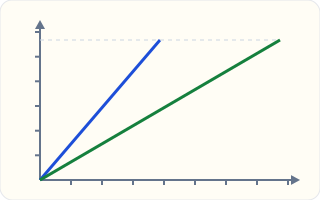
The graph shows the energy two motors transfer against time. Both lines reach the same height, so both motors do the same total work. The blue line gets there in half the time, so it is twice as steep.
The slope of an energy against time graph is the power. A steeper line means more joules per second. A straight line means steady power; a curved one means the power changes, and the slope at any point gives the power at that instant.
If a force $F$ pushes an object a distance $d$ in time $t$, the work is $Fd$ and the power is $Fd/t$. Since $d/t$ is the speed, $P = Fv$. This form is especially handy for vehicles moving steadily.
At steady speed, the engine's force equals the resistance, so the power needed is the resistance times the speed. A truck climbing a hill needs its weight's component along the slope times its speed, which is why trucks slow down on steep grades.
One watt is one joule per second. A laptop uses about $50$ W, a microwave about $1000$ W, and a car engine at full throttle about $150$ kW. Car engines in the United States are usually rated in horsepower, about $746$ W each.
Electric companies bill for energy in kilowatt-hours: one kilowatt for one hour, $3.6$ million joules. A $1000$ W space heater running for three hours uses $3$ kWh, costing about fifty cents at typical American rates.
No machine turns all its input power into useful work. A car engine turns only about a quarter to a third of its fuel's energy into motion; the rest leaves as heat through the radiator and exhaust. Electric motors do much better, often ninety percent or more.
Efficiency is $\eta = P_{\text{out}}/P_{\text{in}}$. To find the input a machine needs, divide the useful output by the efficiency. The difference, $P_{\text{in}} - P_{\text{out}}$, is wasted, usually as heat.
A healthy adult can sustain about $100$ W of useful mechanical power for hours, and trained cyclists about $300$ W. In a short sprint, a person can briefly produce over a kilowatt, but only for a few seconds.
Racing cyclists compare climbers by watts per kilogram, since climbing power must lift the rider's own mass. Tour de France winners sustain about six watts per kilogram for twenty minutes or more on the steepest mountain climbs.
Checking an answer. Input power must exceed output. Human power should be tens to hundreds of watts; cars, tens of kilowatts; power plants, hundreds of megawatts. A wrong prefix is the most common error.
$P = W/t$ is the definition of average power. $P = Fv$ follows by dividing $W = Fd$ by the time, and it holds at each instant even when the force or speed changes, as long as $v$ is the velocity along the force.
Efficiency applies because energy is conserved: the input power must go somewhere, either into the useful output or into waste heat. So efficiency can never exceed one, and claims of machines that do are always wrong.
Air drag grows roughly as the square of speed, so the power to overcome it, drag times speed, grows as the cube. Driving at $30$ m/s instead of $20$ m/s needs about three and a third times the power against drag.
The energy per mile, power over speed, grows as the square, so fuel use per mile climbs steeply at high speeds. This is why the Department of Energy notes that each five miles per hour above fifty costs noticeably more in fuel.
Every appliance in an American home has a power rating on its label. An LED bulb uses about $10$ W to give the light of an old $60$ W incandescent bulb, because it wastes far less energy as heat. A clothes dryer draws about $5000$ W, a refrigerator about $150$ W on average.
The average American home uses about $30$ kWh a day, an average power of about $1.25$ kW. Seeing appliances as power ratings, and bills as power times time, makes it clear which ones cost the most to run.
A large power plant produces around a gigawatt, a billion watts, enough for roughly a million homes on average. Nuclear, coal and natural gas plants turn heat into electricity at about thirty-three to sixty percent efficiency.
Hydroelectric plants turn the gravitational energy of falling water into electricity at about ninety percent efficiency. Wind turbines and solar panels are rated by their peak power, but average much less, because the wind and sun vary.
Average power is the total work over the total time. Instantaneous power, $Fv$ at each moment, may differ widely from it. A sprinter's power peaks near the start, when the force is large, and falls once they reach top speed.
A car accelerating from rest at constant force has power growing in proportion to its speed. That is why engines are rated by maximum power: it limits the acceleration at high speeds, not at low ones.
Energy is an amount; power is a rate. A AA battery stores about $10{,}000$ J, a small amount, but a camera flash releases a fraction of that in a millisecond, a power of thousands of watts.
A car's fuel tank stores huge energy, over a billion joules, but the engine limits how fast it can be used. Confusing the two leads to mistakes such as saying a house uses so many kilowatts a month, when it means kilowatt-hours.
A car or truck climbing a hill at steady speed must supply extra power to lift its weight. If the road rises a height h over a time t, the extra power is the weight times h divided by t, which equals the weight times the vertical part of the velocity.
A loaded tractor-trailer of about 36,000 kg climbing a grade at a vertical rate of one meter per second needs about 350 kW just for the climb, on top of what drag and rolling resistance take. That is close to the engine's full output, which is why heavy trucks crawl up long mountain grades in the right lane.
Many power questions can be checked by a quick estimate. Ask how much energy the task needs and roughly how long it takes, then divide. Boiling a liter of water needs about 300 kJ; a kettle that takes two and a half minutes must deliver about 2 kW.
If an estimate and a calculation disagree by a factor of a thousand, look for a missed prefix, such as kilowatts written as watts, or minutes left unconverted to seconds.
The Hoover Dam, on the Colorado River between Nevada and Arizona, holds back Lake Mead. Water falls up to about $180$ m through its turbines, and the plant's capacity of about two gigawatts serves over a million people in Nevada, Arizona and California.
The power comes directly from falling water: mass per second, times $g$, times the height, times the efficiency of about ninety percent. Washington's Grand Coulee Dam, on the Columbia River, is even larger, the biggest power station in the United States at nearly seven gigawatts, because far more water passes through it each second. During droughts, falling lake levels reduce the head, and so the power, which is why low water in Lake Mead worries grid operators across the Southwest.
American car buyers still compare engines in horsepower, a unit James Watt introduced to sell steam engines by comparing them with horses. A typical sedan produces about $200$ hp, about $150$ kW, at full throttle, but cruising on the interstate needs only about $15$ to $20$ kW to overcome air drag and rolling resistance.
Electric vehicles make the difference between power and energy clear. A battery of $75$ kWh stores energy; the motor's power, perhaps $250$ kW, sets how quickly it can be used. Driving at a steady $20$ kW, that battery lasts nearly four hours, about $250$ miles at highway speed. Driving faster raises the power needed as the cube of speed, which is why range drops noticeably at eighty miles per hour.
It is common to use power and energy as if they meant the same thing. A more powerful motor does not use more energy to lift a load; it lifts it faster. Two motors lifting the same load the same height do the same work, whatever their power.
A related slip is between kilowatts and kilowatt-hours. Kilowatts measure a rate, like miles per hour; kilowatt-hours measure an amount, like miles. Electric bills charge for kilowatt-hours.
A $60$ kg student runs up stairs $4.5$ m high in $3.0$ s. Find the work against gravity.
$W = 60 \times 9.8 \times 4.5 = 2646\ \text{J}$
Weight times height.
Find the average power.
$P = \dfrac{2646}{3.0} = 882\ \text{W}$
Work over time.
Convert to horsepower.
$\dfrac{882}{746} = 1.18\ \text{hp}$
More than one horse, briefly.
Find the power walking in $9.0$ s.
$P = \dfrac{2646}{9.0} = 294\ \text{W}$
Same work, triple time.
Compare the energies.
$W = 2646\ \text{J in both cases}$
Power differs, energy does not.
A car cruises at $30$ m/s against $600$ N of resistance. Find the driving force.
$F = 600\ \text{N}$
Steady speed.
Find the power at the wheels.
$P = 600 \times 30 = 18000\ \text{W}$
$P = Fv$.
The engine is $25\%$ efficient. Find the fuel power.
$P_{\text{in}} = \dfrac{18000}{0.25} = 72000\ \text{W}$
Divide by efficiency.
Find the fuel energy used in one hour.
$E = 72000 \times 3600 = 2.59 \times 10^8\ \text{J}$
Power times time.
Gasoline holds $1.2 \times 10^8$ J per gallon. Find the gallons used.
$\dfrac{2.59 \times 10^8}{1.2 \times 10^8} = 2.16\ \text{gal}$
In one hour.
Find the fuel economy.
$\dfrac{67\ \text{mi}}{2.16\ \text{gal}} = 31\ \text{mpg}$
$30$ m/s is about $67$ mph.
A crane lifts a $2000$ kg steel beam $30$ m in $40$ s. Find the work.
$W = 2000 \times 9.8 \times 30 = 588000\ \text{J}$
Against gravity.
Find the output power.
$P = \dfrac{588000}{40} = 14700\ \text{W}$
Work over time.
Find the lifting speed.
$v = \dfrac{30}{40} = 0.75\ \text{m/s}$
Steady.
Check with force times speed.
$P = 19600 \times 0.75 = 14700\ \text{W}$
The same answer.
The motor is $80\%$ efficient. Find the input power.
$P_{\text{in}} = \dfrac{14700}{0.80} = 18375\ \text{W}$
Divide by efficiency.
Find the heat produced each second.
$18375 - 14700 = 3675\ \text{W}$
Wasted power.
Find the electrical energy in kilowatt-hours.
$\dfrac{18375 \times 40}{3.6 \times 10^6} = 0.204\ \text{kWh}$
Cheap for one lift.
Write the power formula.
$P = \dfrac{W}{t}$
Work over time.
Substitute the values.
$P = \dfrac{3600}{12}$
Joules over seconds.
Evaluate the power.
A winch lifts a $50$ kg load $12$ m straight up at steady speed in $6$ s. With $g = 9.8$ m/s², what power does it deliver to the load, in W?
Complete the worked solution: a cyclist and bike with a total mass of $90$ kg climb $600$ m up a mountain road in $1800$ s. Ignoring drag and friction, and with $g = 9.8$ m/s², find the work done against gravity in kJ, the average power in W, and that power per kilogram in W/kg.
Find the work against gravity.
$W = mgh =$ w
Weight times height.
Find the average power.
$P = \dfrac{W}{t} =$ p
Work over time.
Find the power per kilogram.
$\dfrac{P}{m} =$ q
How cyclists compare climbers.
Note what was ignored.
$\text{drag and rolling resistance}$
Real riders need more.
Match each term to what it means.
| work done divided by time taken | force times velocity along it | one joule per second | useful power out divided by power in | |
|---|---|---|---|---|
| average power | ||||
| power of a force on a moving object | ||||
| one watt | ||||
| efficiency |
A car cruises at a steady $30$ m/s against $500$ N of air drag and rolling resistance. Fill in the power its wheels deliver in kW, the energy they deliver in $60$ s in kJ, and the power in horsepower, with $1$ hp $= 746$ W.
| value | |
|---|---|
| power (kW) | |
| energy delivered (kJ) | |
| power (hp) |
At highway speeds, the air drag on a car is about $0.3v^2$ newtons at speed $v$ in m/s. Write the power, in W, the engine must deliver just to overcome drag at a steady speed $v$.
Answer:
An elevator motor raises a loaded car of $800$ kg at a steady $1.5$ m/s, with no counterweight. The motor is $0.75$ efficient, as a fraction. With $g = 9.8$ m/s², what electrical power must it draw, in kW?
Answer: kW
At the Robert Moses plant at Niagara Falls, about $2800$ m³ of water per second falls through the turbines with a head of about $90$ m. If the plant is $90\%$ efficient and water has a density of $1000$ kg/m³, what electrical power does it produce, in MW?
Answer: MW
Lesson test: one question per skill, one attempt each, no hints. Your answers are checked when you submit.
At highway speeds, the air drag on a car is about $0.5v^2$ newtons at speed $v$ in m/s. Write the power, in W, the engine must deliver just to overcome drag at a steady speed $v$.
Answer:
You can calculate power and efficiency. Explain to someone why a more powerful motor lifts a load faster but does not do more work lifting it.
25. Your turn: a motor does $3600$ J of work in $12$ s. What is its average power?, step 3
$P = 300\ \text{W}$
Watts.