Back to the on-screen lesson ·
A restoring force always pulls back toward equilibrium; when it is proportional to the displacement, $F = -kx$, the motion is simple harmonic.
Paper packet. Every task here also exists on screen, where it is checked automatically; answers written on paper are not assessed by Nydus. When you are back at a device, enter your answers there.
By the end of this lesson you will be able to find spring constants, compute restoring forces and accelerations, and model a small-angle pendulum as a spring.
You can apply Newton's second law and draw free-body diagrams, and you have met the spring force and its stored energy. This lesson looks at forces that always pull an object back toward a resting position, the cause of every oscillation.
| Term | What it means |
|---|---|
| Equilibrium position | Where the net force on the object is zero. |
| Displacement | The distance and direction from equilibrium, $x$. |
| Restoring force | A force that always points back toward equilibrium. |
| Hooke's law | $F = -kx$: the spring force is proportional and opposite to the displacement. |
| Spring constant | The stiffness $k$, in N/m. |
| Simple harmonic motion | Oscillation driven by a restoring force proportional to displacement. |
An object oscillates when a restoring force always pulls it back toward equilibrium. For a spring, Hooke's law gives the force:
$$F = -kx.$$
Any system with this kind of force performs simple harmonic motion.
Another way: picture
Picture a playground swing. Pull it back and let go: gravity pulls it toward the bottom. It overshoots and rises on the other side, where gravity pulls it back again. The pull is always toward the bottom, and it is stronger the farther the swing is from it.
Another way: steps
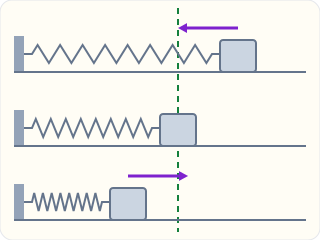
The figure shows a block on a spring at three positions. Pulled right of equilibrium, the stretched spring pulls it left. At equilibrium, the spring is its natural length and exerts no force. Pushed left, the compressed spring pushes it right.
In every case the force points back toward equilibrium, and equal displacements on either side give equal forces. That is what a restoring force means, and why the block, once released, keeps returning to the middle.
Robert Hooke found in 1676 that the stretch of a spring is proportional to the force on it. Double the load and the stretch doubles. The spring constant $k$ measures stiffness: a stiff spring has a large $k$, a soft one a small $k$.
Hooke's law holds only up to the elastic limit. Stretch a spring too far and it deforms permanently, no longer returning to its original length, and the force is no longer proportional to the stretch.
Released from a stretched position, the block accelerates toward equilibrium. When it arrives, the force is zero, but the block is moving fastest, so it overshoots. Past equilibrium, the force reverses and slows it down.
The block stops at the opposite extreme, then the force pulls it back again. Without friction this repeats forever. The restoring force never lets the block settle, because inertia carries it past the point where the force vanishes.
Combining Hooke's law with $F = ma$ gives $a = -(k/m)x$. The acceleration is proportional to the displacement and opposite to it. This relationship is the defining feature of simple harmonic motion.
At the extremes, the acceleration is largest, and the velocity is zero. At equilibrium, the acceleration is zero, and the velocity is largest. Position, velocity and acceleration are out of step with each other throughout the motion.
A mass hanging from a spring stretches it until the spring's pull balances the weight, $kx_0 = mg$. That stretched position is the new equilibrium. Pulled below or pushed above it, the mass oscillates about that point.
Gravity simply shifts the equilibrium; the oscillation around it obeys the same law, with the same $k$. So a vertical spring behaves just like a horizontal one, measured from its hanging position.
A pendulum bob pulled sideways feels the part of its weight along its path, $mg\sin\theta$, pulling it back toward the bottom. For small angles, $\sin\theta \approx \theta \approx x/L$, so the restoring force is about $mgx/L$: proportional to the displacement, just like a spring.
A small-angle pendulum therefore acts like a spring with $k = mg/L$. Longer pendulums have smaller effective spring constants and gentler restoring forces.
Checking an answer. The restoring force must point toward equilibrium. It must be zero at equilibrium. Doubling the displacement must double the force and acceleration.
Hooke's law is an empirical model. For small deformations, the atoms in a spring's metal are displaced only slightly from their natural spacing, and the forces between them respond in proportion.
Near any stable equilibrium, almost every restoring force is approximately proportional to the displacement, which is why simple harmonic motion appears everywhere in nature, from swaying buildings to vibrating molecules.
Springs appear in mattresses, pens, car suspensions, scales and trampolines. A bathroom scale measures weight by how far a spring compresses. A trampoline's springs store energy as you sink and return it as you rise.
Engineers choose spring constants to suit the job. Soft springs give a smooth ride but sway more; stiff springs give precise control but a harsher ride. Racing cars use stiff suspensions; luxury cars, soft ones.
A car's body rests on four springs, one at each wheel. Each compresses until it carries its share of the weight. A bump pushes a wheel up, compressing the spring, and the body begins to oscillate about its resting height.
Shock absorbers damp this oscillation so the car does not keep bouncing after each bump. Worn shocks let the car bounce several times, reducing tire grip and making the ride uncomfortable.
A bungee cord acts like a very long, soft spring. After the jumper falls the cord's slack length, the cord stretches and pulls back, slowing the fall and throwing the jumper upward again.
The jumper bounces about an equilibrium where the cord's pull equals their weight, until air resistance and the cord's internal friction settle them there. Operators choose cords with spring constants matched to each jumper's weight.
Two springs side by side, sharing a load, act like one stiffer spring: their constants add. Two springs end to end act like one softer spring, since each stretches under the full load.
A car's four suspension springs work side by side, so the car sinks a quarter as far as it would on a single spring. Designers use these combinations to reach the stiffness they need.
Many systems have restoring forces without any spring. A floating block pushed down feels extra buoyancy pushing it up. Air in a closed bottle, compressed by a sound wave, pushes back. A ship rolled to one side is pushed upright again.
In each case, a small displacement from equilibrium produces a force back toward it, roughly proportional to the displacement. That is enough for simple harmonic motion, and the same mathematics applies.
Not every equilibrium leads to oscillation. A ball resting at the bottom of a bowl is in stable equilibrium: nudge it and the bowl's sides push it back, so it rocks to and fro. A ball balanced on top of an upside-down bowl is in unstable equilibrium: nudge it and the forces push it farther away, so it rolls off.
Only stable equilibrium has a restoring force. When a problem describes an oscillation, the system must be sitting near the bottom of some kind of valley, where any small displacement is met by a push back toward the middle.
A simple way to find a spring constant is to hang known masses from the spring and measure the stretch for each. Plotting the weight against the stretch gives a straight line through the origin, and its slope is the spring constant.
If the points curve away from the line at large loads, the spring has passed its elastic limit, and Hooke's law no longer applies. Good lab practice keeps the loads small enough that the spring returns to its original length each time it is unloaded.
Every car and truck on American roads rides on springs, usually steel coils or leaf springs, one set at each wheel. The body settles until the springs carry its weight, a sag of several centimeters. Load the trunk and the springs compress further, in proportion to the added weight.
Engineers pick spring constants that keep the body's natural bounce slow and comfortable, about once or twice a second. Pickup trucks meant to haul heavy loads use stiffer springs, so they ride harshly when empty. Shock absorbers alongside the springs turn the bouncing energy into heat, so the car settles after one or two cycles instead of pogoing down the highway.
Once a year, on Bridge Day, jumpers leap from West Virginia's New River Gorge Bridge on bungee cords and parachutes. A bungee cord behaves like a long, soft spring. After free fall through the cord's slack length, the cord stretches and its restoring force grows until it stops the jumper and throws them back up.
The jumper bounces about the point where the cord's pull equals their weight, with each bounce smaller as energy leaks away. Operators match cord stiffness to each jumper's weight, so heavier jumpers get stiffer cords, keeping the lowest point safely above the river and the forces within what the body can take.
Because an oscillating object moves fastest as it passes through equilibrium, it is tempting to think the force is largest there. In fact the force is zero at equilibrium; the object moves fast because it was accelerated all the way in. The force is largest at the extremes, where the object momentarily stops.
A related error is to drop the minus sign in Hooke's law. The force always points back toward equilibrium, opposite to the displacement; without the sign, the object would run away instead of oscillating.
A $0.40$ kg mass stretches a spring $0.08$ m. Find the weight.
$W = 0.40 \times 9.8 = 3.92\ \text{N}$
Force of gravity.
Find the spring constant.
$k = \dfrac{3.92}{0.08} = 49\ \text{N/m}$
Force over stretch.
Predict the stretch for $0.60$ kg.
$x = \dfrac{0.60 \times 9.8}{49} = 0.12\ \text{m}$
Proportional.
Find the force at $0.05$ m past equilibrium.
$F = 49 \times 0.05 = 2.45\ \text{N}$
Extra restoring force.
Find the acceleration there with $0.40$ kg.
$a = \dfrac{2.45}{0.40} = 6.1\ \text{m/s}^2$
Toward equilibrium.
A $0.50$ kg block on a spring with $k = 200$ N/m is pulled $0.10$ m and released. Find the force.
$F = -200 \times 0.10 = -20\ \text{N}$
Toward equilibrium.
Find the acceleration at release.
$a = \dfrac{-20}{0.50} = -40\ \text{m/s}^2$
Largest here.
Find the force halfway to equilibrium.
$F = -200 \times 0.05 = -10\ \text{N}$
Half as large.
Find the force at equilibrium.
$F = 0$
No stretch.
Find the force at the far extreme.
$F = -200 \times (-0.10) = +20\ \text{N}$
Now pointing right.
Describe the speed at equilibrium.
$\text{largest}$
It overshoots.
A $0.25$ kg bob hangs on a $0.50$ m string. Find the effective spring constant.
$k = \dfrac{0.25 \times 9.8}{0.50} = 4.9\ \text{N/m}$
$mg/L$.
It is pulled $0.04$ m sideways. Find the restoring force.
$F = 4.9 \times 0.04 = 0.196\ \text{N}$
Like a spring.
Find the acceleration.
$a = \dfrac{0.196}{0.25} = 0.784\ \text{m/s}^2$
Toward the bottom.
Check with $gx/L$.
$a = \dfrac{9.8 \times 0.04}{0.50} = 0.784\ \text{m/s}^2$
The mass cancels.
Find the angle of the swing.
$\theta = \dfrac{0.04}{0.50} = 0.08\ \text{rad} = 4.6°$
Small enough.
Find the acceleration with a $1.5$ m string.
$a = \dfrac{9.8 \times 0.04}{1.5} = 0.261\ \text{m/s}^2$
A gentler pull.
Explain the effect of a heavier bob.
$\text{no change in } a$
Force and mass both grow.
Write Hooke's law.
$F = kx$
Size of the force.
Substitute the values.
$F = 150 \times 0.04$
SI units.
Evaluate the force.
Hanging a $0.8$ kg mass from a spring stretches it $0.02$ m, where the mass rests. With $g = 9.8$ m/s², what is the spring constant, in N/m?
Complete the worked solution: a $1.2$ kg pendulum bob hangs on a string $1.5$ m long and is pulled $0.12$ m sideways from its lowest point, a small swing. With $g = 9.8$ m/s², find the restoring force in N, the effective spring constant in N/m, and the bob's acceleration in m/s².
Find the restoring force.
$F = \dfrac{mgx}{L} =$ f
Part of the weight along the path.
Find the effective spring constant.
$k = \dfrac{mg}{L} =$ k
Force per unit displacement.
Find the acceleration.
$a = \dfrac{gx}{L} =$ a
The mass cancels.
Note the direction.
$\text{back toward the lowest point}$
A restoring force.
Match each idea to its statement.
| the spring force is proportional to the stretch and opposite to it | always points back toward equilibrium | where the net force is zero | acts like a spring with constant $mg/L$ | |
|---|---|---|---|---|
| Hooke's law | ||||
| a restoring force | ||||
| the equilibrium position | ||||
| a pendulum at small angles |
A $0.3$ kg block on a frictionless floor is attached to a spring with $k = 150$ N/m and pulled $0.04$ m from equilibrium. Fill in the size of the spring's force in N, its size at twice that displacement in N, and the size of the block's acceleration at the first displacement in m/s².
| value | |
|---|---|
| spring force (N) | |
| force at twice the displacement (N) | |
| acceleration (m/s²) |
A $0.5$ kg block slides on a frictionless floor, attached to a spring with $k = 200$ N/m. Taking $x$ as its displacement from equilibrium in meters, write its acceleration, in m/s², as a function of $x$.
Answer:
After the bouncing dies down, a $85$ kg bungee jumper hangs at rest from a cord that behaves like a spring with $k = 900$ N/m. With $g = 9.8$ m/s², how far is the cord stretched beyond its natural length, in m?
Answer: m
The body of a Ford F-150, about $2000$ kg, rests on four suspension springs, each with $k \approx 50000$ N/m. With $g = 9.8$ m/s² and the weight shared equally, how far are the springs compressed, in cm?
Answer: cm
Lesson test: one question per skill, one attempt each, no hints. Your answers are checked when you submit.
A $0.2$ kg block slides on a frictionless floor, attached to a spring with $k = 50$ N/m. Taking $x$ as its displacement from equilibrium in meters, write its acceleration, in m/s², as a function of $x$.
Answer:
You can model restoring forces. Explain to someone why the force on an oscillating block is zero just as it moves fastest.
26. Your turn: a spring with $k = 150$ N/m is stretched $0.04$ m. How large is its restoring force?, step 3
$F = 6.0\ \text{N}$
Toward equilibrium.