Back to the on-screen lesson ·
With no outside torque, angular momentum stays constant: less rotational inertia means faster spin, more means slower.
Paper packet. Every task here also exists on screen, where it is checked automatically; answers written on paper are not assessed by Nydus. When you are back at a device, enter your answers there.
By the end of this lesson you will be able to apply conservation of angular momentum to skaters, rides, divers and stars.
You know angular momentum, $L = I\omega$ and $mvr_\perp$, and that a net torque changes it. You have used conservation of linear momentum for collisions. This lesson applies the same idea to rotation: with no outside torque, angular momentum stays constant.
| Term | What it means |
|---|---|
| Conservation of angular momentum | With no net external torque, $L$ stays constant. |
| Isolated system | One with no net external torque about the chosen axis. |
| Tuck | A diver's or gymnast's compact position, with small rotational inertia. |
| Neutron star | The collapsed core of a massive star, spinning rapidly. |
| Pulsar | A neutron star whose beams sweep past Earth as it spins. |
| Reaction wheel | A spinning wheel used to turn a spacecraft without thrusters. |
When no net external torque acts on a system, its total angular momentum does not change:
$$I_1\omega_1 = I_2\omega_2.$$
Rotational kinetic energy is not conserved in these changes; muscles or internal forces do work.
Another way: picture
Picture sitting on a spinning office chair holding heavy books at arm's length. Pull the books in to your chest and you spin faster; push them out and you slow down. Nothing outside you pushes the chair, yet your spin rate changes, because your rotational inertia does.
Another way: steps
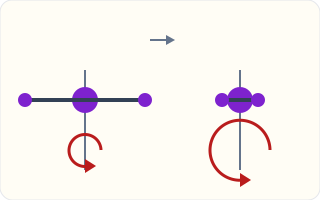
The figure shows a skater spinning with arms out, then with arms pulled in. The curved arrow, showing the spin rate, is much larger in the second view. The angular momentum is the same in both.
With arms out, the hands are far from the axis, and the rotational inertia is large. Pulling them in lowers the inertia, so the angular velocity must rise to keep the product $I\omega$ constant. Elite skaters can go from about two to over five turns per second.
Torque changes angular momentum. When a skater pulls in, the forces between arms and body are internal, and their torques cancel in pairs. The ice exerts almost no torque about the vertical axis, since friction on the skate blade is tiny.
With no outside torque, the total angular momentum cannot change. The skater can rearrange mass and so change the spin rate, but cannot change $L$ itself without pushing on something outside.
Pulling the arms in increases the skater's rotational kinetic energy. Since $K = L^2/(2I)$ and $L$ is fixed, halving $I$ doubles $K$. The extra energy comes from the work the skater's muscles do pulling the arms inward against their tendency to fly outward.
Pushing the arms back out reverses the process, and the energy goes back into the muscles as they resist. This is why angular momentum, not kinetic energy, is the quantity to conserve.
When a child steps onto a spinning merry-go-round, the system is ride plus child. The child adds rotational inertia at the rim, and the total angular momentum is shared, so the ride slows. This is a rotational version of a sticking collision.
If the child runs along the rim's direction before jumping on, they bring their own angular momentum, $mvR$, which adds to the total and can even speed the ride up. Running the other way subtracts from it.
A diver leaves the board with some angular momentum set by the push-off. In the air, no torque acts about the center of mass, so that angular momentum is fixed. Tucking tightly lowers the rotational inertia and speeds the somersaults.
Opening out before entering the water raises the inertia and slows the rotation, so the diver enters cleanly. The same control lets gymnasts and freestyle skiers complete multiple flips in a single jump.
Checking an answer. Lower inertia must give faster spin. Adding mass far out must slow the spin. The product $I\omega$ should be the same before and after.
The rotational second law says the net external torque equals the rate of change of angular momentum. With zero external torque, that rate is zero, so $L$ is constant, exactly as zero net force keeps linear momentum constant.
Internal forces come in third-law pairs along the line between the particles, so their torques about any axis cancel. That is why internal rearrangements cannot change the total angular momentum.
A star's core turning slowly with a radius of hundreds of thousands of kilometers can collapse to a neutron star about ten to twenty kilometers across. Its rotational inertia drops by a factor of billions, so its spin rate rises by the same factor.
The result is a pulsar spinning many times a second, some hundreds of times, sweeping beams of radio waves past Earth like a lighthouse. Astronomers time them so precisely that they rival atomic clocks.
When a helicopter's engine speeds up the main rotor, the system of rotor plus body has no outside torque. If the rotor gains angular momentum one way, the body must gain it the other way, and would spin opposite to the rotor.
The tail rotor pushes sideways against the air, providing an outside torque that stops the body from spinning. Helicopters with two main rotors turning in opposite directions, like the Chinook, need no tail rotor.
A spacecraft in orbit cannot push against anything, yet it must point cameras and antennas precisely. Reaction wheels solve this: spinning a wheel inside the spacecraft one way turns the spacecraft the other way.
The Hubble Space Telescope uses reaction wheels to aim at targets with remarkable steadiness. The total angular momentum of telescope plus wheels stays constant; the wheels simply trade it back and forth with the body.
The Moon's tidal pull slowly slows Earth's spin, lengthening the day. The angular momentum Earth loses is not destroyed: it goes into the Moon's orbit, which grows slowly larger.
The total angular momentum of Earth plus Moon stays nearly constant. Hundreds of millions of years ago, days were a few hours shorter and the Moon was closer, as growth rings in ancient corals record.
A cat dropped upside down lands on its feet, even though it starts with no angular momentum. It does so by twisting its front and back halves in opposite directions, with different rotational inertias, so that the total angular momentum stays zero.
Tucking the front legs in lowers the front half's inertia so it turns a lot, while the back half, legs out, turns only a little the other way. Then it reverses the trick. Astronauts use similar motions to turn in orbit.
If an outside torque acts, angular momentum changes. A skater pushing off the ice with a toe pick gains angular momentum from the ice's torque. Friction on a merry-go-round's axle slowly drains its angular momentum.
Before using conservation, check for outside torques about the chosen axis. Forces through the axis, like the axle's own support, give no torque and do not break conservation.
Linear momentum is conserved when there is no net outside force; angular momentum when there is no net outside torque. The two are independent: a system can conserve one and not the other.
A figure skater pushing off the ice gains linear momentum from friction but may gain no angular momentum about their center. A wheel spun on a fixed axle gains angular momentum from a motor while its center stays still.
Because conservation compares the same quantity before and after, the units only need to match on both sides. A spin given in revolutions per second can stay in revolutions per second, and the answer comes out in the same unit, with no conversion to radians needed.
Conversions matter only when energy is involved, since the kinetic energy formula needs radians per second. Keeping the two kinds of question separate avoids most unit errors in this topic.
At the U.S. Figure Skating Championships, skaters finish programs with spins that blur into a whirl. A skater starts a scratch spin with arms and one leg extended, turning perhaps twice a second, then pulls everything tight to the body.
The rotational inertia can drop by a factor of three or more, and with no outside torque from the nearly frictionless ice, the spin rate rises by the same factor, past five or six turns per second. To stop, the skater extends the arms again, raising the inertia and slowing the spin, then uses the toe pick to apply an outside torque that removes the rest. The whole sequence is a lesson in conservation of angular momentum.
When a massive star dies, its core can collapse from hundreds of thousands of kilometers across to about twenty. Conservation of angular momentum turns its slow rotation into a spin of many times per second, and its magnetic field sweeps beams of radiation around like a lighthouse.
NASA's Neutron star Interior Composition Explorer, NICER, mounted on the International Space Station, times these pulses to within a hundred nanoseconds. The pulses are so regular that NASA has used them to test navigation for future spacecraft, much as sailors once used lighthouses. The fastest known pulsars spin over seven hundred times a second, a direct consequence of a huge drop in rotational inertia.
Because angular momentum is conserved, it is tempting to conserve rotational kinetic energy too. But pulling the arms in takes work, and that work raises the kinetic energy. With $L$ fixed, $K = L^2/(2I)$ grows as $I$ shrinks.
A related error is to think a spinning skater needs a push to spin faster. No outside push is needed: rearranging mass changes the spin rate, because the fixed angular momentum must be carried by a smaller rotational inertia.
A skater with $I = 3.0$ kg·m² spins at $2.0$ rev/s. Find the angular momentum in rev units.
$L = 3.0 \times 2.0 = 6.0\ \text{kg·m}^2\text{·rev/s}$
Units carry through.
Pulling in lowers $I$ to $1.0$ kg·m². Find the new spin.
$\omega_2 = \dfrac{6.0}{1.0} = 6.0\ \text{rev/s}$
Three times faster.
Convert the starting spin to rad/s.
$\omega_1 = 2.0 \times 2\pi = 12.6\ \text{rad/s}$
For energy.
Find the starting kinetic energy.
$K_1 = \tfrac{1}{2} \times 3.0 \times 12.6^2 = 237\ \text{J}$
Arms out.
Find the final kinetic energy.
$K_2 = \tfrac{1}{2} \times 1.0 \times 37.7^2 = 711\ \text{J}$
Three times as much.
A merry-go-round with $I = 500$ kg·m² turns at $1.2$ rad/s. Find its angular momentum.
$L = 500 \times 1.2 = 600\ \text{kg·m}^2\text{/s}$
Ride alone.
A $50$ kg child steps onto the rim, $2.0$ m out. Find the child's inertia.
$I_c = 50 \times 2.0^2 = 200\ \text{kg·m}^2$
A point mass.
Find the total inertia.
$I = 500 + 200 = 700\ \text{kg·m}^2$
Ride plus child.
Find the new angular velocity.
$\omega = \dfrac{600}{700} = 0.857\ \text{rad/s}$
Slower.
The child walks to $1.0$ m from the axis. Find the new inertia.
$I = 500 + 50 \times 1.0^2 = 550\ \text{kg·m}^2$
Closer in.
Find the angular velocity then.
$\omega = \dfrac{600}{550} = 1.09\ \text{rad/s}$
Faster again.
A diver leaves the board spinning at $1.5$ rev/s with $I = 12$ kg·m² in a layout. Find the angular momentum.
$L = 12 \times 1.5 = 18\ \text{kg·m}^2\text{·rev/s}$
Fixed in the air.
In a tuck, $I = 4.0$ kg·m². Find the spin.
$\omega = \dfrac{18}{4.0} = 4.5\ \text{rev/s}$
Three times faster.
The dive lasts $1.2$ s, with $0.2$ s in layout. Find the turns in layout.
$n_1 = 1.5 \times 0.2 = 0.3$
Slow at first.
Find the turns in the tuck for $0.8$ s.
$n_2 = 4.5 \times 0.8 = 3.6$
Most of the rotation.
Find the turns opening out for the last $0.2$ s.
$n_3 = 1.5 \times 0.2 = 0.3$
Slowing for entry.
Find the total somersaults.
$n = 0.3 + 3.6 + 0.3 = 4.2$
Just over four.
Find the turns if the diver never tucked.
$n = 1.5 \times 1.2 = 1.8$
Fewer than two.
Find the angular momentum.
$L = 2.0 \times 6.0 = 12\ \text{kg·m}^2\text{/s}$
First wheel only.
Divide by the total inertia.
$\omega = \dfrac{12}{3.0}$
Both wheels.
Evaluate the angular velocity.
A figure skater spins at $1.2$ rev/s with arms out, a rotational inertia of $4.5$ kg·m². Pulling the arms in lowers it to $1.5$ kg·m². Ignoring friction, how fast does the skater spin now, in rev/s?
Complete the worked solution: a student sits on a frictionless rotating stool, with rotational inertia $2.5$ kg·m² for body and stool, holding a $3$ kg dumbbell in each hand $0.7$ m from the axis, spinning at $1.5$ rad/s. The student pulls the dumbbells in to $0.2$ m. Find the starting and final rotational inertias in kg·m², and the final angular velocity in rad/s.
Find the starting rotational inertia.
$I_1 = I_b + 2mr_1^2 =$ i
Arms out.
Find the final rotational inertia.
$I_2 = I_b + 2mr_2^2 =$ j
Arms in.
Find the final angular velocity.
$\omega_2 = \dfrac{I_1\omega_1}{I_2} =$ u
Angular momentum conserved.
Explain where the extra energy comes from.
$\text{the student's arms do work}$
Pulling inward against the spin.
Match each event to what happens to the rotation.
| the spin speeds up | the ride slows down | it ends up turning hundreds of times a second | the body tends to turn the opposite way | |
|---|---|---|---|---|
| a diver pulling into a tuck | ||||
| a child stepping onto the rim of a turning merry-go-round | ||||
| a star's core collapsing to a few kilometers across | ||||
| a helicopter's main rotor speeding up |
A merry-go-round with rotational inertia $600$ kg·m² turns at $2$ rad/s. A $60$ kg child standing beside it steps straight down onto its rim, $2.5$ m from the axis. Fill in the child's rotational inertia in kg·m², the total rotational inertia in kg·m², and the new angular velocity in rad/s.
| value | |
|---|---|
| child's rotational inertia (kg·m²) | |
| total rotational inertia (kg·m²) | |
| new angular velocity (rad/s) |
A spinning skater starts with rotational inertia $2.5$ kg·m² and angular velocity $4$ rad/s, then changes the position of the arms without any outside torque. Write the angular velocity, in rad/s, as a function of the new rotational inertia $I$ in kg·m².
Answer:
A merry-go-round with rotational inertia $500$ kg·m² turns at $0.4$ rad/s. A $50$ kg child runs at $4$ m/s along a line tangent to its rim, in the direction the rim moves, and jumps on at the rim, $2.5$ m from the axis. What is the new angular velocity, in rad/s?
Answer: rad/s
NASA's NICER telescope on the International Space Station times the pulses of spinning neutron stars. Suppose a star's core turns once every $50$ days with a radius of $600{,}000$ km, then collapses to a radius of $11$ km without losing angular momentum. Treating it as a uniform sphere before and after, what is its new rotation period, in ms?
Answer: ms
Lesson test: one question per skill, one attempt each, no hints. Your answers are checked when you submit.
A spinning skater starts with rotational inertia $5$ kg·m² and angular velocity $2.4$ rad/s, then changes the position of the arms without any outside torque. Write the angular velocity, in rad/s, as a function of the new rotational inertia $I$ in kg·m².
Answer:
You can apply conservation of angular momentum. Explain to someone why a skater spins faster after pulling in the arms, although nothing pushes them.
26. Your turn: a wheel with $I = 2.0$ kg·m² spins at $6.0$ rad/s, and a second, still wheel with $I = 1.0$ kg·m² is clutched onto it. What is their shared angular velocity?, step 3
$\omega = 4.0\ \text{rad/s}$
Shared.