Back to the on-screen lesson ·
A net torque gives angular acceleration, $\tau = I\alpha$; rotational inertia grows with mass and with the square of its distance from the axis.
Paper packet. Every task here also exists on screen, where it is checked automatically; answers written on paper are not assessed by Nydus. When you are back at a device, enter your answers there.
By the end of this lesson you will be able to find rotational inertia for common shapes and use $\tau = I\alpha$ to solve problems with wheels, pulleys and strings.
You can compute torques and describe rotation with angular velocity and angular acceleration. You know Newton's second law, $F = ma$. This lesson gives the rotational version of the second law, connecting torque to angular acceleration.
| Term | What it means |
|---|---|
| Rotational inertia | Resistance to angular acceleration, $I = \sum mr^2$, in kg·m². |
| Moment of inertia | Another name for rotational inertia. |
| Newton's second law for rotation | $\tau_{\text{net}} = I\alpha$. |
| Axis | The line about which rotational inertia is measured. |
| Flywheel | A heavy wheel used to store rotational energy or smooth motion. |
| Rolling without slipping | Motion in which $v = R\omega$ and $a = R\alpha$ link turning and moving. |
The rotational form of Newton's second law is
$$\tau_{\text{net}} = I\alpha.$$
The rotational inertia $I$ measures how hard an object is to spin up. For point masses, $I = \sum m_ir_i^2$: mass far from the axis counts much more than mass near it.
Another way: picture
Picture spinning a bicycle wheel and a solid wooden disk of the same mass and size. The bicycle wheel, with its mass out at the rim, is harder to start and harder to stop. The disk, with mass spread toward the center, responds more quickly to the same push.
Another way: steps
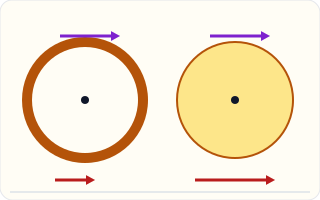
The figure shows a thin hoop and a solid disk of equal mass and radius, each pulled by the same force at its rim, so each feels the same torque. The disk gets twice the angular acceleration of the hoop.
The reason is rotational inertia. All the hoop's mass sits at the rim, giving $MR^2$. The disk's mass is spread from the center outward, and on average sits closer to the axis, giving only $\tfrac{1}{2}MR^2$. Half the inertia means twice the angular acceleration.
For a single point mass at distance $r$ from the axis, $I = mr^2$. For many, add them: $I = \sum m_ir_i^2$. The square means distance matters enormously. Moving a mass twice as far from the axis quadruples its contribution.
Rotational inertia depends on the axis. A rod spun about its center has $\tfrac{1}{12}ML^2$; about one end it has $\tfrac{1}{3}ML^2$, four times as much, since more of its mass is far from that axis.
Just as a net force gives a mass a linear acceleration, a net torque gives an object an angular acceleration. The correspondences are exact: force to torque, mass to rotational inertia, acceleration to angular acceleration.
Doubling the torque doubles the angular acceleration; doubling the rotational inertia halves it. A heavier wheel, or one with mass farther out, responds more sluggishly to the same torque.
Earlier, pulleys were treated as massless. A real pulley with mass needs a torque to spin up, so the string tensions on its two sides differ. The difference in tensions times the radius gives the pulley's torque.
For a string wound on a drum without slipping, the hanging mass's acceleration and the drum's angular acceleration are linked: $a = R\alpha$. Writing one equation for the mass, one for the drum and the link gives everything.
For a mass $m$ hanging from a string on a drum of rotational inertia $I$ and radius $R$, the drum behaves like an extra mass of $I/R^2$ that must also be accelerated. For a solid cylinder that extra mass is $\tfrac{1}{2}M$.
So a bucket on a windlass falls with $a = mg/(m + M/2)$, less than $g$ because the drum absorbs part of the driving force. A light drum barely slows the fall; a heavy one slows it a lot.
Checking an answer. A hoop accelerates less than a disk of equal mass and radius. A hanging mass on a heavy drum falls slower than $g$. Units: N·m over kg·m² gives rad/s².
Each small piece of a turning object moves in a circle. Its tangential acceleration is $r\alpha$, so by $F = ma$ it needs a tangential force $m r\alpha$, with torque $mr^2\alpha$. Adding over all pieces gives $\tau_{\text{net}} = (\sum mr^2)\alpha = I\alpha$.
Internal forces between pieces cancel in pairs and contribute no net torque, just as in the linear case. Only external torques change the rotation.
Engineers shape rotating parts to control rotational inertia. Racing bicycle wheels are light at the rim so they accelerate quickly. Flywheels are heavy at the rim to store energy and resist changes in speed.
A figure skater's arms, a tightrope walker's long pole and a diver's tuck all change rotational inertia. The pole's large inertia slows any tipping, giving the walker time to recover balance.
A flywheel smooths out uneven torque. In a car engine, each cylinder fires in turn, pushing the crankshaft in pulses. The flywheel's large rotational inertia keeps the engine turning steadily between pulses.
Flywheels are also used to store energy. Some power grids and data centers use heavy spinning flywheels to supply power for a few seconds during an outage, until backup generators start.
When friction acts at a wheel's rim, it produces a torque opposing the rotation. The angular deceleration is that torque divided by the rotational inertia. A heavier wheel, or one with its mass farther out, takes longer to stop.
A table saw blade coasts for many seconds after being switched off. Modern saws use electric brakes that apply a large opposing torque, stopping the blade in under three seconds for safety.
A gymnast spinning in a tuck has a small rotational inertia and spins fast; in a layout, arms and legs extended, the inertia is several times larger. Changing shape changes how the body responds to torques from the ground or bar.
Sprinters bend their knees sharply as they swing their legs forward, bringing the mass of the lower leg closer to the hip. That lowers the leg's rotational inertia so the hip muscles can swing it forward faster.
Rotational inertia has units of kg·m². A bicycle wheel has about $0.1$ kg·m²; a car's flywheel about $0.2$; a playground merry-go-round several hundred. Torques in newton-meters divided by these give angular accelerations in rad/s².
Because $I$ depends on $r^2$, getting the radius wrong by a factor of two throws the answer off by a factor of four. Check the radius and whether the problem gives a diameter instead.
Rotational inertia about any axis equals the inertia about a parallel axis through the center of mass plus $Md^2$, where $d$ is the distance between the axes. This parallel-axis theorem explains why the rod about one end has more inertia than about its center.
A door swinging on its hinges turns about its edge, not its center, so it has about four times the inertia of the same door spun about its middle. That is part of why heavy doors feel slow to start moving.
Many problems involve both: a hanging mass moving in a line and a pulley turning. Treat each object with its own law, $F = ma$ for things that move and $\tau = I\alpha$ for things that turn, and link them through the string.
The string's tension appears in both equations, as a force on the mass and a torque on the pulley. Solving them together eliminates the tension and gives the acceleration.
Before computing an angular acceleration, estimate whether the answer should be large or small. A light wheel pushed hard at its rim should spin up quickly; a heavy merry-go-round pushed by one person should take many seconds to get going.
If a calculation says a playground ride reaches hundreds of radians per second squared, a radius was probably squared twice or a diameter used in place of a radius. Comparing with everyday experience is the fastest check of all.
Some data centers and grid operators in the United States store energy in heavy flywheels spinning in vacuum chambers. A motor applies torque to spin the flywheel up when power is plentiful; when the grid falters, the flywheel drives a generator, supplying power for seconds to minutes.
Designers want large rotational inertia, so they put most of the mass at the rim, often using carbon-fiber rims that can survive very high speeds. The torque the motor can apply sets how fast the flywheel spins up, through $\tau = I\alpha$. A plant in Stephentown, New York, uses two hundred such flywheels to help keep the grid's frequency steady, responding within seconds to changes in demand.
A classic playground merry-go-round is a heavy steel disk a few meters across. Pushing along its rim gives a large torque for a modest force, but its large rotational inertia means it spins up slowly, which is part of what makes it safe.
When children climb aboard and sit near the rim, they add a lot of rotational inertia, since each contributes $mr^2$. The same push now spins the ride up more slowly. Children sitting near the center add much less. Playground safety guidelines from the Consumer Product Safety Commission recommend speed limiters on newer designs, since a large inertia also means a spinning merry-go-round takes a long time to stop.
It is tempting to think two objects of equal mass are equally hard to spin. But rotational inertia depends on how far the mass sits from the axis, squared. A hoop has twice the rotational inertia of a solid disk with the same mass and radius.
A related error is to treat a pulley with mass as massless, so that the tensions on both sides are equal. A pulley that must be spun up needs a net torque, so the tensions must differ.
A $2.0$ kg hoop of radius $0.40$ m is pulled at its rim with $5.0$ N. Find the rotational inertia.
$I = 2.0 \times 0.40^2 = 0.32\ \text{kg·m}^2$
Hoop: $MR^2$.
Find the torque.
$\tau = 5.0 \times 0.40 = 2.0\ \text{N·m}$
Force times radius.
Find the angular acceleration.
$\alpha = \dfrac{2.0}{0.32} = 6.25\ \text{rad/s}^2$
$\tau = I\alpha$.
Repeat for a solid disk of the same size.
$\alpha = \dfrac{2.0}{0.16} = 12.5\ \text{rad/s}^2$
Half the inertia.
Find each angular velocity after $2.0$ s.
$\omega_{\text{hoop}} = 12.5,\ \omega_{\text{disk}} = 25\ \text{rad/s}$
From rest.
A $4.0$ kg bucket hangs from a rope on an $8.0$ kg solid drum of radius $0.10$ m. Write the bucket's equation.
$4.0 \times 9.8 - T = 4.0a$
Down positive.
Write the drum's equation.
$T \times 0.10 = \tfrac{1}{2} \times 8.0 \times 0.10^2 \times \alpha$
Torque equals $I\alpha$.
Link the accelerations.
$\alpha = \dfrac{a}{0.10}$
No slipping.
Simplify the drum's equation.
$T = 4.0a$
The radius cancels.
Solve for the acceleration.
$39.2 = 8.0a \Rightarrow a = 4.9\ \text{m/s}^2$
Add the equations.
Find the tension.
$T = 4.0 \times 4.9 = 19.6\ \text{N}$
Less than the weight.
A $6.0$ kg solid grinding wheel of radius $0.20$ m turns at $100$ rad/s. Find its rotational inertia.
$I = \tfrac{1}{2} \times 6.0 \times 0.20^2 = 0.12\ \text{kg·m}^2$
Solid disk.
A tool presses on the rim with $8.0$ N of friction. Find the torque.
$\tau = 8.0 \times 0.20 = 1.6\ \text{N·m}$
Opposing the rotation.
Find the angular deceleration.
$\alpha = \dfrac{1.6}{0.12} = 13.3\ \text{rad/s}^2$
Torque over inertia.
Find the time to stop.
$t = \dfrac{100}{13.3} = 7.5\ \text{s}$
Steady slowing.
Find the angle turned while stopping.
$\theta = \tfrac{1}{2} \times 100 \times 7.5 = 375\ \text{rad}$
Average rate times time.
Convert to revolutions.
$n = \dfrac{375}{2\pi} = 59.7$
About sixty turns.
Find the stopping time for a hoop of equal mass.
$t = 15\ \text{s}$
Twice the inertia.
Write the rotational second law.
$\alpha = \dfrac{\tau}{I}$
Torque over inertia.
Substitute the values.
$\alpha = \dfrac{6.0}{1.5}$
SI units.
Evaluate the angular acceleration.
A string wound around a uniform solid disk of mass $10$ kg and radius $0.25$ m is pulled with $15$ N, turning the disk on a frictionless axle. What is its angular acceleration, in rad/s²?
Complete the worked solution: a grinding wheel, a solid disk of mass $10$ kg and radius $0.15$ m, spins at $75$ rad/s. A tool pressed on its rim gives a friction force of $10$ N. Find the friction torque in N·m, the angular deceleration in rad/s², and the time to stop in s.
Find the friction torque.
$\tau = fR =$ t
Force at the rim.
Find the angular deceleration.
$\alpha = \dfrac{\tau}{\tfrac{1}{2}MR^2} =$ a
Torque over inertia.
Find the stopping time.
$t = \dfrac{\omega_0}{\alpha} =$ s
Steady slowing.
Explain the effect of a heavier wheel.
$\text{larger } I, \text{ longer stop}$
More rotational inertia.
Match each shape, turning about its central axis, to its rotational inertia.
| $MR^2$ | $\tfrac{1}{2}MR^2$ | $\tfrac{2}{5}MR^2$ | $\tfrac{1}{12}ML^2$ | |
|---|---|---|---|---|
| a thin hoop | ||||
| a solid disk | ||||
| a solid sphere | ||||
| a thin rod about its center |
A motor applies a steady $4$ N·m torque to a solid disk flywheel of mass $10$ kg and radius $0.4$ m, starting from rest. Fill in the rotational inertia in kg·m², the angular acceleration in rad/s², and the angular velocity after $6$ s in rad/s.
| value | |
|---|---|
| rotational inertia (kg·m²) | |
| angular acceleration (rad/s²) | |
| angular velocity (rad/s) |
A solid disk of mass $4$ kg and radius $0.5$ m turns on an axle with a friction torque of $1.5$ N·m. A string wound on its rim is pulled with force $F$, in newtons. Write the disk's angular acceleration, in rad/s², as a function of $F$ while it turns.
Answer:
A $6$ kg bucket hangs from a rope wound around a well's windlass, a solid cylinder of mass $3$ kg turning on a frictionless axle. Released, the bucket falls. With $g = 9.8$ m/s², what is its acceleration, in m/s²?
Answer: m/s²
A playground merry-go-round is roughly a uniform disk of mass $350$ kg and radius $1.6$ m. A parent pushes along its rim with a steady $140$ N. Ignoring friction, what is its angular acceleration, in rad/s²?
Answer: rad/s²
Lesson test: one question per skill, one attempt each, no hints. Your answers are checked when you submit.
A solid disk of mass $10$ kg and radius $0.4$ m turns on an axle with a friction torque of $2$ N·m. A string wound on its rim is pulled with force $F$, in newtons. Write the disk's angular acceleration, in rad/s², as a function of $F$ while it turns.
Answer:
You can apply the rotational second law. Explain to someone why a hoop spins up more slowly than a disk of the same mass and size under the same torque.
26. Your turn: a net torque of $6.0$ N·m acts on a wheel with $I = 1.5$ kg·m². What is its angular acceleration?, step 3
$\alpha = 4.0\ \text{rad/s}^2$
Radians per second squared.