Back to the on-screen lesson ·
A turning object carries kinetic energy $\tfrac{1}{2}I\omega^2$; a rolling object shares its energy between moving along and turning, in a ratio set by its shape.
Paper packet. Every task here also exists on screen, where it is checked automatically; answers written on paper are not assessed by Nydus. When you are back at a device, enter your answers there.
By the end of this lesson you will be able to compute rotational kinetic energy and use energy conservation for rolling objects and flywheels.
You know kinetic energy $\tfrac{1}{2}mv^2$, conservation of energy, rotational inertia, and the rolling link $v = R\omega$. This lesson adds the energy of turning, and shows how rolling objects share their energy between moving along and spinning.
| Term | What it means |
|---|---|
| Rotational kinetic energy | Energy of turning, $K_r = \tfrac{1}{2}I\omega^2$. |
| Translational kinetic energy | Energy of moving along, $K_t = \tfrac{1}{2}mv^2$. |
| Rolling without slipping | Motion with $v = R\omega$, the contact point momentarily at rest. |
| Shape factor | The number $k$ in $I = kmR^2$. |
| Flywheel | A heavy spinning wheel used to store energy. |
| Kilowatt-hour | An energy unit, $3.6 \times 10^6$ J. |
A turning object has rotational kinetic energy:
$$K_r = \tfrac{1}{2}I\omega^2.$$
A rolling object both moves along and turns, so its total kinetic energy is
$$K = \tfrac{1}{2}mv^2 + \tfrac{1}{2}I\omega^2, \quad v = R\omega.$$
Another way: picture
Picture racing a solid rubber ball and a hollow ring down the same slope. The ball wins every time. Both lose the same height energy, but the ring, with its mass at the rim, has to put more of that energy into spinning, leaving less for moving forward.
Another way: steps
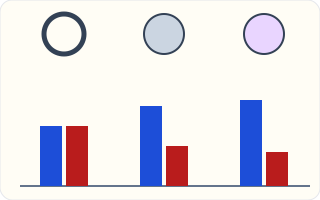
The figure compares a hoop, a disk and a ball of the same mass rolling at the same speed. Each has a blue bar for the energy of moving along and a red bar for the energy of turning. The blue bars are equal, since mass and speed are equal.
The red bars differ. The hoop's equals its blue bar, so half its energy is rotational. The disk's is half its blue bar, a third of the total. The ball's is two fifths of its blue bar, two sevenths of the total. The hoop carries the most energy at a given speed.
Each small piece of a turning object moves in a circle at speed $r\omega$. Its kinetic energy is $\tfrac{1}{2}m(r\omega)^2$. Adding over all pieces gives $\tfrac{1}{2}(\sum mr^2)\omega^2 = \tfrac{1}{2}I\omega^2$.
The formula mirrors $\tfrac{1}{2}mv^2$, with rotational inertia in place of mass and angular velocity in place of velocity. Doubling the rate of turning quadruples the energy, which is why flywheels store energy by spinning very fast.
When an object rolls down a slope without slipping, the height energy it loses, $mgh$, becomes both kinds of kinetic energy. With $I = kmR^2$, the speed at the bottom is $v = \sqrt{2gh/(1 + k)}$.
Mass and radius cancel. Every solid ball reaches the same speed, whether a marble or a bowling ball, and every hoop the same lower speed. Only the shape, through $k$, matters.
Release a solid ball, a solid cylinder and a hoop together at the top of a ramp. The ball, with the smallest $k$, reaches the bottom first; the cylinder next; the hoop last. A frictionless block, sliding without turning, would beat them all.
This surprises many people, who expect heavier objects to win. The race is decided entirely by how the mass is distributed, a vivid demonstration of rotational inertia.
A ball rolling without slipping needs static friction at the contact point to make it spin, but that friction does no work, because the contact point is momentarily at rest. So mechanical energy is conserved in pure rolling.
If the slope is too slippery, the object slides as well as rolls, and kinetic friction turns some energy into heat. Then energy conservation needs a thermal term, and the rolling link $v = R\omega$ no longer holds.
Checking an answer. A rolling object's speed at the bottom must be less than a sliding block's. The ball beats the disk, which beats the hoop. Rotational energy must never exceed the total.
Rotational kinetic energy is just the sum of ordinary kinetic energies of the object's pieces, so it enters energy conservation like any other kinetic energy. Nothing new is being assumed, only accounted for.
For rolling, the motion of each piece is the sum of the center's motion and the turning about the center. The energy splits cleanly into the two terms because the center of mass is the reference point.
A flywheel stores energy as rotation. Because $K$ grows as $\omega^2$, spinning faster stores energy much more effectively than adding mass. Modern flywheels spin at tens of thousands of rpm in vacuum chambers to avoid air drag.
Flywheels can deliver their energy very quickly, which makes them useful for smoothing power supplies. Some roller coasters and amusement rides use flywheels to launch trains, storing energy slowly and releasing it in seconds.
A moving car's wheels carry rotational kinetic energy as well as translational. Heavy wheels add more to the energy needed to accelerate the car than their mass alone would suggest, since they must also be spun up.
Racing cyclists and car designers therefore value light wheels, especially light rims. Saving a kilogram at the rim of a bicycle wheel helps acceleration about as much as saving two kilograms elsewhere on the bike.
Earth's daily spin stores an enormous rotational kinetic energy, about $2 \times 10^{29}$ J. Tidal friction from the Moon slowly drains it, lengthening the day by about two thousandths of a second per century.
That lost energy heats the oceans slightly and pushes the Moon into a higher orbit, about four centimeters farther each year, as measured by lasers bounced off reflectors left by the Apollo astronauts.
A yo-yo unwinding from its string turns faster and faster as it falls. Its height energy goes into both falling and spinning. Because its axle is thin, the string's link gives a large spin rate, and most of the energy goes into turning.
At the bottom, a well-made yo-yo keeps spinning in place, sleeping, with nearly all its energy rotational. A quick tug makes the string grip again, and the spinning energy carries it back up.
Rotational energy is measured in joules, like any energy. A spinning bicycle wheel at twenty miles per hour carries only a few joules of rotational energy. A large grid flywheel stores tens of megajoules.
Always convert rpm to rad/s before using $\tfrac{1}{2}I\omega^2$. Using rpm directly gives an answer about a hundred times too large or too small, depending on the error.
A torque acting through an angle does work $\tau\theta$ on a turning object, just as a force through a distance does $Fd$. That work changes the rotational kinetic energy: $\tau\theta = \Delta(\tfrac{1}{2}I\omega^2)$, the rotational work-energy theorem.
This gives a quick way to find how far a wheel turns while a motor spins it up or a brake slows it down, without finding the angular acceleration first.
A rolling ball climbing a slope converts both its translational and rotational energy into height. It therefore climbs higher than a sliding block moving at the same speed would, since it has more energy to spend.
A hoop rolling at a given speed climbs highest of all, with the most energy stored in turning. Bowlers and skateboarders feel this as extra momentum carried by spinning wheels and balls.
Most problems give the shape rather than the inertia, so it pays to know the common shape factors. A thin hoop or ring puts all its mass at the rim, giving the largest factor, one. A solid cylinder or disk has one half, a hollow ball two thirds, and a solid ball two fifths.
Real objects fall between these ideals. A car tire, with a heavy tread and lighter sidewalls, behaves somewhat like a hoop; a bowling ball, nearly uniform, like a solid ball. When in doubt, the factor lies between zero and one, and more mass near the rim means a larger number.
The electricity grid must match supply and demand second by second. A plant in Stephentown, New York, uses two hundred flywheels, each a heavy carbon-fiber rotor spinning at about $16{,}000$ rpm inside a vacuum chamber, to help keep the grid's frequency steady.
Each rotor stores a few tens of kilowatt-hours as rotational kinetic energy. When demand spikes, the flywheels slow slightly and feed energy in within seconds; when there is a surplus, motors spin them back up. Because energy grows as the square of angular velocity, designers make the rotors spin as fast as their materials safely allow, and the vacuum removes almost all air drag so the energy lasts.
Physics teachers across the country run a favorite demonstration: a solid ball, a solid cylinder and a hoop released together at the top of a ramp. Students usually predict the heaviest will win, but the finish order is always the same: ball, cylinder, hoop.
The race shows that rotational inertia, not mass, decides the outcome. A heavy steel hoop loses to a light wooden ball. Swapping in a hollow ball or a can of soup adds variety: a can of thick soup rolls like a solid cylinder, while a can of broth, whose liquid barely turns, behaves more like a sliding block and wins surprisingly often.
Because all objects fall with the same acceleration, it is tempting to think all rolling objects reach the bottom of a ramp at the same speed. But rolling objects must spend part of their height energy on turning. The more mass at the rim, the more energy goes into spinning and the slower the object moves along.
A related error is to forget the rotational term altogether and use $mgh = \tfrac{1}{2}mv^2$, which gives the speed of a frictionless sliding block, too fast for anything that rolls.
A $7.0$ kg bowling ball rolls at $6.0$ m/s. Find its translational energy.
$K_t = \tfrac{1}{2} \times 7.0 \times 6.0^2 = 126\ \text{J}$
Moving along.
Write its rotational energy in terms of $v$.
$K_r = \tfrac{1}{2} \times \tfrac{2}{5}mR^2 \times \dfrac{v^2}{R^2} = \tfrac{1}{5}mv^2$
Solid ball.
Evaluate the rotational energy.
$K_r = \tfrac{1}{5} \times 7.0 \times 6.0^2 = 50.4\ \text{J}$
Turning.
Find the total.
$K = 126 + 50.4 = 176.4\ \text{J}$
Both kinds.
Find the rotational share.
$\dfrac{50.4}{176.4} = \tfrac{2}{7}$
As expected for a ball.
A hoop, a disk and a ball roll from rest down a ramp $0.90$ m high. Write the speed formula.
$v = \sqrt{\dfrac{2gh}{1 + k}}$
Mass and radius cancel.
Find the numerator.
$2 \times 9.8 \times 0.90 = 17.64$
Same for all.
Find the ball's speed.
$v = \sqrt{\dfrac{17.64}{1.4}} = 3.55\ \text{m/s}$
$k = 0.4$.
Find the disk's speed.
$v = \sqrt{\dfrac{17.64}{1.5}} = 3.43\ \text{m/s}$
$k = 0.5$.
Find the hoop's speed.
$v = \sqrt{\dfrac{17.64}{2}} = 2.97\ \text{m/s}$
$k = 1$.
Rank the finishers.
$\text{ball, disk, hoop}$
Smallest $k$ wins.
A $40$ kg solid flywheel of radius $0.50$ m spins at $3000$ rpm. Find its rotational inertia.
$I = \tfrac{1}{2} \times 40 \times 0.50^2 = 5.0\ \text{kg·m}^2$
Solid disk.
Convert the rate.
$\omega = \dfrac{3000 \times 2\pi}{60} = 314\ \text{rad/s}$
Radians per second.
Find the stored energy.
$K = \tfrac{1}{2} \times 5.0 \times 314^2 = 246490\ \text{J}$
About a quarter megajoule.
It drives a $5000$ W load. Find how long the energy lasts.
$t = \dfrac{246490}{5000} = 49\ \text{s}$
Energy over power.
Find the energy left at half speed.
$K = \tfrac{1}{4} \times 246490 = 61623\ \text{J}$
Energy goes as $\omega^2$.
Find the fraction released by halving the speed.
$1 - \tfrac{1}{4} = \tfrac{3}{4}$
Most of it.
Find the braking torque that stops it in $200$ turns.
$\tau = \dfrac{246490}{200 \times 2\pi} = 196\ \text{N·m}$
Work equals energy.
Write the formula.
$K = \tfrac{1}{2}I\omega^2$
Rotational kinetic energy.
Substitute the values.
$K = \tfrac{1}{2} \times 0.50 \times 20^2$
SI units.
Evaluate the energy.
A $10$ kg solid cylinder rolls without slipping across a floor at $4$ m/s. What is its total kinetic energy, in J?
Complete the worked solution: a solid disk flywheel of mass $50$ kg and radius $0.4$ m spins at $200$ rad/s, and then delivers all its energy to a generator over $20$ s. Find its rotational inertia in kg·m², its kinetic energy in J, and the average power delivered in W.
Find the rotational inertia.
$I = \tfrac{1}{2}MR^2 =$ i
Solid disk.
Find the kinetic energy.
$K = \tfrac{1}{2}I\omega^2 =$ k
Rotational kinetic energy.
Find the average power.
$P = \dfrac{K}{t} =$ p
Energy over time.
Explain why flywheels spin fast.
$K \propto \omega^2$
Speed stores energy efficiently.
Match each object moving at the same speed to the fraction of its kinetic energy that is rotational.
| one half | one third | two sevenths | none | |
|---|---|---|---|---|
| a rolling hoop | ||||
| a rolling solid disk | ||||
| a rolling solid ball | ||||
| a block sliding without friction |
A solid disk flywheel of mass $20$ kg and radius $0.3$ m spins at $3000$ rpm. Fill in its rotational inertia in kg·m², its angular velocity in rad/s, and its kinetic energy in kJ.
| value | |
|---|---|
| rotational inertia (kg·m²) | |
| angular velocity (rad/s) | |
| kinetic energy (kJ) |
Treat a bowling ball as a rolling object that starts from rest and rolls without slipping down a slope, dropping a height $h$ in meters. With $g = 9.8$ m/s², write the square of its speed at the bottom, in m²/s², as a function of $h$.
Answer:
In a lab race, a solid ball, with $I = 0.4mR^2$, starts from rest and rolls without slipping down a ramp $1.2$ m high. With $g = 9.8$ m/s², how fast is it moving at the bottom, in m/s?
Answer: m/s
A flywheel used to steady a power grid has a rotor that is roughly a solid cylinder of mass $2000$ kg and radius $0.5$ m, spinning at $8000$ rpm in a vacuum. How much energy does it store, in kWh?
Answer: kWh
Lesson test: one question per skill, one attempt each, no hints. Your answers are checked when you submit.
Treat a basketball as a rolling object that starts from rest and rolls without slipping down a slope, dropping a height $h$ in meters. With $g = 9.8$ m/s², write the square of its speed at the bottom, in m²/s², as a function of $h$.
Answer:
You can include rotation in energy conservation. Explain to someone why a solid ball beats a hoop in a race down a ramp.
26. Your turn: a wheel with $I = 0.50$ kg·m² spins at $20$ rad/s. What is its rotational kinetic energy?, step 3
$K = 100\ \text{J}$
Joules.