Back to the on-screen lesson ·
An object at rest needs zero net force and zero net torque; taking torques about an unknown force's point removes it.
Paper packet. Every task here also exists on screen, where it is checked automatically; answers written on paper are not assessed by Nydus. When you are back at a device, enter your answers there.
By the end of this lesson you will be able to apply both equilibrium conditions to find unknown forces on planks, ladders, arms and cranes.
You can compute torques with signs, draw free-body diagrams, and use the condition that forces balance for an object at rest. This lesson adds the second condition for a rigid object to stay at rest: the torques must balance too.
| Term | What it means |
|---|---|
| Static equilibrium | At rest, with no linear or angular acceleration. |
| Translational equilibrium | Zero net force, $\sum F = 0$. |
| Rotational equilibrium | Zero net torque, $\sum \tau = 0$. |
| Center of gravity | The point where an object's whole weight can be taken to act. |
| Support force | An upward force from a prop, hinge or floor. |
| Counterweight | A mass placed to balance a load's torque. |
A rigid object stays at rest only if two conditions hold:
$$\sum F = 0 \quad \text{and} \quad \sum \tau = 0.$$
Solve the torque equation first for one unknown, then the force equations for the rest.
Another way: picture
Picture carrying a long board with a friend, one at each end, and a heavy toolbox resting on it near your end. You carry most of the load. The board is balanced when your two upward forces add up to the total weight and their torques about any point cancel, which requires the person nearer the toolbox to lift more.
Another way: steps
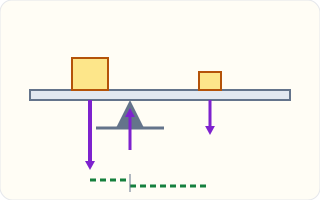
The figure shows a plank on a pivot with a large box close on the left and a small box twice as far out on the right. The large box weighs twice as much, but its lever arm is half as long, so the two torques are equal and the plank balances.
Balance depends on torques, not on weights alone. The pivot pushes up with a force equal to both weights together, so the net force is zero too. Both conditions hold, and the plank stays still.
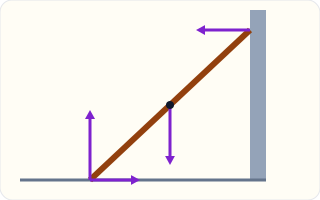
The figure shows the four forces on a ladder leaning against a smooth wall: its weight at the middle, the floor's upward push and friction at the foot, and the wall's horizontal push at the top.
Taking torques about the foot removes both floor forces at once. Only the weight and the wall's push remain, giving the wall's push directly. Then the horizontal force balance says friction equals the wall's push, and the vertical balance says the floor's push equals the weight.
Zero net force keeps an object's center of mass from accelerating, but it does not stop the object from starting to spin. Two equal and opposite forces applied at different points, a couple, give zero net force but a nonzero torque.
Zero net torque stops the angular acceleration. Together, the two conditions ensure the object neither moves off nor starts turning. A seesaw with children pushing up on the pivot and weights pressing down satisfies both.
For an object in equilibrium, the net torque is zero about every axis, so you may choose any point. The best choice is where an unknown force acts, since that force has no lever arm and disappears from the equation.
For a plank on two supports, take torques about one support to find the other. For a ladder, take them about the foot. A good pivot often turns a problem with two unknowns into one with a single unknown.
Gravity pulls on every part of an object, but for torque purposes the whole weight acts at the center of gravity. Near Earth's surface this is the same as the center of mass: the middle of a uniform plank, rod or ladder.
An object hung from a point settles with its center of gravity directly below that point. Hanging an irregular sheet from two corners in turn and drawing the vertical lines through each shows where they cross: the center of gravity.
Checking an answer. Support forces must add up to the total weight. A support nearer a heavy load carries more. Taking torques about a different point must give the same answers.
An object at rest has zero acceleration and zero angular acceleration. Newton's second law then requires zero net force, and its rotational version, the subject of the next lesson, requires zero net torque.
If the net force is zero, the net torque is the same about every point, so choosing a convenient pivot is always valid. That is the fact that makes the pivot trick work.
An object resting on a base is stable as long as its center of gravity lies above the base. Tilt it, and its weight creates a torque that restores it, until the center of gravity passes beyond the edge. Then the torque tips it over.
Low, wide objects are hard to tip. Race cars sit low; floor lamps have heavy, wide bases. People standing on a moving bus widen their stance to keep their center of gravity over their feet.
Muscles attach close to the joints, so they work at a large mechanical disadvantage. Holding a weight in the hand with the forearm horizontal needs a biceps force many times the weight, since the biceps' lever arm is only a few centimeters.
The same torque balance explains back injuries. Bending over to lift a box puts the load far from the lower back, and the back muscles, with short lever arms, must pull with enormous forces to balance it.
A beam bridge rests on supports at its ends. A truck on the bridge shares its weight between the supports in inverse proportion to its distance from each, exactly like a painter on a scaffold plank.
Engineers compute these support forces for every possible load position, and design the supports for the worst case. Cantilevers, like balconies and diving boards, are held at one end only, and rely on a torque at the wall to balance the load.
A hanging mobile is a set of balanced rods, each in rotational equilibrium. The sculptor Alexander Calder built mobiles by balancing torques, placing heavy shapes close to each pivot and light ones far out.
An old-fashioned balance scale compares masses by torques: equal arms balance equal weights. A steelyard scale uses unequal arms, balancing a heavy load near the pivot with a small sliding weight far out.
When a force acts at an angle, as a cable holding a sign or a strut propping a shelf, split it into components. Only the component perpendicular to the lever arm contributes torque; both components enter the force equations.
A horizontal beam held by a slanted cable has a hinge force with both a vertical and a horizontal part. Taking torques about the hinge gives the cable tension, and the force equations then give the hinge's components.
A ladder at a shallow angle needs a large wall push to balance its weight's torque, and so a large friction force at the foot. If the floor cannot supply that friction, the foot slides out.
The Occupational Safety and Health Administration recommends setting a ladder at about seventy-five degrees to the ground, the four-to-one rule: one foot out for every four feet up. At that angle the friction needed is small.
Because equilibrium holds about every point, a torque equation about a second pivot gives an independent check. After finding both supports of a plank, take torques about the middle or the other end and confirm they cancel.
This check catches sign errors and misplaced lever arms, the two most common mistakes, without redoing the whole problem.
The tower cranes rising over American downtowns balance on a single mast. The long jib carries the load; a short counter-jib on the other side holds concrete counterweights. The counterweights' torque about the mast offsets the load's, so the mast carries mostly downward force rather than a huge bending torque.
Because the load moves in and out along the jib, its torque changes. Each crane has a load chart giving the heaviest load allowed at each distance, and sensors cut power if the torque limit is exceeded. A crane that can lift several tons near the mast may manage only a fraction of that at the jib's tip, since the lever arm is so much longer. Operators check the chart before every lift.
Falls from ladders injure thousands of American workers each year, and many happen when the foot slides out. The Occupational Safety and Health Administration's four-to-one rule sets the base one foot from the wall for every four feet of height, about seventy-five degrees.
Torque balance explains the rule. The steeper the ladder, the shorter the weight's lever arm about the foot, and the smaller the wall's push and the friction the floor must supply. A worker climbing adds weight farther up, increasing the torque and the friction needed, which is why the danger grows near the top. Rubber feet raise the friction coefficient, and tying the top off removes the risk of sliding altogether.
It is natural to think a seesaw balances only when the children weigh the same, or that a balanced plank has equal weights on each side. What must match is the torques. A heavy child close to the pivot balances a light child far out.
A second error is to forget the support forces when taking torques, or to include a force at the pivot with a nonzero lever arm. A force acting at the pivot always has zero torque about it.
Children of $30$ kg at $2.0$ m left and $20$ kg at $1.0$ m left sit on a seesaw. Find their total torque.
$\tau = 30g \times 2.0 + 20g \times 1.0 = 80g\ \text{N·m}$
Both counterclockwise.
A $40$ kg child sits on the right. Write the balance condition.
$40g \times x = 80g$
Zero net torque.
Solve for the distance.
$x = 2.0\ \text{m}$
The $g$ cancels.
Find the pivot's upward force.
$N = (30 + 20 + 40) \times 9.8 = 882\ \text{N}$
Zero net force.
Check the torques numerically.
$784 = 40 \times 9.8 \times 2.0$
Both sides $784$ N·m.
A $4.0$ m plank weighing $200$ N rests on supports at each end. A $600$ N painter stands $1.0$ m from the left. Choose the left end as pivot.
$\text{left support drops out}$
Unknown force at the pivot.
Find the torque of the weights.
$200 \times 2.0 + 600 \times 1.0 = 1000\ \text{N·m}$
Clockwise.
Find the right support's force.
$R = \dfrac{1000}{4.0} = 250\ \text{N}$
Balances the torque.
Find the left support's force.
$L = 800 - 250 = 550\ \text{N}$
Zero net force.
Check with torques about the right end.
$550 \times 4.0 = 200 \times 2.0 + 600 \times 3.0$
Both $2200$ N·m.
Explain which support carries more.
$\text{the left, nearer the painter}$
A shorter lever arm.
A $12$ kg ladder $5.0$ m long leans on a smooth wall at $60°$ to the floor. Find its weight.
$W = 12 \times 9.8 = 117.6\ \text{N}$
At the middle.
Find the weight's lever arm about the foot.
$\ell_W = 2.5\cos 60° = 1.25\ \text{m}$
Horizontal distance.
Find the wall force's lever arm.
$\ell_N = 5.0\sin 60° = 4.33\ \text{m}$
Vertical distance.
Balance the torques.
$N_w \times 4.33 = 117.6 \times 1.25$
About the foot.
Solve for the wall's push.
$N_w = 33.9\ \text{N}$
Horizontal.
Find the friction at the foot.
$f = 33.9\ \text{N}$
Horizontal forces balance.
Find the least friction coefficient needed.
$\mu_s = \dfrac{33.9}{117.6} = 0.29$
Friction over normal force.
Write the balance condition.
$20 \times 1.5 = 30x$
Equal torques.
Solve for the distance.
$x = \dfrac{30}{30}$
Divide by the mass.
State the position.
A $50$ kg child sits $1.2$ m to the left of a seesaw's pivot. How far to the right of the pivot must a $30$ kg child sit for the seesaw to balance, in m?
Complete the worked solution: a person holds a $8$ kg ball in the hand, $0.34$ m from the elbow, with the forearm horizontal. The $1.8$ kg forearm's weight acts $0.15$ m from the elbow, and the biceps pulls straight up $0.04$ m from the elbow. With $g = 9.8$ m/s², find the ball's torque about the elbow in N·m, the forearm's torque in N·m, and the biceps force in N.
Find the ball's torque.
$\tau_b = m_bgd_b =$ p
Weight times lever arm.
Find the forearm's torque.
$\tau_a = m_ag \times 0.15 =$ q
At its center of gravity.
Find the biceps force.
$F = \dfrac{\tau_b + \tau_a}{0.04} =$ f
Its torque balances both.
Compare with the ball's weight.
$F \gg m_bg$
A very short lever arm.
Match each idea to what it says.
| the net force is zero | the net torque is zero | removes that force from the torque equation | the point where the whole weight can be taken to act | |
|---|---|---|---|---|
| translational equilibrium | ||||
| rotational equilibrium | ||||
| taking torques about the point where an unknown force acts | ||||
| the center of gravity |
A uniform scaffold plank $5$ m long and weighing $300$ N rests on supports at its two ends. A $700$ N painter stands $2$ m from the left end. Fill in the total clockwise torque of the two weights about the left end in N·m, the right support's force in N, and the left support's force in N.
| value | |
|---|---|
| torque about the left end (N·m) | |
| right support force (N) | |
| left support force (N) |
A uniform plank $5$ m long and weighing $300$ N rests on supports at its two ends. A $700$ N painter stands a distance $x$, in meters, from the left end. Write the right support's upward force, in N, as a function of $x$.
Answer:
A uniform $18$ kg ladder leans against a smooth wall, making an angle of $55°$ with the floor. With $g = 9.8$ m/s², how hard does the wall push on the top of the ladder, in N?
Answer: N
On a high-rise site in Miami, a tower crane lifts a $3$ metric ton load at $35$ m from its mast. Its counterweight sits $10$ m from the mast on the other side. What counterweight, in metric tons, balances the load's torque about the mast?
Answer: t
Lesson test: one question per skill, one attempt each, no hints. Your answers are checked when you submit.
A uniform plank $6$ m long and weighing $240$ N rests on supports at its two ends. A $900$ N painter stands a distance $x$, in meters, from the left end. Write the right support's upward force, in N, as a function of $x$.
Answer:
You can solve static equilibrium problems. Explain to someone why a heavy child must sit closer to the pivot to balance a seesaw.
25. Your turn: a $20$ kg child sits $1.5$ m from a seesaw's pivot. Where must a $30$ kg child sit to balance?, step 3
$x = 1.0\ \text{m on the other side}$
Closer to the pivot.