Back to the on-screen lesson ·
Angle, angular velocity and angular acceleration describe rotation with the same equations as straight-line motion; a point at radius $r$ moves at $r\omega$.
Paper packet. Every task here also exists on screen, where it is checked automatically; answers written on paper are not assessed by Nydus. When you are back at a device, enter your answers there.
By the end of this lesson you will be able to describe rotation with angular quantities, use the rotational kinematics equations, and link them to the motion of points on a turning object.
You can describe straight-line motion with position, velocity and acceleration, and use the constant-acceleration equations. You have met uniform circular motion. This lesson describes the turning of a whole rigid object with angular versions of the same quantities.
| Term | What it means |
|---|---|
| Radian | The angle whose arc equals the radius; a full turn is $2\pi$ rad. |
| Angular displacement | The angle an object turns through, $\Delta\theta$. |
| Angular velocity | The rate of turning, $\omega = \Delta\theta/\Delta t$, in rad/s. |
| Angular acceleration | The rate of change of angular velocity, $\alpha$, in rad/s². |
| Tangential speed | The speed of a point along its circle, $v = r\omega$. |
| Revolutions per minute | A common rate of turning; $1$ rpm $= 2\pi/60$ rad/s. |
A rigid object turning about a fixed axis is described by three angular quantities:
With constant $\alpha$, the kinematics equations carry over directly:
$$\omega = \omega_0 + \alpha t, \quad \theta = \omega_0t + \tfrac{1}{2}\alpha t^2, \quad \omega^2 = \omega_0^2 + 2\alpha\theta.$$
A point at radius $r$ moves at $v = r\omega$.
Another way: picture
Picture a merry-go-round. A child at the center and one at the edge go around once in the same time, so they share the same angular velocity. But the edge rider covers a much bigger circle each turn, so they move much faster through the air, which is why the edge is the thrilling place to sit.
Another way: steps
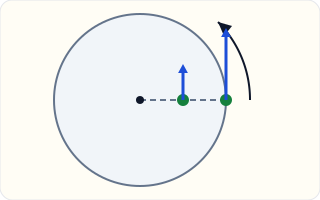
The figure shows a turntable turning counterclockwise, with two dots on one radius: one halfway out and one at the rim. Both turn through the same angle each second, so they share one angular velocity.
But the rim dot travels a circle twice as large, so its speed, shown by its longer arrow, is twice as great. That is $v = r\omega$: the same $\omega$, twice the radius, twice the speed. Every point on a rigid turning object shares $\omega$ but not $v$.
A radian is the angle at which the arc length equals the radius. A full circle, with circumference $2\pi r$, is $2\pi$ radians, so $360°$ equals $2\pi$ rad, and one radian is about $57.3°$.
Radians make the rotational formulas simple. Arc length is $s = r\theta$ and speed is $v = r\omega$ only when angles are in radians. Using degrees or revolutions in those formulas gives wrong answers, so convert first.
Angular velocity measures how fast an object turns. A wheel turning once a second has $\omega = 2\pi$ rad/s. Engines and motors are usually rated in revolutions per minute; divide by sixty and multiply by $2\pi$ to get rad/s.
Angular velocity has a direction: counterclockwise is usually positive. A car engine idling at $800$ rpm turns at about $84$ rad/s; a hard drive spindle at $7200$ rpm, about $754$ rad/s.
When a wheel speeds up or slows down, its angular velocity changes, and the rate of change is the angular acceleration. A fan speeding up from rest to $30$ rad/s in $5$ s has $\alpha = 6$ rad/s².
Each point on the wheel then has a tangential acceleration $a_t = r\alpha$ along its path, in addition to the centripetal acceleration $v^2/r$ toward the center that every turning point has.
Because $\theta$, $\omega$ and $\alpha$ relate to each other exactly as $x$, $v$ and $a$ do, the constant-acceleration equations carry over with the letters changed. Every technique from the kinematics unit applies.
For example, the angle turned while slowing steadily to rest is the average angular velocity, half the starting value, times the time. A velocity against time graph for rotation has the same meaning: its area is the angle turned.
Checking an answer. A point farther out must move faster. An object slowing down must have $\alpha$ opposite in sign to $\omega$. Revolutions are radians divided by $2\pi$.
The kinematics equations came from the definitions of velocity and acceleration and the assumption of constant acceleration. The angular definitions have the same form, so the same algebra gives the same equations.
The link $v = r\omega$ follows from $s = r\theta$: in a short time, a point at radius $r$ moves an arc $r\Delta\theta$, so its speed is $r\Delta\theta/\Delta t$. That definition of the radian is what makes the link so simple.
When a wheel rolls without slipping, the point touching the ground is momentarily at rest, and the wheel's center moves forward one circumference per turn. So the car's speed equals the rim speed, $v = r\omega$.
A car's speedometer actually measures the wheels' angular velocity and multiplies by the tire's radius. Fitting larger tires without recalibrating makes the speedometer read low, since each turn now carries the car farther.
Two gears in contact have the same speed at their touching teeth, so $r_1\omega_1 = r_2\omega_2$. A small gear driving a large one turns faster, and the large one turns slower. A bicycle's chain links the front chainring and rear cog the same way.
In a low gear, the chain runs on a large rear cog, so each pedal turn moves the wheel less, making hills easier. In a high gear, a small rear cog spins the wheel more times per pedal stroke for speed on flat roads.
Vinyl records turn at $33\tfrac{1}{3}$ or $45$ rpm, CDs at a few hundred rpm, and older computer hard drives at $5400$ to $7200$ rpm. Because every point shares $\omega$, the outer tracks pass the reading head faster than the inner ones.
CD players solve this by slowing the disc as the laser moves outward, keeping the track speed under the laser constant. The music plays at a steady rate even though the disc's angular velocity changes.
Earth turns once every day about its axis, with $\omega = 7.29 \times 10^{-5}$ rad/s. Every place on Earth shares this angular velocity, but places near the equator circle the axis at a larger radius and so move faster.
A point on the equator moves at about $465$ m/s, over a thousand miles per hour, while Anchorage moves at less than half that. NASA launches rockets eastward from Florida to gain a free boost from this rotation.
A point on a turning wheel always has a centripetal acceleration, $r\omega^2$, toward the center. If the wheel is speeding up or slowing down, the point also has a tangential acceleration, $r\alpha$, along its path.
The two combine as perpendicular components. A car tire speeding up on the highway has a huge centripetal acceleration at its rim, hundreds of times $g$, and a much smaller tangential one.
Choose counterclockwise as positive, as seen from a stated side. Then a wheel turning clockwise has negative $\omega$, and one slowing down from counterclockwise turning has negative $\alpha$.
Keep signs consistent throughout a problem. A common error is to treat a slowing wheel's angular acceleration as positive, which predicts that it speeds up instead of stopping.
A few reference rates help with estimates. A second hand turns once a minute, about $0.1$ rad/s. A car wheel at highway speed turns about $14$ times a second, around $85$ rad/s. A kitchen blender blade can reach over $2000$ rad/s.
If an answer gives a ceiling fan spinning thousands of revolutions per second, look for a missing conversion from rpm, or radians confused with revolutions.
An angular velocity against time graph works just like a velocity graph. Its slope is the angular acceleration, and the area under it is the angle turned. A straight line sloping down to the time axis describes a wheel slowing steadily to rest, and the triangle under it gives the angle it turns while stopping.
Reading graphs this way avoids choosing an equation at all. For a fan that spins up, runs steadily and then coasts down, the total angle is simply the area of a trapezoid, split into easy triangles and a rectangle.
NASA and commercial launch companies send most rockets from Cape Canaveral in Florida, heading east over the Atlantic. Earth's rotation gives every point on its surface an eastward speed, and at Cape Canaveral's latitude of about $28.5°$ that speed is about $408$ m/s.
A rocket launched eastward starts with that speed for free, a few percent of the roughly $7.8$ km/s needed for low orbit. Launch sites nearer the equator gain more: at the equator the boost is about $465$ m/s. Launches from Vandenberg Space Force Base in California head south into polar orbits instead, giving up the boost for orbits that pass over every part of Earth, which weather and mapping satellites need.
The blades of a large wind turbine on the Great Plains may be $60$ m long, turning at about $15$ rpm. That slow angular velocity hides a startling tip speed: $v = r\omega$ gives about $94$ m/s, over two hundred miles per hour.
Engineers limit tip speed to control noise and blade wear, which is why larger turbines turn more slowly. Inside the nacelle, a gearbox multiplies the rotor's slow turning to the much higher rate the generator needs, using meshing gears whose rim speeds match, $r_1\omega_1 = r_2\omega_2$. Newer direct-drive turbines skip the gearbox, using large generators that work at the rotor's own slow rate.
It is tempting to think every part of a spinning wheel moves at the same speed, since the wheel turns as one piece. Every part does share one angular velocity, but the speed along the path is $v = r\omega$, so points farther from the axis move faster.
A related error is to use revolutions per minute or degrees in $v = r\omega$. The formula works only with radians per second; with rpm, the answer is off by a factor of about ten.
A record turns at $45$ rpm. Convert to rad/s.
$\omega = \dfrac{45 \times 2\pi}{60} = 4.71\ \text{rad/s}$
Radians per second.
Find the speed at $0.08$ m from the center.
$v = 0.08 \times 4.71 = 0.377\ \text{m/s}$
$v = r\omega$.
Find the speed at $0.04$ m.
$v = 0.04 \times 4.71 = 0.188\ \text{m/s}$
Half the radius, half the speed.
Find the angle turned in $2.0$ s.
$\theta = 4.71 \times 2.0 = 9.42\ \text{rad}$
Constant rate.
Convert to revolutions.
$n = \dfrac{9.42}{2\pi} = 1.5$
One and a half turns.
A bicycle wheel turning at $20$ rad/s slows steadily to $8.0$ rad/s in $4.0$ s. Find the angular acceleration.
$\alpha = \dfrac{8.0 - 20}{4.0} = -3.0\ \text{rad/s}^2$
Negative: slowing.
Find the angle turned.
$\theta = \dfrac{20 + 8.0}{2} \times 4.0 = 56\ \text{rad}$
Average rate times time.
Convert to revolutions.
$n = \dfrac{56}{2\pi} = 8.9$
Nearly nine turns.
Find the time to stop.
$t = \dfrac{0 - 20}{-3.0} = 6.7\ \text{s}$
From the start.
Find the total angle to stop.
$\theta = \dfrac{0 - 20^2}{2 \times (-3.0)} = 66.7\ \text{rad}$
$\omega^2 = \omega_0^2 + 2\alpha\theta$.
Find the rim speed at the start, with $r = 0.35$ m.
$v = 0.35 \times 20 = 7.0\ \text{m/s}$
Tangential speed.
A car moves at $27$ m/s on tires of radius $0.30$ m. Find the angular velocity.
$\omega = \dfrac{27}{0.30} = 90\ \text{rad/s}$
Rolling without slipping.
Convert to rpm.
$\text{rpm} = \dfrac{90 \times 60}{2\pi} = 859$
About fourteen turns a second.
Find the tire's circumference.
$C = 2\pi \times 0.30 = 1.885\ \text{m}$
Distance per turn.
Find the revolutions in one mile, $1609$ m.
$n = \dfrac{1609}{1.885} = 854$
Per mile.
The car brakes to rest in $5.0$ s. Find the wheels' angular acceleration.
$\alpha = \dfrac{0 - 90}{5.0} = -18\ \text{rad/s}^2$
Steady slowing.
Find the car's deceleration.
$a = r\alpha = 0.30 \times (-18) = -5.4\ \text{m/s}^2$
Linked by the radius.
Find the wheels' revolutions while braking.
$n = \dfrac{\tfrac{1}{2} \times 90 \times 5.0}{2\pi} = 35.8$
About thirty-six turns.
Write the equation.
$\omega = \omega_0 + \alpha t$
Constant angular acceleration.
Substitute the values.
$\omega = 0 + 4.0 \times 3.0$
From rest.
Evaluate the angular velocity.
The edge of a 45 rpm single is $0.09$ m from its center, and it turns at $45$ revolutions per minute. How fast does a point on the edge move, in m/s?
Complete the worked solution: a car travels at $30$ m/s on tires of radius $0.35$ m that roll without slipping. Find the wheels' angular velocity in rad/s, their rate in rpm, and how many revolutions they make in $1500$ m.
Find the angular velocity.
$\omega = \dfrac{v}{r} =$ w
Rolling without slipping.
Convert to rpm.
$\text{rpm} = \dfrac{60\omega}{2\pi} =$ m
Revolutions per minute.
Find the revolutions.
$n = \dfrac{d}{2\pi r} =$ n
One circumference per turn.
Explain the speedometer.
$\text{it counts wheel turns}$
Larger tires read low.
Match each rotational quantity to its definition.
| arc length divided by radius | change in angle per second | change in angular velocity per second | radius times angular velocity | |
|---|---|---|---|---|
| angle in radians | ||||
| angular velocity | ||||
| angular acceleration | ||||
| speed of a point at radius $r$ |
A grinding wheel starts from rest with a steady angular acceleration of $0.5$ rad/s². After $10$ s, fill in its angular velocity in rad/s, the angle it has turned in rad, and the number of revolutions.
| value | |
|---|---|
| angular velocity (rad/s) | |
| angle turned (rad) | |
| revolutions |
A wheel turning at $4$ rad/s speeds up with a steady angular acceleration of $3$ rad/s². Write the angle it turns through, in radians, as a function of the time $t$ in seconds.
Answer:
A ceiling fan turning at $1200$ rpm is switched off and slows steadily to a stop in $10$ s. How many revolutions does it make while stopping?
Answer: rev
Earth turns once a day with angular velocity $7.292 \times 10^{-5}$ rad/s and has a radius of $6371$ km. Denver, Colorado lies at latitude $39.7°$ north. How fast does the city move around Earth's axis, in m/s?
Answer: m/s
Lesson test: one question per skill, one attempt each, no hints. Your answers are checked when you submit.
A wheel turning at $3$ rad/s speeds up with a steady angular acceleration of $4$ rad/s². Write the angle it turns through, in radians, as a function of the time $t$ in seconds.
Answer:
You can describe rotation with angular quantities. Explain to someone why a rider at the edge of a merry-go-round moves faster than one near the center.
26. Your turn: a wheel starts from rest with $\alpha = 4.0$ rad/s². What is its angular velocity after $3.0$ s?, step 3
$\omega = 12\ \text{rad/s}$
Radians per second.